Mar With P-NG "Locusts"
pp. 21-152 · Read in the full issue
Mr. Hasluck Leads In His Mar With P-NG "Locusts"
ige Background To Month's Events
A Survey By R. W. Robson
jstralian Territories Minister Hasluck is still riding high retty.
sjG the past month (mid tember to mid-October) he vived some sharp attacks in itralian Parliament; • con nsly ignored the New Guinea bellion; • been praised and ;d by Prime Minister Menzies both parties in Parliament; 'hursday, October 1, cocked d snook at his ill-wishers in md New Guinea, overwhelming majority of n-official classes in New have demonstrated their iism. Probably most of the people are equally hostile— y, for obvious reasons, hide ielings. . , those facts have weighed with the ruling class in bureaucrats are controlled ally) by the Government; overnment by Parliament; Lent, by the people; and— the theory of it all—the are instructed and guided free Press”. illy, people and Parlia kn o w practically nothing the real position in P-NG. s because of the complete of whatever public re the New Guinea taxpayers ble to organise, squently, in the final show- Mr. Hasluck carried Parlia vith him.
ie Newspaper Blackout
uly and August, while the ebellion flared, practically no —and no explanatory words lose critical events in New , appeared in the Australian ipers. significance of the High decision that the Full Bench hear the Taxpayers’ chal -0 the Papua and New Guinea as not explained. The event )t even mentioned. it the end of August, Sydney ig Herald began to publish selected letters and an article about the P-NG position; but sally everything published was 1 in favour of Hasluck. public was left to believe that
“the New Guinea trouble” was merely the traders’ and planters’ opposition to paying income tax, and that it would die down if ignored.
Never, in a very long newspaper life, have I seen the newspapers so consistently and deliberately dis honest in their presentation of a matter involving public interest and the administration of justice.
It was expected that the High Court hearing—virtually promised for August 17-18 —would at least be reported fully by the newspapers in August, and thus give the public some idea of the real issues in volved.
That application still is on the High Court list—but Heaven knows when it will be heard. (See panel).
Some day, I hope to have the opportunity of commenting upon the circumstances surrounding this High Court matter.
The Legco 'Boycott 7
The candidates nominated by the Taxpayers’ Associations, and pledged to resign, overwhelmingly defeated the more-or-less pro-Administra tion candidates, on September 12;
and when the Legislative Council met on September 29, and Messrs. v T Sanders , . New Guinea Mainland j L Chipper . . . New Guinea Islands g Barker Papua were formally sworn in, the three gentlemen named resigned. (Mr.
B ar ker a day or two later than the others, because he had been visiting Canberra when Legco opened).
Each explained that this course was being followed to demonstrate to the Australian Government, Par liament and people the Territories’ lack of confidence in the M>mster personally, , T a “^.‘ r l h r e n , mentality (Legislative Council) which the Australian Government has provided to give Terntonans
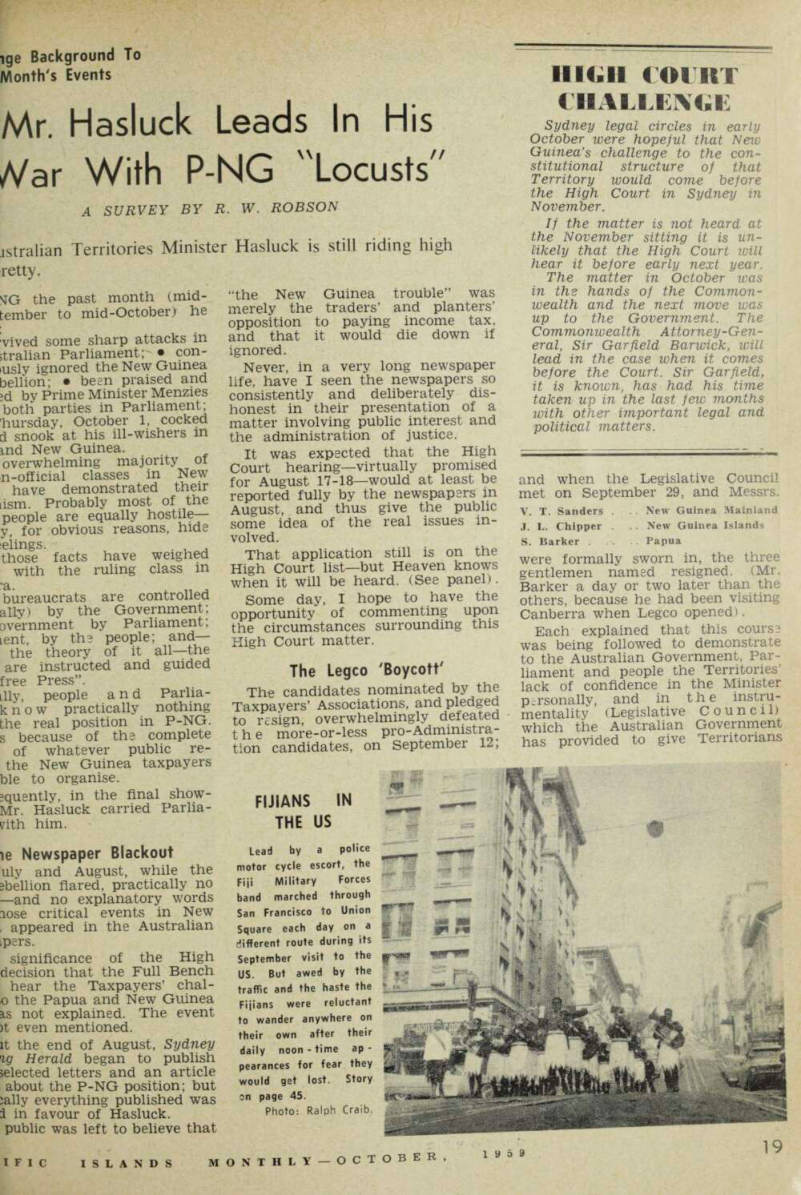
Fijians In
The Us
Lead by a police motor cycle escort, the Fiji Military Forces band marched through San Francisco to Union Square each day on a different route during its September visit to the US. But awed by the traffic and the haste the Fijians were reluctant to wander anywhere on their own after their daily noon-time ap pearances for fear they would get lost. Story on page 45.
Photo: Ralph Craib.
some voice in administration.
Those three elected men, acting on behalf of the Territorians, wanted it known that they thus were fully supporting the other three elected representatives (Messrs. E. A.
James, Dudley Jones and lan Downs), who resigned in July from the Council, for the same reasons.
But the incident was sneered at by the Minister, and dismissed in a few words by the Australian newspapers, and not one attempted to explain its purpose and back ground.
But when Prime Minister Menzies, in early September, and Minister Hasluck himself, defended and ex plained the Hasluck policies and administration, the newspapers re ported their anti-Territorian state ments very fully.
Mr. Hasluck and the locusts'
In the Commonwealth Parliament on September 30, in a long speech explaining his acts, answering his critics and defending his policy, Mr.
Hasluck said ( SM Herald report) : The Territory should be administered for those white and coloured people who would
stay there and build a just and enduring social order, not for the less useful minority of Europeans who had flown in for the sake of the pickings .
No Government could afford to allow the Territory to be treated like a private estate —it was a public trust .
There was misunderstanding and ill feeling over the recent change in the method of raising taxes in the Territory, and unfortunately very great misrepresen tation of the Department’s point of view.
The private enterprise of every native villager was just as sacred to liberalism as the private enterprise of any European who had established a business there.
These statements by the Minister were completely in line with his famous dictum of January, 1958: “And I say quite bluntly that many of the people who come to me in the guise of solid pioneers and frontiersmen of private enterprise in Papua and New Guinea are merely the locusts, in the sense that they are gathering what they have not sown.”
Therefore, up to this time (early October) it has been a complete victory for the Minister.
All his published statements in
the period August-September have
indicated—
(Continued page 149)
; belief that the Tax Re as the reaction of private j (the “locusts”, in his the imposition of income (He has flatly refused to e fact that this was a re ;ainst his method of intro ; insistence that his lofty regarding native welfare ig misrepresented by the ms. belief that greater Legco ation to Europeans must ipanied by a similar con o natives (irrespective of that it is practically im o find, under present con ,ny educated natives com sit on Council), for a handful of “back the whole Parliament [ Mr. Hasluck.
Parliament and P-NG axpayers’ Association can ilamed for the failure of lie relations —shown in the ice of the public, the ignor the Parliament, and the refusal of the newspapers lem any help, he newspapers ganged up the Territorians, and in the dictator against whom e rebelling, I do not know lave my own ideas.
Bwspaper offices today are icademic Socialists of the type; and few newspaper Dday show any concern for outside power and profits, the working journalists’ linking has been created by war developments in newe mership. Maybe, the Aus »ublic deserves the kind of ir service and Parlia representation it now is is a tragedy that the Terri vith a case which in all re ctifies their Tax Rebellion, e ground between the upper ier millstones of “slanted” m and an ignorant Parlia asluck, for the present, is ier—away out in front.
e High Court Position
y be a very different story be Taxpayers’ application, ing the Papua and New Act , gets before the Full f the High Court, imething could happen be e case reaches the High than once in the last few arfield Barwick, an eminent tional lawyer, has expressed
doubt about the validity of the P and NG Act, under which the Legislative Council was created and given its powers.
Lately. Sir Garfield Barwick has become the Commonwealth Attorney-General; .and the Act is under challenge in the High Court.
What is to prevent the Commonwealth Parliament, under the direction of this skilled constitutional lawyer, and before the High Court hearing, passing some sort of amending legislation, to give substance and validity to both the Papua and New Guinea Act and the acts of its subsidiary, the Legislative Council?
But could such an amendment
be made retrospective, to cover all the Acts of the Legislative Council since it began to function I wouldn’t know.
But I, for one, hope that the p-NG Territorians will keep their chins up and their powder dry.
Like Britain in two world struggles, they may lose every battle, but yet win the war, and live to dance on the neck of a defeated dictator, d Mr*'-. iMexr rnase Or r-iN\j S \kl I aXQTIOn War it is anticipated that the three vacancies now existing in the Legislative Council of Papua and
New Guinea will be filled I Administrator or the Minis! nomination.
There is authority for taki:: course now, in the Papua Guinea Act, under whioi Legislative Council was consr The Council’s three electees bers—Messrs. E. A. James, , F. Jones and lan Downs—n in a body last July, as a j against the way in which j taxation was introduced) against the policy of the 1 in ignoring the Legislative T in relation to taxation, amr matters.
The Administration ther ranged by-elections, to ft vacancies, on September 12S of the three electorates n candidates pledged to resign l as they were sworn in, in o demonstrate to the Ministh people’s support of the ] taken up by Messrs. James and Downs.
On September 22 and 2Zi being sworn in, the thre' Councillors—Messrs. V. T. £ (Papua), J. L. Chipper i Guinea Islands) and Sydney v (New Guinea Mainland)—ft resigned.
The three announced thri Taxpayers’ Associations, h; j thus demonstrated the people satisfaction with Minister Administration, would not boycott any steps taken 1 latter to fill the vacancies.