Pacific Commerce and Produte
pp. 167-168 · Read in the full issue
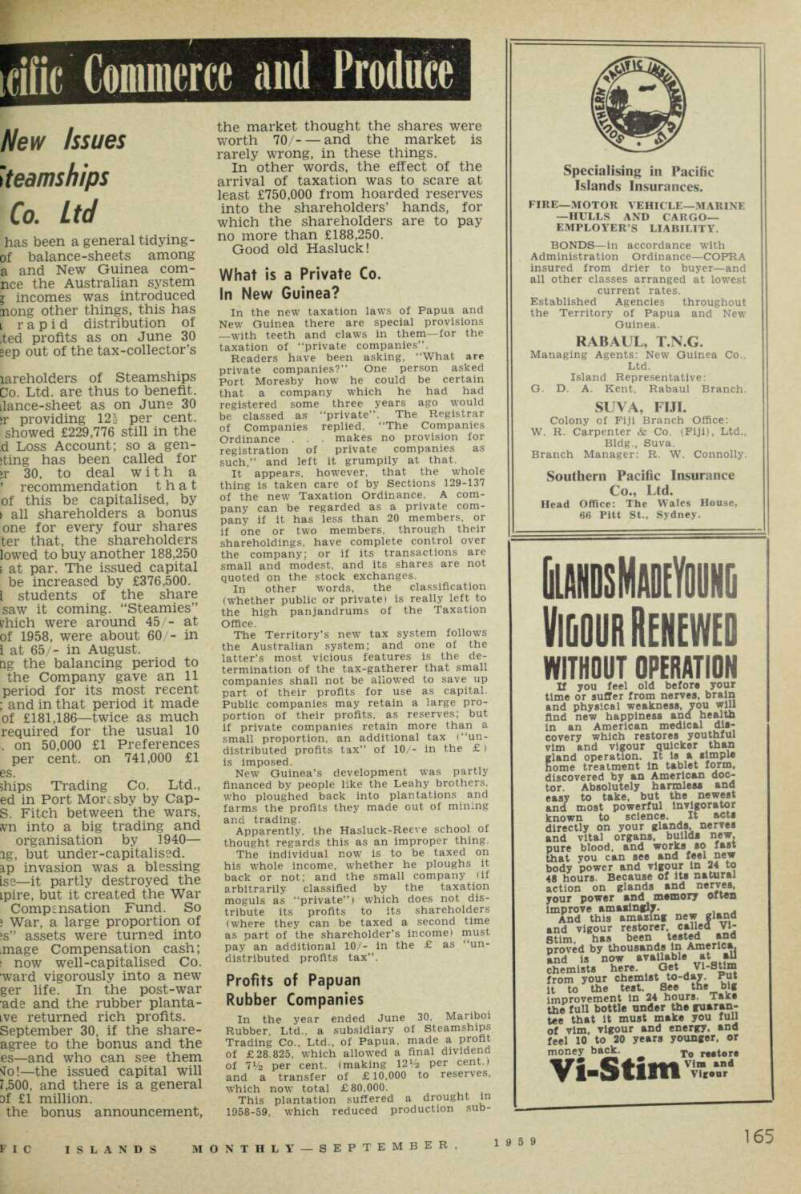
New Issues Steamships Co. Ltd
has been a general tidying of balance-sheets among a and New Guinea com nce the Australian system y incomes was introduced mong other things, this has i rapid distribution of ited profits as on June 30 eep out of the tax-collector’s lareholders of Steamships Co. Ltd. are thus to benefit.
Jance-sheet as on June 30 ;r providing 12 2 per cent, showed £229,776 still in the d Loss Account; so a gen sting has been called for ;r 30, to deal with a • recommendation that of this be capitalised, by > all shareholders a bonus one for every four shares ter that, the shareholders lowed to buy another 188,250 i at par. The issued capital be increased by £376,500.
I students of the share saw it coming. “Steamies” irhich were around 45/- at of 1958, were about 60/- in 1 at 65/- in August, ng the balancing period to the Company gave an 11 period for its most recent ; and in that period it made of £lBl,lB6—twice as much required for the usual 10 . on 50,000 £1 Preferences per cent, on 741,000 £1 es. ships Trading Co. Ltd., ed in Port Moresby by Cap- S. Fitch between the wars, vn into a big trading and organisation by 1940 — ig, but under-capitalised, ap invasion was a blessing Ise—it partly destroyed the ipire, but it created the War Compensation Fund. So ; War, a large proportion of ;s” assets were turned into ,mage Compensation cash; 1 now well-capitalised Co. ■ward vigorously into a new ger life. In the post-war ■ade and the rubber planta ive returned rich profits.
September 30, if the share agree to the bonus and the es—and who can see them sTo! —the issued capital will 7,500, and there is a general Df £1 million. the bonus announcement,
the market thought the shares were worth 70/ and the market is rarely wrong, in these things.
In other words, the effect of the arrival of taxation was to scare at least £750,000 from hoarded reserves into the shareholders’ hands, for which the shareholders are to pay no more than £188,250.
Good old Hasluck!
What is a Private Co.
In New Guinea?
In the new taxation laws of Papua and New Guinea there are special provisions —with teeth and claws in them—for the taxation of “private companies”.
Readers have been asking, “What are private companies?” One person asked Port Moresby how he could be certain that a company which he had had registered some three years ago would be classed as “private”. The Registrar of Companies replied, “The Companies Ordinance . . . makes no provision for registration of private companies as such,” and left it grumpily at that.
It appears, however, that the whole thing is taken care of by Sections 129-137 of the new Taxation Ordinance. A com pany can be regarded as a private com pany if it has less than 20 members, or if one or two members, through their shareholdings, have complete control over the company; or if its transactions are small and modest, and its shares are not quoted on the stock exchanges.
In other words, the classification (whether public or private) is really left to the high panjandrums of the Taxation Office.
The Territory’s new tax system follows the Australian system; and one of the latter’s most vicious features is the de termination of the tax-gatherer that small companies shall not be allowed to save up part of their profits for use as capital.
Public companies may retain a large pro portion of their profits, as reserves: but if private companies retain more than a small proportion, an additional tax (“un distributed profits tax” of 10/- in the £) is imposed.
New Guinea’s development was partly financed by people like the Leahy brothers, who ploughed back into plantations and farms the profits they made out of mining and trading.
Apparently, the Hasluck-Reeve school of thought regards this as an improper thing.
The individual now is to be taxed on his whole income, whether he ploughs it back or not; and the small company (if arbitrarily classified by the taxation moguls as “private”) which does not dis tribute its profits to its shareholders (where they can be taxed a second time as part of the shareholder’s income) must pay an additional 10/- in the £ as “un distributed profits tax”.
Profits of Papuan
Rubber Companies
In the year ended June 30, Mariboi Rubber, Ltd., a subsidiary of Steamships Trading Co., Ltd., of Papua, made a profit of £28.825, which allowed a final dividend of 7V2 per cent, (making 12Vi per cent.) and a transfer of £lO,OOO to reserves, which now total £BO,OOO.
This plantation suffered a drought in 1958-59, which reduced production sub
stantially (bringing dividend down from 15 per cent.) but since then both produc tion rate and world prices of rubber have increased considerably.
This company—which enjoys a protected market in Australia—has gained more from abolition of export tax than it ex pects to lose from income taxation.
Kerema Rubber, Ltd., made a net profit for the year ended June 30 of £10,389 (slightly up on previous year) and is continuing its dividend at the rate of 10 per cent., although the issued capital last year was doubled by a bonus issue.
Owing to drought, the net profit of Rubberlands, Ltd., for the half-year to June 30 was down slightly, at £6,536; so interim dividend was cut from ey 4 to 5 per cent. This company paid 10 per cent, for 1958.
NG Gold Mine Returns
Enterprise of New Guinea’s mine treated 90 tons of ore for 75 oz bullion in the four weeks ended August 21.
During June and July, approximately 62 oz of gold was taken from 10,000 cubic yards of material treated by Sandy Creek Gold Sluicing, Ltd., in New Guinea.
Tobacco Enterprise in
New Guinea
An issue of 131,095 ordinary 5/- shares in New Guinea’s pioneer company. Pacific Tobacco and Development Co., Ltd., of Madang, has been underwritten by Sydney stockbrokers L. A. McFadyen and Co.
The company Is making twist tobacco, from locally-grown and from imported leaf, for the New Guinea market; and the new capital is to be used to increase pro duction from 210 lb to an estimated 665 lb per day.
Directors are Messrs. J. A. Corrigan (chairman), G. E. Bliss, A. L. Hope J H. A. Treacy, and N. F. Vincent.
Fiji Gold Increases—
But Less Manganese
The value of gold produced in Fiji for the year up to June 30 last, almost wholly from the Tavua field, was £1,193,419 Stg compared with £1,017,808 in the previous year.
But the value of manganese produced fell from £470,207 Stg. in 1957-58. to £262,892 in 1958-59. This was because early in last year, the world value of manganese fell from £lB to £l2 per ton for ore containing at least 50 per cent, of metal; and this, plus buyers’ stricter specifications, put many “marginal” mines in Fiji out of operation.
New Ore Body In
New Guinea
A large body of potentially valuable ore was discovered on the New Guinea pro
perty of Australian Gold Development, Ltd., and a testing of the ore body, through a drilling, underground develop ment and sampling programme, is being carried out by King Island Scheelite (1947), Ltd. Should a public company be formed to exploit the ore body, AGD will be en titled to a 75 per cent, interest, and Shee lite to 25 per cent.
To Examine Low-Grade
Nickel Ore
A company is being formed in Noumea with a capital of 30 million francs (£150,000 Aust.) and comprising the government of New Caledonia, the Nickel Co. and the Mining Bureau of France.
The company is to study and experi ment with methods of treating low-grade nickel deposits, of which there is an im mense supply in New Caledonia.
The extent of the New Caledonia govern ment s participation in the company will be 10 millions (£50,000). In the Terri torial Assembly only the . Lenormand (majority) party voted for the project The opposition in New Caledonia’s Assembly is implacably opposed to Lenor mand projects, whether good or bad.
New Guinea's Bali Ltd.
Absorbs Londolovit
Bali Plantations. Ltd.—formed in Rabaul a few months ago. with a capital of £200,000 in 10/- shares, to take over Mr.
H. T. Coldham’s well-known plantation in the Witu Islands—has now absorbed Lon dolovit Plantation, 721 acres, on Lihir Island, 30 miles off the northeast tip of New Ireland.
Londolovit has been owned by Lon dolovit Estates, Ltd.; and the purchase was made by exchanging two £ 1 Lon dolovit shares for seven 10/- Bali shares.
To take care of the transaction, Bali issued 98,000 new 10/- shares to Londolovit shareholders, who thus put on their property a nominal value of £28,000.
But it is better than that. When the sale was made, Bali’s 10/- shares were be ing quoted on the Sydney Stock Exchange at around 16/-.
Whether the market will stay at 16/- (making the 98.000 shares received by Londolovit worth £78,000) remains to be seen.
Reporting the transaction to Bali share holders, chairman J. Dunbar-Read said; “On Londolovit plantation are about 32,000 mature coconut palrps and 6,000 new plantings. The mature palms have averaged 380 tons of copra a year over the past three years. The cost of produc ing copra is under £35 a ton, the actual cost over the past three years ranging from £3O/18/- to £34/19/6.
“There are 2,000 cocoa trees in bearing on the plantation. The ground has been prepared and the holes are ready for a further 25,000 cocoa trees, and it is hoped to plant them by the end of the year.
This planting must be looked upon as experimental, but it is considered to offer good prospects as similar land has been successfully planted in the district.
“On a production of 380 tons of copra a year and a return of £72/10/- a ton, the estimated profit of Londolovit after income tax is about £ll,OOO, which is 22 per cent, on your company’s investment.”
Oil Drilling in Papua—
Negative Report
Australasian Petroleum Co. Pty., Ltd., on September 8 reported on its explora tion operations in Papua as follows:
Puri
Puri IB has been deepened by 614 feet
to 8,520 feet, in unproductive: and drilling has ceased.
A test of an upper format!
No. 1 is being undertaken ovei interval. 1,980 feet to 1996 fe: perforations in the casing, befo is finally completed.
Bwata
The hole has been deepene feet, and 18 and five/eighths has been cemented at 248 feet.
Dense Limestone Fora
A report Issued by the ct August 8 said that deep born through limestone of “dense had failed to produce any oi' formations which yielded a flow 10 months ago.
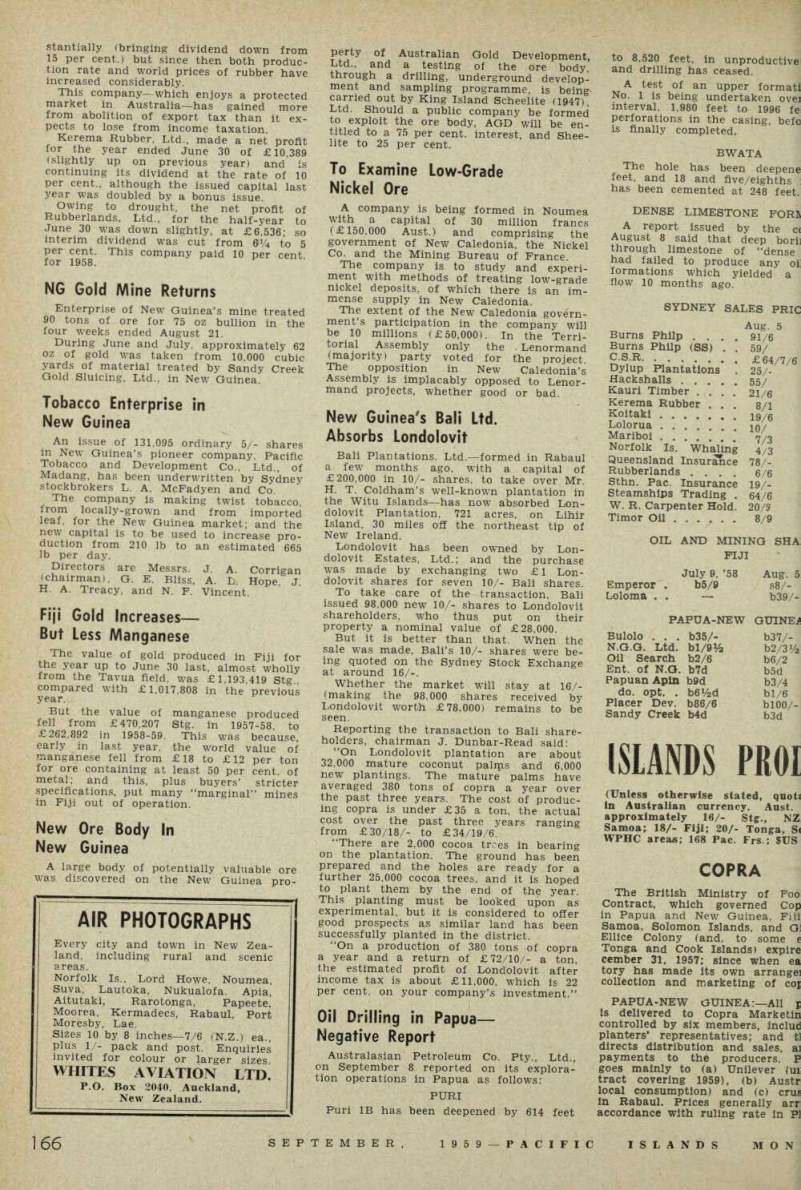
Sydney Sales Prig
Oil And Mining Sha:
Fiji
Papua-New Guinea
July 9, ’58 Aug. 5 Emperor . b5/» s8/- Loloma . . — b39/-
Bulolo . . . b35/b37/- N.G.G. Ltd. bl/SVa b2/3Va Oil Search b2/6 b6/2 Ent. of N.O. b7d b5d Papuan Apln b9d b3/4 do. opt. . b6Vad bl/6 Placer Dev. b86/6 blOO/- Sandy Creek b4d b3d