Pacific Report
pp. 119-147 · Read in the full issue

The month’s round-up of news and pictures of people and ;nts, from PIM correspondents in the South Pacific.
Men Climb
)00 Coconuts
tough some five years have I since the rhinoceros beetle liscovered in Fiji, it has not spread beyond the South n section of Viti Levu. That because it is a weakling pest, cks a yearning for the fat at plantations of Vanua Levu raveuni. restriction to the small area d Suva is due to the vigorous of the Coconut Pests and ses Board, which was set up diately after the presence of beetle was discovered and i maintains a ceaseless fight st the beetle. example, the Board maintains f of 125 Fijian men, who each climb between 500,000 and 0 coconut palms, and treat the is of the palms with icide. Every year they use 60 tons of insecticide, which between £5,000 and £6,000. 1 cost of maintaining this or ation is considerable and it is led by a tax' on copra of; 17/6 on.
tonga Might Have
)il Flood
recent months it was meed that oil companies ted to establish bulk storage ties at Nukualofa and at Apia, there have also been reports ans for a similar installation arotonga in the Cook Islands. b man behind the Cook Islands ne was Mr. Walter S. Johnson, of South Pacific Trading Co.
Rarotonga, who has been ing oil in drums from Tahiti s schooner Tiare Maori for the couple of years, and selling a price below that of oil pro ; shipped in from New Zealand the satisfaction of all motorists, me time ago, Mr. Johnson made cation for a piece of govern ) land on the Avatiu foreshore site for a bulk oil installation, there were reports that he was tiating the purchase of a small er in the United States, though
nothing has recently been heard of this.
Now it appears that Mr. Johnson might be in for some competition.
Mr. Kelvin H. Day, of Standard- Vacuum (NZ) Ltd., paid a visit to Rarotonga in August and was re ported to be investigating the possibility of also establishing a bulk oil terminal there on behalf of his firm.
Kostelanetz Visits Tahiti
Andre Kostelanetz may not carry much weight with the rock-and roll generation, but for those who prefer something that aids rather than irritates the digestive pro cesses, his name has been pretty well known for the past quarter century as an interpreter of pleasing and generally restful music.
So it came as no surprise to
music lovers along the TEAL Coral Route to find in the great conductor a man of truly charming per sonality. He was paying his first visit to the South Pacific—although Honolulu and Tokyo have seen him in action before.
The Tahiti trip was purely one of recreation. Mr. Kostelanetz, who seemed younger than many people expected him to be, said that he does no composing. “My activities are confined to the interpretative sphere”, he said.
Kostelanetz was born in St.
Petersburg—now Leningrad—a n d went to the United States in 1922.
He has been an American citizen for many years.
Fiji Plans Fun
For Hibiscus Festival
This year, for the first time, a special cruise has been arranged from Sydney to Suva to coincide
He Did it Himself
—and It Flies
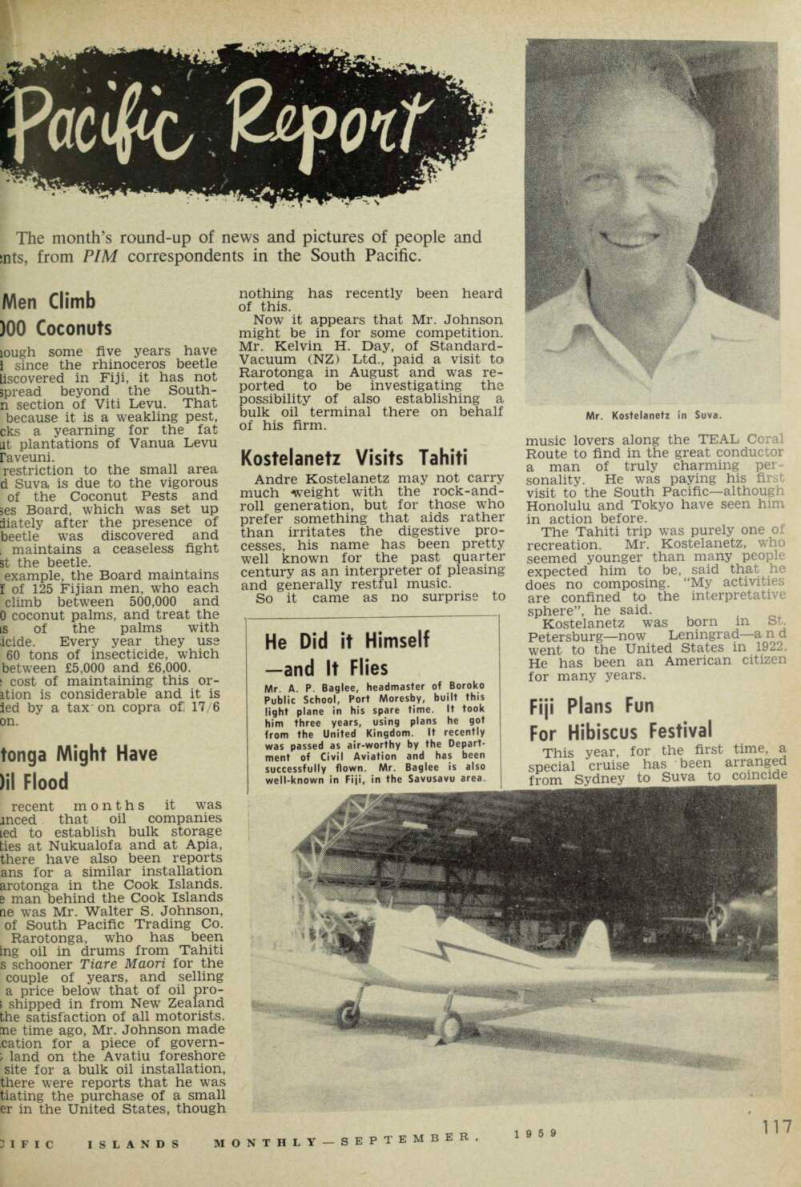
Mr. A. P. Baglee, headmaster of Boroko Public School, Port Moresby, built this light plane in his spare time. It took him three years, using plans he got from the United Kingdom. It recently was passed as air-worthy by the Depart ment of Civil Aviation and has been successfully flown. Mr. Baglee is also well-known in Fiji, in the Savusavu area.
Mr. Kostelanetz in Suva.
pound contract to Evans, Deakin & Co., of Brisbane, for the construc tion of new phosphate loading equipment at Nauru Island.
Evans, Deakin recently completed similar work—a cantilever loading system and shore installations—at Ocean Island.
Check of Radio Activity
At Niue Island
Sir Ernest Marsden, of the New Zealand Department of Scientific and Industrial Research, was in vestigating radio activity in New Zealand’s islands territories in July- August.
Focal point of the survey, accord ing to a New Zealand government statement, was to be Niue where earth on parts of the island has shown radio-activity much higher than that of normal soils.
According to another earlier re port from the Cook Islands, there is also an area of comparitively high radio-activity at Black Rock, near the seaward end of the Raro tonga airstrip.
New Hotel in
Suva by January
Work was expected to commence in September on the new Hotel Suva, a license for which was granted re cently.
The building, which will be partly an addition to the upper part of the Waimanu Building, in Waimanu Road, Suva, and partly on an ad joining site, will be owned by Hotel Suva Ltd. The company, registered last June with a capital of £50,000, is largely owned by J. L. Norris, a Sydney hotel broker, and other Syd ney interests.
The hotel is expected to be open for business by next January. It is not expected to enter the luxury accommodation field.
Mangaia Is. Shrinks
By One Third
According to a recent official re lease from the Cook Islands, aerial photography has sho w n that Mangaia Island, previously thought to have the largest land mass of any in the Group, is much smaller than estimated.
The Mangaians have always opposed any official survey of their island, suspecting that it might be the thin edge of the wedge from a taxation point of view. The esti mated acreage has in the past been placed at about 17,500 acres, but it is now put at only 12,700 acres.
Aerial photography has confirmed the Rarotonga acreage as about 16,500, thus this island takes pride of place as largest of the 14 lsl^ nd ® in the Cook Group. ( ° ver)
he fourth annual Hisbiscus il. een 300 and 400 people are in the 10,952-ton Adelaide ihip Co. passenger ship ra, which will arrive in Suva tember 27, and stay for three ng the ship’s visit the pro ie includes an evening bar it Nukulau Island, near Suva, swimming and dancing by ght. girl selected this year as Hibiscus” will have an aerial f to Brisbane, travelling by ench TAI Airline. She will be ;d at the Grand Pacific Hotel tober 3, on the last night of istival.
a Pacific-Wide
n Competition in 1960
is are already in hand for pro- X a Pacific Queen contest in Under this scheme, the in al Pacific Islands territories fahiti west to New Guinea will vited to organise their own carnivals prior to the annual Hisbiscus Festival. The in al Queens selected would then to Suva and a Pacific Queen be selected there.
Loading Gear
Nauru Phosphate
British Phosphate Com bers have let a half-million
las a Do-it-yourself
I Survey
g staff with war-time experi i chartered aircraft, and the ration of the RNZAF the Fiji Department has made a low jhotographic survey of some acres of parts of Viti Levu Dst of only £650.
Department estimates that rvey would have cost at least ir acre had it been done under ;rcial contract. Further areas w to be done on Vanua Levu.
iuna Ships Could
the Weather Forecasters
principal complaint of South ; forecasters is that there isufficient observing stations d them in their work— illy during the hurricane sea- They often wish that there islands where such stations be established on the more expanses of this ocean. > might be changed if the Id Japanese fishing vessels red from the Gilberts to North ind and from New Guinea to ‘uamotus for a good part of ear could be induced to co ;e. > IM representative who went i two of the Japanese tuna
mother ships tending fleets in the South Pacific this year, gained the impression that reasonable co operation would be forthcoming. For example, prior to the visit of Tenyo Maru No. 3 to Suva in July, neither this ship nor Nojima Maru were sending in routine weather reports to Suva Radio. However, it was
noted that when the ship returned to her station on the high seas, the reports started to come in regularly.
Nojima Maru thereupon followed suit, and the reports from these mother ships were no doubt useful to the Nadi forecasters at times.
The PIM representative was also shown the form of message sent by
Indian on Hot Coals
Essentially a Hindu religious festival ceremony associated with the goddess Mariamman, the annual fire-walking ceremonies in Fiji are attended by many thousands of non-Hindu sightseers who pay for a seat on the temporary grandstands, or elsewhere in the area close to the fire-pit These photos show one of Suva’s best known Hindu priests, Sadhu Suruj Bali (left) who played a leading part in recent ceremonies ; and one of the participants bustling across the hot coals.
Photos: Stinsons.
shing boat to the mother ship imes per day. This message s a brief weather report. It possible, therefore, that even lar reports could not be ex from the fleet vesssls, co on might be forthcoming ;he forecasters were in par need of reports from specific jast this would seem to be ing for the Nadi forecasters ) in mind.
Guineans Do
s Differently
Jaidusek, of Washington, who stigating the movements of n in primitive societies, is t the Kainantu area of New where the Papua-New , Department of Public Health
conjointly with the Rockefeller In stitute and National Institute of Health and the Australian Scientific Mission from Adelaide are making a thorough investigation of the symptoms and looking for the basic causes of the deadly kuru disease, Anybody who has lived for some time among the primitive peoples know that native children some times handle things in a different way from European children. Judg ing by the way a steersman the writer recently watched on one of Rabaul’s small ships, was turning the wheel with his toes, older natives are a^SO al3le USe eir * or superior purposes.
Dr. J. J. Saave, Regional Medical Officer in Rabaul, agrees with a medical writer in the Lancet that the way a New Guinea mother moves her baby with short movements up and down will soothe the child and
stop it crying; also that the motion of the mother as she walks with the child slung on her back has the same beneficial effect.
He also agreed with a statement recently made in Sydney in an ABC news session, that coronary thrombosis is very rare among New Guinea natives because of their low intake of fats.
That "Tourist Band"
Is Off to the US
The Fiji Military Forces Band, probably best known to the outside world as the band which greets the thousands of tourists arriving at Suva in the big liners, is off on a United States tour.
The Band left Suva in the Himalaya in September, at the expense of the Pacific Area Travel Association —of which all the major shipping and air lines are members —and after touring 11 Western States and British Columbia, will return by sea to Honolulu and by air from there to Suva.
It is anticipated that Fiji will obtain a lot of valuable tourist publicity as a result of the tour, dur ing which the band will appear on television, and will also be filmed at Hollywood.
Garlic Importers
In a Stew
To the Fiji Department of Agri culture, a consignment of 364 crates of garlic and 10 sacks of onions which arrived at Suva from Singa pore early in August had a very bad smell, indeed.
The importing merchants, who should be fully conversant with the import regulations, were not in possession of documents certifying origin. They hoped that the depart ment would accept the origin as be ing the same as the port of ship ment. Unfortunately, things did not quite work out that way, as each garlic crate was found to contain documentary evidence that the pro duce had, in fact, originated m
[?]dmaster Kini Cava conducts the hand of the Fiji Military Forces [?] a rehearsal at Queen Elizabeth’s barracks. He has been with the [?]or 18 years and took over as bandmaster in 1956. The band left [?]our of the United'States in September. See attached story.
ind had been trans-shipped ;apore. The deal had been irough Singapore exporters, [arlic would have retailed in it about lOd per pound ig to the landed cost A-but as a likelihood that it would een retailed at about 2/8, s the current price of Aus garlic, which has been in ort supply. j and other such produce of n origin is totally banned in e to the danger of introduc certain stock diseases. No ites would have bsen issued i importations, and the Be lt of Agriculture promptly ced that the shipment would i be dumped at sea. wl went up from the im who stood to lose a good ually there was a stay of ings to give the badly-shaken rs a chance to try to re the produce, or to sell it as ores to some overseas ship, adline was fixed at August n the importers would have ipportunity to ship the stuff Singapore—and hope for a less freight and commission
md Tenacity
Iff
len Rehder, top photo, earned a couple of hundred pounds New Guinea, on August 22 3-tons crate of motor spares ad been dropped overboard he MV Citos was recovered efforts. -sea divers are about as around Lae these days, as se troops but Ken Rehder, s offsider, M. Hamersley, re returned from Samarai where ad been engaged fishing for
Gold Lip pearl shell. At a Works Department sale a few weeks ago, Rehder purchased the full diving equipment helmet, boots, gloves, and air hose, the lot—but didn’t guess that he would have it in com mission so soon. He was at his coffee plantation at Kainantu, Eastern Highlands, when the job came up, but was quickly on the spot for the diving operation.
Right sort of compressed air hap pened to be aavilable locally, too.
Two skin divers had failed to locate the crate the previous Sun day—the sea-bed is muddy and 40feet is a long way down —but first attempt on August 21 by Rehder was successful, although only on the third try was he able to attach a line.
After some crane trouble the fol lowing day, Rehder went down for the fourth time, attached the slings and his job was over. Centre photo shows him going over the side for the first time, and the last photo shows the case breaking the surface of the water.
Old Gravestone And
Fiji History
Some interesting history was un covered lately by the vicar of Levuka, Fiji, Archdeacon C. W. Whonsbon- Aston, when searching through the old cemetery at Levuka for some trace of a German who was buried there nearly 100 years ago.
The vicar had received from Ger many an enquiry from a woman whose great-uncle died in or near Levuka in 1864. She wanted some details connected with his death.
It appears that sometime in the last 100 years the original cemetery at Levuka was used for some other purpose—evidently a garden — ana the old gravestones were taken ana carefully piled at one side. In go-
(See story, this page.) Photos: Pat Robertson. ing through these gravestones, searching for the headstone of the German—which, incidentally,
he did not find - Archdeacon
Whonsban-Aston found a s tone in scribed “To the Memory of John Brown Williams, Esq., United States Consult for the Fiji Islands. Born
Salem, Mass., September I Died Totogo, Ovalau, June I The Archdeacon, who hai ing for history, says that t Williams was the American whose house at Nukulau Isk accidentally burned down c July 4 celebration, and a go of his property was taken That was in 1849; and the commenced a long struggle the US Government, Mr. V and the Fiji Government— the native king Cakobau, ; advisers—on the subject c pensation, which ended in 18' Fiji was ceded to Britain Chiefs.
Concrete Building Bloc
Are Mechanised
An Australian precast t company has installed at i Moresby factory an au machine for the manufac: concrete building blocks. C blocks are becoming populai Territory.
The company, Concrete In (Australia) Ltd., recently ii the machine from the States. It makes blocks 16 by eight in. wide, or eif square, and in three thic as required—four in., eight 12 in.
The blocks are suitable types of buildings, including quarters. The machine is al able of turning out other products of the block type.
Native workmen operat machine, which can produc 16 in. x eight in. x eight in. a day. Cost of the machi, eluding installation, was installing the machine.
NZ Garment Trade
Out After Cl Competith
“Unfair, cut-throat compt was the description given I delegate at the annual com of the NZ Textile and Gj Manufacturers’ Federatior August, in reference to c. manufactured in the Cook I For years, textiles have: imported into Rarotonga, factured there into clothing re-exported for sale in Zealand. Most of the work ii by one factory, under contr certain retailers or wholesal New Zealand. The clothing : factured is mainly khaki working gear, and at presen restricted to drill shorts.
At intervals, there have protests by manufacturers in Zealand, and occasionally by unions there. Delegates have: winter cruises north, butj opposition has invariably down.
The Cook Islands Administt looks with favour on this—a
- industry which provides lent and offers an alter ource of earnings for the The wages paid are higher iges paid to other workers look Islands. of the delegates at the NZ conference suggested it could be shown that the ilands workers should not New Zealand rates of pay, i firms involved should still • pay NZ rates, and the in excess of the wages paid out should go into a slands development fund, han into the pockets of the iders. h pay rates in NZ are very ligher than in the Cooks, otonga industry has to bear sts of freight to and from ealand, and less efficient during methods, and would y not be able to compete he New Zealand manu s if both were on an even any taxation, collected from tory owners in Rarotonga, eady help to swell the local
A Sealed Main Street
For Rarotonga
The tar-sealed roadway through the main townships of Avarua and Avatiu on Rarotonga Island may be realised next year, if the Cook Islands Finance Committee follows the recommendations of the Legis lative Council which met in July. A sum of about £B,OOO is involved.
For years Councillors have urged that this stretch of road—from the hospital in the east to A. B. Donald & Co.’s store in the west, a distance of about two miles —be sealed on account of the dust nuisance and menace to health.
It is now believed that the founda tions of the existing road are satis factory and that little preparatory work would be involved.
The machinery can probably be “borrowed” from New Zealand, from the Ministry of Works, during the winter months.
Whales in Suva—
But No Meat
Humpback whales on their northerly migration were sporting in Suva harbour on July 13.
Not by any means a unique event (it has happened at least twice in recent years) they nevertheless cre
[?]nder Eric Feldt, whose job [?] expand and organise the [?]atchers of the SW Pacific World War II, unveils one [?]laques (see bottom, right) Coast Watchers’ Memorial alibobo, Madang, on August [?] full story is on page 69, [?]e.
Photo: S. Diczbalis.
deal of interest among Suva 5 throughout the morning, e of four of them sounded touted, and showed the curve ir backs, quite close inshore wharf and Victoria Parade, irds noon they moved round the reef towards Nukulau -and probably made the open ;ain through the Sandbank e. At this stage of their ig there was some anxiety ley might become stranded > residential area of Suva t nd create a problem—but all rell. crewmen of a Tongan Gov it vessel in port at the time lumbfounded that no one any interest in landing the , as whales mean cheap meat, ot of it, in Tonga, and small »ften travel a long way out it.
ay Arrives
fa ig the many cars arriving in i recent months was one that )ut just a little from the svas a 1958 Cadillac, two-door ible which the Customs docu showed was valued at £1,859. ity and sundry charges added ded cost, excluding freight, ,676. Imported from Hono was driven away by Mr. of the Mocambo Hotel,
sly Birthrate
ligh Literacy
al figures show that the ion of Fiji is unique in two i— it is increasing more than that of any other Terri the Pacific, and the popula- Fiji has the highest literacy
rate of any country outside the Caucasian group.
It is officially estimated that there now are 157,808 Fijians, 184,000 Indians and 8,987 Europeans.
The rate of natural increase in the Colony in 1958 was 32.67 per thousand. That is the average.
The rate of the Indian birth-rate is usually slightly more than 40 per thousand and that of the Fijians slightly under 30 per thousand. By comparison, it may be noted that the birth-rate in New Zealand is slightly under 17 per thousand.
Tprrihlp Trnniral Dkpacp
lemme ropitdl ulbcaSc i n K| olA/ Toalanri m ,>,ew The bout of malaria developed by New Zealand’s Leper Man, Mr. p j Twomey, after a visit to the Solomons about 21 years ago, has s tm got the Dominion —wh e r e malaria is a notifiable disease in convulsions. They are still issuing bulletins about his health, (“Stricken down with a tropical disease”, is the way they put it.) Mr. Twomey was probably that one in-1,000 peculiarly susceptible to malaria. Europeans have been liv ing in the SW Pacific for a century, and before modem drugs we dis covered, taking bouts of malaria as a matter of course. Mr. Twomey is just about recovered now—which is a very good thing for the many Pacific lepers who are his special care. c in TnOSG JOII riUmS LfOn I D dGHGVG in riOgrCSS T u prp verv mtle yaws in the tst-w wphrides but there would be Were not for the activ even Frums”— the local jwes 0 cult. The cult is among villages on the Si an d of Tanna which carries the largest population of any island in group (Over)
One of the first cement brick buildings built in Papua-New Guinea is this new High School, now nearing completion at Boroko, a suburb of Port Moresby. The High School will take pupils of all races who have reached the necessary standard of education, and as such, will issue in [?] new era of secondary education in the Territory. European, Asian and part-European children who reached the necessary standard hitherto, have been given a secondary education grant of £l48 and one return air-fare per annum for education in Australia. Removal of this grant—and most people prefer to send their children out of the Territory for their secondary education —has been threatened before, once the high schools in Port Moresby, Rabaul and Lae were built, but no definite time has been set, as yet. —Papuan Prints Photo.
)onald R. Huggins, a World Organisation regional adviser imunicable diseases control, look at the New Hebrides tuation in July-August, and iney on his way back to explained how things were tid that WHO and UNICEF, e Condominium Government, •veyed and tested 90 per cent. population in the New is for yaws. The first re was now nearly completed, irvey was always made to >n the success of the original ;nt campaign, which in the ebrides was made last year, ■esurvey team would be pulled the end of the year, for the of the campaign had been atisfactory. There was now aws left. a had not been quite satis , however. The original team lated only about 30 per cent, na’s population of about 8,000 ! the leaders in the Jon Frum i did not want to co-operate, s a Government-sponsored ,nd they didn’t want to be in fas interesting to find,” said
Dr. Huggins, that when natives from the Jon Frum villages left Tanna to work in other parts of the New Hebrides they co-operated with us. They were then away from the influence of the leaders.
“Fve got an idea that the Jon Frum villages are beginning to come around now. There is some good work being done there to gain their ProbaWy co-operate in the end.
Dr. Huggins also visited Honiara this trip to see a resurvey of the Solomons get under way. The original survey was made in 1956-57 and in the next six months a team
will make a sample resurvev of 110,000 people Team leader is Dr. F Tross and includes Dr. P. Wang T i* r IJ l/•|l tl I rllS LOUlu Kill Ihe rn i J
rdCITIC LOpra Industry
A warn i ne that a virulent rnmnnt disease™ 1 rnuch* more 6 danger Sus than the rhinoceros beetle, and prevalent in the Philippines where it is known as Cadang-Cadang could wipe out the South Pacific copra industry if it gained a foot ing, was given recently by Western
[?]. and Mrs. D. B. V. Treliving, Fiji on “Waitomo” in August [?]oin the Fanning Island cable [?]on community. Mr. Treliving, [?]erly of Adelaide, joined the raph cable organisation in He has been at Fanning be [?]-two years during the war, [?] the only transport was by [?]esy of the United States [?]ed Forces. [?]ere were about 360 American [?]cemen stationed at Fanning [?]at time, and the atoll had a [?]-weekly Catalina mail con [?]on with the outside world via [?]lulu, which is better communi [?]n than now when the only of getting in and out is by the end of his wartime term [?]he island, Mr. Treliving flew to Honolulu by Catalina and [?]e by Liberator to Canton Is [?] From there he thumbed his to Sydney in an RAF aircraft.
Fiji since 1948, Mr. Treliving now become manager at Fan-
L -s Director of Agriculture,.
E. V. Parham.
Parham said that the disease, Sown as Yellow Spot Decline, ret noticed in the Philippines 7 but not much notice was of it until 1951, by which time I rendered a million palms luctive. . . hen it had a very firm foot id up to now is estimated to tilled about 16 million palms [ still spreading steadily, as ans of controlling it has yet iscovered despite a great deal
earch and experimentation,
little is, in fact, known of is spread or its exact nature.
Parham describes the disease of the most destructive to be in any region on earth today, “sent it is confined to the lines but there is a very real ■ that it could spread east first symptoms are tiny spots on the fronds, these ,lly increase in number and into larger patches giving md a bronze appearance from ,nce. nuts change in shape and ncrease in number and de in size and become marked dark brown streaks and s. The fronds soon fall off ; a bare trunk. only action being taken at t is to fell and burn the as soon as the disease is ied.
Research Council of the Pacific Commission is aware i danger, and is urging that be made available to make e study of this and other e diseases which have not yet i the South Pacific coconut
d Public Servants
flore?
Commission of Inquiry into •n Samoa Public Service s concluded its hearing in n August and the New Zea lembers returned home, s expected that the recom tions of the Commission will emitted to the West Samoa iment by September 30.
Public Service Association r estern Samoa submitted a for increases commensurate e rising cost of living to de retrospective to January 1, Phe rate of increase claimed [) per cent, with a maximum j per year. The claim was on the Consumers’ Price Index pared by the Commissioner of r.
Association, in addition, :d a further 8 per cent, in as compensation for the 35 minutes work daily intro as a result of the financial in 1957. Thus, the total salary
increase claimed amounts to 18 per cent.
The Government, on the other hand, represented by Mr. Vaiao Alailima, of the Public Service Com missioner’s Office, contended that there was no basis for a general wage increase, though there was scope for improvement in some special aspects of the wages and salaries structure.
The Government representative also opposed the demand for a minimum adult wage of £165 per year. Such a provision was not necessary under conditions existing in the Territory. He stated that for 13 Government jobs carrying the minimum salary of £lOO per annum a total of 393 applicants had applied since January last.
The Government treasury sup ported the claim that the Govern ment lacks the finance to pay higher Public Service salaries and the Western Samoa Trust Estates Cor poration, a Government institution, produced evidence that a minimum rate of pay of £165 per annum for plantation workers would Increase its payroll by £103,730 and would have meant a loss of £32,993 to the Corporation on the 1958 figures in stead of a profit of £70,720.
The Government representative pointed out that in a Service where there were Samoan, part-European and European employees a cost of living index was of little use when determining salaries.
He expressed the belief, however, that in view of the improved financial situation of the Territory, former emergency measures could be modified, annual increments could be improved and wider margins for skill and efficiency for the better qualified staff could be created.
Pouvanaa: Conditions
In French Polynesia
Late reports from French Polynesia Indicate that progress now is being made with preparations for the trial on charges of arson and connected matters, of Pouvanaa a Oopa, who was arrested in Papeete a year ago after he had led demonstrations against political developments of which he disapproved.
Because of the difficulty of arrang-
Mr. J. S. Hynd, B.Sc., of the CSIRO Fisheries Division, Thursday Island, who recently completed a survey of the Manihiki MOP oyster beds at the request of the Cook Islands Administration. His report will assist the Administration in formulating a sound conservation, policy in regard to this valuable fishery.
Fahiti a trial that would be om local prejudices, the authorities have been seak ie alternative, including trial re in the French Union, itest advices, a small com from France was examining ation in Tahiti, ryer of Papeete, M. Gerard •at was recently elected a of the French Senate, to it French Polynesia. ;al conditions in French a are reported to have been nd uneventful, since the rations which led to the f Pouvanaa a Oopa.
ble Arrangement Over
Liabilities
,tions in September were ssrs. Harvey Trinder Ltd., the and New Guinea creditors, k of New South Wales, and other interests affected, jombine amicably to keep is various P-NG businesses ly owned by Hamac Hold l. of New Guinea, and thus lat new and unfortunate ,tion from liquidation, and jsses.
As shown in the PIM article of August (page 20) the liabilities of Hamac Holdings Ltd. are between £400,000 and £500,000, of which no less than £330,000 is owed to Harvey Trinder (NSW I Pty. Ltd.
The London and Sydney directors of Harvey Trinder Ltd. have been making an effort to keep the whole Hamac organisation alive, so that the local creditors especially traders in Papua and New Guinea — may be paid in full; and the latest arrangements seem to indicate that that will be done.
A number of Lae creditors, where debts have been incurred through tire operation of some of the hotels owned by Hamac Holdings Ltd., were inclined to resist the proposed arrangements, and to demand payment directly from the Hamac subsidiaries which operate the hotels.
But when it was shown that certain creditors (especially Bank of NSW) had preference (through registered securities) in relation to the hotels’ debts, the Lae unsecured
ffl is
iSns'W Bank C °o/^New
Cecil in Lae, and that if this par tieular unit ol Hamac Holdings Ltd. was forced into hqmdation very little if anything would b. left for the unsecured creditors.
Kin Wnmpn'c fluh finpc
Nb Women S UUD V7OOS c rnm Qfrpnnth to Strpnoth
rrom Mrengin to airengrn
a/tvc t-t 'P’nvcrnft r>rp- Be Sed h « annua”' reportto P t he Sydney New Guinea Women’s Club recently, it marked her 12th year i n office, and 18 years of existence 0 f the club which has met weekly, p i us additional festive occasions, since the year of Pearl Harbour, The club was formed originally tQ . ye women who normally would have been living in the Territory, a focal point in very difficult days, A p the women and children re maining in the Territory after Pearl Harbour, were evacuated to Aus tralia during Christmas and New Year 1941-2; but a great many others had come South before that, and for obvious reasons did not go back. The Club, therefore, was already in existence when tne balloon went up in the Territory and became a really strong force in keeping Terntoria: ns together. A
G-Tsk
Sr “ rnose rn Y /rnft succeeded Mrs Page Mrs re^d X e °n? and helped by a ha?d s executive that has changed . to year has carried
Step right up and win yourself a nice fat pig at the "Barraques" at the July 14 Fete celebra tions in Papeete. At each turn of the wheel, some lucky number wins a pareu, a blanket, a dish, a glass or some chewing gum The little pig numbers cost more, but are the most exciting events of the evening and the proud owner usually spends the rest of the night lugging his pig around with him, afraid to put it down, as it would quickly go off as pigs are still the "piece de resistance" in these islands.
Photo: Studio Mackenzie.
the club magnificently years of peace.
Although, in the nature: things, it might hav imagined that the Club w out with the return to p conditions, it has, in fac tamed its place in the loya affections of those women it was originally formed has, as well, held the in many actual Territorians n again in P-NG, who make of continuing their conts the Club whenever they Sydney. In this way, the tween Club and Terr:
continually being renewed
obvious now that, whatevi have been thought when ended its wartime service has a role in peace—and tl is plenty of life left in it Mrs, Foxcroft reported a ful year at the 1959 annual All the usual functions v attended, and the first luncheon, held in the Club Rooms on October was attended by 90 ex an
Territorians, including all
foundation members but c was ill.
Financially, also, the Clu the year under review in position.
News of Papeete
And Easter Airports
The work on Tahiti’s ae (close to Papeete) started : is now in full swing. Nei workers work shifts, 24 he day, and seven days per \ Work at present is conci on the filling in of the towards the sea end. Son million cubic metres of mate be needed.
A report from Papeete re the idea of a trans-Pacific from Chile via Easter Isla Tahiti. The report is tl aerodrome on Easter will 1 pleted by 1963.
As that is still four year it still could be so, althoug of sceptics will be waiting t materialise before they che< In 1957, we were informi the airstrip on Easter was under construction—even barrels of bitumen that ha landed to surface it. An air would be in operation within or two.
When we were trying tc up on the progress of this for the new edition of the Islands Year Book, that wa lished some months ago, tl information we could get we Sir Gordon Taylor, who ha; the establishment of a South air-route between Austral!
South America something hobby. He assured us that abs nothing had been done on
>se Visitor Looks
Rewa Sugar Land
ever the future of sugar Rewa Valley of Viti Levu, e subject was still alive in ( was a good deal of guess ien IVfr. Ram Jati Singh, y of the newly formed sugar y, Fiji Sugar Milling Co., topes to mill where the CSR >ff, was sighted shepherding lese visitor round the Rewa md Tailevu district, isitor was Professor Tatsuji of the Totory Prefecture ty, north-western Japan. He n brought to Fiji by Banno a Japanese firm which is ;d in Suva and active in the field. ling to Banno’s manager, jashima, Professor Fukuta is r of Agriculture with a great pre-war experience in sugar in Formosa. In recent years spent periods in Thailand n as an agriculture adviser ! governments of those is.
mained a week in Fiji, living Banno house at Tamavua Bering the nearby sugar and reas day by day. ssor Fukuta and Banno atatives had a meeting with •s of Fiji Sugar Milling ay on August 15, and on the g prior to his departure for the professor visited the Fiji nent agricultural research at Koronivia.
Nagashima would make no at when asked if the Banno ay was thinking of buying e new sugar milling company, ;h he did say that there be a Japanese market for gar produced by a mill in his firm was interested.
hat Noumea
) Again
)up including members of the )ly Territoriale, headed by
Deputy Lenormand, has introduced a motion for forming a company to build and operate a casino in Noumea, New Caledonia.
This project will come up for dis cussion in a later session of the Assembly.
At a recent meeting of tourist interests, hotel keepers, travel agents and the Official Tourist Bureau, the suggestion was warmly received.
The idea of a casino for Noumea is not new; it has been rearing its head at intervals, over the last 30 years but has always been vetoed by the Metropolitan Government.
It will be interesting to hear what Paris now thinks of the project.
It is certain that the powerful Catholic Church in New Caledonia will oppose it.
The most important question when thinking of casinos, is to know where the gamblers will come from, to patronise it. It is hard to believe Australians will go there to gamble, even if currency problems were overcome. Australian are pretty well catered for, in the gambling line at home, where everything from horse racing to State Lotteries and poker-machines cater for the urge to indulge in a flutter.
It is even more difficult to imagine that Americans would go all the way across the Pacific to
Professor Tatsuji Fukuta.
-by-passing casinos in the nciies, not to say side r the attractions of Monte id their own Las Vegas.
aniel Defoe
the Answer?
> got to have an angle to tourists in, these days, ong, Fiji’s second large Vanua Levu, has watched j the growing stream of to main Viti Levu. Mostly, ived at Nadi by air, do the i-Deuba-Suva sights circuit, n depart again; or come nd do the same thing from rharf, Suva. e other 300-odd islands of up. they hear a thing or seldom sight them. j, to lure the tourists to iCvu. Mr. H. B. Gibson, well MLC, solicitor, and pro if the Grand Eastern Hotel, came up last month with , of a five-days “Robinson tour.
i-the-movs look at Labasa roundings, after flying over iva by Fiji Airways. Then in the 34 ft cutter Tuiseva Alf Williams) to the n Crusoe-style island of It has everything (in a modern “Man Friday” to lem) that is calculated to le tourists camera-clicking ental-note-taking for the ts months later back home, our continues, after return- Labasa, with an air-hop the Korotini ranges to u, in the heart of the copra !’ domain. Tourists have a )f the Hot Springs Hotel or ind bure-bungalows at ala Estate, nine miles along m-fringed coast. Motoring biscus Highway, exploring 's, finger-testing Namaka hot or boating on the 16 miles vusavu Bay help while away e before flying back to Suva.
Mapping the Solomons
The BSIP Lands Department has undertaken to make an extensive survey of the Solomon Islands.
Already three Trig Stations have been erected near Honiara.
The complete survey is estimated to take up to three years and will mean more accurate mapping of the Solomons land masses.
In March, 1960, a team of sur veyors will arrive from England to operate three Tellurometers provided by the Overseas Survey Branch of the Colonial Office.
Leahy Case Still
Awaits High Court
There still is no indication of when the High Court of Australia will hear the appeal of the P-NG Administration against the sub stantial verdict given by the P-NG Supreme Court to Mr. M. J. Leahy, some months ago.
Mr. Leahy claimed that he had lost 53 head of cattle because of careless and inefficient methods employed by the officials of the De partment of Agriculture in relation to the treatment of red-water fever It took Mr. Leahy the better part of a year to get his case for trial before the Supreme Court and obtain a verdict; now it looks as if another year will elapse before the appeal will be heard.
The case is typical. The private litigant must pay his own costs ii he loses. But if a Government is a litigant, and loses, the taxpayer pays.
In this NG case, Mr. Leahy paid his ow r n costs as a plaintiff, and won, but so far has not even collected costs. Now he is paying another lot of costs, defending the appeal, ii he loses he personally is out oi pocket by hundreds of pounds foi costs, apart from any damages suf fered. But if he wins, the Govern
mint will pay costs—not the officials concerned, but the taxpayers—who are you and I and Mr. Leahy.
New Kind of Depth
Finder for Small Ships
An echo-sounder or depth-record ing instrument of a new type, called the “Fairway”, has been produced by Marine Electronics Ltd., of Lon don.
It employs the Transistor prin ciple which recmtly has become familiar through the very small radio receivers which have come on the market. This means that it can be operated with small dry batteries, like an electric torch.
The Fairway echo-sounder is very small, but quite efficient, and will show depths up to 150 feet. A larger model shows up to 800 feet.
Its special features are that it can. be packed into a small space; it does not require a special electric supply, although it can be attached to the vessel’s electric supply if de sired: it does not require a hole in the hull; and it can be installed in such a way that it gives readings at an angle, ahead, as well as straight down.
It seems to be an appliance of interest to people running small ships among the Islands —especially as it detects those vertical coral columns called “niggerheads.” It will detect shoals of fish, and show the nature of the sea-bed. It does not give a clear recording in heavy sediment or muddy water.
The agency is held in Australia by Parer Bros. Pty. Ltd., of 36 Forbes Street, East Sydney, to whom application should be made for de tails and prices.
Stray From Cruising
Yacht Section
The Australian yacht Star Dust , which has b en in Noumea for two weeks, left on August 9 for Isle of Pines, Mare Island and Suva Dur ing its stay, two members of the crew, a man and woman left the ship, stating piquantly, that they had been asked to leave The couple returned to Australia later by Melanesie. During her stay in a Noumea hotel, the young lady #as victim of a robbery She re ported that she lost nearly all her
possessions.
Useful BSIP-Hebrides
Shipping Connection
The decision of the A u s tralia- West Pacific Line, test yeai% to make a ouarterly call at Vila and Santo, New Hebrides, after calling S trnniara and Vanikoro, has made
cormnunications
dominium and the BSIP rroiec SSte a great deal easier and
"Tuiseva" at anchor in the passage [?]avuva Island and Macuata-i-Wai.
H. B. Gibson and Miss Vera Marshall.
?/■ Ben . . .
. . . and Buka
the two territories closer isly any visit between the id Groups was by air via inea and Australia. Now, by travelling South-bound istralia-West Pacific vessel, n can be made to return otectorate by Burns Philp’s IP people who have availed >s of this opportunity have . Sims, Principal Auditor, Gordon Cox, Commissioner
-A New
in Sugar Market
>sition of the world’s sugar on which depends some of utlook—was confused in
on and political confusion
seemed to have thrown tion of the sugar industry )int, and at the same time med to be a serious decline orld price. Generally, in urnment was pessimistic, a few days after a gloomy al survey in Australia’s nt, came the announcement Soviet group had purchased ons of Cuban sugar; and d price rose sharply by £2 in per ton. [me, there was moaning in md, where sugar growers iuced a mighty surplus of ual to 1 h million tons, or ; to give 200,000 tons of ormally worth £6 millions in. Most of this surplus : ploughed back into the 1957 there was an apparent lortage, and the raw sugar mt up to £6O per ton, and )ns on exports were lifted. !: the uncertain factors at is the amount of the com )pean beet sugar crop, is or shortage—it does not tely concern Fiji’s earnings, re controlled, as to quantity
and price, by international agree ments.
Enquiry about a Girl
A resident of Fiji has sent us the following enquiry.
Some time ago, the PIM pub lished an article about the Greig family of Fanning Island, and its history.
Several years ago, when the members of the Greig family were finally leaving the Island, it appeared that one of the teenage girls—a good looking and attractive part-European had formed an attachment for a Gilbertese labourer, and did not wish to leave the atoll. She ran away and hid in the bush and could not be found, and was left behind.
Some reports say that in later years she was seen in Suva —but
that is not proved.
Is there anyone who can give some information which would allow the writer to find out what eventually became of that Greig girl?
Soochow's Thirty
Anxious Minutes
Before dropping anchor at Point Cruz, Honiara, BSIP, on August 22, the NG-A Line Soochow had a few anxious moments.
With Cedarbank at the No. 1 anchorage, Soochow, when coming in to drop anchor, ran aground on a mudbank at approximately 7 p.m.
Fortunately, within half an hour, she was afloat again, without assistance.
After discharging at Honiara Soochow proceeded to Tenaru to
000 supsr feet of timber for is the second shipment from in recent months, the having lifted a similar r in June.
.ooks Ahead With
ocoa Industry
the direction of the BSIP dent’s Cocoa Officer, Mr. sevil, the infant cocoa in in the Solomons looks as it could eventually become itectorate’s No. 2 revenue expected that next year, ) tons of cocoa beans will [able for export. With the up of more areas in the and Malaita districts, it is d that by 1970 production n the vicinity of 3,000 tons, which is the headquarters cocoa industry, is rapidly ig due to the opening up of id available for cocoa grow the construction of a road ill run from Bina to Fauabu, ;e of approximately 40 miles, rst section of the road and ; bridge over the Kwaibala have already been com ntial blocks have also re teen put out for tender by eminent.
>ns Rocked
thquakes
Ive r e earthquake shook throughout the Western s at 8 a.m. on August 18. lain force was felt at Gizo a Lavella where, apart from n tremor, there were many takes for an hour or so. so, a concrete pier support e District Commissioner’s ras cracked and there was lot of movement around the of all houses raised on Ing in the houses on the i were all damaged, but lings on the flat and in the wn area were unaffected, la Lavella, the tremor seems been severe as some water i stands were thrown to the the end of a bridge was ome 18 inches, and the walls ipra drying shed collapsed. y and glassware was also il leaf houses on the island fgera also collapsed, strength of the quake was Jd at 7.2. Only a slight was felt in Honiara. on the morning of 25th, emors were experienced but
this time no damage was reported.
The strongest tremors on this occasion were felt at Ysabel and New Georgia; also, again slightly, at Honiara.
No NG Enthusiasm
For Local Govt.
“The Government would welcome the introduction of local municipal government in towns such as Port Moresby or Rabaul, even though we recognise that it would be a com plicated question because of mixed populations and the varying owner ship of rateable property,” said
Territories Minister Hasluck, in Canberra, in September 2.
“I say, without reflection on the people of the Territory, that up to the present there has been no sign of any great enthusiasm for the inauguration of municipal govern ment in the towns.
“If, at any time, the towns are prepared to bear that burden we will certainly co-operate with them in bringing about local municipal government.
“In the meantime, that sort of function is performed by the Administration with the assistance of town advisory councils, on which both European and indigenous people are represented.” (Over)
id Beaux
Papeete
js of meat are running low ti, according to the local ent, because of the pre drought, aggravated by a ;han usual consumption of ring the fetes of July 14. blem is likely to become Tahiti has not a beef cattle herd to supply al needs. i the same mail comes news nember of the Beaux Arts recently visited Tahiti to oth musicians and dancers, in all. This troupe is to nted in a Parisian theatre 1960. ;ium impressario is also to liti to recruit dancers and s for a European tour.
uried the
Body
aen died in Port Moresby i August—an Australian, 'lends arranged that he be lere, and a New Australian, body was placed in the so that it might be ;d, ready for sending to for burial there, iry attendants were care ifhen the hearse came for y of the Australian, they o look under the shroud ck the name of the corpse;
and* so the body of the New Aus tralian was taken away and buried.
The error was discovered soon afterwards —but by that time it was too late. It appears that a body, once buried in that way, cannot be embalmed.
The New Australian’s body was exhumed, a suitable service in his own church was arranged, and it was re-buried.
There was much newspaper publicity—but no indication of whether the blunderers were Euro peans or New Guineans.
DCA Man Beaten,
Robbed in Noumea
A member of the crew of an Australian Department of Civil Aviation plane was set upon and robbed of a considerable sum of money in Noumea, in August.
The robbery took place in one of Noumea’s best-lit squares, in the early hours of the morning. It is reported that the victim had made himself conspicuous during an evening’s tour of the local night clubs. He was considerably beaten up during the robbery, although it may ease his hurts to know that his aggressor was a local Wallisian strong-arm-man who next day was arrested trying to change some of the victim’s Travellers’ Cheques with a taxi driver.
In the opinion of many, however, the victim got what he was looking for.
ET IN FIJI: Some of the Girl Guides who arrived in Fiji from other Island territories >r to attend a World Regional Gathering. Guides from French Polynesia are wearing ; and those from the Cook Islands are wearing white hats. At centre is Miss Valda 1 air hostess. On her left is Guide A. Williams, of Suva, and second from right of rs. D. J. Barnes, who were present at Laucala Bay air terminal to meet the visitors.
Photo: Stinsons.