Pacific Shipping And Cruising Yachts
pp. 103-117 · Read in the full issue
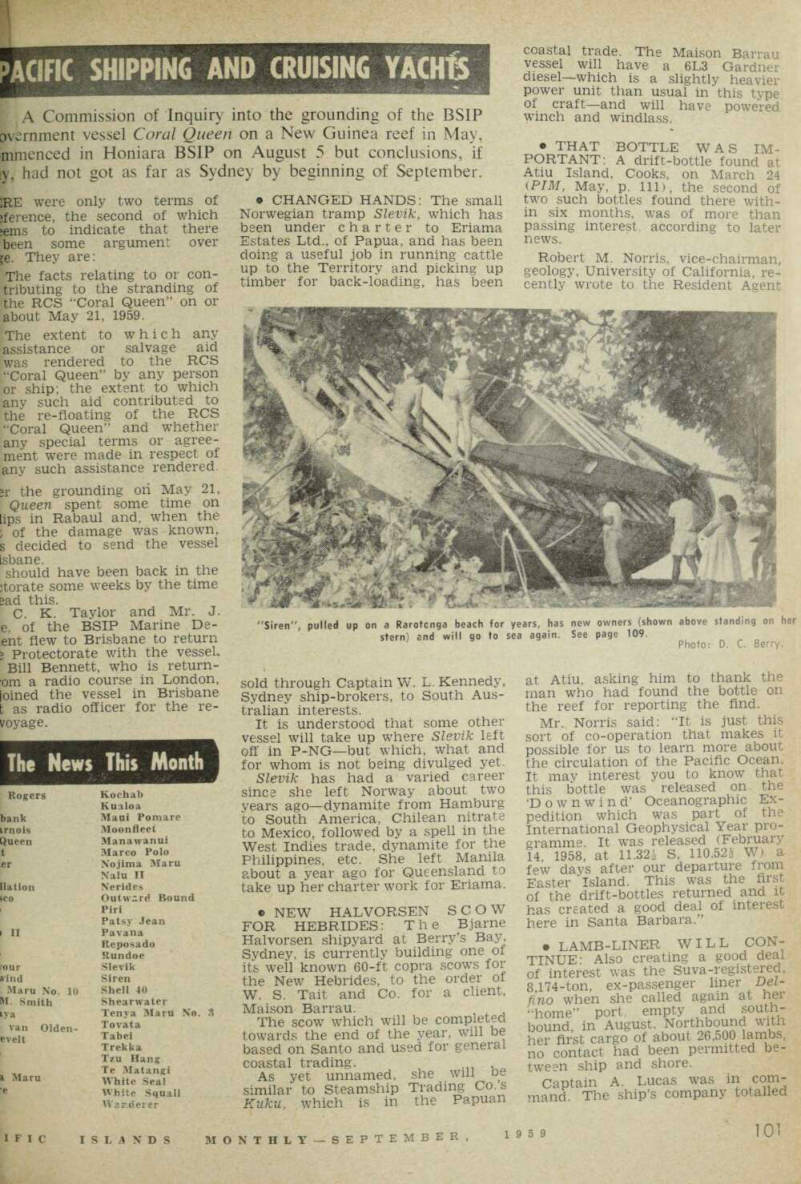
A Commission of Inquiry into the grounding of the BSIP overnment vessel Coral Queen on a New Guinea reef in May, mmenced in Honiara BSIP on August 5 but conclusions, if y, had not got as far as Sydney by beginning of September.
IRE were only two terms of jference, the second of which »ems to indicate that there been some argument over re. They are: The facts relating to or con tributing to the stranding of the RCS “Coral Queen” on or about May 21, 1959.
The extent to which any assistance or salvage aid was rendered to the RCS “Coral Queen” by any person or ship: the extent to which any such aid contributed to the re-floating of the RCS “Coral Queen” and whether any special terms or agree ment were made in respect of any such assistance rendered. ;r the grounding on May 21, Queen spent some time on lips in Rabaul and, when the ; of the damage was known, s decided to send the vessel isbane. should have been back in the iterate some weeks by the time Bad this.
C K. Taylor and Mr. J. e, of the BSIP Marine De ent flew to Brisbane to return b Protectorate with the vessel.
Bill Bennett, who is return om a radio course in London, loined the vessel in Brisbane t as radio officer for the re iroyage.
o CHANGED HANDS; The small Norwegian tramp Slevik, which has been under charter to Eriama Estates Ltd., of Papua, and has been doing a useful job in running cattle up to the Territory and picking up timber for back-loading, has been
sold through Captain W. L. Kennedy, Sydney ship-brokers, to South Australian interests.
It is understood that some other vessel will take up where Slevik left off in P-NG—but which, what and for whom is not being divulged yet.
Slevik has had a varied career since she left Norway about two years ago—dynamite from Hamburg to South America, Chilean nitrate to Mexico, followed by a spell in the West Indies trade, dynamite for the Philinnines etc She left Manila abouPa year ago for Queensland to take up her charter work for Eriama.
© New Halvorsen Scow
FOR HEBRIDES: The Bjarne Halvorsen shipyard at Berry’s Bay, Sydney, is currently building one of its well known 60-ft copra scows for the New Hebrides, to the older of W. S. Tait and Co. for a client, Maison Barrau.
The scow which will be completed towards the end of the year, will be based on Santo and used for general coastal trading. 0 As yet unnamed, she will be
SShF whilh Ts in te Papuan
coastal trade. The Maison Barrau vessel will have a 6L3 Gardner diesel—which is a slightly heavier power unit than usual in this type of craft—and will have powered winch and windlass.
• That Bottle Was Im
PORTANT; A drift-bottle found at Atiu Island, Cooks, on March 24 (PIM, May, p. Ill), the second of two such bottles found there with in six months, was of more than passing interest, according to later news.
Robert M. Norris, vice-chairman, geology, University of California, re cently wrote to the Resident Agent
at Atiu, asking hirn to thank the man who had found the bottle on the reef for reporting the find.
Mr. Norris said: “It is just this sort of co-operation that makes it possible for us to learn more about the circulation of the Pacific Ocean it may interest you to know that this bottle was released on the ‘Downwind’ Oceanographic Ex pedition which was .part of the International Geophysical Yeai P o gramme. It was released iFehraa. I 14, 1958, at 11.32- S, 110.52- v\) a few days after our departure from Easter has created a good deal of interest here in Santa Barbara.
R Amb-Liner Will Con
TTNUE. als q crea ting a good deal 174-ton ex-passenger liner Del -8,174 again ‘‘hnmp” nort, empty and south , in p AugUs t. Northbound with > cargo 0 f a b o ut 26,500 lambs, contact had been permitted be twe°n ship and shore.
CaDta in Lucas was in com mand. The ship's company totalled
"Siren", pulled up on a Rarotonga beach for years, has new owners (shown above standing on her stern) and will go to sea again. See page 109.
Photo: D. C. Berry,
[1 told on arrival. Three people J. D. Steel, of the Sydney irsity veterinary school, Mrs. who was the only woman d. and a man who had been irge of the eight horses aboard back to Australia from San F. J. Hamilton, of the CSIRO’s ister Laboratory in Sydney, on ion, was in charge of the ical side—the planning of the imodation, feeding arrange 3, etc. Under Mr. Steel were eterinary students, addition, there were 24 stock of whom seven were Australian, fc 10 of the Fiji crew members it Fijian stockmen and two n stewards —were signing off iva and were to be replaced.
Hamilton said that the lamb Ities—just over 3 per cent. — not considered excessive on first voyage. There was insur cover for a loss of up to five :ent. Most of the casualties from heat exhaustion in the decks. About two per cent. ;e total casualties occurred as suit of six hours in port at and 36 hours in Honolulu, when
-entilation was greatly reduced
;o lack of motion of the ship. 5 calls are essential to take vater. Further ventilating .inery now to be installed was ;ted to cut losses greatly on e voyages. b lambs consumed an average lbs of fodder per head per some gaining weight en route; ere in reasonable condition. At Diego they went into a 10-acre tntine paddock close to the f. They were to be hand-fed ! for a month, and would then irectly to the slaughter-house, e eight horses aboard arrived :>od shape; five of them were ings consigned to international s player Jack Kramer, who purchased other race horses in ralia. A black kelpie sheep-dog, h accidentally boarded at Syd was left in California, e ship was discharged in 36 s in San Diego, remained there lays in all, clearing again on
August 2 and arriving at Suva on August 18, direct. At Suva she was to undergo engine maintenance work, expected to take at least 10 days, before continuing south to Sydney for a second load.
• The Fishing Is Good
One of Japan’s most modern tun?, mother ships, the 8,504-ton Nojima Maru, owned by Nippon Suisan KK
Suva's handsome new Flying Angel Club for seamen, officially opened by the Governor Fiji on August 9. It is located in Jellicoe Street, adjoining the wharf area, and is under the management of Captain S. E. Gaskin (right), a well-known mariner for many years with the Union Steam Ship Co. and later with the London Missionary Society.
yo called at Suva on August took aboard 1,670 tons of •s and about 2,000 tons of water. She then returned to ihing station about 200 miles west of Suva, and within 70 if the opposition mother ship Maru No. 3 of Taiyo Gyogyo latter vessel made her second Suva for bunkers and water days later. Nojima Maru’s ; Captain Choichi Okada, re that in addition to the tuna asuga Maru, which went miss th all hands south of Ocean a few days after the season need, another boat, Shimei Vo. 10, was lost on the South a Reef (between the Ker ! and the Lau Group of Fiji) r visibility on the night of Radio Officer, who remained i post for too long, was id, but the other crew mem 'ere picked up. The 100-ton i vessel was a total loss, ng Manager Yukio Kato said ,700 tons of fish had been since loading from the tuna ommenced at the end of May. iiota permitted by the Jap- Fishery Agency, 5,700 tons, be reached by late September the ship would return to has 140 fish handlers and a of 68 —including six radio . Her radio room is probably equipped than any other mt ship to visit Suva, o Maru No. 3, on her second isit on August 10, had handled >ns of fish in the same period hma Maru, and expected to her quota of 5,400 tons by igust when she was to return However, the 7,600-ton Koyo -with a Fishery Agency quota lit 5,700 tons—and with some nal tuna boats, bringing the
fleet strength up from 35 to 50 boats, was to take over as from Sep tember 1.
In addition, a fourth mother ship has been licensed for South Pacific operations in the permitted area east of 170 degrees East this season, due to a poor fishing season in the North Pacific near home.
This vessel, Jinyo Maru, 7,200 tons, launched last year, will have a quota of about 5,700 tons of tuna.
She was to sail from Japan on Sep tember 1 and, like the others, would operate in the area west of the Gilberts-Ellice-Fiji chain.
The Fishery Agency has thus issued licenses for a total quota of 22,500 tons of tuna-type fish for the 1959 season.
In addition, there were probably about 30 independent fishing vessels not attached to mother ships and operating south of the equator.
These vessels are not controlled by any quota, and may operate in any area.
• Ship Safe, Cargo Lost;
The 5,690-ton, six-years-old Andrew Weir tramp Beaverbank, which went ashore just south of the la |oon entrance on the west of Fan ning Island in July, was refloated at the beginning of August and later reached Honolulu for dry-docking an ßutTS-eat deal of her cargo, in
Suva's latest shallow-draught tourist launch, owned by Mr. Vince Storck, and called "Oo-la la". This is what Frenchmen are supposed to sav; Mr. Storck's first tourist launch was called "Oolooloo", which, according to one tourist story. was what Fijian mermaids say. (Mr.
Storck says it didn't mean anything.) —Photo by Stinsons.
Top, left, NZ yacht, "Cimba". Top, right, 96-ft. motor yacht "Reposado". At right, Bill Tellen and owner Sid Nettleton of the Brisbane yacht "Shear water", and Dick Rohe, one of "Kochab's" crewmen, at Suva in August. See "Cruising Yachts" section.
c 2 507 tons of coconut oil, 2,132 f copra, and 830 tons of coco leal. was jettisoned and lost, aving Fanning for Honolulu, lip had aboard 2,220 tons of and 230 tons of meal. Of this 271 tons had been discharged jloaded. . refloating operation was aided i Royal Fleet Auxiliary Fort arnois and a Royal Navy from Christmas Island, and US Navy salvage vessel USS if, which was recently in Pago nvestigating the possibility of • a sunken Navy tanker ( PIM , ). 101) . services of this vessel cost the niters a substantial sum. portable pumps carried by it were of great assistance, lors were lost both by Beaver md Fort Beauharnois in the g-off operation. Seven sets of I tackle had been laid by the vhen the stranded vessel was hauled clear. Her main shaft rankshaft were believed then omewhat out of line, but trials ;ed that she was capable of f to Honolulu under her own and permission for such a ! was given by the under j and by the British Ministry
t nsport/
Hange Of Duties; The Us
Sc- Wildlife vessel, Hugh M. one of several attached to acific Oceanic Fisheries In ition project based at Hono ind a vessel well known in Pacific Polynesian waters, has transferred to other duties. ias now been leased to the s Institution of Oceanography, »lla. California, for oceano c and marine biological re . It is not yet known whether ew, but similar, duties will ber back to the South Pacific.
Rill In There Trading:
yacht-gone-trading ketch
r Rogers —best remembered e voyage she made round the s a few years ago with an all rew—has lately shifted her ing ground to the Vanikoro- Cruz Island area. The Hep ; report their newest crew er, Jenifer Natasha—b or n the ketch was last in New id waters—as thriving. Ex operator Close and his wife, ; UK, who joined the vessel t time, are now living at Santo, Mr. Close is employed by Pacific Fishing Co., Palikulo.
Ccording To Plan: The
cig schedule for New Zealand l Territories Department’s new to replace Maui Pomare, is lows: Contract was signed last keel laid in July; framed by fiber; plating completed by try next; launching March; eted July, 1960; and delivered gust, 1960. lure to meet the schedule in ; a penalty of £1,600 per month.
The vessel will almost certainly have a Cook Islands name.
• New Guinea-Bound: The
264-ton ICI explosives vessel Piri, laid up and for sale in Auckland for the past year or so, has been purchased by a Rabaul syndicate, This solid kauri vessel was built by Morrison & Sinclair Ltd., of Sydney, in 1917, for the Pacific Cabls Board. and was purchased by ICI in the mid-1920’5. She once carried a fair spread of canvas, but this was later reduced to a mere steadying sail or two.
The six-man syndicate, headed by Mr. Frank Dyer, an Englishman, paid a reported price of £5,000, and intend to use the ship for general
trade in New Guinea waters Cap tain Robert Ellery, a former chit officer in the ship, was to be lr. command for the delivery voyage Chief Engineer Fred James who had also served in her befor: lay-up.
Mr -. Dyer, who came south to negotiate the purchase, was also to ieturn in her. Pin was expected to B e t away from Auckland about August 8.
• Navy In Trouble: Hmnzs
Endeavour, New Zealand’s Antarctic supply ship and general-purpose re search vessel, was in trouble north of the Kermadecs bound Suva in August, during heavy weather, Almost a sister ship to the ill-fated
'earl, which was burnt out of New Guinea several years ndeavour was built as a US net layer in 1944 and is of eavy timber construction. The i 184 S-ft vessel apparently a plank or two and was to put back to Auckland. She > shepherd the SDML Viti, has been on loan to the Fiji back to Auckland. Instead 5 Kaniere was despatched on sk and the two vessels sailed luva for Auckland on August
)Ok Missing: The 19,787-
itch liner Johan van Olden zlt lost her starboard anchor de Suva wharf on August 13, was about to depart in the of an Islands cruise from anchor had been dropped in tinary way to assist berthing, ten the cable was being hove ailing time the main shackle ship sailed and attempts were nade later in the month to p the £5OO piece of ship »ry—after a diver had located attached a marker-line. (OTHER NAME: Tovata, ex Sea, ex SC-671, in the pro being reduced to a cargo may shortly wear yet another ■Mac 11.
Xing Business With
URE: The New Zealand yacht *ean arrived at Rarotonga on 8, with owner-skipper Don ife, small daughter and Bob aboard. They had visited Tuomotus, Leeward Islands ra Bora since leaving Russell, Auckland, on May 2, and ex to visit both Samoas, New and Japan before going ill that was changed in Raro n mid-August, when the trip d abruptly from pleasure to s. The party was offered the in —one of Dick Brown’s con is wrecks that decorate the ,pe there —for what is re to be a give-away price.
Siren, a ketch, was wrecked in October, 1951; she was purchased on the reef by Mr. Brown and hauled in to Avarua, where she has rested quietly under the trees on the beach beside the Brown business establish ment ever since.
Don Silk is a boat-builder and after four days work he and Bob Boyd had stripped deck and cabin roofing from her and pronounced the hull in good condition—except where she had been holed in her encounter with the reef.
They expect to leave for New Zea land before the end of the year to hunt up some necessary gear but Silk has promised that Siren will be back at sea “within the year”.
Jopeda, another Brown wreck— Dick Brown bought her after she went up in June, 1957, and had her hauled up on the beach near Ngatangiia school—was inspected by Silk and Boyd, but was evidently considered somewhat past redemp tion.
• Unexpected Angle To
TRIANGLE; It was unfortunate that the 28,000 tons, P & O liner Himalaya on her longest voyage ever —45,479 miles London back to Lon d o n—and the first of the “Triangular” voyages, now scheduled in the Orient and Pacific Lines Service—should have been delayed through a minor accident.
By the time the ship gets back to London she will have been away
five months—three weeks longer than scheduled because of a mishap to a propeller in the Suez Canal during the voyage out. After slow progress during the rest of the voyage, Himalaya entered the RAN’s Captain Cook Dock in Syd ney and emerged after a week with a new tailshaft and propeller.
Nonetheless, she was 22 days late by the time she left Sydney on August 29. Her Triangle voyage will take her to Auckland. Suva, Hono lulu, Vancouver, San Francisco, Los Angeles, Yokohama. Kobe, Hong kong and Manila. She will then re turn to Sydney and take the normal Suez route back to the UK.
Mr. Len Usher sailed on her from Sydney back to Sydney on a sort of working-holiday as press relations officer. He is beter known to PIM readers as Vakatawa of Fiji Talanoa; and in Fiji, as the executive director of Fiji Times Ltd.
• Quitting The Islands:
Shell-40, a craft which caused some news a year or so ago in Fiji waters when she got further from land than her navigator could cope with, was sold to a Brisbane firm in July.
A 61-ton motor tug, originally named Tanac-No. 136, this little vessel was apparently one of many brought to Australia by the Ameri can Forces and later sold. She was built in Trenton, Ontario, in 1944, and acquired by the Shell Company in Sydney in 1950 to be used in towing barges with cargoes of oil products in drums between Suva and Lautoka-Nadi, and she arrived in Suva under tow of the GSR’s Tahua on June 13, 1950, suffering some damage en route. When Shell established their bulk oil terminal at Vuda Point, near Lautoka, several years later the tug was no longer required and has had only occasional use since. She is powered with a Vivian 6-cylinder, 240 hp motor and is equipped for fire fighting, having a Chrysler-powered sea-water pump for this purpose.
She has been purchased by the Riverside Coal Transport Company Pty Ltd , of New Farm. Brisbane, for river work. For the August de-
The new Tonga bulk oil barge, nearing com pletion in Auckland. It will be towed by "Hifofua" between Suva and Island ports.
Photo: John Duder.
The modern tuna mother-ship "Nojima Maru" (See page 103).
ihe was to be commanded by
i Henry Simpson, of Suva,
dined by Fijian engineers and
seven men all told.
i of Cruising Yachts
Shter Control Of Cruising
>; Under an amendment to the ' and Seamen Act introduced in Zealand House of Representatives ist, there is to be tighter control sure boat movements, if the Bill a. s on off-shore cruises will have to certain information to maritime ies before sailing, and their craft subject to inspection to see that minimum safety standards are up expense involved in a subsequent for a missing craft will be charge the yacht owner to the extent of le of the yacht and its stores and ;nt. yachtsmen will feel that the ;s in this Bill represent an undue hment on personal liberty. Al there is much in favour of yachts ing presented with a questionnaire of the clearance papers prior to re, a yachtsman should have the i refuse to supply the information so long as he clearly understands so refusing he will not be entitled public rescue operations. a fact that searches’ have been out unnecessarily for yachts which been sheltering safely in some d bay, and that the yachtsmen led have neither wanted or required
assistance. It is almost impossible for a yacht-master to provide a course, speed, and accurate ETA when his movements are governed by the wind. It is also al most impossible for a small yacht to keep in regular radio contact over long dis tances.
So long as a man forgoes all rights to public rescue operations, he should surely be permitted to put to sea in a bath-tub if he so wishes and stay there for as long as he likes provided that he is not endangering other lives or infringing some one’s three-mile limit.
What happens, of course, is that re latives ashore bring pressure to bear on the authorities to institute these searches sometimes against the wishes of the mariners concerned.
There will always be an element of risk in small-boat cruising, just as there is in many sports, but freedom to sail the seas
is a fundamental freedom which she. not—subject to above provisions—be limitr by too many regulations. • SHEARWATER of Brisbane, a ;U home-brew Bermudan cutter of Austraii, PIET HEINE design, arrived at Suva August 4. With owner-builder Sid Nettie ton, and Brisbane taxi driver Bill Teller? aboard. The yacht left Brisbane June it. made a nine-day passage to Noumea, spen 10 days there then five days at Isle of Pines, then headed for Mare east of New Caledonia. Bad weather there prevented a landing so a course was laid ffor Suva, Calms and strong head winds were ex perienced. After a month of Fiji inter island cruising this yacht will bead for Tonga, possibly the Kermadecs, northern NZ ports, and should be back in her home port of Brisbane before next Easter.
Sid Nettleton some time ago helped de liver a 40-ft. ex-US Army tow-boat,
A. Lucas of "Delfino", the lamb -see page 101.
Houng Lee, one of Suva's best known [?] owners, with the motor-bike on does his waterfront chores.
from Rabaul to Australia earlier ar. TABEI was bound for Sydney J to put into Cairns for repairs.
JHUA of Auckland, 30-ft. ketch with Matheson and Peter Ashcroft was reported at Papeete early tOCHAB of England, with Dr. m-Evans and two NZ companions, ji westbound in August. Leaving ;arly May this yacht cruised to Levuka, Savusavu, Taveuni, Qamea, , Komo. and Kabara and arrived i Suva on July 27, where she went slip.
IDA’S crew-member, Andre Mayet ice. left the yacht at Noumea. DIDA in Sydney.
IRRIGO II and the Crawfords were eported in Brisbane awaiting a r event”. (’HITE SEAL which added a junior r to her crew is Brisbane some time as momentarily expected in Darwin ing to an early August report.
OONFLEET of Suva was under in tion by a well-known overseas cruis ichtsman in August. A sale may ate.
RUSADER of Auckland arrived at nga July 7, and sailed for Papeete 5. It was not expected that a long vould be made at the latter port, ation California. lEPOSADO wrongly reported as SADO was to clear Papeete August md Auckland via Bora Bora, Pago and Suva. With owner Brian Niell lis wife and two children are Don Jerry Burns, Roger Marchon, Tyrna m, Dr. Lehman, and Dr. Schneider, is the 96-ft. x 17-ft. launch which exchanged for his motor-sailer iWANUI some months ago at te. The twin-screw launch is beauti fitted with just about every con ice except stabilisers. \’HITE SQUALL, the 33-ft. Auckland in which Ross and Doreen Norgrove
cruised the Islands several years ago, will venture forth again next March, bound for the US via Island ports. „ .. .. , • ClMBA—the same little ship that cruised from the US to Fiji years ago (“Saga of Cimba ), and which Gordon Russell, now of Rarotonga, sailed to Auck land in May, 1945, and sold, is sailing late this year for England, via Noumea and Torres Strait. With owner Frank “Buzz”
Perkins and his wife and two children will be crewman Crawford of Keri Keri, NZ.
CIMBA measures about 35-ft. x 9i 2 -ft. x 5-ft„ and was built as a Nova Scotian fishing schooner in 1929. She is an attractive and sturdy little craft.
» Los Angeles - Honolulu Yacht
RACE: Our Honolulu correspondent reported mid-August that after much entertaining and gaiety and a lot of hard work by the host yacht clubs in Honolulu, most of the yachts that took part in this deepwater event were on their way home or were planning to leave Honolulu for further cruising.
The overall winner on handicap was de dared to be NALU 11, 4« ft. sloop of Balboa, owned by Peter Grant. Winner of class A was 75 ft. schooner CONSTELLA xiON; class B. «6 ft. yawl CHUBASCO; class c XALU II; and class D 38 ft. s;oop
Debit
The two Australian yachts, 52 ft, schooner PAVANA, and 38 ft cutter ANITRA, were unplaced. (The latter later sailed home to Sydney.) .. ... * h . e lhl ' ft : Newport schooner GOOD owned by Ralph Larrabee, made fastest time arriving July 14, after 10 . I^ ho . urs J 8 m 'nutes and lo seconds.
She lost her topmast half-way through the race or would have made better time The onJy yacht to start and not finish the course was the 45 ft. yawl, CLOUD NINE which lost both masts near the half wav mark and was towed the rest of the way by a Coast Guard ship, ® WANDERER, owned and sailed by movie-star Stirling Hayden who was last
d Japanese midget submarine, raised i harbour in Rabaul, is now being used as a ships' fender there.
Photo; C. J. Fonceca.
I at Tahiti, is believed to be plango further south—maybe to Aus- But with all the world’s Press on —he has his four children along nee of a Court order taken out by rife in the US—he’s not talking JALOA, 36 ft. yawl owned by the family is back in Honolulu after the Pacific, north and south of lator, for the last 10 years. Mrs. fruman and her son Tary Truman. e on board when they got back.
Fred Truman had flown back ipan earlier for hospital treatment. lARCO POLO with lone-hander ’ederson arrived in San Francisco ly one year and three days after ( r ”T» NZ Des ‘ Denmark, via Panama.
IEKKA, the 20 ft. ocean cruising owned by John Guzzwell of whom ren’t heard since he survived a off the Queensland coast the ” before last, arrived in Honolulu out from Panama Canal late July. leaving Canada in 1956, Guzzwell iled 30,200 miles—Pacific, Torres Indian Ocean, Cape of Good Hope iross the South Atlantic to West through Panama to Honolulu. He lied—during the same period—some-
thing like 7,000 miles with the Smeetons on TZU HANG (see Book Reviews, this issue). • TE MATANGI and the Fergusons were still in Nukualofa. Tonga, in August, with no indication as to when they would move, although they expect to be in New Zealand for Christmas. The idea ap parently is to sail direct from Tonga to NZ, giving Samoa and Fiji a miss until after the coming hurricane season. • NERIDES, which passed through the Tonga group on way back to New Zealand apparently caused some wrath among officials there as she entered at Vavau — which is rhinoceros-beetle infected —before going on to Nukualofa. • OUTWARD BOUND, with the cruis ing Caldwells still in high spirits, reported to us from Darwin—in late August. • RUNDO WITH AN E: We are in formed that the explanation as to why this ketch from Oslo (last reported Suva) is sometimes spelled without a final “E' and sometimes with it, is that final “O" is the Scandanavian letter with a stroke through it—and that the English conversion of same is OE. Now we all know.
E Goodewind Or Goodewin 50 Ft.
ketch left Brixham. Devon, in early August and should now have crossed the Atlantic on the first leg of her journey to Aus tralia via Pacific Islands (Tahiti, Tonga, Fiji). Owner-skipper is Dr. Keith Laws, whose fortunes in NIRVANA we followed in 1958 when he crossed the Pacific to the US with a team of Australians and one Englishman. When he is not sailing yachts, Dr. Laws has a London dental practice. Dr. Laws tried once before to sail his ketch from UK to Australia in 1954 —but gave up that attempt when she lost her mainmast near the Azores.
On the current voyage he Is accom panied by three Englishmen, two Aus tralians, one American and a Pole—chosen from the 150 ‘‘young men with a taste tor adventure” who answered an advertise ment. One of the Australians is John Hunter, who accompanied Dr. Laws on the NIRVANA cruise.
[?]-tons "Piri” of Auckland, NZ, which has been sold to Rabaul interests (see page 107).
[?]unborg and Carl Petersen of the 44 ft.
Norwegian ketch "Rundo”.
The 30 ft. yacht "Drifter”, at Rarotonga, August 7. Lone-hander James Moore, of Welling ton NZ, left there early in April intending to sail' alone to Canada, but his sails blew out a few hundred miles east of Wellington so he sailed eastwards to Rapa Island in the Tuamotu group and then north via Mangareva to Tahiti He is now returning to New Zealand via Raro tonga.