Island Villages
pp. 88-101 · Read in the full issue
The Success Story of Co-ops In The Cooks
come To Life
By Gordon Russell
There is something of a new spirit abroad in the Cooks today. In recent years the reins have been loosened a bit, the pace has quickened, horse and rider are in closer harmony.
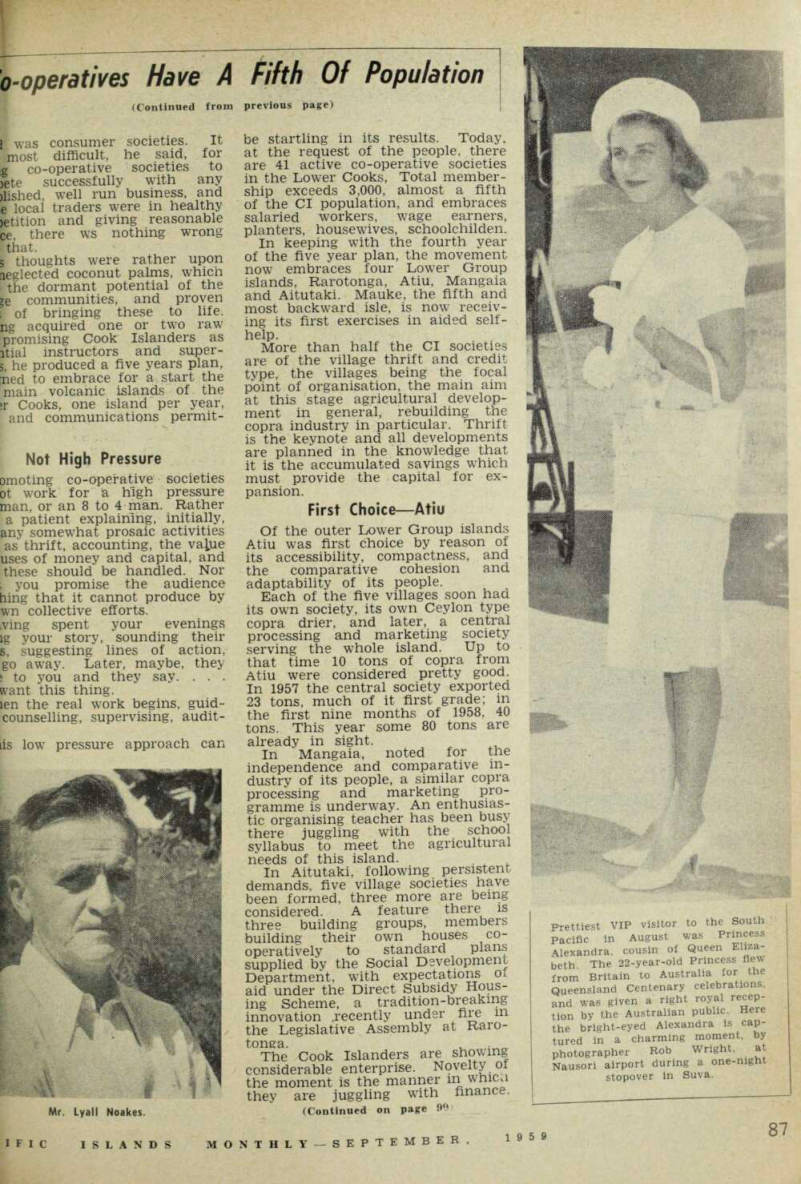
SOME of the credit for this new spirit must go to Mr. Lyall Noakes, who in July retired from the post of Director of Social Development and Registrar of Co operative Societies. What this man has been doing over the past four years is an interesting success story . . . the success story of Cook Islands’ co-operatives.
Conceived in self-defence in the English village of Riochdale in 1844, the co-operative movement as we know it today spread throughout this world, and, its laws and principles tested, trimmed and per fected, it reached India in 1905, the East Indies in the 20’s, New Guinea and the Gilberts in the 40’s, Fiji in 1949, Samoa in the early 50’s, the Cooks in 1955.
But we are talking of the modern co-operative. In their feudal days,
the Polynesians knew something of co-operation. In the Cooks the early missionaries noted that co operative effort in small groups on the land was the common practice.
In the 1890’s native co-operatives were trading in oranges, cotton, coffee, with Auckland and Tahiti, In the 20’s, for a while, an officially sponsored consumer society opera ted in Rarotonga.
Native Evolution
There was the Cook Islands Progressive Association, a native evolution that blossomed in spec tacular style only 15 years ago, only to wither away for lack of know ledge and true leadership. It left a trail of sentiment for a lost cause but no immediate stomach for more.
It was fortunate for the ( that the man who disembi from the Matua at Rarotong May, 1955, to become Registn Co-operative Societies, was rather rare thing in the South a Colonial Service man with a lifetime of background and perience in this and kindred f.
New Zealand born, he was fact, back in New Zealand Sarawak on retirement leave he accepted the Cooks’ assignn Under the paternal eye of the 1 Rajah of Sarawak, Lyall No had entered the Sarawak Service in 1930, and while on administrative ladder, survived years as a prisoner of war of Japanese, participated in transition of this British protec ate to a colony in 1945, vis Ceylon in 1949 to make a sp< study of co-operative societies, retired from the Sarawak servic 1954 as Commissioner of C munity Development.
Commerce Reaction
Now here he was in Rarotc with his own typewriter, hal weather-beaten Nissen hut, a sticks of furniture, and no sta; First reaction was from the L Chamber of Commerce which w; to the New Zealand parent b urging that this movement boycotted at all costs. p“Afe wb cost?” replied the NZ chamber, effect, giving them no change all.
It soon became clear that ah the last thing on Lyall Noa!
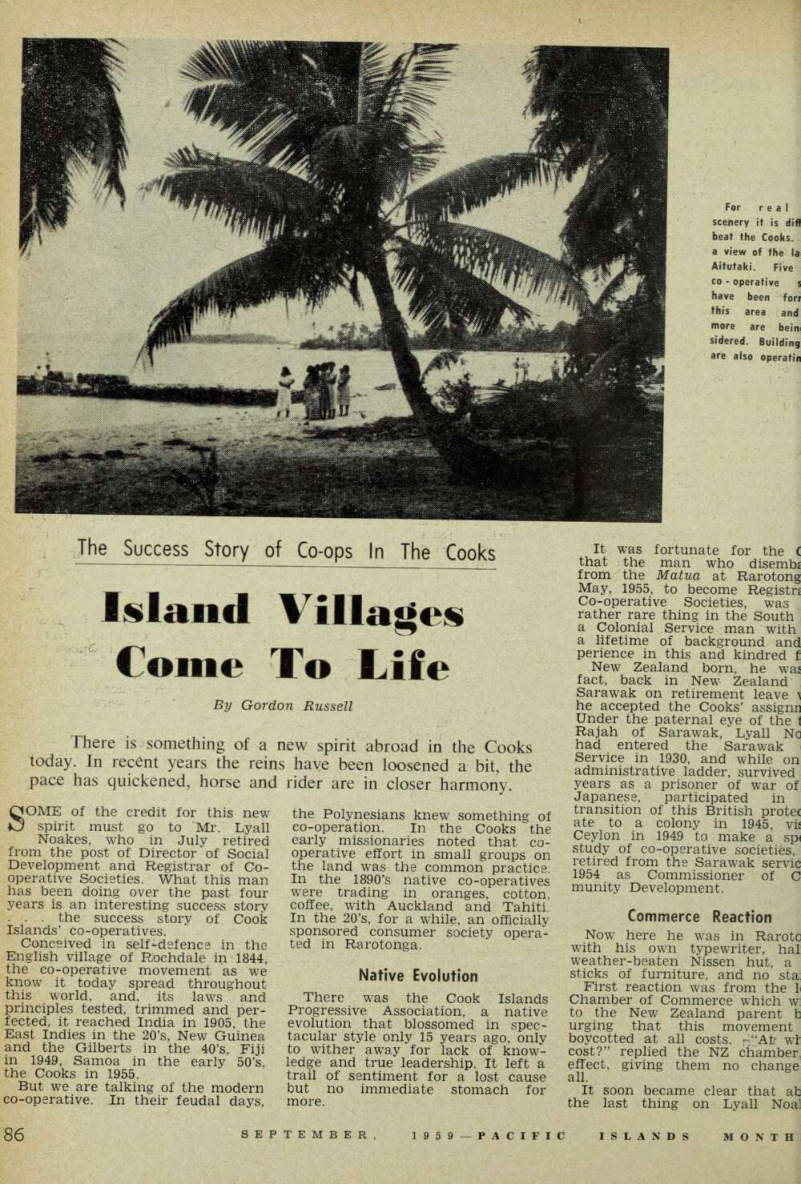
For real scenery it is diff beat the Cooks, a view of the la Aitutaki. Five co - operative s[?] have been for[?] this area and more are bein[?]
sidered. Building
are also operatin[?]
I was consumer societies. It most difficult, he said, for ,g co-operative societies to >ete successfully with any Wished, well run business, and e local traders were in healthy jetition and giving reasonable ce. there ws nothing wrong > that. s thoughts were rather upon neglected coconut palms, which ■ the dormant potential of the *e communities, and proven i of bringing these to life, ng acquired one or two raw promising Cook Islanders as itial instructors and super 3, he produced a five years plan, ;ned to embrace for a start the main volcanic islands of the ;r Cooks, one island per year, and communications permit- Not High Pressure omoting co-operative societies ot work for a high pressure man, or an 8 to 4 man. Rather a patient explaining, initially, any somewhat prosaic activities as thrift, accounting, the uses of money and capital, and these should be handled. Nor i you promise the audience hing that it cannot produce by wn collective efforts, ving spent your evenings ig your story, sounding their s, suggesting lines of action, go away. Later, maybe, they ; to you and they say. . . . want this thing, len the real work begins, guid counselling, supervising, audit lis low pressure approach can
be startling in its results. Today, at the request of the people, there are 41 active co-operative societies in the Lower Cooks, Total member ship exceeds 3,000, almost a fifth of the Cl population, and embraces salaried workers, wage earners, planters, housewives, schoolchilden.
In keeping with the fourth year of the five year plan, the movement now embraces four Lower Group islands, Rarotonga, Atiu, Mangaia and Aitutaki. Mauke, the fifth and most backward isle, is now receiv ing its first exercises in aided self help.
More than half the Cl societies are of the village thrift and credit type, the villages being the focal point of organisation, the main aim at this stage agricultural develop ment in general, rebuilding the copra industry in particular. Thrift is the keynote and all developments are planned in the knowledge that it is the accumulated savings which must provide the capital for ex pansion.
First Choice —Atiu
Of the outer Lower Group islands Atiu was first choice by reason of its accessibility, compactness, and the comparative cohesion and adaptability of its people. , Each of the five villages soon haa its own society, its own Ceylon type copra drier, and later, a central processing and marketing society serving the whole island. Up to that time 10 tons of copra from Atiu were considered pretty good.
In 1957 the central society exported 23 tons, much of it first grade; in the first nine months of 1958, 40 tons. This year some 80 tons are already in sight.
In Mangaia, noted for the independence and comparative in dustry of its people, a similar copra processing and marketing pro gramme is underway. An enthusias tic organising teacher has been busy there juggling with the school syllabus to meet the agricultural needs of this island.
In Aitutaki, following persistent demands, five village societies have been formed, three more are being considered. A feature there is three building groups, members building their own houses co operatively to standard plans supplied by the Social Development Department, with expectations oi aid under the Direct Subsidy Hous ing Scheme, a tradition-breaking innovation .recently under fire m the Legislative Assembly at Raro tonea. , . „ The Cook Islanders are showing considerable enterprise. Ngvelty of the moment is the manner in whica they are juggling with finance.
(Continued on page 90
Mr. Lyall Noakes.
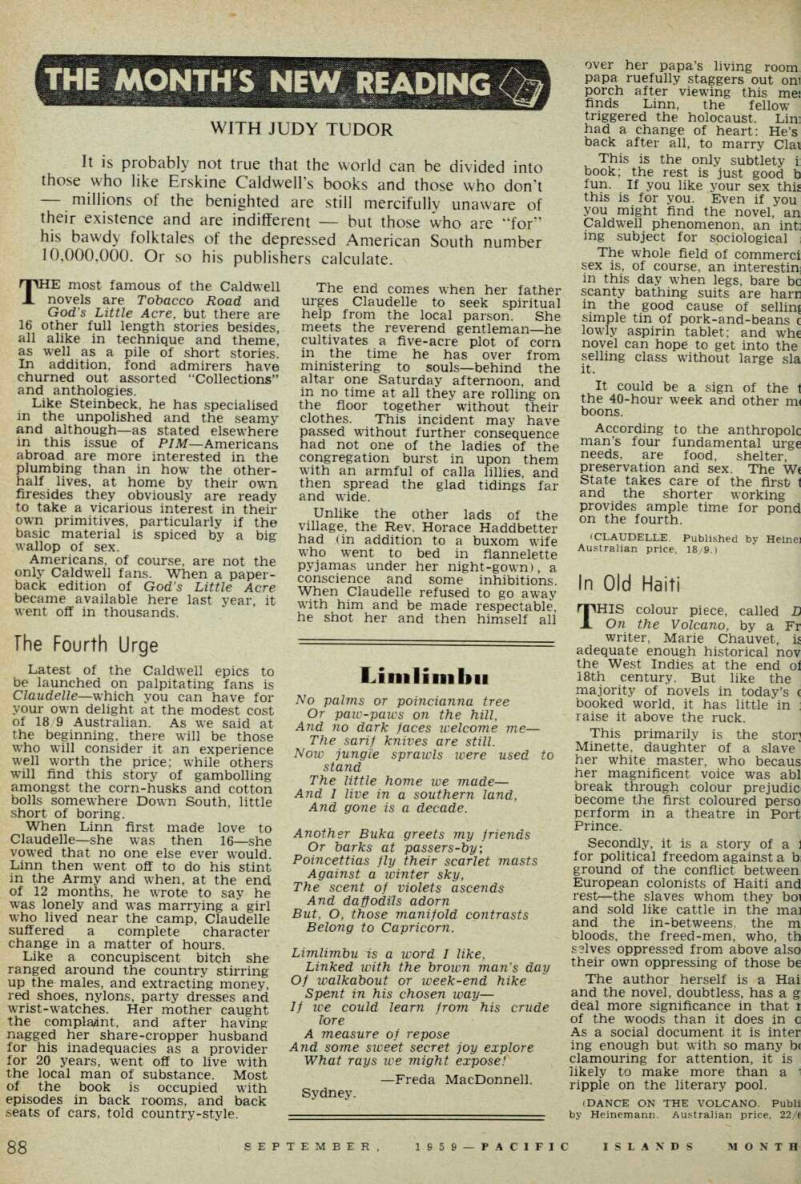
Prettiest VIP visitor to the South Pacific in August was Princess Alexandra, cousin of Queen Eliza beth The 22-year-old Princess flew from Britain to Australia for the Queensland Centenary celebrations, and was given a right royal recep tion by the Australian public. Here the bright-eyed Alexandra is cap tured in a charming moment, by photographer Rob Wright, at Nausori airport during a one-night stopover in Suva.
With a mere £315 in share capital behind its export of 40 tons of copra in 1958, the Atiu Processing and Marketing Society had a surplus of £235 to dispose of. They wrote down the value of their buildings, estab lished a share transfer fund, paid a bonus, returned £5O to the reserve fund.
Rarotonga, largest, wealthiest, most populous island of the Cooks, now has 15 societies with a total membership of over 1,600; savings in excess of £9,000.
In 1958 the Processing and Marketing Society exported £2,081 in tomatoes, coconuts, taro, and
paid a bonus of 1/6 for everv £ of produce marketed. Wealthiest group is the Thrift and Loan Society for salaried Government employees, with 212 members ano some £6,000 in the kitty. No society has yet suffered any loss from its loan business.
The Cook Islands Co-operative Union Ltd. has now been started The Union is a bank through which the capital of co-operatives is being channelled, and in which to deposit surplus funds and to which credit worthy societies can apply for financial assistance. Bulk purchases by outer island societies are en couraged, but only in essential supplies for agricultural and build ing requirements.
New Department
In 1956 Mr. Noakes accepted the post of Director of Social Develop ment, a new department planned primarily to implement some of the recommendations of the Belshaw- Stace report of 1955. The Cl co operative structure is now embraced within this department with. Ton Muir, a New Zealander with special training in this field, as assistant director and assistant registrar.
There are now four Maori co operative officers, each caring for the needs of one island; Apenera Short in Rarotonga, Ngatangata Rairi in Atiu, T. M. Tuavera in Mangaia, Benioni Joseph in Aitutaki. Four more local men are in training for such posts.
David Murray joined the staff to train as an assistant registrar Percy Henderson to become Com munity Development Officer, Stuart Kingan as Information Officer.
Local Maori teachers have played a leading part in the formation of village societies. Many have passed a special course of study in co-operation at the Nikao Teachers’
College, Rarotonga, and this subject is now on the curriculum of primary schools in the Lower Group.
All sections of the community appear to be benefiting from this new interest in life in the Cooks, and the general trend towards a better standard of living emanating from the Social Development De partment is being actively supported by other government departments.
There is great public interest in the new housing benefit schemes and the land utilisation project.
Copra output from the .Lower Group is leaping up, quality is greatly improved, and society members, by handling this product right to the export stage, are get ting a much more satisfying return than applied in the old ‘ crack a nut for the store” days.
Export and import requirements for the societies are handled on very favourable terms by the old established Cook Islands Trading Company, which offered its services to the movement at the outset.
Mr. Noakes’ medicine is going down very well. He has earned his retirement.