A Vital Principle Was Established When Burns
pp. 86-101 · Read in the full issue
And Carpenter Fought The Dutch
• From that dedicated historian of South Pacific ships, Mr. Nevill Chatfield, I received a file of official and part-official documents (which, 1 hope, is destined for the Mitchell Library); and, from those 70-years-old records, I was able to build up, in detail, the extraordinary story of the Costa Rica Packet, and the late Sir James Burns’s seven years’ war against the Netherlands Government. Some of the documents were transcriptions of the old Dutch East Indies official reports, and the record was so clear that it was possible to reconstruct the probable dialogue.
By R. W. Robson
The tall, broad-shouldered, bearded, tough-looking sea captain was buying provisions in a store in Temate; and he was not pleased when a cocky Eurasian, in the uniform of the Dutch East Indies constabulary, tapped him authoritatively on the shoulder.
YOU are Captain John Bolton Carpenter?” he inquired. ‘•Well, what of it?” snarled the big seaman. ‘‘Of the barque Costa Rica Packet?” proceeded the official.
“Yes, that’s my ship—she’s lying out there now. What’s biting you?” demanded Captain Carpenter.
“You will come with me to the Governor, please,” said the police man.
The captain’s beard bristled.
“What!” he roared, belligerently.
“Can’t you see I’m busy? Get out!”
“My orders are to take you at once to the Governor,” replied the official. He motioned towards the doorway. Another policeman was waiting there.
The captain smelled trouble —he knew well the East Indies of the 1870’s—he had been through those shining archipelagoes many times.
So he told the storekeeper, pro fanely, that he’d have to go and see what it was all about —but he’d be back. He strode off up the hill, closely attended by the policemen.
The Dutch officer (his official title was “Resident” in charge of that section of the Molucca Islands) was formal and rigid.
Piracy
Was he Captain John Bolton Carpenter? Was his ship the Costa Rica Packet? The captain, equally unfriendly, answered Yes to both questions. ‘‘Then I arrest you on a charge of piracy,” said the Resident. “I commit you to prison, to await orders from Netherlands Indies Government.”
Captain Carpenter literally bellowed. Using fiery American oaths —for. until he was driven by the
events of the Civil War to seek British naturalisation, he had been an American —he demanded details of this outrageous charge.
The Dutchman —a cold, sneering
type of human simply told policemen to take him to Ternate gaol and lock him up “You are mad!” roared the tain. “You can’t do this to a Bi citizen. I demand some reasoi this charge!”
“The captain knows well wh is,” remarked the Resident, prau that was stolen from Bo and the cases of liquor which sold in Batjan—we also kncn Take him away,” he said to policemen.
For a moment, the furious sk: showed an inclination to figl out. Then he shrugged his shoul told the official that much
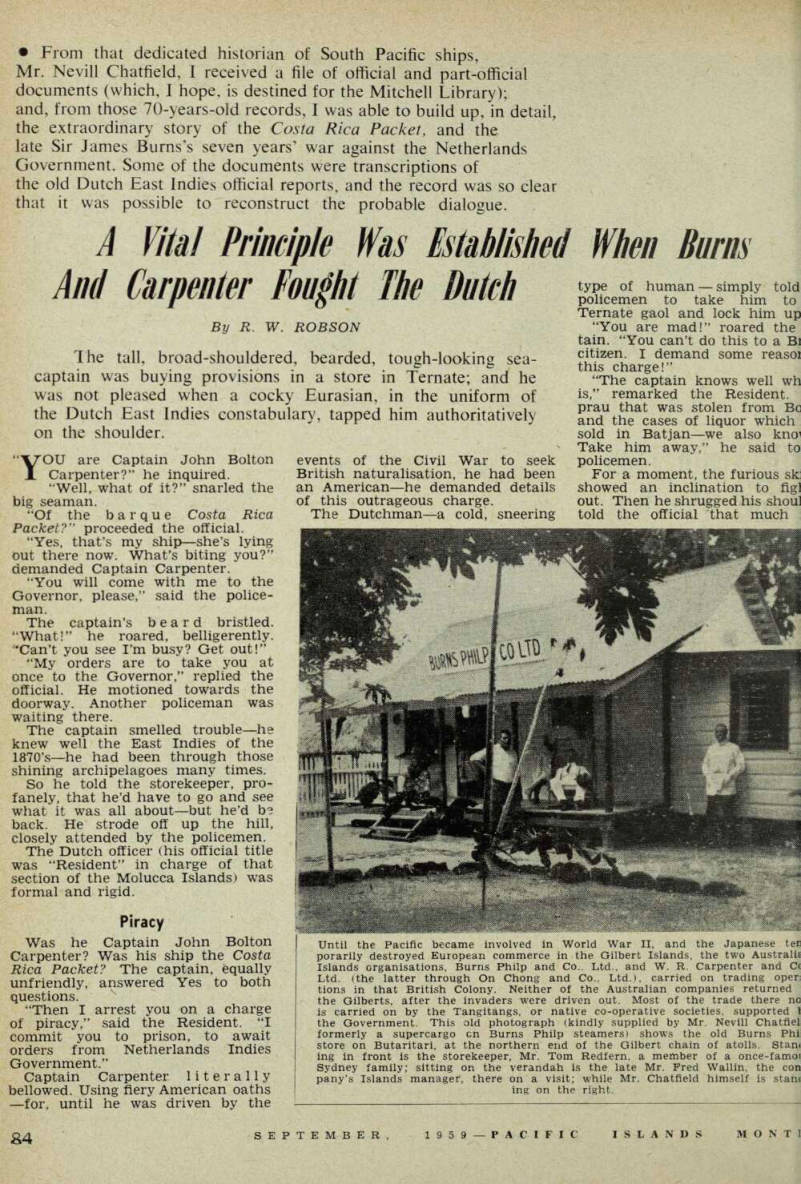
Until the Pacific became involved in World War II, and the Japanese ten[?] porarily destroyed European commerce in the Gilbert Islands, the two Australia Islands organisations. Burns Philp and Co.. Ltd., and W. R. Carpenter and C[?] Ltd. (the latter through On Chong and Co.. Ltd.), carried on trading oper[?] tions in that British Colony. Neither of the Australian companies returned the Gilberts, after the invaders were driven out. Most of the trade there no[?] is carried on by the Tangitangs, or native co-operative societies, supported [?] the Government. This old photograph (kindly supplied by Mr. Nevill Chatfiel formerly a supercargo On Burns Philp steamers) shows the old Burns Phi[?] store on Butaritari, at the northern end of the Gilbert chain of atolls. Stan[?] ing in front is the storekeeper, Mr. Tom Redfern, a member of a once-famo[?] Sydney family; sitting on the verandah is the late Mr. Fred Wallin, the con[?] pany’s Islands manager, there on a visit; while Mr. Chatfield himself is stan[?] ing on the right.
Id be heard of this, and was :hed off to gaol. f, he marched, he became ghtful. The Resident’s last re t had given him a clue his was November 1, 1891. •ly four years before that —on iary 24, 1888—there had occurred ‘thing that had seemed strange ie time, but which he’d almost >tten.
Whaler and Derelict Prau i had only recently taken charge ie Costa Rica Packet, 531 tons, ■ in Guernsey in 1861 for the t Indian trade, and converted arque rig just before she was based in 1887 by the then 4s-old firm of Burns Philp and Ltd. ie dynamic James Burns had led that he would try a whaling rprise in the East Indies region the barque; and he had en d Carpenter, a rugged, 44-years navigator, for the job, because •enter could handle men, and he i j whaling, and he knew that Indies area, ie barque went north, whaling. 887, and the venture wars very essful—so much so that in 1891 was re-equipped and sent back another whaling trip, with a er crew. i her first whaling voyage, on iary 24, 1888, at an estimated 7 miles off the coast of Boeroe, he Banda Sea. the Costa Rica zet sighted a large prau (native ng-vessel), apparently derelict, tain Carpenter sent away a and the mate reported back the vessel was drifting, had no aboard, but carried a number ases of liquor. iptain Carpenter brought his iue close alongside, had a look, then had the dozen cases sferred to the Costa Rica Packet. left the prau drifting. She tied worthless. here were eight cases of arrack, of gin, two of cognac and one :erosene. he crew manifested a lively in st in the cases there was siderable drunkenness, and the :ain noticed that the bottles were dy disappearing. little later, when the barque it into Batjan port for pro ons, he sold the remaining cases liquor to Chinese traders there; i went on with his fishing.
Dutch Suspect Piracy
le was not to know it—but the ippearance of the prau had sed quite a stir in a little town Boeroe.
A trader there complained to a Dutch official that a prau which he had chartered, and onto which he had loaded some cases of liquor, had disappeared in the night of January 18, while her crew were ashore.
The official formally reported the matter to the Resident at Amboina (in the Moluccas). The latter passed the word around, among his agents. That seemed the end of it.
But late in 1888, an official in Batyan chanced to notice a case of arrack in a trade-store. It had marks upon it; and thus he identi fied it as one of the cases which had disappeared on the prau.
The Chinese storekeeper said he had bought the case from Captain Carpenter, of the Costa Rica Packet.
Immediately, officialdom was on the warpath. A warrant was issued for the arrest of Captain Carpenter.
That was in 1888.
Angry Captain Under Arrest
Over three years later, Captain Carpenter, now in the law’s grip in Ternate, was thrust into a dirty gaol, with some native prisoners.
He created such a disturbance that the gaoler presently brought an official from the Residency; and the Captain found that it was as he suspected—he was being charged with having stolen the liquor and, probably, the prau.
"Damn ye for a lot of fools! shouted the captain. "We took that liquor off a derelict ship, far out on the high seas—and there’s men aboard my ship now who can prove it. That was four years ago.”
“But you do not deny that you stole it,” replied officialdom.
T did not,” roared the angry sea man. “That was a derelict ship, and our law says we were entitled to take possession of the ship, and anything on the ship.”
“We do not agree. We think you stole the ship from Boeroe, and took her cargo.”
They kept the captain for four days in that dirty little gaol: and then they put him aboard a coaster, bound for Macasser, to be tried.
He did not take it silently. In fact, he created so much uproar that the officials finally allowed him to select three men from his crew, who had been with him on the 1888 cruise, to go with him to Macasser, as witnesses. , , orl Captain Carpenter was taken aboard the coaster under guard.
When he found that he was ex pected to bed down among the native deck passengers for the voyage he became “difficult again, and finally they were glad to let him settle in a cabin.
(Continued on page
Meither Idle Nor Silent"
Macasser, Captain Carpenter put in a cell with a sick an soldier, and kept there for ys. He was neither idle nor finally got word to the Gov of the British Straits Settle , and the latter took strong , and had the case brought ickly for trial, Dutch could not prove that irau was stolen from her rage—in fact, the evidence >ted that she had broken loose her crew were having a party ;, and drifted away to sea. captain’s witnesses, on the hand, gave exact details of she was found derelict away n the open sea, far beyond enerally recognised territorial (three miles).
Dutch claimed that she was ed by the Australian ship to the shore; and they argued in those waters, there was no >rial limit. their case broke down com 7, and Captain Carpenter was ipon turned out of the gaol e he had been for 26 days) sft there, to shift for himself, ntually, early in 1892, he got to Ternate and his barque, lut captain and without dis b, and apparently without , she was a sorry mess. The tig season now was over, ing on James Burns’s instruc- Captain Carpenter took the Rica Packet to Singapore, old her.
Burns's 7-Year War I then the famous Costa Rica '■t war began. les Burns was determined that me should pay compensation; ie was a tenacious fighter, those days, Burns Philp & Co.
were very small potatoes. The Dutch Government treated their claim with disdain.
There was no Australian Com monwealth then—merely six dis united Australian Colonies. Burns was a member of the NSW Parlia men t. The NSW Government backed the claim.
The Hague’s response was merely a sneer.
Burns’s good friend, Dr. J. M.
Creed, a brilliant lawyer, took up the case in the Legislative Council in October, 1893; and he never let go of it again.
The Costa Rica Packet claim went from Council to NSW Government: on to British Colonial Office (which ducked and dodged); on to British House of Commons and House of Lords (which finally forced the British Government to carry on the fight); on to the International Court at The Hague, which said that the claim was just, and sent it on to Russia, to nominate an arbitrator or accessor; to the Czar of Russia, who nominated Professor de Martens, a jurist of international repute, who decided that The Netherlands should pay £8,500 compensation, plus costs and 5 per cent, per annum interest from 1892.
That was in 1898. James Burns had carried on that war for seven years. By 1898, the case of the Costa Rica Packet was known to every newspaper reader in the South Pacific Captain Carpenter (who died in 1921, aged 78, and who was the father of Sir Walter Carpenter, founder of W. R. Carpenter & Co.
Ltd.), got £3,150; officers and crew, £1,600; and Burns Philp, as owners, £3,800.
But that is of comparatively little moment. The fact is that the case was extremely important in relation to international law governing ship ping. It established the three-miles limit of territorial jurisdiction; and it clarified the rights, privileges and restrictions of the masters of ships upon the high seas.