When The Germans Made
pp. 79-81 · Read in the full issue
$1,250,000 Worth of Damage Was Done
War On Papeete
Within seven weeks of the outbreak of World War 1 they called it the Great War then, until we had a bigger and better one 25 years later Papeete got its first and" last ex perience of shot and shell. It was probably the most excitement he little town has ever had in one day just 45 years ago,
)n this September 22.
lERE have been many versions of what happened on that day when Tahiti had its “hot” war: ions based partly on fallible aory. and sometimes on ex jrated press reports published ;he time. n the day following the event, ever, the United States Consul he day, one James H. Goodsir, down and reported to his State artment. A photostat copy of letter, recently obtained by tain Fred K. Klebingat, retired fic Master Mariner now living San Pedro, California, shows the Consul probably took the t excited view of the incident, his official report comes clearly n the years, setting out events ;hey happened. ir”, he wrote formally in the ialese of the times, “I have the )ur to report that on the 22nd , at about 6.30 in the morning, battleships with a collier iared off Papeete.” le battleships were Gneisenau Scharnhorst, from the German la Station, although several days r the attack, Papeete was still irtain as to whether they might have been Yorick and Roon, of same class. i the morning of September 22 ne had been very sure what they :, friend or foe, and when they iayed nothing except a signal for pilot, the port pilot obligingly put to them. it if the pilot were doubtful, batteries on the heights behind )ete were not. First, a shot was across the pilot’s bows and ped him in mid-harbour, then shots were fired at the battle s.
Declared War |e battleships treated this, and mtermittant salvoes fired in the eeding hour, with as much dis as an elephant would a luito. They cruised up and down ide the entrance to the harbour een 6.30 a.m. and 7.30 a.m., and showing no flag. ; ut,” wrote the Consul, “at the
latter hour the German flag was displayed by both vessels, and word sent in for all non-combatants, women and children, to leave the town immediately, as they were about to open fire.
"At about 7.45, both ships opened on the forts on the hill, which were soon silenced. The gun-boat Zelee was moored alongside the steamer Walkure, captured from German in terests by the French (while she had been loading at Makatea on August 12).
“After finishing with the land batteries, the Germans directed their fire at the Zelee, which was sunk with three shots. The same shots badly damaged the steamer, tearing a great hole in its hull, carrying part of its upper works away and damaging its smokestack.”
The battleships then went to work on the town, leaving almost two entire blocks “from A. B. Donald’s store on one side to the Rue Bonnard on the other,” a mass of smoking ruins. The market place, the wharf and customs house shed were plastered in a 2 h hours bombard
rnent; in all an estimated $1,250 00 * worth of damage was done Shrapnel fell over a wide are but the only fatal casualties were a lahitian, a Chinaman and “a hors ei°nSing to a Mr. Lambert, which was killed by a bursting shell as it stood in its stall.” (The same shell wrecked Mr. Lambert’s residence Mr. Goodsir was naturally mosr con cerned with his American nationals; none were killed and onlv one suffered even superficial injuries An American lumber schooner william Olson, ran up a flag im mediately the firing started and wa left alone by the Germans, althougi ‘’bits of flying shrapnel did cut some of his rigging—a loss that the Master places at $15.”
The American who suffered most was Mr, Charles H. Norris, who traded in vanilla, motor spares and food specialties.
To the Last Man Both battleships withdrew about 11 a.m., sailing off in a northerly direction which gave rise to the be lief that they were headed for Mako tea Island to replenish their coal supplies. It was expected that when this was done they would return to try to seize and occupy Tahiti. Pre parations were made to resist a landing, and local military and naval units declared that they would fight to the last man. In the* event of course, they were not called upon to do so, as the warships never re turned.
“As it was,” reported the Consul “they could do nothing against the vastly superior armament of the at tackers who silenced the batteries on the heights and then toyed with the town.”
When the Germans had first showed their colours, the authorities
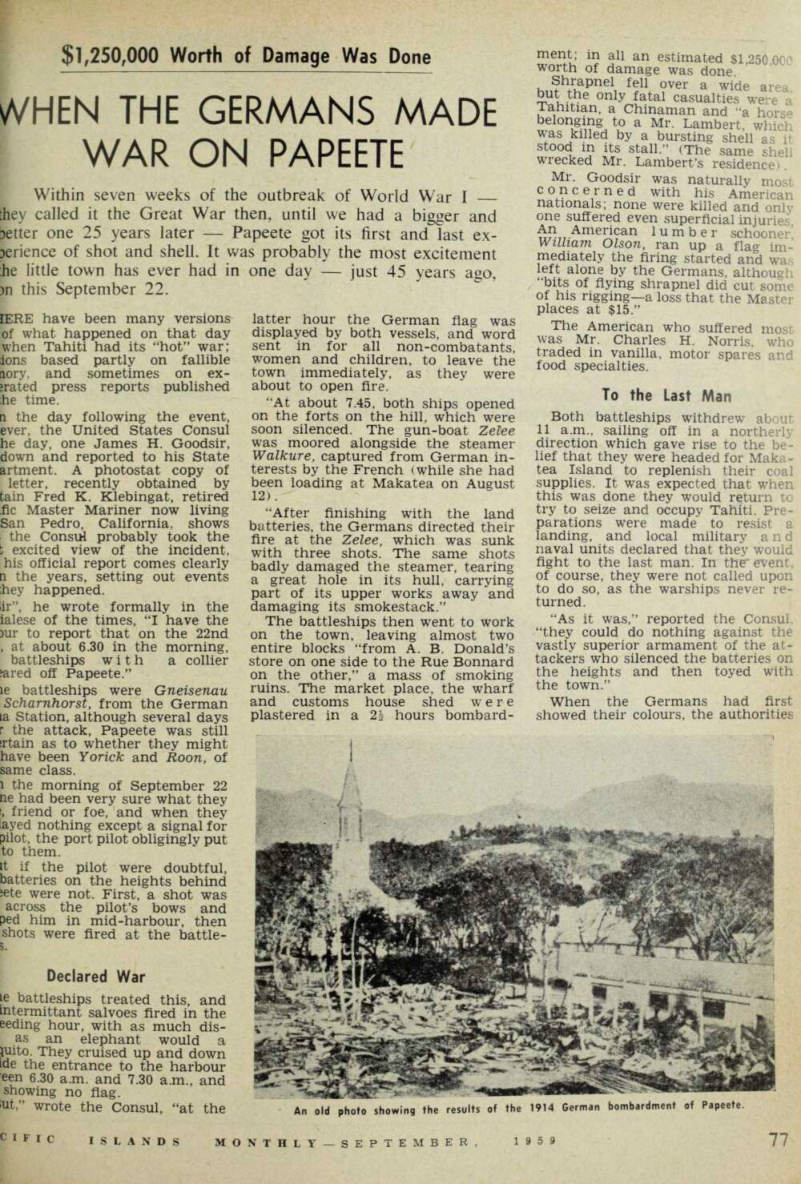
An old photo showing the results of the 1914 German bombardment of Papeete.
lediately fired the government es at Papeete to keep them from ing into enemy hands, and the [ supply that burned for some s later proved an embarrassment ;he defenders. The fires started ;he shells also took some putting The Germans Got Mad :o the credit of the men-of-war,” te the Consul, “be it said that ire they opened on the town, f. they both hoisted flags of e and apparently offered to ev, but no attention was paid their signals. After waiting a onable time for some boat to put from the town, with none so g. they opened fire. fc is my opinion that if the land eries had not opened upon the s in the first instance, perhaps would not have molested the rat all, although they were un itedly bent upon procuring a ily of coal here. As it happened • several shots had been atched in their direction they apparently goaded to action, s a result of the operations of morning, the steamer Saint cois, of the Comp&gnie Navale Dceanie, was sent to Suva, start yesterday afternoon, to spread alarm, and if possible to notify English and Japanese squadrons le Germans’ presence in these rs.” id in the end, before he had the ur to be, Sir, your obedient ser , the Consul indulged in a little speculation: he Germans who have been ned on Motu-Uta Island as al prisoners of war (although Governor will not specifically nate them as such) for the past ;h or five weeks, were yesterday transferred to the Colonial n from the island, and it is said they have been threatened with nary execution if the attack on ;own is renewed, hey are said to have attempted gnal the attacking ships from position on the island, which is the barrier reef, he Walkure, although badly •led, has been towed out to the and placed in a position for ng upon a re-appearance of the ships. aday all is calm in the port, •ugh business is temporarily mded, and the refugees v of day are rapidly returning to homes.” ■eisenau a,nd Scharnhorst never ned to Papeete. They sailed on ®et their end at the Battle of 'alkland Islands, after they had a at Easter Island to tak( rd some livestock as they ed for the Atlantic.