A Light Flashes for the Men
pp. 71-75 · Read in the full issue
Nem Bilong OI I No Ken Lus A Light Flashes for the Men Who "Saved the Pacific"
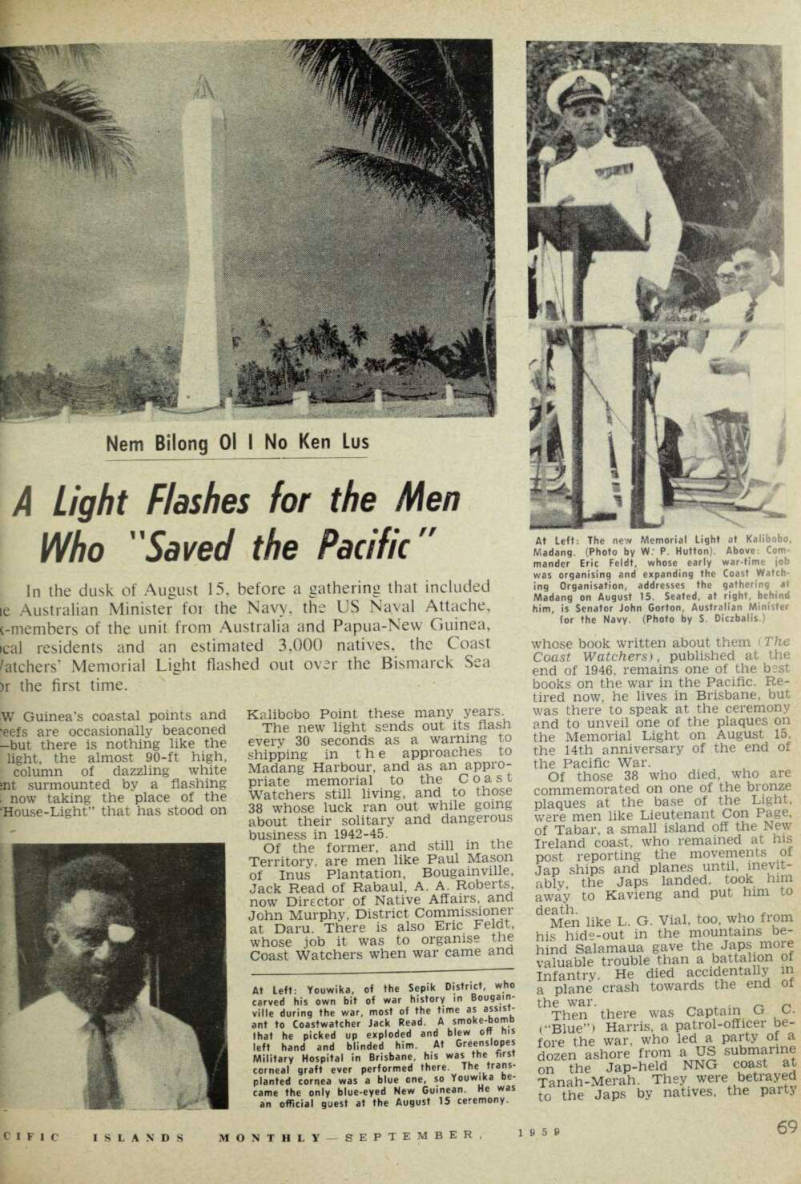
In the dusk of August 15, before a gathering that included ic Australian Minister for the Navy, the US Naval Attache, i-members of the unit from Australia and Papua-New Guinea, ical residents and an estimated 3,000 natives, the Coast Catchers’ Memorial Light flashed out over the Bismarck Sea )r the first time.
W Guinea’s coastal points and *eefs are occasionally beaconed —but there is nothing like the light, the almost 90-ft high, column of dazzling white ;nt surmounted by a flashing , now taking the place of the ‘House-Light” that has stood on
Kalibcbo Point these many years.
The new light sends out its flash every 30 seconds as a warning to shipping in the approaches to Madang Harbour, and as an appro priate memorial to the Coast Watchers still living, and to those 38 whose luck ran out while going about their solitary and dangerous business in 1942-45.
Of the former, and still m the Territory, are men like Paul Mason of Inus Plantation, Bougainville, Jack Read of Rabaul, A. A. Roberts, now Director of Native Affairs, and John Murphy, District Commissioner at Daru. There is also Eric Feldt, whose job it was to organise the Coast Watchers when war came and
whose book written about them ( The Coast Watchers ), published at the end of 1946, remains one of the best books on the war in the Pacific. Re tired now, he lives in Brisbane, but was there to speak at the ceremony and to unveil one of the plaques on the Memorial Light on August 15. the 14th anniversary of the end of the Pacific War.
Of those 38 who died, who are commemorated on one of the bronze plaques at the base of the Light, were men like Lieutenant Con Page, of Tabar. a small island off the New Ireland coast, who remained at his post reporting the movements of Jap ships and planes until, inevit ably, the Japs landed, took him away to Kavieng and put him to dc&tli Men like L. G. Vial, too, who from his hide-out in the mountains be hind Salamaua gave the Japs more valuable trouble than a battalion of Infantry. He died accidentally in a plane crash towards the end of the war. . . n Then there was Captain G c. (“Blue”) Harris, a patrol-officer be fore the war, who led a party of a dozen ashore from a US submarine on the Jap-held NNG coast at Tanah-Merah. They were betrayed to the Japs by natives, the part}
At Left: Youwika, of the Sepik District, who carved his own bit of war history in Bougain ville during the war, most of the time as assist ant to Coastwatcher Jack Read. A smoke-bomb that he picked up exploded and blew off his left hand and blinded him. At Greenslopes Military Hospital in Brisbane, his was the first corneal graft ever performed there. The trans planted cornea was a blue one, so Youwika be came the only blue-eyed New Guinean. He was an official guest at the August 15 ceremony.
At Left; The new Memorial Light at Kalibobo Madang. (Photo by W; P. Hutton). Above Com mander Eric Feldt, whose early war-time job was organising and expanding the Coast Watch ing Organisation, addresses the gathering a; Madang on August 15. Seated, at right, behind him, is Senator John Gorton, Australian Minister for the Navy. (Photo by S. Diczbalis.)
; in two and one-half eventually ped. But Harris’ half was at :ed by a Japanese unit equipped l machine guns and mortars within a few hours all were dead pt Harris, who was wounded.
Japs captured him, shoved him gainst a tree and when he would
mswer their questions, bayoneted
to death.
Names That Live Forever
Dr does the Light forget those 1 natives who made it possible the 'European Coast Watchers emain at their posts; Men like ogun Peta, now a MLC; Youwika, bearded veteran with one blue and that not his own; and Daik of New Britain, who died dw months back, full of years ;ervice and much honoured by Dpean and native. d commemorate the Coast chers’ native comrades there is pecial plaque on the Light in fin-English, the last sentence of zh says: “Nem bilong ol i no ken —the equivalent of “their names never be forgotten,” he frame work of the Coast idling Organisation existed in tralia, New Guinea and in the >mons, long before the outbreak World War 11. Men of all walks life, stationed in very remote is, formed the nucleus, but, as al in peace-time, money for the essary equipment to expand the nt service was not readily forth img. he outbreak of war in 1939 nged that, and before that year i ended, Eric Feldt, who was on RAN “emergency list,” but who n 1922 onwards had been an cer of the District Service De tment of the Mandated Territory New Guinea, was given the job Navy Staff Officer, Port Moresby, hs task was organising and ex iding the Coast Watching Organ :ion. By the end of 1940, most sonnel had been selected from ongst the planters, missionaries
and Administration officials living at strategic places covering the northern and no r t h-e astern approaches to Australia. Teleradios had been installed and their operators instructed in their use and in reporting what they saw.
By the time the Japanese came into the war in December, 1941, Coast Watchers, at posts from Manus to the Solomons, were ready. In early 1942, as the Japs swept south wards, they ceased being a civilian organisation and became part of the three Services.
They were a branch of the Allied Intelligence Bureau (AIB), and were usually referred to as the Coast Watchers, although Feldt himself had his own private code-word for them—Ferdinand.
Ferdinand the Bull was a char acter from a Walt Disney movie
cartoon of the time. According the story, he wasn’t keen on dir action or fighting Matadors in bid rings, but preferred to sit under tree and “sniff the pretty flower; The Coast Watchers didn’t ha v much time for smelling flowers; bi they kept under the trees and didn engage in direct action, either Their record and their contribu tion to the Allied cause in the S\ Pacific theatre of war is now matter of history. They receive praise from high places—notabl from the late Admiral Willie i (“Bull’’) Halsey, who command* the United States Third Fleet i the Pacific, and from Genen Douglas MacArthur.
Someone Still Watches
There were about 40 survivin Coast Watchers and 26 of tl
Page of Tabar, off New Ireland, who was [?]ded by the Japanese for his Coast Watch ing activities.
ives who had spent the hidden rs with them, at the ceremony August 15. It was probably the t get-together they had ever had. the nature of their war-time cs was strictly individual, a addition to the Coast Watchers, ually every European and native ag within walking or riding ;ance of Madang turned up to Australian Minister for the Navy, lator Gorton, turn the switch t lit the Light for the first time, 1 to hear the addresses of tradier D. M. Cleland, Admm ator of P-NG, and others, aptain I. H. McDonald, chair a of the Coast Watchers’ aiorial Committee, was present, 1 so was its honorary secretary, W. Brooksbank, who, until he red late 1957, was the civilian stant to the Director of Naval elligence and as such was the k-room boy who “mothered” the i,st Watchers. he United States was represented the ceremony by Captain C. M. ite, US Naval Attache in Aus ia —an appropriate choice as >tain White was commanding a adron of fighter planes on idalcanal in 1943.
he Coast Watchers’ Organisation
, of course, never been disbanded, is, said a Navy spokesman at Sang, on August 15, now more ;ient than ever—but who its per nel are, and where they are ioned, only the Navy knows, and ihese matters the Navy remains ery silent service.