Staggers At Edge Of Collapse
pp. 59-61 · Read in the full issue

Soekarno's Grab Wholesale Confiscation As Indonesia Staggers At Edge Of Collapse
Events moved fast in Indonesia (New Guinea’s nearest leighbour on the northwest) in August, bringing that country ery close now to complete economic collapse.
collapse comes —and competent observers do not see how it can be avoided —it will have two tanding results — There will be social and political loil, which may directly affect Territory of Papua and New lea.
The world’s supply of copra will fleeted. From 25 to 30 per cent. ;opra comes out of the East es. This supply already has uated considerably over the last years, according to changes in mesian conditions; and this in has affected world prices, iving failed completely to make Western Parliamentary system the rabble-rousing Soekarno a months ago. finally abolished esentative government, and as ed dictatorial powers.
Ee has called the set-up “guided ocracy”; but it is actually an y-backed dictatorship.) iereafter, the existing confusion me worse confounded, lere was social and political is. The administration was so t of money that it was virtually lysed. The Indonesian Rupiah, ih has been at a very low figure years, became virtually worth le only stable things in the whole •essed country were the in ries controlled by foreign private rprise. •itish and Dutch planting con s, and certain big Western oil ing companies, were allowed to operate. They really kept mesia going.
His "Guided Economy" lose whom the gods destroy they make mad. A form of madness ainly descended upon Soekarno his so-called Ministers, i mid-August, they issued a bs of “decrees’ which seem to b emanated from some asylum crazy economists. Summarised, le decrees provided— All notes of the face value of [) and 500 rupiahs were reduced ralue by 90 per cent.—to 10 per k. of their face value.
All bank deposits of over 25,000 iahs (about £2OO Australian) were :en; and the sums thus repre ted became a compulsory loan
to the Government. (Confiscation, in other words.) • A new foreign currency ex change of 45 rupiahs to one US dollar (making one rupiah worth about Australian) was “estab lished”. • The system of taxing exports was abolished, to be replaced by a system of direct taxes and import duties. • The State will cut, or postpone, certain expenditure. • There will be “guided savings” and “compulsory savings” schemes for Civil Servants, workers and farmers.
Panic immediately swept across the whole of the trading community in Indonesia. By August 24, most business establishments had closed, and riots were threatened. The
banks could not carry on.
On August 25, troops with rifles and bayonets at the ready were guarding the banks and the chief financial establishments against the clamouring mobs, who were trying
e something from the wreck, he week’s pay day arrived, the grew. The majority of em s could not withdraw money their banks in order to pay staffs. -Indonesian traders like i planters, oil and shipping nies, even Australia’s Qantas d their stocks of rupiahs or worthless, and suffered embarrassment, as well as Government then proceeded Ice “Government loans” to the s. at fixed rates of interest, f the funds they had seized ;hese same traders. :arno called this “guided ny”, and a logical develop of “guided democracy”, chants and traders generally no imagination to visualise esia’s crazy set-up as it was rly September. No one then what would happen next. But not seem possible that the rno administration could last longer. Communistic news > and organisations, which y support Soekarno, joined in meral attack on his devalua lolicy.
Danger to South Pacific our files show, this develop was consistently forecast by ournal ever since the West’s ary “statesmen” abandoned fetherlands and let Soekarno lis party loose on this vast, ountry and the helpless Dutch. ! Dutch of Indonesia have beaten and robbed on a scale before seen in a post-war tnent. Yet the Jap-led Indo is were losers in World War ad The Netherlands was one e Western victors.
The South Pacific’s particular interest in all this lies in the fact that, when this Soekarno dictatorship (maintained at present by what is called “the army”) finally collapses, three organised communities will be ready to step in and perhaps take control. They are the Moslem community, the Communist Party and the Chinese (who number about 3 million in a country of 83 million).
Either the Moslems or the Communists may take over The Chinese
unlike 6 the’stogapore CWneTe co£
SiKw y er haV6 n6Ver S ° USht If either Communists or Chinese get control of this vitally important land bridge between Asia and Australia, it will be an event of much importance to the South Pacific.
r nn L c Paiorf
'-Ooks Rcjcct
MJccinnaru Hnnta
iVilSSlOnary vJUOTd
nptitinn that snmp snrt nf our > A petition mat some sort of quo,-. system be established on the entr of religious missionaries to the Coo; ; Islands was firmly rejected by the Cook Islands Legislative Assembly i n July. Only the proposer and. seconder of the motion supported it.
A select committee, set up to look Z P ttos, y was very r m B uch against
°PM°n and.would contra;
yene 18
tion of Human Rights. The com mittee recommended against the move.
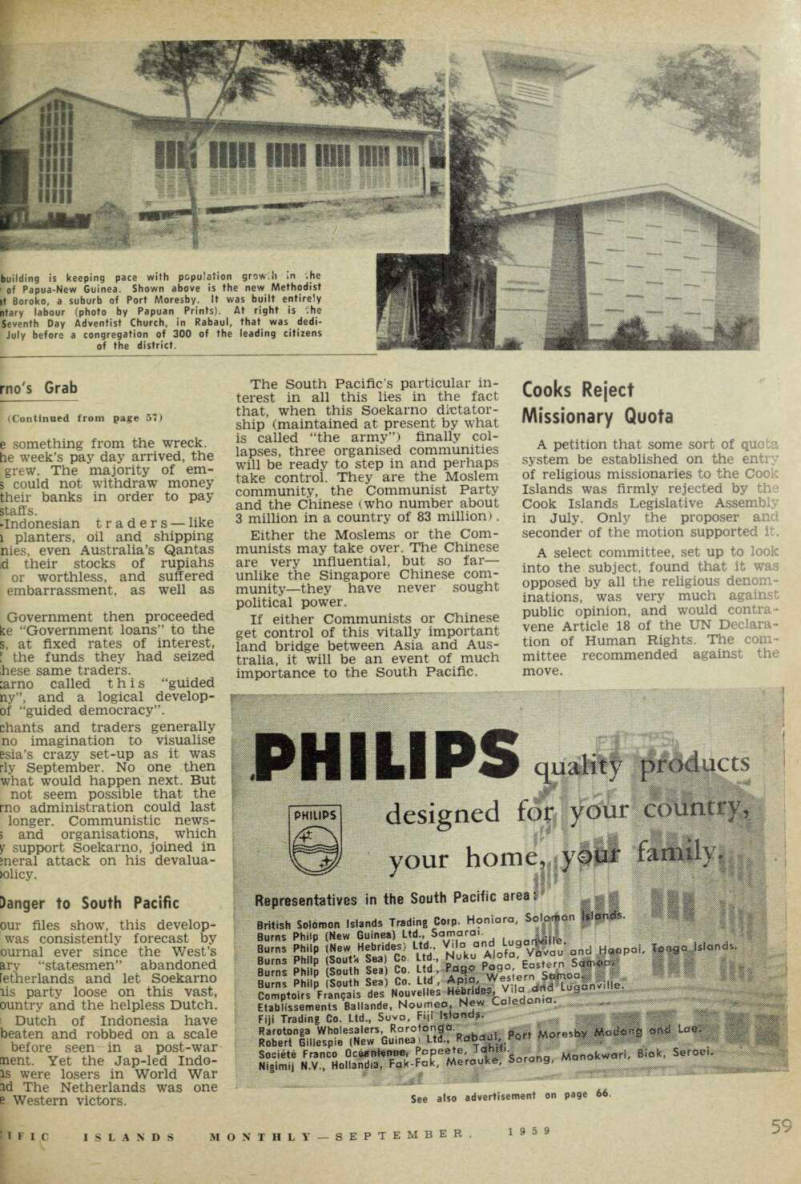
building is keeping pace with population growth in the [?] of Papua-New Guinea. Shown above is the new Methodist [?]t Boroko, a suburb of Port Moresby. It was built entirely [?]ntary labour (photo by Papuan Prints). At right is the Seventh Day Adventist Church, in Rabaul, that was dedi [?] July before a congregation of 300 of the leading citizens of the district.