Commission Winds Up Its
pp. 49-51 · Read in the full issue

No Challenge to Fijian Rights
Investigations In Fiji
The Bums Commission which has spent several weeks : close investigation into how Fiji’s growing population should 'an for its future, will be ready to pack up and go home within .e next few days. The next move is then over to the British jcretary of State for the Colonies.
E Commission, headed by Sir dan Burns, GCMG, has in estigated population, racial and opment problems of Fiji. It is ;ted that it will have completed ork in the Colony in September will leave for London via the ;d States. e Commission will report in de -0 the British Secretary of State he Colonies; and the future of depends largely on the nature le recommendations made by Commission, and the extent to 1 they are accepted and im ented. e primary problem with which Jommission is dealing is that of ding, within Fiji, means of nance for the increasing popu i of Fijians (145,000) and Indians )00). e problem is complicated by fact that Britain, under the of Cession of 1874, is pledged rotect the land rights of the enous people; while the Indian e (who arrived in Fiji long the Deed of Cession) are •ally without land or land s. ere has been no move by ,ns to challenge the funda al land rights of the Fijians; my formal move by the Fijians ny the use of land to Indians, acute official embarrassment lie in the facts that there )t enough land available for m use; and that a lot of Fijian for one reason and another, iked up and out of use. e following, which gives a good ation of the nature of the ems before the Commission, is i from an admirable summary 'ommission proceedings issued le Fiji Public Relations Office ugust 26:
Their Fundamental Rights
e of the Indian representatives, A. I. N. Deoki, contended that as the Deed of Cession was a je to Fijians by Britain, so was al correspondence between Fiji England, and England and i, a pledge that Indians who
had settled in Fiji should be regarded as permanent colonists.
Another Indian representative, Mr. Hari Charan, complained that it was difficult for Indians to acquire land. Most of the freehold land, he said, belonged to the Europeans, the Fijians, or to the Crown. Very little freehold land was held by Indians, and they experienced difficulty in acquiring leasehold land for cultivation.
One witness, Mr. H. E. Snell, contended that if there was land hunger
a board, committee or individual should have power to go to the owner and say: “You are not using your land to the best public advantage. You must use it, or we for all vou” ange that “ shaU be Mr. Snell emphasised: “Nobody in his senses has ever suggested that ownership of the land should be taken from the present ownersin particular, the Fijians. It is the in an area where land was unused the Native Land Trust Board. If
use of the land which should be taken from them.”
Fijian 'Alarm'
Semesa Sikivou, who is a Fijian representative on the Legislative Council, appeared before the Com mission as the spokesman of the Fijian Teachers’ Association. He de clared : “We were rather alarmed when we read a report that the Indians were claiming to be considered for ownership of land in Fiji. This is probably the first occasion that this has been brought up, and we don’t like it.”
Asked if he thought it right that land which could be used should be left unproductive, Semesa re plied: “We have never for one moment held that view.”
He said the Association’s views were that land should be opened up by the construction of feeder roads and added: “People who are land-hungry are only after the land which is readily accessible.
“The Fijian people have agreed to let land not required for their immediate use to be put in trust to
that land is opened up. we would hke people to make application to useit- . /.nnstnirt roads “But we construct roads, The only thing we- can do m Questl‘o r nerabo™t la a le ' suggestion that loansor grants shOTldbe made to the FiJums by ernment said that tne Fijian found it very difficult to gei ca PJ tal ; n a Q bih n snokesman for Mr. A. G. Sahib, a spokesman
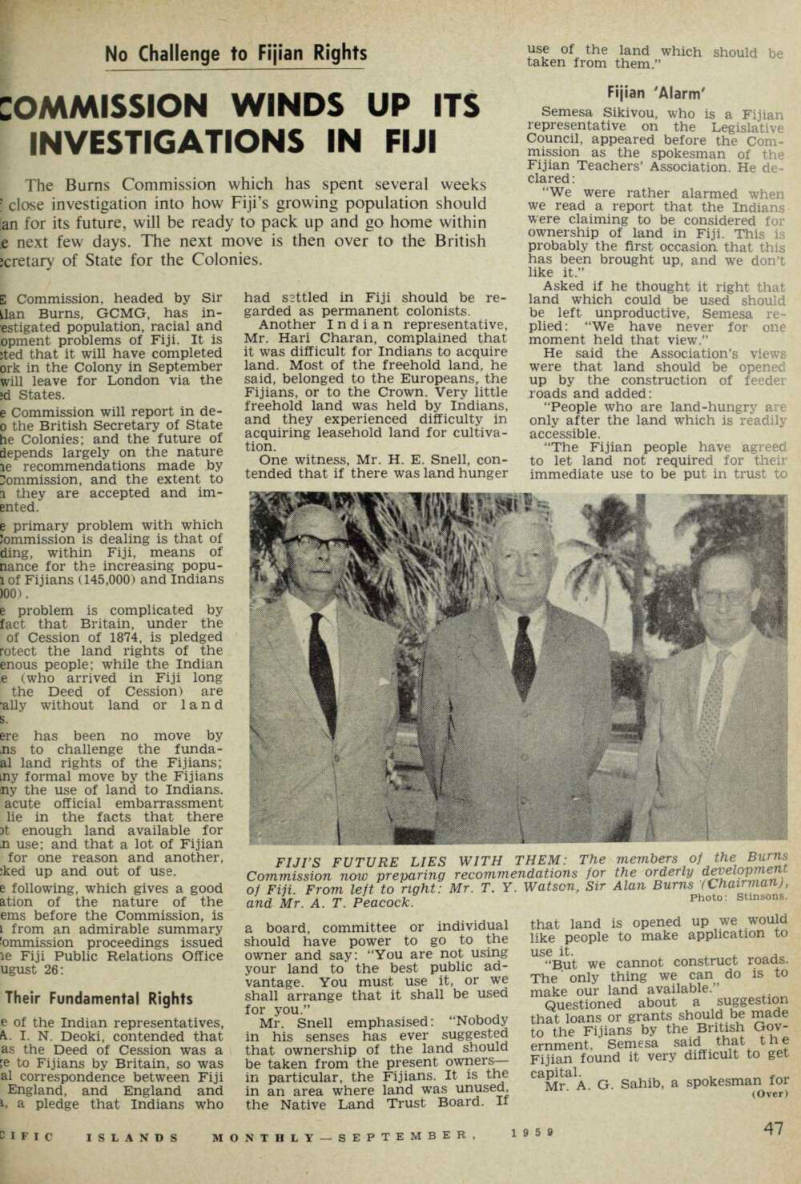
FIJI'S FUTURE LIES WITH THEM: The members of the Burns Commission now preparing recommendations for the orderly development of Fiji. From left to right: Mr. T. Y. Watson, Sir Alan Bums (Chairman), and Mr. A. T. Peacock. photo: stinsons.
Suva Muslim League, told the nission that if there was a r distribution of land there i be no population problems.
: iji Can Feed More People
, A. N. Jayant, who led a dele ii from the Education Workers’ ty, urged that there should be settlement schemes, with a in amount of help in the way ipital, for students who had leted agricultural courses. He I: msidering the population of ries like Java or Japan on a quare mile basis, we feel that lan cater for a bigger popula ;han we have at present.”
Editorial Commentary: "What ens in Fiji After Burns Re ?"