Follow-Up Visit
pp. 39-41 · Read in the full issue

Advice for NG Coffee Producers Hawaii Expert Is Back On Follow-Up Visit
Considerable changes have taken place in the New Guinea [fee industry since the first visit there of Hawaiian coffee pert, Professor Y. Baron Goto, 3i years ago. His second it, which will commence on September 29, will be interesting r him and, without any doubt, again profitable for the Terri ry’s coffee producers whom he will advise.
GOTO is Senior Professor of griculture and Director of the gricultural Extension Service j University of Hawaii. Prime • in his second NG visit, as in jst, is Mr. R. A. Colyer, of r Watson Pty. Ltd. and Colyer >n (NG) Ltd. The expenses of ioto’s current visit are being i by the Colyer Watson com s and by the Bank of New . Wales. i first visit by the professor sponsored by Colyer Watson Ltd., the Bank of NSW, Mr. hinting, the Commonwealth and the Highland Farmers’
Settlers’ Association.
Sydney, in early September, R. A. Colyer said that this d visit of the Hawaiian expert st a logical development of the Special stress will be placed, is visit, on processing coffee — e course of which, of course, rfect crop of beans can be d into a very inferior finished ict. *ing his visit in early 1956, Dr. visited 87 NG coffee planta the majority of which were not in full bearing. In the ig year 1955-56, Papua-New ea was exporting at the rale of >ns of coffee p.a., all but about 10 of it from the New Guinea side.
It is expected that production this year will be about 900 tons; and next year 1,350 tons, after which, on present plantings, the production should remain about static —if some thing is not done to boost yield.
Highlands Altered the Picture Although there was some interest in coffee growing before the war, it was regarded mostly as an agricul tural alternative to copra during its decade of low prices. As an altern ative to copra, this coffee had to be the low-lands, or Robusta, type.
However, during the middle and late 1930’5, a flourishing coffee estate, planted up from Arabica seed obtained from the Blue Mountains of Jamaica was estab lished at Wau, by the late C. L. B.
Wilde. In 1940-41, 71 tons of coffee of all varieties were exported from the Mandated Territory.
Then the war came and during it, about 80 per cent, of the low lands coffee was destroyed.
After the war the availability of the Highlands, which had been closed to European settlement since their discovery in 1933, put a dif ferent complexion on NG coffee growing. But in the early stages, it was largely a matter of trial and error.
The climate of the Highlands at elevations between 5,000 feet and 6,500 feet, was believed to be similar to that of the coffee-producing areas of East Africa: the soil seemed reasonably fertile; there was the example of the Wau coffee plant ation, at an elevation of 3,500 feet, which turned out a promising pro duct.
Those were the known factors. In dividuals who had obtained leases of agricultural blocks in the Eastern and Western Highlands just had to find out the unknown factors of coffee cultivation for themselves.
Mostly they learned about it from books and pamphlets, and by pool ing experience.
One of the things to do, accord ing to the books, was to protect coffee with shade trees, but some new planters did not wait for the shade trees to grow but planted the young coffee seedlings without, with mixed results.
Tricks of the Trade
That was just one of the tricks, and since those early days, of course, a great deal has been learnt about shade —that the amount desirable varies with altitude, prevailing cloud, the age and productivity of the tree.
In other branches of coffee culture, also, the new planters were seeking knowledge. Not much help was available from the P-NG De partment of Agriculture. It had ex perts on coconuts and cocoa and other lowland products, but no one in the Department knew much more about coffee than the planters them selves. (In recent years the Depart ment has sent several officers abroard to study coffee cultivation.) That was generally the situation at the end of 1955, and it was at this critical stage that Mr. R. A.
Colyer was able to introduce Dr.
Goto to the NG scene.
Mr. Colyer had taken a personal interest in the infant coffee industry, just as previously he had taken an interest in the cocoa industry and the abortive attempt to establish kenaf-growing in the Territpry as an alternative fibre to Indian jute upon which Australia depended for raw
Dr. Goto will arrive in Lae by air on September 29, and will proceed, on the same day, direct to Goroka, Eastern Highlands.
During his three weeks in the Territory, he will visit Kainantu, Wahgi Valley, Banz, Minj Mt.
Hagen and Wau. If he has time he will also visit the coffee growing area in the mountains behind Finschhafen, where native planters have planted Arabica. . .
Throughout his visit , Dr. Goto will be accompanied by Mr R. A.
Colyer, and Mr. R. I. Oatley of Colyer Watson Pty. Ltd., Sydney office.
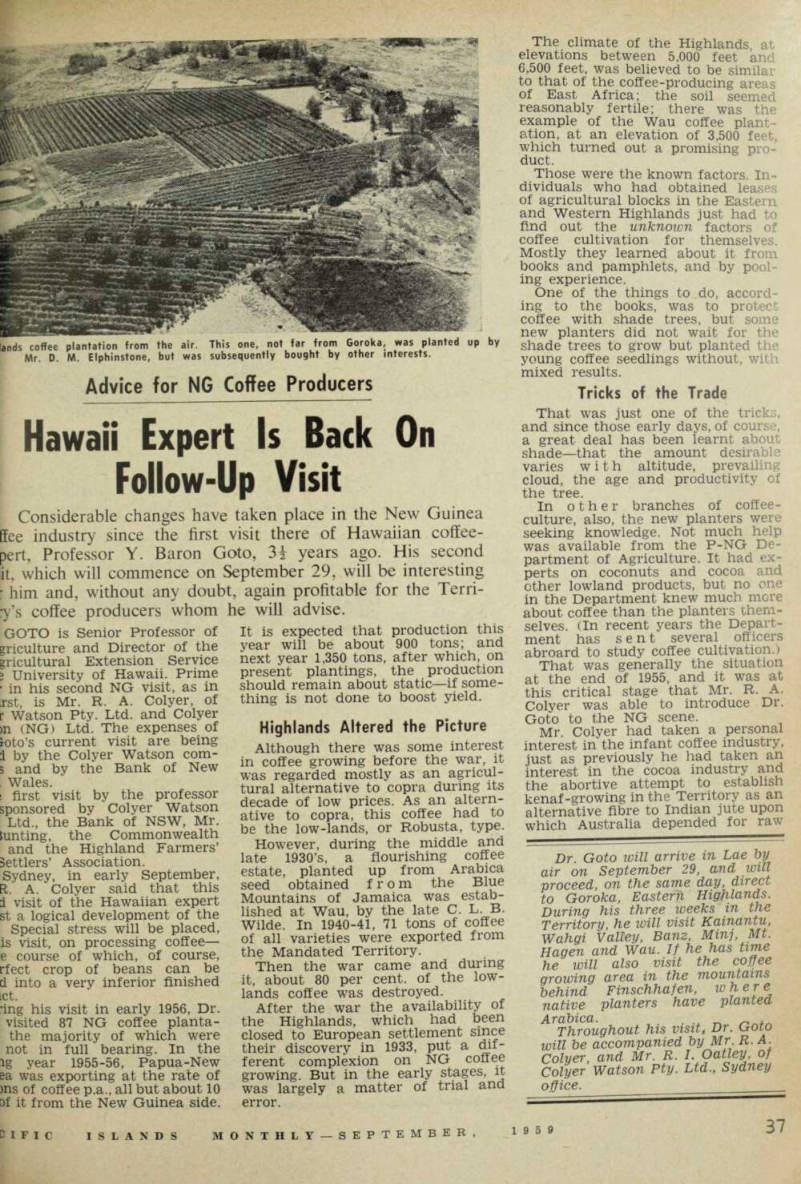
lands coffee plantation from the air. This one, not far from Goroka, was planted up by Mr. D. M. Elphinstone, but was subsequently bought by other interests.
•rial for her huge requirements ags, sacks and wool-packs, i was proved that kenaf —a -stemmed plant related to the cus _would grow successfully in ia and New Guinea and that ibre from it was equally as good ate for sacks and wool-packs. he time the kenaf experiments ed. the price of jute was ex ant; but as soon as it was >d that kenaf could be produced sssfully in the Territory, the of jute came down very tly—to such an extent that it obvious that the infant kenaf stry was going to need some ralian Government protection, loubt through pressure from l and Pakistan, which buy - Australian goods, this pro m was never forthcoming, so p-NG industry was allowed to As far as Australia was con ;d. of course, it didn’t die in It served its purpose by ing the price of jute back to nable levels.] . Colyer felt that the coffee ws of NG would be helped by t advice, and on one of his to the United States was able intact, through business asso 5, Professor Goto, of Hawaii, a nised world authority on coffee its cultivation. hough he was only three weeks ie Territory on that first visit, observations that Dr. Goto i then, the advice and demon ons he gave, have steadily borne since. There are, of course, isual sceptics who never believe the experts say, and these have their own way; but those ers who have followed the Goto of reasoning in the last three , are now producing good coffee.
ligh Yield Now Important
e of the most important aspects ultivation that he discussed planters in 1956 was the matter sing fertiliser. Fertiliser was volutionary thought to most ;ers then —and still is to a cer extent, in view of the fact that landed-cost at Goroka, of the •nitiogen content fertiliser im d from Japan, is £125 per ton ; planters who have tried it out found that the ratio between iser application and yield can >e ignored. now can be regarded as a er of book-keeping: Planters initially felt that they could ifford to use fertiliser, now are ng that they cannot afford not e world has moved on since Dr. was in New Guinea last. World e prices have fallen, making it ! important than ever to get utmost yield per acre; and so is New Guinea is concerned, all plantations that he saw on his visit now have come into pro ion. Planters, therefore, now ; to know not only how to grow
good coffee, but how to process it to please the merchants at point of consumption.
Since his 1956 visit to the Terri tory, Dr. Goto has visited other coffee growing countries, including South America, and planters in NG can expect to learn from him the latest overseas techniques in culti vation.
Before he leaves for New Guinea from Sydney on September 28. Dr.
Goto will spend a few days in Northern NSW examining native Macadamia stands. This so-called “Australian bush-nut” has been cultivated extensively in Hawaii, where agricultural experts have managed, by grafting, to develop a soft-shelled type.
The nut is neglected in Australia, mainly because its exceedingly hard shell almost defies domestic use.
What Professor Goto’s interest is in the natural stands of Macadamia nuts in Northern NSW is not clear, but if he could show someone how to produce the soft-shelled, Hawaiian variety it could be the basis of a new domestic industry.
It has been suggested that he might also look at New Guinea’s Galip nut (called also Narli nut in some of the other SW Pacific teritories), while he is in the Territory. The Galip also is a forest tree, and like the Macadamia has excellent eat ing qualities but in its natural state is cursed by a very hard shell.