The Editors' Mailbag
pp. 29-31 · Read in the full issue
dais Destroyed
Hagen Memorial
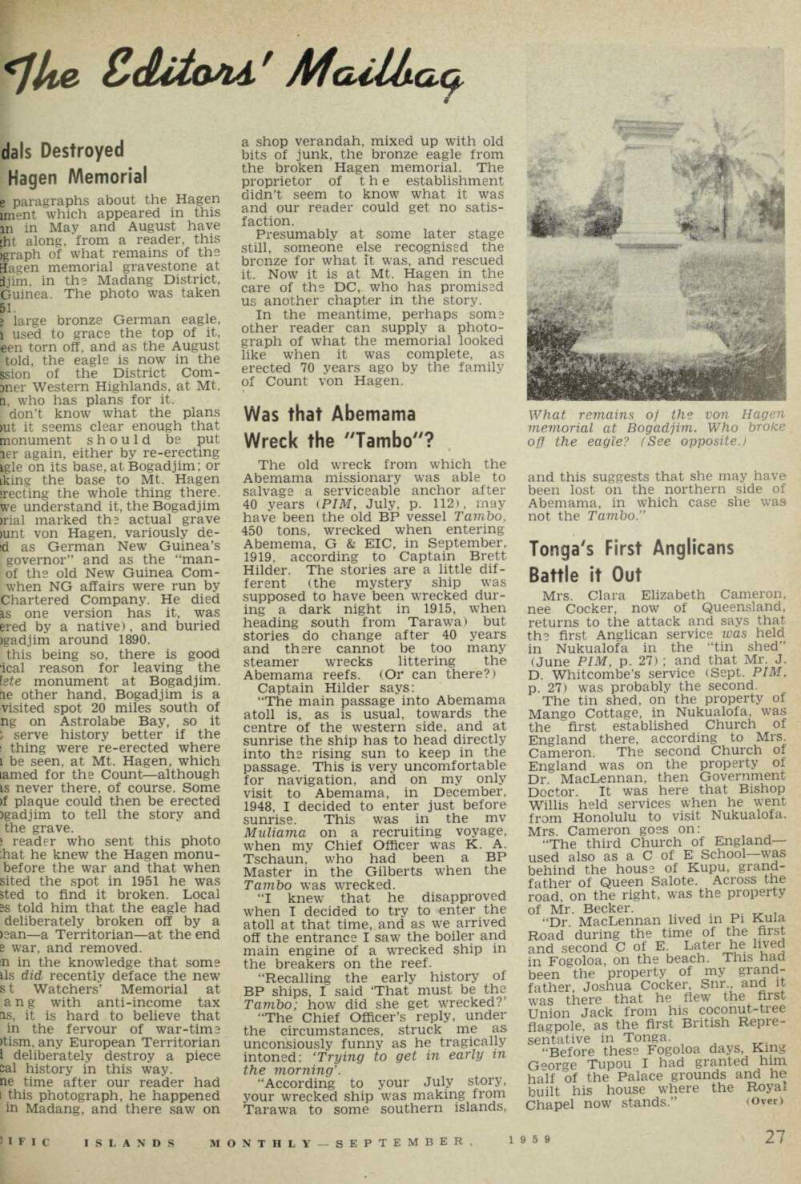
e paragraphs about the Hagen unent which appeared in this in in May and August have fht along, from a reader, this >graph of what remains of the Hagen memorial gravestone at djim, in the Madang District, Guinea. The photo was taken 51. \ large bronze German eagle, i used to grace the top of it, een torn off, and as the August told, the eagle is now in the ssion of the District Com jner Western Highlands, at Mt. q. who has plans for it. don’t know what the plans >ut it seems clear enough that monument should be put ler again, either by re-erecting igle on its base, at Bogadjim; or iking the base to Mt. Hagen erecting the whole thing there, we understand it, the Bogadjim >rial marked the actual grave >unt von Hagen, variously de id as German New Guinea’s ; governor” and as the “man of the old New Guinea Com when NG affairs were run by Chartered Company. He died is one version has it, was ered by a native), and buried )gadjim around 1890. this being so, there is good “ical reason for leaving the lete monument at Bogadjim. tie other hand, Bogadjim is a visited spot 20 miles south of ng on Astrolabe Bay, so it ) serve history better if the i thing were re-erected where i be seen, at Mt. Hagen, which tamed for the Count—although is never there, of course. Some )f plaque could then be erected igadjim to tell the story and the grave. ; reader who sent this photo ;hat he knew the Hagen monu before the war and that when sited the spot in 1951 he was sted to find it broken. Local es told him that the eagle had deliberately broken off by a >ean —a Territorian—at the end e war, and removed, n in the knowledge that some ils did recently deface the new s t Watchers’ Memorial at an g with anti-income tax as, it is hard to believe that in the fervour of war-time )tism, any European Territorian I deliberately destroy a piece eal history in this way. tie time after our reader had i this photograph, he happened in Madang, and there saw on
a shop verandah, mixed up with old bits of junk, the bronze eagle from the broken Hagen memorial. The proprietor of the establishment didn’t seem to know what it was and our reader could get no satis faction.
Presumably at some later stage still, someone else recognised the bronze for what it was, and rescued it. Now it is at Mt. Hagen in the care of the DC, who has promised us another chapter in the story.
In the meantime, perhaps some other reader can supply a photo graph of what the memorial looked like when it was complete, as erected 70 years ago by the family of Count von Hagen.
Was that Abemama
Wreck the "Tambo"?
The old wreck from which the Abemama missionary was able to salvage a serviceable anchor after 40 years (PIM, July, p. 112), may have been the old BP vessel Tambo, 450 tons, wrecked when entering Abemema, G & EIC, in September, 1919, according to Captain Brett Hilder. The stories are a little dif ferent (the mystery ship was supposed to have been wrecked dur ing a dark night in 1915, when heading south from Tarawa) but stories do change after 40 years and there cannot be too many steamer wrecks littering the Abemama reefs. (Or can there?) Captain Hilder says; “The main passage into Abemama atoll is, as is usual, towards the centre of the western side, and at sunrise the ship has to head directly into the rising sun to keep in the passage. This is very uncomfortable for navigation, and on my only visit to Abemama, in December, 1948, I decided to enter just before sunrise. This was in the mv Muliama on a recruiting voyage, when my Chief Officer was K. A.
Tschaun, who had been a BP Master in the Gilberts when the Tambo was wrecked.
“I knew that he disapproved when I decided to try to enter the atoll at that time,, and as we arrived off the entrance I saw the boiler and main engine of a wrecked ship in the breakers on the reef.
“Recalling the early history of BP ships, I said ‘That must be the Tambo; how did she get wrecked?’
“The Chief Officer’s reply, under the circumstances, struck me as unconsiously funny as he tragically intoned: ‘Trying to get in early in the morning “According to your July story, your wrecked ship was making from Tarawa to some southern islands,
and this suggests that she may have been lost on the northern side of Abemama, in which case she was not the Tambo.”
Tonga's First Anglicans
Battle it Out
Mrs. Clara Elizabeth Cameron, nee Cocker, now of Queensland, returns to the attack and says that the first Anglican service was held in Nukualofa in the “tin shed” (June PIM, p. 27) ; and that Mr. J.
D. Whitcombe’s service (Sept. PIM, p. 27) was probably the second.
The tin shed, on the property of Mango Cottage, in Nukualofa, was the first established Church of England there, according to Mrs.
Cameron. The second Church of England was on the property of Dr MacLennan, then Government Doctor. It was here that Bishop Willis held services when he went from Honolulu to visit Nukualofa.
Mrs. Cameron goes on: “The third Church of England used also as a C of E School was behind the house of Kupu, grand father of Queen Salote. Across the road, on the right, was the property of Mr. Becker. .
“Dr. MacLennan lived in Pi Kula Road during the time of the first and second C of E. Later he lived in Fogoloa, on the beach. This had been the property of my grand father, Joshua Cocker, Snr., and it was there that he flew the first Union Jack from his coconut-tree flagpole, as the first British Repre sentative in Tonga.
“Before these Fogoloa days, King George Tupou I had granted him half of the Palace grounds and he built his house where the Royal Chapel now stands.” (Over)
What remains of the von Hagen memorial at Bogadjim. Who broke off the eagle? (See opposite.)
an Emma's Store
Ng Bop
. J. Bryan, of Rere Plantation, ialcanal, BSIP, corroborates Tolala had to say about the tebaul store, a picture of which ired in the July and August ?: Originally Queen Emma myth’s establishment, it ended 5 the Rabaul Times office and blasted to pieces by Allied ers during World War 11. additional piece of informa from Mr. Bryan is that dur the German days, the upper p was used for the prepara and packing of bird-of lise, goura pigeon and osprey BS. ere has been no export of plumes since those days ough there probably is a r trade in them now than to supply natives with bigger better head-dresses) but it jommon talk in the Territory ;en the wars, that some of the German plantations were ed up on the proceeds of
of-paradise exports.
Hat That
n't Wally's
>■ Jan Croft, who has, in recent hs, been in the throes of fer from Daru, Papua, to New Guinea, returns to the ment controversies which we n March. She writes: ; first Mrs. Maidment did die aru Island, sometime in 1927, Wally, who died a few months > buried alongside her. She did, ding to the present Mrs. Maid , suffer agony with a skin com t, as Mr. Nixonwestwood de
scribed; a remedy was suggested and tried; she did go to Australia for treatment; but did most definitely return and died in Daru, of black water! I have a photograph of her grave and one also showing Wally’s grave alongside.
Now to Wally’s topper (also de scribed in March issue, page 87). I can only think that there must have been two hats although the one discovered amongst Wally’s possessions, at his death, I have now been told by Lucy Maidment, belonged to her father and was worn by him at his wedding. Lucy brought it with her to Papua on the occasion of her marriage to Wally at the Tamate Chalmers Memorial Church.
It seems that the other “hat” was a bowler and was used for more purposes than was intended, but it certainly wasn’t the one bought at the Exhibition in Sydney in 1893.
Perhaps it would be interesting to know where the “other” is today?
The “topper” is in an excellent state of preservation and in the same box in which it was purchased.
Over to you Mr. Nixonwestwood!