P-NG Taxpayers 'Boycott'
pp. 21-147 · Read in the full issue
[?]er Demonstration Against Mr. Hasluck P-NG Taxpayers 'Boycott' The Leg. Council
In mid-September, the Papua-New Guinea Tax Rebellion active on three fronts: Payments of the new “provisional” assessments, brought into operation from August 1, were being made under formal protest.
A large section of the voters had “boycotted” the Legis lative Council in the by-elections.
A formal challenge to the validity of the Tax Ordinance and the Papua and New Guinea Act was before the High Court, awaiting a hearing by the Full Bench.
eptember 12, in the Papua 1 NG Islands electorates, a stantial majority of the expressed their disapproval Legislative Council, in its form by supporting can pledged—if elected —to follow ample of Messrs. Dudley [an Downs and E. A. James, ;ign. (See figures below.) a strong anti-Hasluck vote, neans more confusion in the ;ive Council, and more em inent for Canberra, ise Territorian opinion split on the wisdom of actually ing the by-elections (caused e resignation of elected rs James, Dudley Jones and in protest against Minister t’s methods), pro-Legco ites were nominated in and New Guinea Islands.
ott of Legislative Council
;upon the Taxpayers’ As ns nominated against them ites who were pledged to e the boycott—i.e., to resign touncil, if called upon. ; were strongly-worded gns in both areas—and some ss, especially in the Rabaul contests, such as they were, finally to settle down as a sluck and anti-Hasluck by-elections took place on ber 12, and (with postal votes counted) they resulted:
Papua
, not pledged to resign 205 Sanders (Taxpayers’ As tion, and pledged to i, if requested) .. .. .. 394
Ew Guinea Islands
Thomas, not pledged to i 54 Shipper (Taxpayers’ As tion, and pledged to n, if requested) 367
New Guinea Mainland
Sydney Barker, elected un opposed. (After nominating, he gave the Taxpayers’ Association his pledge of resignation, if required, so no one was nominated against him.) No one was nominated when nomina tions were first called for, on August 4.
Mr. Barker’s nomination arrived four minutes late, and was shut out. Nomina tions again were called, for September 1.
This time, Mr. Barker got in early; and, on September 1, made his pledge to the Taxpayers.
Appeal to High Court
The application to the High Court of Australia to declare the Taxa tion Ordinances invalid on a number of grounds (one being the unsoundness of the Papua and New Guinea Act, under which the Legislative Council is constituted) made by Mr. M. W. Fishwick, of Rabaul, on behalf of the New Guinea Taxpayers’ Association, had not come up for hearing by Sep tember 14 very much to the surprise of the persons primarily concerned.
The application first came before Mr. Justice Taylor in the High Court in Sydney on July 30, and wa adjourned until August 4; and the Judge then decided to refer it to the Full Bench of the Court.
It was known that the Attorney- General (Sir Garfield Barwick) an eminent authority on constitutional law, wished to have the Act (long a subject of criticism and doubt) finally tested.
It was authoritatively stated then that the matter would probably come before the Full Bench on August 17, 18, or 19. ■ After three weeks had passed, without a hearing, reports began to circulate in Sydney early in September that there had been “interesting” exchanges between certain Departments in Canberra (where Mr. Hasluck —see elsewhere
—was fighting for his Ministerial life) ; and that it was unlikely that the High Court would reach this particular application before the Sydney Session closed late in Sep tember.
That meant either (a) trans ferring the application to another State, or (b) awaiting the return of the Full Bench to Sydney about December.
Hasluck and Parliament Although the Territorians, in June, July and August, had dpne everything short of physical violence—to resist the procedures of Minister Hasluck, and to demon strate 1 their lack of confidence in him Members of Australia’s Parlia ment remained mostly indifferent.
The Australian newspapers re fused to report the Tax Rebellion (see article on page 43), and so the politicians ignored it. (Over)
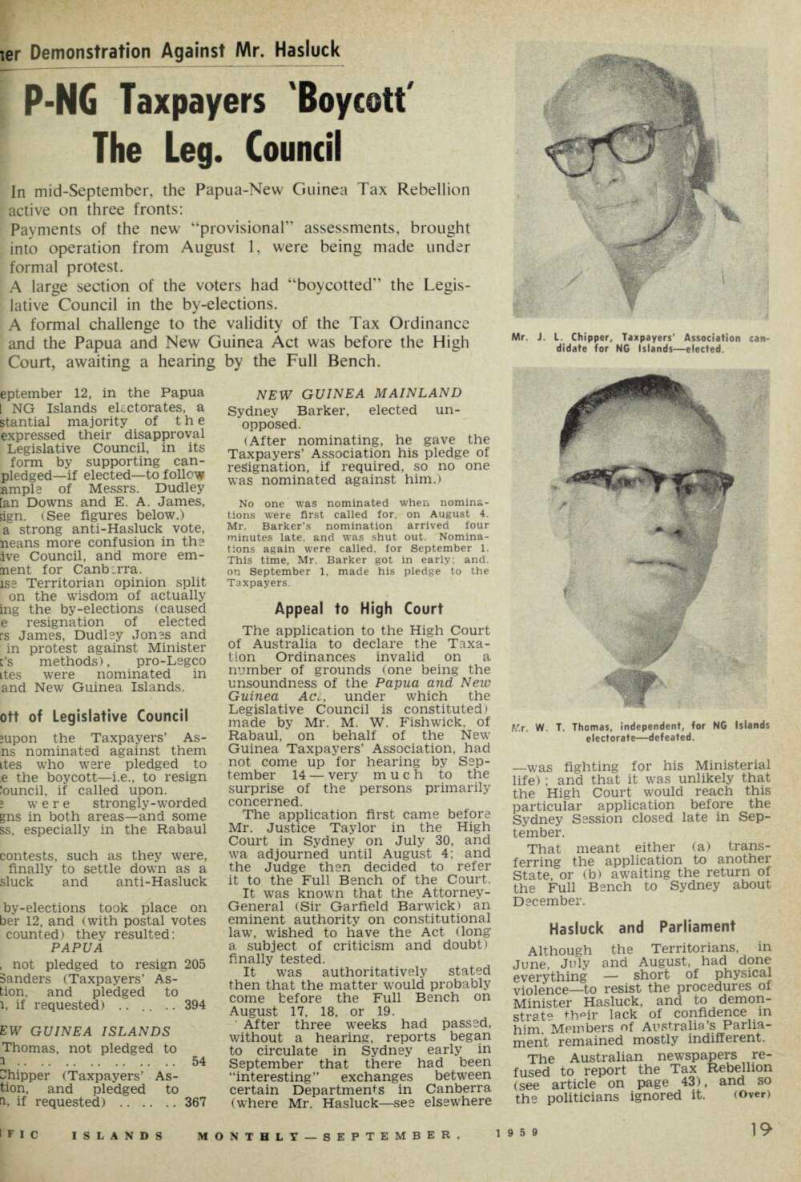
Mr. J. L. Chipper, Taxpayers' Association can didate for NG Islands—elected.
Mr. W. T. Thomas, independent, for NG Islands electorate —defeated.
Only two members, Messrs.
Wheeler and McColm (see this page) spoke up for the oppressed Terrltorians; and they got precisely nowhere.
Behind the scenes, out of the public sight, there were demands that “Hasluck should be shifted out of that portfolio before the situa tion gets worse”.
But Mr. Hasluck has staunch friends in Parliament, and they rallied to his support. So far, the Prime Minister has refused even to consider the challenge to Mr.
Hasluck’s administration.
Mr. Hasluck has replied to the few Australian protests on P-NG conditions, by saying that the tax, to which the Territorians object, is a low and a fair tax. He says nothing of the real causes of the Tax Rebellion.
The Canberra plan is to play down and ignore the Tax Rebellion, so that it will die of inanition— and, in this, Canberra has been supported by the newpsapers.
That plan probably would have succeeded, had it not been for the initiative of Mr. Dudley Jones and Mr. Fish wick in getting the con stitutional challenge before the High Court.
But the slowness of the High Court in hearing the application could defeat that move by the Taxpayers.
Mr. Hasluck remains high in the saddle.
Tax Collectors are at Work A factor which may defeat Canberra’s plan to let the Tax Rebellion die (by ignoring it) is the activity of Treasurer Reeve’s tax-collecting machine, which came full-blooded into operation on August 1.
From that moment, employers were compelled to make Pay-As- You-Earn deductions from all tax able wages and salaries —and the people generally were brought suddenly to full realisation of what had happened.
The truth of the Taxpayers’ claim that it was a half-boiled taxation scheme, framed and put into opera tion without proper thought and preparation, was brought home to them.
Employers had no tax-gathering machinery ready. Employees suddenly found part of their wages taken away, without any sign of compensation in the shape of higher living costs.
Canberra, thinking that to ignore the Tax Rebellion would kill it, should have been listening in in Papua and New Guinea in August, when the first taxes were grabbed from pay-envelopes.
The by-elections of September 12 came opportunely. All those resent ful taxpayers had a vote!
Public Service Resentment
The Public Service Association, P-NG’s largest body of organised
workers, ranged itself originally be side the Taxpayers’ Associations in resistance to Mr. Hasluck’s methods of introducing income tax. It wisely kept out of the constitutional fight that developed later in Legislative Council and the Supreme Court.
But soon as the tax-machine began to operate, in August, the public servants individually, and as a body, gave tongue vigorously—and with good reason.
The Minister and his mouth pieces have argued that the public servants would get the benefit of reduced living costs, through abolition of import and export taxes.
That is complete poppycock.
There is no reduction in living costs and can be none until merchants’ stocks are cleared, if then.
The bureaucrats, knowing this, probably will try to enforce price fixing, and start another row.
This tax system follows the Aus tralian pattern, and all sorts of privileges—like free housing, and messing allowances—now are being assessed on an annual value, for tax. The public servants have not taken kindly to this.
They have passed a vote of no confidence in the Minister (see page 45) and they are demanding immediate increases in salaries of sums up to £3OO per annum.
The worst feature probably is that the tax has put a blanket discouragement upon recruiting for the P-NG services.
Unemployment and Theft
The impact of income tax is making worse the already serious native unemployment problem in Port Moresby, the Central District Officer, Mr. D. Marsh, reported on August 24. Many Port Moresby people were sacking house-servants.
“Already there are about 1,500 unemployed natives around Port Moresby, and this number is grow ing daily,” he said.
“The question of relief work is being considered by the administra tion but this is only a partial answer.”
Mr. Marsh said the obvious solu tion was to ship the unemployed back to their villages, where they can be assured of food.
Port Moresby Police Superinten dent, Mr. W. Dix, said the incidence of petty thieving and house breaking was increasing weekly.
“We know most of these crimes are being committed by unemployed natives but they are very hard to find.
“They live with friends who steal food for them from their own employers,” Mr. Dix said.
Battle in Rabaul Area
There has been much under cover, tactical fighting in the Terri tory—mostly to the Minister’s embarrassment.
The Taxpayers had hoped that, to
(Continued on page 145)
show the strength of public feeling, no citizen would nominate for the by-elections.
If there had been no nominations, the Administration would have called again for them. Then the Taxpayers, having demonstrated the feeling of the public, would not have opposed nominations, on the second invitation.
The Administration, however, urged certain prominent citizens to nominate on August 4; and when Messrs. Fox and Thomas did so, some pretty strong feeling was shown by the Taxpayers’ supporters.
It meant that the Taxpayers also had to nominate candidates.
Mr. Thomas was President of the New Britain Branch of the NG Planters’ Association. He was asked at the annual general meet ing whether he intended to nominate for the Legislative Council. He declined to give any assurance, one way or the other.
Thereupon Mr. Dudley Jones (leader of the Taxpayers’ Associa tion) was nominated against Mr.
Thomas for the Presidency, and in the ballot Mr. Jones won.
Mr. Thomas, however, was re elected President of the New Guinea Planters’ Association, Mr. Thomas did nominate for the Council; whereupon the Taxpayers nominated Mr. J. L. Chipper to run against him.
Thereafter election campaign exchanges were bright and lively.
The Taxpayers criticised Mr.
Thomas for letting down the side, after Mr. Dudley Jones had supported the Tax Rebellion by joining Messrs. James and Downs in resigning en bloc from the Council. Mr. Thomas replied with the accusation that Mr. Dudley Jones was “politically immature”.