Battle Looms For Airways
pp. 19-149 · Read in the full issue
The Customer Could Still Be Right Battle Looms For Airways Routes And Fares
Now that the whine of the jet and the turbo-prop aircraft iccoming commonplace, a general re-assessment of the ediate future of commercial aviation is being made by all international air companies, and all the signs are that the e for routes and over fares will soon be on, in earnest.
hternational Air Transport jciation—lATA—is to meet month in Honolulu against ground of threat to the y of this formerly closed ganisation. recently, most international panics have been content to A. fix the price they must ustomers. Now some of them ing the UK Government irlines—think they could do and cheaper, without the ion. Air-travellers think so, ying public, of course, would nd any break-away move ;ant cheaper fares. Up to i faster, bigger, more com planes that we have been 1 over the last decade (and iw got), have not fulfilled promise—a slash in fares, have risen steadily, year by hough some measure of re been given through the in )n of, first, Tourist class, v, Economy class, urist and Economy classes, a lot less, and get a lot service and amenities. But introduction of jet aircraft
means that there is now rarely more than four or five hours be tween hops, more and more travellers find that they can put up with Tourist or Economy classes very well.
Jet Age in Cash
Just at the moment, operators are finding it difficult to calculate just what the jet age means to them in increased turnover.
A lot of the international operators are not yet jet-equipped, or only partly so, and are losing customers hand-over-fist to those who are.
The snap-conclusion is that jet aircraft mean a fantastic increase in passengers—although it is pretty obvious that the present state of affairs will level itself out. When every big operator gets jets operat ing all will again share in the avail able traffic. (We have had an ex ample of this type of temporary in balance, here in the Pacific, where three operators, Qantas, Pan Ameri can and Canadian Pacific, shared the traffic. Qantas started its jet ser vices in July, and as the other two operators have not yet brought jets
(Continued on page 145)
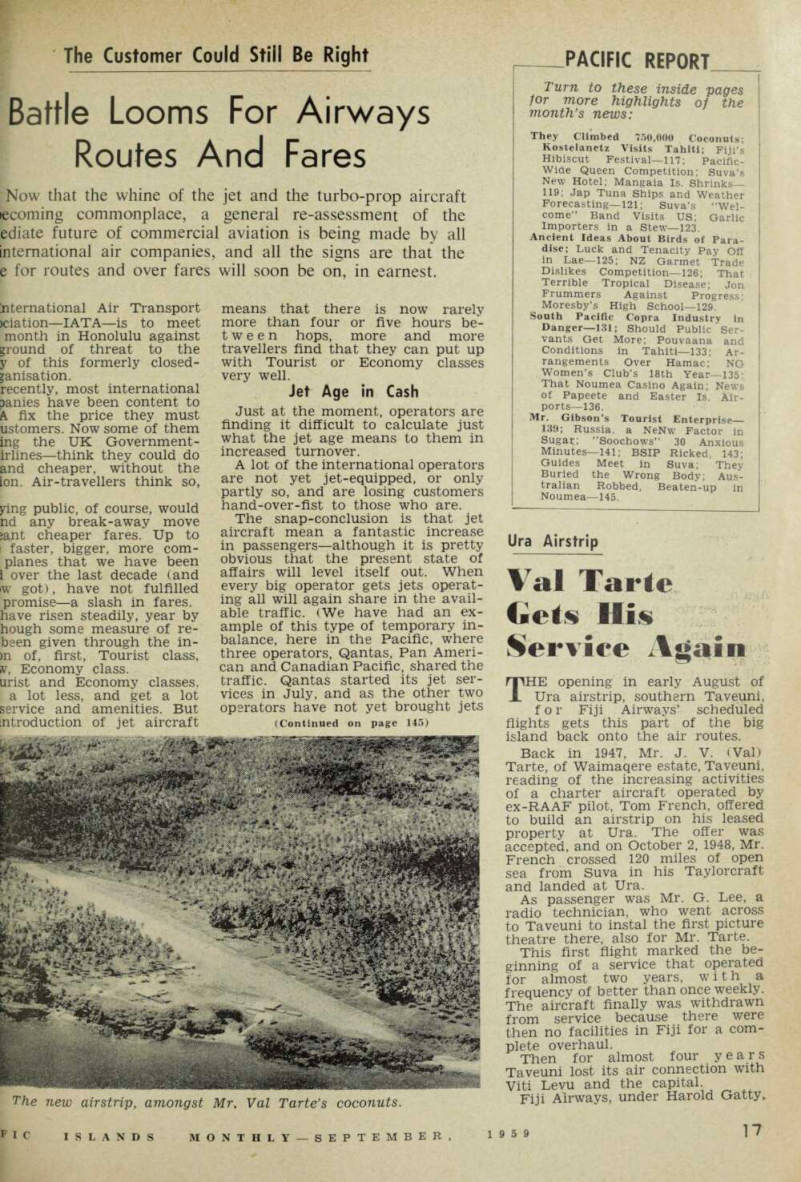
The new airstrip, amongst Mr. Val Tarte’s coconuts.
onto their Pacific services, Qantas is skimming the cream off the trade, for the time being. This will adjust itself when CPAL and PAA put jets on this route).
Nonetheless, with a few static periods, the growth of air trans portation since the end of the Second World War has been steady, and according to some calculations, the initial phases of the jet age will increase traffic permanently by as much as 20 per cent.
The British Government, which owns British Overseas Airways Corporation and British European Airways, made it plain some months ago that in view of this increased turn-over, it was thinking about re
ducing fares, with or without IATA’s obvfous g lv as° W nart n September ’ thSe thp P tbls campaign from the same source. r
Commonwealth Airlines
“The idea has been under ronsideration for some time ” said a UK Ministry of Transport snokes
ss; ?4sss?sC£S SS
ear.y yet to <U S e«£k ‘°° British Commonwealth airlines are . ’ boac, TEAL, and South African Airways. Presumably the idea SC b lnd° pXT age Canadlan ’ dian and Pakistan airways to
join the family in which PVPnt fh*
British Commonwealth organ"sati?n
would then feel strong enough to th * Australian civil authorities are cautious about the whole plan. If lt became a serious proposition, said the .Minister for Aviation, then Aus would have to consider its Relationships with other countries. planes. i Another threat to IATA control nas come recently from “independent operators” These operators calcu late that when the Pe bf g to ope C rators turn over to jets, there will become
available some bargain-pri type aircraft good yet fo: service.
They calculate, also, t still will be sufficient p terested in using the old-t; if the fares are suitably And some of the reduc gested are staggering: Hongkong, for £Stg.l36, i the lATA rate of £Stg.24o Nairobi, at £Stg.lOO ir £Stg.234.
The “independent” opera ever, have no “rights” scheduled services where and until they do, it see that longer and cheaper are out.
Complexities of "Ric This brings up the whol< of international landinj which, week by week becc and more complicated.
It has always been an u right of shipping compani their ships anywheres on seas or into foreign ports ternational aviation is t with a system of reciprocg rights that are becoming sc some that they could bre under their own weight.
A great deal of the compc “rights” comes from fon lines who want to lane United States, and in th; the US has been generous, this generosity raises the i airline companies—none Government owned— wrangling goes on continu It has always been assu the rules laid down by IA conveniently irrevocable, looks as though a powerf could challenge them. In way, these international i landing rights might som< scrapped in favour of free ; competition. Some compan go to the wall, but it is a that would level itself out ally, and probably for the the flying public.
The international air-trg tion business was born in £ Government control that be Government control. The that without rigid regirr and protection this highly sf and expensive industry w have progressed as fast as But that is a theory thal to argument.
TAA Becomes Agent fo From the beginning of Se the Government-owned Ai internal air-operator, Tra] tralia Airlines, became Ai general agents for the Fre; vate airline company, Tr Aeriens Intercontinentaux. ously, TAl’s agent in Austr the French shipping line
Maritimes. Messageries Mari as any other travel service, r course, continue to take s for TAI. love seems to be one of ration i rather than one indicat great change of policy. TAA adv agents for Air France, the
Government-owned airline;
lough Air France and TAI iarate entities, in France; re some sort of tie-up in the sian area. TAA also services anes in Australia, where i made at Darwin and Bris , the way to Noumea from If, or when, TAI gets land
its in Sydney, presumably
uld do that chore for them K).
hanges New for Old Service
1 be seen from the Time- Section, this issue, Pan n Airways will, from the this month, cut out the (American Samoa) —Nadi rvice which they have been for several years, and will commence a new service nolulu to Tafuna. leans that American Samoa its link with the Pacific le airservices at Honolulu d of at Nadi. However, 5 who want to go south in north, may still do so by asing the local airservices American and Western ,nd then flying to Suva by ping-boat.