Pacific Report
pp. 119-149 · Read in the full issue

The month’s round-up of news and pictures of people and nts, from PIM correspondents in the South Pacific.
Knew If
efore
Fes of Kanam village, on the 12 miles north of Madang, [ distinguish today between ren Commandments taught [by the missionaries and >r set of commandments 1 down to them by their ors. ge elders explained to Fr. el Wiltgen in July that the ihristian missionary to con them was Divine Word aer Father Henry Buschoff, who opened a Catholic school 5 1905. en we heard the late Father iff list the Ten Commandants, d him we already knew most m,” the village elders said. t Ten Commandants sounded mch like the precepts handed to us by our ancestors,” they “This made us feel Father off was teaching the true re so we decided to join it.” kding to native tradition, it •odaw who gave the precepts ancestors. Dodaw is the name d in the Kananam vernacular, iaw cannot be seen because ,s no body,” they said. “He ever die, and he always will cise, forceful and melodious [ vernacular, the precepts are remember and easy to under [ They are in no particular leal sequence, a must not attack what your r and father have to say to one precept says, nr eye must not look long at the wife of another man,” another. Its counterpart for he eye to look with desire at sr man’s goods, ianam elders wearing only loths explained that the more )ok at a nice thing that be to someone else, the more you to steal it. a man steals the wife of er man, he is to be attacked filed by the rest of the village ■ children can come from this mion,” the ancestors had said, ns is not done, the children tow up, become aware of the
crime of their parents, and then perpetuate the crime in the village by following their parents’ example.”
Other precepts forbade the tell ing of lies and making light of Dodaw’s name and the names of fellowmen, “Those who lie are barred from the good place reserved for the dead where Dodaw rules and where there are nice homes and beautiful flowers,” the elders said.
Dodaw’s name was never told to children or young unmarried people for fear they might make light of it in conversation and so dishonour the sacred name.
The penalty for disobedience to parents was a threatened speedy death; the reward for obedience was Fife.
The villagers said they had no commandments from the ancestors regarding prayer and the offering of sacrifice to Dodaw.
The Rule Is: Don't
Hit the Other Player
A few years ago, Litu Litu was a small girl wearing a grass skirt and tending her father’s pigs.
Today, a proud young mother, her baby in a spotless white napkin tucked inside her bilum (loosely netted basket that she wears hang ing from her head) she is one of the first arrivals each Thursday afternoon at the Lae Wam b a
Women’s Club, New Guinea.
Litu is but one of hundreds of native women now attending clubs throughout Papua and New Guinea, the club movement being started by Miss Lois Niall, daughter of the Morobe District Commissioner.
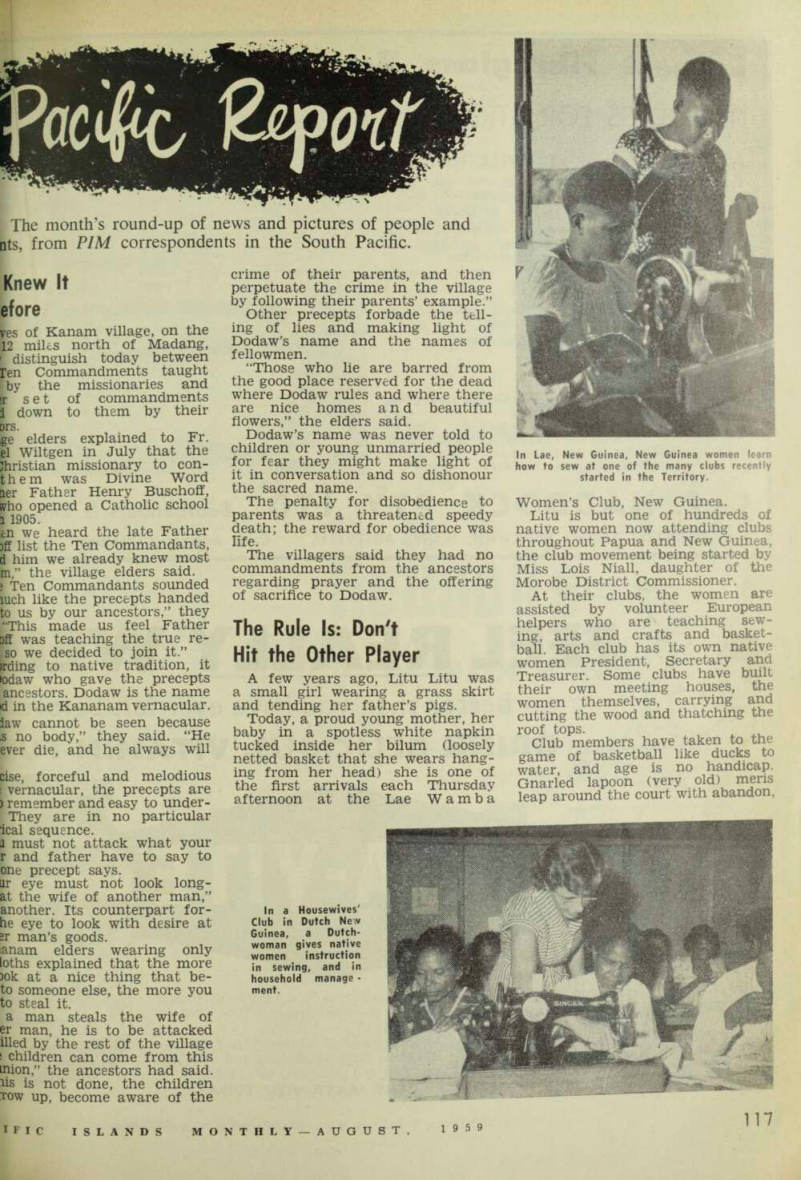
At their clubs, the women are assisted by volunteer European helpers who are teaching sew ing, arts and crafts and basket ball. Each club has its own native women President, Secretary and Treasurer. Some clubs have built their own meeting houses, the women themselves, carrying and cutting the wood and thatching the roof tops.
Club members have taken to the game of basketball like ducks to water, and age is no handicap.
Gnarled lapoon (very old) mens leap around the court with abandon,
In a Housewives' Club in Dutch New Guinea, a Dutch woman gives native women instruction in sewing, and in household manage ment.
In Lae, New Guinea, New Guinea women learn how to sew at one of the many clubs recently started in the Territory.
ieir ancient bare feet. Blouses ften discarded when the game s up and blows are sometimes Dged when the heat is really .this score there’s a little word arning in the Rules Book written for the women’s [“Do remember that it is only ne and do not get angry with bother. Never hit the person ire playing against.” ae club members have run into r hostility from their own aids. At least one husband his top when he came home, [ the dinner not cooked and sd that his wife was out play asketball. He gave her a good ig. fever, it was pointed out to him the wife of a certain local jean police officer had broken irm. Since then her husband een cooking tea —and liking it— fortnight. The native husband juite impressed and now he is g his turn at preparing dinner. b of the aims of the clubs is ake saleable articles having a e flavour. Money so earned will sed for buying club amenities squipment. ne club members have shown a ess acumen likely to put many ,rd-boiled business tycoon to e. They are buying lolly water sweets, then selling them to husbands and sweethearts on b afternoons at an exorbitant
igh to Produce
maid Noises
ien Mr. Vince Storck gets his water-bus operating (see ship section, July issue) it won’t a name like his last one—
00100100. “We’re asked its meaning a hundred times a day, and it is just a word we thought up,” he said.
Odd. We remember that when 00100100 went into service, the fame of its name spread even as far as Sydney, where according to some columnist—Granny of the SMH, we think—it was said to be the noise Fijian mermaids make.
The new water-bus will take tourists cruising in Suva harbour during which excursion they will visit a strange new feature soon to appear out on the reef in line between Suva’s “GPH” and Beqa Island.
If the plan is approved by the powers-that-be, a 25-ft. long, 8-ft. diameter cast-iron tube is to be lowered vertically into a small channel in the reef. At low tide
the tube will stand in about eight feet of water, and in about 13 ft of water at high tide, The bottom end will be sealed and the top end open. Near the top will be an encircling platform, with perhaps a canvas canopy over all quickly erected as required, and passengers will be served refresh ments here on this look-out.
They will be able to descend into the tube by a zig-zag stairway and view and photograph the passing marine life from a series of large portholes below the water line. To ensure that the marine life does pass their viewing caison, there will be a wire-netting race to guide fish close past the viewers, This structure will be located a considerable distance in from the exposed seaward edge of the reef, but even so it may be necessary to
[?]RVICES RENDERED. As a gesture of ap [?]on for medical aid dropped by the [?]to the tuna mother-ship "Koyo Maru" [?]ar, Captain K. Tsuruda (right) and fish [?]ager, Mr. N. Tanaka, of the same com
mother-ship "Tenyo Maru No. 3", in
[?]ought gifts of dolls in glass cases to [?]ernor of Fiji, the commander of the and the Medical Superintendent of Suva hospital, from the president of the Fishery Co., Kenkichi Nakabe. Here is the dolls, in Suva. Photo: Stinsons.
it well stayed against heavy ' u be is understood to be ting discarded by a sugar mill, ie portholes to be added.
Gets All
lips at Once
worst shipping congestion jxperienced in Apia port >d during the 10 days between 0 and July 1, when six large is ships arrived to unload jns of cargo and to load 6,500
[Samoan produce.
Union Co. s Tarawera brought is of Fiji and trans-shipment and loaded nearly 20,000 if bananas for New Zealand.
Jank liner Yewbank lifted 1,000 tons of copra and cocoa 1 English market. istone loaded 1,000 tons of ■for Puerto Cabello (Vene i Waiana brought 800 tons of lian cargo; Tofua a large )f New Zealand goods, mainly iffs; and MV Thorsisle carried bfrom Canada and the USA. [heavy accumulation of ship rained the port’s limited re i to the utmost and again clear the urgent need for the imsnt of a deep sea harbour roper wharfing facilities at pd also at Savai’i.
Sir Lala Sukuna's
■ations for Museum
In the decorations and swords i late Ratu Sir Lala Sukuna anded over to the Fiji Museum ly, the Chairman of the m Trustees, Mr. D. M. N. lane, described the decora is an illustration of the life of
achievement and success which Ratu Sir Lala had lead.
The decorations included the KCMG, the KBE and the CBE.
There was also the French Medaille Militaire, which Sir Lala won dur ing the First World War while serv ing with the French Foreign Legion.
Lady Liku, Sir Lala’s widow, handed over the decorations and swords at Sir Lala’s former home.
Rairaiwaqa. She said: “It is not easy for me to have to part with such treasured possessions which are evidence of achievements in life but I am willing to part with them knowing that there is no safer place than the Fiji Museum for them.
There they will be seen by a greater number of people, both local and from overseas.”
She expressed thanks to Mr. and Mrs. J. S. K. B. Borron, for arrang ing the ceremony.
Five Annual Shows
Now in P-NG
The growth in r:cent years in Papua and New Guinea of the annual Show idea —that is, a regular exhibition of the products of the districts—has been remarkable.
There was the usual big exhibition in July of Papuan products, arts and crafts at Sogeri (the lovely high valley at the back of Port Moresby), and at least 12,000 people attended.
About 8,000 of them paid entrance —the remainder came in through the bush and rubber-lands and meadows which surround the picturesque showground.
It was a fine, sunny day—in con trast with last year’s show which was washed out by torrential rain.
That was why the committee moved the show forward from September to July. (Over)
When civilisation catches up with a Chimbu, this is what happens. The bath towels round the middle may possibly be an improvement on a bunch of leaves, but those interested in retaining native customs would no doubt be appalled. The picture was taken at Papua's Sogeri Show in July. See above.
Photo: Papuan Prints.
In June there was anoli cessful show—although not as Papua’s Show at £ Kokopo, which presented crafts and products of the; around Rabaul.
A notable show is now 11 year at Goroka, for the; Highlands; and Wau holds a exhibition in December Incidentally, Wau peoc haps feeling that Lae is r. its part—has changed its ns Morobe District Agriculture to Wau Agricultural Socie Messrs. N. Owers, J. Sin Slade, B. Fletcher, C. Gan Kirchoff, Minchin, and F., and Mesdames Maloney, and Crawford at the head The Madang show was July in brilliant weather success.
Hotel Offer
Another Papeete
“If the French Polynesia. ities will play bail, we’re • to start on the foundatid first-class hotel near Pap December and have it re business when the new opens next year,” said Mj Helgoe in Suva in July.
A Los Angeles attorne restaurant interests in P' California, “just as a hobl Helgoe was returning to the States after 12 days in Ts vestigating hotel possibilities half of a California-Texas; Mr. Helgoe said that, with a Papeete architect, he amined several available t close to Papeete city. He fa boom in the hotel business soon as the new internatio* port opened—“and they’re working on it right now,”
There are—or were early in some 46 motor trucks work nine-hour shifts per day spoil on the site.
Mr. Helgoe said that his associated with French ii had made certain propositi the French Polynesia gove; conditional on them makinu cision by December 1.
If the reply was favourable would commence on a hoc mediately—“but we insist or cision by December 1, oti we wash our hands of the s< Mr, Helgoe said that tl Governor of French Polyne* the government officials cok had given him every assistaj felt that they were now qu finitely interested in encourag, entry of overseas hotel capie It was true that other Ak hotel interests had made littK way in Tahiti in recent yean perhaps with General de Gs the helm, the policy has cl; That is certainly my impn Mr. Helgoe added.
Wanted The
Life
tiame was Lili Tavia. She was King and she came to Noumea Tahiti some years ago with putation of being one of the of hula dancers. As principal ■ in Noumea’s night spots she [ that the reputation had not
ightly bestowed,
had a trim figure and legs he knew would be a crime 0 show, and Lili was no al. Her vivaciousness wa s hat only French and Tahitian ors could bestow. She was a hit with the tourists. r some three years of danc iili hankered after a quieter she settled down and obtained is messenger girl in a Noumea Everyone knew Lili, and out her name as—dress fly he thundered down the street uch too fast, everyone said . . . r powered scooter. ; month she was coaching an dancing teams to perform ; July 14th celebrations. The itation was to be Lili’s master on July 9, Lili was speeding the main road leading out umea when a car cut across lath. Swerving round it, Lili 5-ton truck, which threw her 1 30 yards, and she died almost Ltly. en Lili was buried the next a record crowd followed her al. She left a deeply mourning ian and Wallis community in
Noumea, and many friends and ad mirers everywhere.
We Stand Corrected
—Or Almost
A correspondent says that Fiji does not get most of its imported rice from Australia —as was stated in July PIM. To the contrary, in 1958 only 531 tons came from Aus tralia while Thailand supplied 3,577 tons. Our correspondent goes on: “Thailand can easily outsell Aus tralia here . . . their rice is cheaper and considered tastier, . . Presum ably there is a protective tariff that keeps Thailand rice out of P-NG,
or Thailand would be able to under sell Australian there, too.”
As to the last statement, thereon hangs a tale, of course. Before the war, most New Guinea rice came from Saigon and other parts of Asia; price ranged around £lO-£l2 per ton. During the war, and for 10 years after it, supplies of Asian rice were cut off and the SW Pacific islands had to depend wholly on supplies from Australia.
As a consequence, Australia came to consider that she had a monopoly of the rice market in her own Territory of P-NG. About five years ago, however, supplies of rice again became available from Saigon, and
wanted the quiet life, on her motor scooter in Noumea.
Photo: Sud Pacifique.
jut £25-£3O cheaper than ian rice. There was a great f backing and filling, and from both sides but finally NG Administration reached promise with the Australian pwers under which the latter d their monopoly but reduced De by about £lB per ton. This das been adjusted annually ace. arrangement, from ethical I could be regarded as un itary, nonetheless from the Dint of view, Fiji rice con should do their arithmetic if they imagine that they Btting rice much, if any, r than consumers in New Australian f .o.w. cost, i, is £6l/10/- for five-ton lots; is another £lO/15/- per ton. ore, with this and that, a ton should be landed in the Terri ir about £A7S.
CSR Company, when or if its rice mill going in Fiji, > to be able to sell milled rice 15 per ton. At this price, :ding to Government an ments in June, it should have ige on imported rice to the of about £FS. -F75 equals about £AB4, and equals £A9O, Fiji consumers ike it as read that although nd may very well be able to ell Australia on the Fiji rice t, they, the consumers, are )tting the benefit of it.
Flavour or eating qualities of Aus tralian rice may be a different pro position; but all rice imported into the Territory is for feeding native labour, for whom the N/L Regula tions stipulate either brown, or vitamin-enriched. This may, or may not be “tasty”, as our correspondent puts it, but it certainly builds bonny labour-lines, and in P-NG that’s what counts.
The fact that Fiji imports rice to the tune of 3,000-4 000 tons a year is a recent development. Until 1955, in a normal year, the Colony was just about self-supporting in rice.
In that year it imported 579 tons —124 from Australia, 321 tons from India and 58 tons from Thailand Early 1956 brought hurricanes and floods and from that time on, the importation of rice into Fiji has as sumed larger and larger proportions.
Suggested Local Broadcast
For New Guinea DCs
The sub-governor (District Com missioner J. Foldi) of what is probably the most difficult section of the New Guinea people, the Tolais, is an advocate of some form of local radio broadcast, for com munication between District head quarters and the village com munities.
It should not be costly and, in the case of a difficult and suspici ous people like the Tolais, regular
communication between the local director of administration and the heads of the village communities should be a helpful thing.
Under present conditions, the DC is in direct personal contact with the village heads far too infrequently —and then only through the irregular visits of administrative officials. A local radio broadcast, from DC to villages, at regular fixed times, could do no harm, and it might be of real value at this time, when the relations between Administra tion and Tolais apparently are not good, and may be deteriorating.
A School for
Native Boat Builders
Mr. A. SWinfield, Sydney ship architect, of many years experience,
GIANT Mr. Colin White, of Miller's shipyard Suva holds a two inch diameter casing left by a giant toredo worm recently found in the Nubukalou Creek, Suva. In July "PIM" it was stated that a tordo as thick as a man's thumb is regarded as a giant-so this one can be looked up on as the grand-daddy of all worms.
visited the Solomons durii for a preliminary investigate the possibilities of a boat school at Auki, Malaita IslJ Present intentions are school to accommodate 24 M ans, 12 from the Solomons remainder from New Guir the New Hebrides.
The School will be a joint: and funds are to be provider United Nations, South Pacil mission and the BSI Goven If there is enough mone will commence later this yes Whilst on Malaita, Mr. g visited the Langa Langa Ls district renowned for its? boats. He was impressed standard but said tha additional training eve ni boats could be produced.
In BSIP Medicines
Go Duty Free
A long-awaited amendmen BSIP Customs Regulations effective from June 22.
All medicinal and pharma products, including dressings ances and materials for the dl and treatment of diseases, p country of origin is a sc country, will be free of duty ously 111 per cent, (i.e., Prefl Tariff).
The rate applicable to simj ports from foreign countr been reduced from 35 per 171 per cent.
The levying of duty againj items has been a bone of tion for some time, parti amongst the missions who st provide hospital facilities tl out the islands.
Government had hoped tc duty against patent medicine; were not used regularly in hi and dispensaries but apparei laxation of the tariff in tc far simpler than enforcing tions that granted exemption) tain items only.
Who's Who Of
The McNicolls
Of all the people who haT prominent in the Pacific : probably none produced a distinguished family than Bri General Sir Walter I McNicoll, KBE, CB, CMG VD, who was Administrator Guinea, 1934-42. In 1905, he r the Baroness Hildar Man Wedel-Jarlsberg (daughter of Oscar Wedel-Jarlsberg, of N and she was with him ii Guinea.
Walter McNicoll, a school t entered World War I as a and came back from Gallipc France as a Brigadier, with sz of decorations and a smash Sir Walter filled a very c
Rabaul in the ’Thirties (it d the Rabaul eruption in nd the Jap invasion at the 1941) but he had a fine and he was greatly helped v McNicoll, who probably was indsomest woman, of dis led appearance, who ever , Government House in the Pacific.
Valter died at the end of War II; but Lady McNicoll a rpsident of Rose Bay,
\ They had four sons —and owing three names appear on 17 of the 1959 edition of the ian Who’s Who: , Rear - Admiral Alan Wedel y, CBE, GM, Deputy-Secretary ment of Defence, Canberra. , David Ramsay, Editor-in-Chief, tdated Press (Daily Telegraph, Sydney. , Major-General Ronald Ramsay, lE. MIE, GOC, Central Command, le.
“Ramsay” which appears in names was the family name late Sir Walter McNicoll’s
; Loans To
Icheme Growers
New Zealand Government is Iking loans available to Cook [ citrus growers owning is which are not a part of icial Citrus Scheme, loans will be in respect of story orchards in bearing and i restricted to the financing Uisars and sprays. They will rgeable at 5 per cent, and re i by deductions from the is of fruit sold at the rate [•thirds of the annual earn f the orchard. terms are the same as those ig to the Scheme orchards have been initially wholly sd by the Government, new plan is apparently de to overcome the problem of t non-Scheme orchards iring pests which cause con )le expense to neighbouring e plots. Non-Scheme owners somplained that they cannot to carry out the necessary ig. The loans now offered ake this possible.
Government has made £12,000 ble for these loans in the D financial year and a similar it for the following year.
Sir Walter Ramsay McNicoll.
Loans will be granted on the basis of the condition and productivity of the orchards concerned.
Ex-Service Settlers in NG
Now Include Natives
The machinery developed last year for the settlement of ex servicemen in Papua and New Guinea—for which Australia made a grant of £25 millions—is function ing smoothly.
Already, an expert committee has examined some hundreds of
applications for aid, and a large proportion have been approved.
Among the applications approved are between 20 and 30 men who plan to settle in an area of excellent land that has been made available in Popondetta, in the Northern Division of Papua. A number of them already are there, and have started work on their blocks. This volcanic land is very suitable for cocoa.
The scheme has been extended to include native ex-servicemen, and applications for land and loans have been received from more than 100 natives.
These are being sympa examined. The responsibU will try to assess eac: agricultural knowledge ai potency to manage and plantation, and grants will! accordingly.
Selected European ex-se may be advanced up to £:: the development of a plai
Newspaper Organisatii
In Papua-N. Guinea
A couple of years ago tl Pacific Post, of Port established two new week; papers the Rabaul Times Islands section of the Terrii the Lae Courier, for the Nev mainland section.
There was a staff and ; in both Rabaul and Lae. T. and advertising copy wen; Port Moresby printing of! the printed newspapsrs we back in bulk, for distribut; The system provided s newspaper service; but in o it proved to be too cumbers expensive.
The two separate newspa: have been discontinued; their place, there is one newspaper, the New Guinea Courier. The existing Rah Lae staffs function as bef copy goes to Port Moresby; weekly newspaper is printe and sent by air from the mid-week, to Lae and Rabi< With daily air services a there seems no reason whv < newspaper, published in tin (Port Moresby) should not \ the whole Territory. There almost complete communit; terest between centres such!
Moresby, Samarai, Rabat Madang, Goroka, Wewak, I and Kieta.
But the old jealousy betv Territories of Papua a n Guinea will not die—hei separate newspaper enterpi ferred to. Before World ' Rabaul, Port Moresby and I had its own local newspa; commercial printery.
Few Islanders are
Taxed in Cooks
Few Cook Islanders have; incomes and most of the taxi is collected from compam European residents.
This was shown by the F of the Cook Islands Le?
Assembly (the Resident 0 sioner, Mr. G. Nevill) in h;j ing address at the June of the Assembly.
Mr. Neville said that wl new system of local taxat:: introduced in 1956 it was st some that it would weigh hec
aori people. That this had not to be the case was seen in est taxation statistics. Of the collected, the only contri were 16 companies, 161 Euro and only 46 of a total popula f 17,000 Maoris.
)ld Croc. Shooter
Lucky
\ the 300-tons coastal vessel I was destroyed by explosion rak, New Guinea, on May 12, 12 natives and one European, Fe other natives missing pre dead, that ancient, active le-shooter, George Mitchell ut another notch on the ;of his bowie-knife. [had some narrow escapes,” fe gnarled Mr. Rio to a PIM ti Port Moresby last month, me narrower than that.” lad been on his way to the ;ountry, after skins; and he ;d with the Busama people to ibout a ton of his gear, and m along as a supernumerary mate. id a premonition about that declared Mr. Rio. “I got it a my nose. I distinctly smelt fumes, a few times. The i was carrying some hundreds ns of motor spirit.”
Busama got into Wewak in ming of May 11; and, when pper went ashore early next g Mr. Rio thankfully went Soon afterwards, there were pled of muffled explosions, b ship was immediately ablaze s was no chance of saving r cargo. The first mate, Mr.
Riik, 52, of Sydney, was immediately, but Mr. James t, who was supervising cargo, awn overboard and escaped, old croc-shooter lost all his nd his pet rifle. “It was made ly for me, and it cost £118,”
he said. But he did not moan—if his luck had not been in, he would have gone up with Busama.
Re-equippcd, G. M. Rio thought he might pay a call on the Western Papua crocodiles. He was born in Belgium 69 years ago, and he has been nearly 40years in New Guinea: but he still can get around more quickly than any tropical saurian.
In July, Coroner R. G. Ormsby reported he was unable to determine the cause of the fire.
Jets Bring Tighter
Air Traffic Control
With the entry of jets on the South Pacific airlanes a tighter
system of air traffic control will soon come into operation, designed mainly to prevent air collisions.
Under the new system, aircraft southbound from Nadi to Sydney will fly a controlled air lane which crosses Tontouta, New Caledonia Northbound aircraft will follow another lane which crosses Norfolk Island.
At present, the existing propeller driven aircraft follow the same lane north and south but fly at different heights —the odd number of thousands of feet of altitude in one direction and the even number in the other direction. This type of separation is not considered suf ficiently safe in jet operations.
The path taken by a drum of petrol [?]ad exploded during the "Busama" fire, [?]graph was taken at night by George Rio. See below.
Snail Plague:
asant Evidence
iss fire which burned for days e swept across much of the iter-owned coconut planta [Malapau, near Kokopo, New pau has historic interest, illy, it was part of the group onut plantations established Jum by the Mrs. E. E. th (“Queen Emma”) in -the first coconut planta- Q New Britain. [palms did not suffer much sßabaul’s drought broke later; I the fallen nuts were lost, ong over these hills a few [ter the fire, one was startled urious stench. It came from tting carcases of giant shell hails, killed by the fire, have been told by planters lese creatures —introduced by ?anese in 1942-43 as an article )d —are now all over the 5 Peninsula, in millions. The removal of the grass over square miles of Malapau gives ea of the snail population gh on plantations the pest . controlled.
Few Coastal Ships
ipua-New Guinea
e observers in Papua and New 1 are becoming anxious about •astal shipping situation.
Tal handy little ships have
been lost in the past year or two.
Others have reached the end of their working life.
They are not being replaced. Small European investors can see an im mediate return from new ships— but the long-distance prospect does not please them. They would like some assurances from the Govern ment.
Some planters and traders expect that Burns Philp & Co. Ltd. will enter more deeply into the coastal shipping business; others think that the growing ranks of Chinese
merchants may do something. Com merce and trade in P-NG move almost wholly upon the coastal waters.
NG Highlands Highway
Lacks One Big Bridge
Residents of the New Guinea Highlands watch patiently while the Lae-Goroka road—some day probably to be called the Highlands Highway creeps slowly towards them.
Actually, the roadway has been completed, long since—the obstacles to regular road communication are non-existent bridges over the shifting, treacherous Markham River and its tributaries.
The Erap bridge now has been completed, and is being regularly used. But it will be another three years before the biggest bridge, over the Leron, is finished.
Road vehicles now move fairly regularly between Lae and the Highlands, but they still have to be dragged through one or two streams—and notably the Leron.
This is a risky procedure in wet weather—and it is usually raining in that area.
Broadcasting Station
Urged for Cooks
The immediate establishment of a broadcasting station in the Cook Islands was strongly urged by some members of the Cook Islands Legislative Council in July.
The speakers pointed out that such a station was an urgent necessity from an educational and public information point of view and that its establishment, approved in principle but deferred for financial reasons, should be no longer delayed.
[?] Seventh Day Adventist church, on Coronation Drive, Lae, New Guinea, was dedicated [?] 5 in the presence of the Morobe District Commissioner, Mr. H. L. R. Niall, Pastor [?]ohanson, of the Australian Division of SDA, leading citizens of Lae and adherents of [?]urch In his address during the ceremony, Mr. Niall expressed regret that the SDA had not established itself in Lae before it had. He said that the average Territonan see to advantage the work accomplished by the Adventist Mission as its institutions, Is, dispensaries and schools are all out in those centres where the need was greatest, a result, much of what they accomplished passed unnoticed. Mr. K. J. Gray, SDA at Lae and his congregation have worked hard to build this church; various SDA [?]ations made building funds available, and local members of the church built pews, furniture and rostum themselves from New Guinea timber.
Recent wedding in Rabaul, New Guinea — Mr. Derek Hallam and Miss Cynthia Sidney, who were married at the Church of St.
George the Martyr. The Rev. Father James Smith performed the cere mony. Photographed here with the bride and groom are bridesmaid Faye North and best man John Georgiades.
Photo: L. Chin.
lory Making"
oyment Board for P-NG
still a long way to unionism, apua-New Guinea natives in srere given machinery which jlow them to express their as employees. machinery is part of a Native yment Board which has been 3 by the Administration to employers and employees of B to express their views on wages and conditions and to ically review labour legisla (Board will hold inquiries on b matters which may be re [to it by the Administrator, >ep the Administration advised ch things as changes in cost ng likely to affect native wage Irman of the Board is Mr.
C. Caterson, a former chief rial officer for Qantas and rith the P-NG Administration, members are Mr. L. A. Willis [r. D. H. Lloyd (for employers ives); Mr. Mase Rei and Mr. in To Patiliu (Papuan and Juinea representatives for em s respectively); Mr. N. J.
I (Public Service Commission epartment); Mr. W. R. Dishon re Affairs). irnative members of the Board It. J. W. Lukin (who will sit ! absence of either of the em ■ representatives) and Mr.
B, Goava (for employees). i Board held its first meeting ily 30 to inquire and report le question of wage scales — iequacy of the legal minimum and the matter of margins for I men. The Board will hear
evidence from organisations and em ployers.
Said the Administrator, Brigadier Cleland, at the inaugural meeting: “The bringing into the composition of the Board of Papuan and New Guineans, representing their own fellow workers, is a step forward towards the ultimate plan of ad vancement of the native peoples so that they can assist in the control of their own destiny. What we witness in this Board today may be regarded as history-making.”
The Administrator added a word of warning. The Board, he said, was charged with the responsibility of ad vising the Administrator on matters of policy and “it should not allow itself to become embroiled in in dividual complaints or problems but should rather look to the broader issues.”
For Suva: Just
The Purest Milk
Suva has never had much of a reputation for the standard of its milk supply. A certain amount of visible dirt and the addition of a reasonable amount of water has always been considered fairly normal.
Once in a while the law has cracked down on supplies, but as of July, 1959, no pasteurisation or sterilisation of public milk supply exists, and the Health Department advises scalding before use Very soon, however, all that will be changed. . . „ The finishing touches were being made to an ultra-modern new dairy factory at Tamavua, a few miles out of the city, in July.
Owned by the Rewa Co-operative Dairy Co. Ltd., it will produce homogenised milk.
Under the homogenisation process the milk is not only sterilised but the fat globules are broken up to give an Iven distribution through out. After treatment, the crea ™ longer rises to the surface when the milk is left standing.
The machinery has been sup nlied by New Zealand farm machinery suppliers. J. B. Mac Ewan & Co. Ltd. The plant has a pro cessing capacity of 200 gallons per h Most of the milk will come to from the shareholders farms in the district —some from a fmrdistanc away—by an insulated road tanker, at a temperature of about 40 deg. r From e the tanker it will be trans ferred to an insulated holding tank.
At this stage it will undergo a
Time Off For A Chat
Usually, on Saturday mornings, the Kokopo district planters of New Britain and their wives drive into Kokopo for shopping and interchange of news; and, while the family chiefs gather in the Kokopo Club's more secluded section, the wives have a happy meeting on the Club's wide verandahs. These two groups were photographed by a "RIM" man recently.
of tests for purity and in a well-equipped laboratory, will pass to an ultra-high ture steriliser-homogeniser. plant, manufactured by the ium Plant & Vessel Co. of i, brings the milk to a tem b of 275 degrees, milk is then cooled by re ion to 185 degrees and fed UDEC automatic bottling b. The one-pint pyrex bottles, lard crown-top type like beer are imported from England, this method of milk pro it is necessary that bottles ipletely sealed as the milk x pressure during a further ,tion process and cardboard capped bottles would be un le full bottles come off the ; machine they are trans to strong stainless wire de crates which move along a conveyor-belt into a 26-ft ‘rilising “tunnel” which holds of 400 bottles per batch, ig the 15 minutes that the is held in this tunnel it is again to 275 degrees, i there the crates continue n rollers into a cooling tunnel same length but of more x construction. The crates wly rotated by motor while col them down to handling ature, when they are stacked for the delivery trucks, sterilisation process permits Ik to be kept in its crown bottles at ordinary room atures in fresh condition for 3.
TNOTE: One of PlM’s , who was once given ly homogenised milk in an t somewhere between Singa nd Calcutta, feels that if that
were any indication of the brew, then Fiji milk drinkers are going to have to re-educate their palates.
That Asian homogenised could, of course, have been made from water buffalos’ milk; or tigers’ milk; even elephants’ milk. Certainly any re semblance it had to cows’ milk was wholly coincidental.
It Might Be The
Sunflower State
In New Caledonia efforts are now being made to develop pro duction of sunflower seeds on a commercial scale. The oil will be processed for use on the local market. Sunflower seed oil is sup
posed to be richer in vitamins than olive oil and a Noumea correspon dent says the experiment will be watched with interest.
Those concerned with the pro duction and import of peanut oil, large quantities of which are used in New Caledonia, will no doubt be especially interested.
Raft Adrift With
Half Its Crew
The four members of the trans pacific drift raft Cantuta II (see Cruising Yachts section) split up late July—but not intentionally.
The raft —slightly less primitive in equipment than its predecessors —left Peru in April to drift to Samoa. By late July it was off Napuka, northernmost of the Tua motu (not Marquesas, as reported) and it was decided to put in there for fresh water and food before continuing the voyage.
Joseph Matous and Jaime Toledo went ashore with natives in out rigger canoes and while they were there, a storm developed that drove the raft, with Edouard Ingris (leader) and Joaquin Guerrea aboard, out to sea.
Later, two radio messages were received from the raft, and all shipping in the area was alerted to watch for it. A French ship later picked the raft up and the men were reunited.
Accidental Death of
W. Samoa Doctor
Doctor W. P. (Billy) Williams, the first West Samoan Scholarship student graduate as a doctor, was killed in a tragic car accident in Apia on July 21. He was a man of
[?]ree Nauruans are now in Sydney, attending a course in agriculture. They are, from left, J. Tibare, A. Stephen and R. kun. —Tele-Photo.
t promise and his death in jircumstances stunned the immunity, where he was a • figure. He was aged 29.
Director of Health, Dr. R. xwell, said at a graveside that all Western Samoa had roud of the young doctor, id taken up his work at a f great difficulties of a re nedical staff in Apia.
Williams was the youngest of y of five children of the late rthur Williams, a former five Council member. He 0 New Zealand in 1941 as if the first scholarship s, attending St. Patrick’s at Silverstream and later g Otago University. •turned to West Samoa early ar to take up his appoint m the staff of the Health nent, where his unassuming mial disposition soon made ipular. wing the death of Dr. as, the Apia Chamber of irce asked for an investiga te the “shortcomings of the Samoa health service”, and jeople were critical of wnai said was Samoa’s serious if doctors, equipment and ’ in July the West Samoan ment announced that it will a surgeon specialist and a an specialist for West The latter will also be
1 superintendent of the
lospital. Salary would be 2,800 a year with a gratuity per cent. nother serious accident near n July, ten passengers in a bus were injured, four of seriously, when the bus sd into a coconut tree on the oeach road.
Be On The
Run
l the construction of an air fiose to Korolevu, on Fiji’s fast”, and the arrival shortly he United States of a small for Mr. Tom French, tourists able to fly directly from Nadi itional Airport direct to the r Korolevu Beach Hotel.
Mr. French apparently does not intend going into the general air charter business but will use his new plane—which will carry four—solely for the transportation of hotel guests.
Mr French is a son-in-law of Sir Hugh Ragg, whose Northern Hotels Ltd. owns Korolevu Hotel.
Move in the
r
Pouvanaa Lase
Four deputies of a 12-man commission set up in Paris to inquire into the Pouvanaa a Oopa case, are to proceed to Papeete, Tahiti, according to a Noumea report. ~„ 6 .
M. Pouvanaa a Oopa is a memhpr of the French Chamber of Denuties but S been held in orison in Papeete October 1958 without trial pXwing polftfcai “s i " a pape“ S letter half of last year, Pouvanaa and some of his closest supporters were arrested on a charge which apparently included arson and assault. (See PIM, July, p. 19.)
I A AnTOn Man A Name t pQmniriUn -1 u A man who seems to be getting increasing attention from both Ad ministration and natives is an educated New Guinean named Kere, who first came to notice in recent times in the Buka east coast village of Lonhan.
Buka’s east coast villages gener ally are regarded as politically rest less. This goes back many years, to the time when nine Buka labourers, who had settled in Samoa and taken Samoan wives, were forcibly re patnatedto their homes in east Buka. Their influence thenceforth was anti-European. , . int - 0 About the end of 1958, these Buka villagers decided they were being exploited by the traders. They said they were not getting enough per ba* «« -"g that : T , 0 e 0 n iin «ir nearesi; 1)0 L was some £7O per t° n • The villagers selected Kere to go to Port Moresby and put their grievances before the Government.
Seeking First
Aid Badges
These were some of Suva's Girl Guides of all racial groups who sought their First Aid badges at the Rally in Suva in July. Their instructors and ex aminers (left) are Nurse Morvick and Nurse Richards.
Photo: C. L. Cheng.
Married at the Methodist Church, Rabaul, Rabaul, recently, Mr. Ken Appleton and Miss Helen McEnnally.
On the left are Mr. Peter Lovell and Mrs. Gwen Howett, and on the right Mrs. Dorrie Ross and Rew. E. Bray who officiated.
[was educated and trained Roman Catholic missionary; jarently he broke away from in, and has become an in ti man among the Buka three or four months ago a ( official, on patrol, reported subversive stuff” among the pillagers. This is not neces lonnected with Kere. this year, Anthony Kere ed the natives’ grievances in [oresby; and his representa ppear to have been seriously i by the Administration. He jcted to appear more pro ly in native affairs. He now m as Anton Kiari.
ink or Not?
Guinea Deaths
death of six natives in Port y early in August following hyl-alcohol drinking party [ the controversy as to r or not natives should be [ to drink beer, matter has been before the ;ive Council on several oc , but legislation that would latives drink-permits has >een put into general prac though a few years ago it :t at the stage where issue >e made at the Administra
kretion.
recent drinking party was night affair after a wedding.
Ived only natives from the irea and during the night that “smelled like methy ipirit” were served by two (or part-natives, both had mised names), one a painter ie other a medical orderly, hese men later died, yell as the six who died, others were admitted to 1; one is reported to have lind. e were fatalities after a native drinking party a ars ago, and although there me very good reasons why 2sent blanket prohibition on
native drinking should not be lifted too hastily, those who advocate re laxation of the regulations to per mit some beer drinking, have a good point in incidents like the August disaster.
Although most native people in the Eastern Pacific seem to be able to brew something lass lethal for themselves —bush-beer, or fer mented coconut-toddy—the Mel anesians had to wait for the white man’s alcohol, usually in the form of cheap methylated spirit.
Most of the Missions in the Ter ritory are against lifting the ban on native drinking, on the ground that you can’t cure one evil by permit ting another.
In the Steps of
The Leathernecks
What stands today on the sites of those war-time recreation clubs,
PX’s, camps, and battle-grounds where the US Marine Corps served or enjoyed its recreation in the South Pacific? And where are the girls who served the cups of coffee, or provided the dancing partners?
Robert C. Hayes, a Marine Corps reserve Lieutenant-Colonel and free-lance writer flew in to Nadi from Seattle in July on the first stage of a South Pacific trip in which he hopes to answer a lot of these questions for the Marines —through their journal Leatherneck and through other magazines and newspapers with which he has arranged contracts.
Ex-Leatherneck Hayes was one of several thousand Marines who had their first sight of the South Seas from the troop transport President Polk. That vessel was a day out of San Francisco bound for Honolulu as an ordinary passenger liner when the Japanese struck Pearl Harbour. She put back and was converted to a troop transport.
Heading south for Noumea, the ship narrowly missed colliding with a heavily loaded unidentified tanker somewhere east of Fiji on a dark night with both ships blacked out.
After arriving at Noumea it was not long before this group found itself heading north for the Solomons battle area. Leatherneck Hayes was an officer in the aviation intelligence section.
Eighteen months later he flew in to Suva from Santo in a PBY flying-boat, and had his first ice cream soda since Noumea at a PX which was located in Millers store.
Heading for Tonga from Suva, one motor of the plane failed and it just managed to get back to Laucala Bay.
Colonel Hayes was particularly
HES ROUND FIJI: Most of Fiji's commercial fishing is handled by individuals rather [?]y organisations at present, and Fred Simonet of Levuka (left), with his refrigerated "Kerekere", is perhaps the “biggest" of this hardy community. H.s operations range [?]aters round Viti Levu. The fish shown in this truck represented part of a catch brought [?]tly and sold to one of the big firms, on the wharf, for 1/- to 1/6 per lb, gutted.
;d in Koro Island, for it was lat the first detachment of ;t Marine Corps, bound for ial landings at Guadalcanal few Zealand, spent July 942, rehearsing the landing n. Many of the local people een removed from the area some days previously. ;ests were satisfactory and voy resumed its voyage to the battle landing on August in August, 1959, Colonel will fly to New Caledonia i New Hebrides, then travel lagi to Honiara, and from i the coming months, he will on to Bougainville, New and the New Guinea main ence to Sydney, from where head back home, notebooks as a passenger in the liner Mariposa next er. sen now and then he’s likely tiling on a good many people ed with the war days in the
IR as in European,
i as in Asian
P-NG Administrator, Briga eland, does not think that m “Euranesian” is “entirely “iate” as a description of ruinea’s mixed race people nts some evidence that the race people themselves want pt the name.
He got some of his evidence at a Rabaul Town Advisory Council meeting in July when one of the Euranesians, Mr. H. Lewerissa said his people felt “very strongly” that they wished to be known as “Euranesians and they would be very happy if that word could be adopted.
He said they didnt like being referred to as half-castes, mixed blood or mixed race people—and particularly did not like being referred to as half-castes by the natives, who were the main users of that term. Mr. Lewerissa said that his people felt about the word half-caste just what the Chinese had felt about the word “Kong-
Kong”. And “Kong-Kong” was now never used about the Chinese community, so it should be possible to use the word Euranesian instead of half-caste.
Mr Lewerissa explained that the WO rd Euranesian was composed of EUR for European, A for Asians, NESIAN for Micronesians, Polv nesians and Melanesians, .. .. . . . the suggestion of chairman J. f Dowling, Mr. Lewerissa agreed to write to his people m other New Guinea centres to see if they wer . e m fa y° u J . the wor 4 Eura " nesian, so that their support would strengthen the appeal to the doubt- Administrator.
More American Goods
For West Samoa
American imports are making themselves felt in Western Samoa, which, although it is only a few miles from American territory, is on a New Zealand economy.
Recently the motor vessel Thorsisle brought one of the largest consignments of American goods to Apia for many years; 1,187 tons of cargo included a con
signment of more than 6,000 cases of American sardines, which sold at a cheap price and soon monopolised the Samoan market.
American soft drinks and machinery, and Canadian timber and salmon were also in the consignment.
Meawhile, the Australian Senior Trade Commissioner in New Zea land, Mr. H. C. Menzies, and the chief editor of the German mag azine, Economist, Prof. F. E. Alt mann, have both been on short visits to West Samoa, pushing the
barrow for West Samoan ti; their own countries.
Mr. Menzies said that would not import banam West Samoa as NSW gro'( a surplus of fruit. But th no restrictions on the sale; in Australia. Mr. Menzies goods which Australia couj West Samoa were fresh fi meat if the shipping probll be overcome—and plans for connection were being disc Professor Altmann said tH good opportunities for cn market for Samoan cocoa a in Western Germany an parts of Europe. German welcome an expansion of tr West Samoa.
Cole of California in
Exotic Tropics
Mr. Fred Cole, successfu facturer of famous swim US, Australia and e; visited Tahiti in June, with him a large staff for pose of getting unusual beautiful girls clad inj bathing suits against thi Tahiti background.
Two top-flight photo* three models and a pubL pert were in the party.
Weeping Axes From
Dutch New Guinea
Two more bronze axes —e to be about 2,000 years oc been uncovered in two vil the Lake Sentani distril Hollandia. They are the sa as those found in the same August last year. They are si of the Dongson culture—ths Bronze Age of eastern In Indonesia. Other bronze sp including a spear head and! of a dagger, have been u:j in that area since 1930 Hollandia report says it
One of the bronze axes found in Sentani district last year..
that similar discoveries of •onzes have still to be made, of the new axes is round, decoration on one side. Be :e area was Christianised, 930, the people believed that :endants of the village where i was found received their >m the axe and when one i was soon to die that axe itart to weep.
moan Public Servants
For More Money
;blic Service Salaries Com began sitting in Apia, Wes moa on July 24. As a result, ■s of the Public Service As n were “confidentally ex ” a substantial pay rise, pointed out that official indicated that since the last Jrease in April, 1955, living ad shown an increase of 15 it. for seconded employees overseas) and 16 per cent, al employees.
Mood and Old
iji Legco
?iji Legislative Council ceased t on July 23 and nomina osed for a new one on August ing day for the Southern and
North Western Divisions has been fixed for September 12, and for the Eastern Division with its widely scattered islands the date will vary from September 5 to September 12.
Precisely who would be standing for the various seats would not be known for certain until August 14, but as of the end of July the situation looked something like this: For the three European seats it seemed probable that there would be straight fights, with Mr. John Falvey and Mr. Serge Tetzner contesting the Southern Division seat; Mr. H. B. Gibson and Mr. Les Martin battling for the Eastern seat; and Mr. R. G. Kermode possibly being challenged for the North Western seat by Mr. Mark
White, though it was uncertain at the end of July whether Mr Whi would be a candidate. He was de feated by Mr. Kermode by a mere seven votes in a by-election last year, The Indian contest will be much more complicated with almost cer tainly four candidates standing for each Indian seat and possibly more than four in some, Certain candidates for the Southern seat appeared to be Mr.
K. B. Singh, Mr. Odin Ramrakha, and Mr. Davendra Pathik, with Mr.
A. I. N. Deoki probable, and Mr.
R. L. Regan and Dr. Gopalan as possibles.
In the Eastern seat Mr. Vijay Singh and Mr. Jamnadas Kanji have
Ccd their intention to stand, . Tularam and Mr. Shankar are possible starters.
North Western seat will be id by Mr. Madhavan and D. Lakshman, with Mr. a Prasad, Mr. D. S. Naidu, p other as possibles.
Fijian members are selected t by the Great Council of who submit a list of names Governor. The Governor y selects the first five names lis list.
European and two Indian ‘s are also nominated by vernor. The retiring mem -5 Mr. W. G. Johnson and the G. Cowled, and Mr. A. I. N. and Dr. Sahu Khan re *y. mgust 1 it was announced e following Fijian members sn selected by the Governor he list submitted by the of Chiefs: E. T. T. Cakobau, Ratu Mara, Ratu Penaia Ganilau, s a Sikivou, and Ravuama iu.
Are There Flies At
Peanut Time?
Do p2anuts bring on flies? It’s a question which has been worrying some people in Lae, New Guinea, lately many of whose residents grow peanuts as a sideline. The Lae Bowling Club even hopes to erect a new club house with the aid of its peanut harvest.
Here is how the matter came up at the Town Advisory Council and what they said about it.
Mrs. Serafini: The growing nuisance of flies will probably have to be referred to the Health De partment. When I first came to Lae one rarely saw a fly here, now they are a great nuisance. Perhaps the matter could be brought to the at tention of the Regional Medical Officer or Health Inspector to make some suggestion before it gets to be a plague.
Dr. Jameson : It is a problem for the individual householder. If they kept their allotments clean and their houses clean they should not be troubled with flies.
Chairman : On the company
plantation at Nunum for the culti vation of peanuts, flies are like you see in the north of Australia— —literally a nuisance. Down near our office we have about eight acres under peanuts. It was raining rather heavily during the course of harvest ing and the peanuts were put on the verandah, and the next morn ing and subsequent mornings the flies were unbearable. I wonder if the peanuts could be the possible cause of the increase of flies in Lae?
Peanuts are being brought down and stored in Lae.
Mrs. Serafini: During an after noon tea party at BGD we had a job to serve afternoon tea because of the flies. Perhaps something could be done before they get worse.
Dr. Jameson : We will certainly investigate the matter. I don’t know whether any member of this Coun cil has been associated with the wheat growing areas of Western Queens land, but out there when the wheat is ready for harvesting the fly problem is tremendous. It is not a question of cattle or anything else; they breed in the vegetation.
Bathie Get's It
On Film
Bathie Stuart, well-known American traveller, photographer, lecturer and TV artist, is in circuit in the South Pacific again, in search of new material for her lecture tours and TV programmes.
In Tahiti in June, she shot many feet of movie film to augment and bring up to date her “Polynesia— Garden of Eden”, which she has shown for the past few years. Her new sequences will show the great changes in Tahiti and special at tention will be focused on the re stored marae in the district of Miss Stuart later continued her travels through to New Caledonia,
EALANDER'S VISIT. The High Commissioner for New Zealand in Australia, Mr. F. [?]ade a wide tour of Papua-New Guinea in July. Here at Rabaul he inspects a guard [?]ur from the Royal Papua-New Guinea constabulary drawn up at the airport. With him is Rabaul Police Superintendent, J. Carroll.
Photo: C. H. Meen.
Miss Bathie Stuart, now on a lecture tour, pays a visit in Noumea to Mr. Jean Brock, managing director of French Pacific Tours.
Photo: Fred Dunn.
a Noumea for the Bastille Drations. New Guinea and Hebrides will be the locale v film entitled, “Melanesia irk Islands”. She will visit s Great Barrier Reef be rning to the States. s on Memorial
to Sukuna
s likely to commence soon non-boarding secondary r Fijian boys and girls as ial to the late Ratu Sir una. f the cost of £15,000 was ailable, at the request of t Council of Chiefs, by the Legislative Council, so work could proceed with er. It is also intended to statue of Sir Lala at a ■1,500. The sites for these s had not been selected id of July. ians will contribute 1/- per r ards their cost.
age Fiji sugar workers family, and arrived at a weekly figure of £4/19/4 to meet what he considers to be the basic needs.
On the basis of a 44-hour week, as at present, this results in a minimum hourly wage rate of 2/3 — or an increase of Bd. on the existing rate, and this is the figure that he contends should be paid at the present time.
While not denying or confirming the accuracy of Mr. Bhindi’s figures, the majority opinion dismissed this approach to the subject and stated: “An increase in wages can only be given either in consequence of an increased rate of productivity which has already been established, or where there is a reasonable hope that, when awarded, increased productivity will be either encouraged or will result. Otherwise inflation is bound to follow.
“Where inflation follows an in crease in wages, the people who suffer most are the very people for whom the increase was intended, namely, workers on the minimum rate.”
The majority opinion further stated: “We firmly believe that the very large increase recommended by our colleague is wholly un realistic and would produce a dangerous inflationary situation.”
The majority figure of 3d. per hour was arrived at by considering the general world outlook for the sugar industry, the general economic situation in the Colony at present, and the amount of increase given to the sugar workers last year, which on the average was 20 per cent, As things were not so good this year they considered that a figure of 17 per cent.—or 3d.—would be reason able.
. . . and Buka
[?]r Ben . . .