Pacific Shipping And Cruising Yachts
pp. 105-117 · Read in the full issue
The Territory of Papua-New Guinea has added its quota o the lengthening list of Pacific Islands smallships which in scent years have disappeared mysteriously and apparently without time to utter even one last SOS.
(HIGH for the small Papuan Coastal vessel Muniara had ground almost to a stop by July eight days after she had last rted her position south of Ihu hi Gulf of Papua and about 100 6 from Port Moresby. She last rted on July 15; two days later q she still had not appeared in I Moresby some concern was I The following day two air- I went out to search and by f2O a full-scale air and sea ch with five vessels was in fetion. ie vessel was carrying two Euro i officers, 12 native crew and ibly passengers when she dis jared. [the first couple of days of the ch the usual reports which at [these disappearances began to e in—life-rafts “which could I come from the vessel” were ted; flares were reported seen [ the coast; a lifebuoy was ted. A deep-freeze unit, pieces heckage, obviously part of the , were also sighted. A pilot of a thing aircraft reported “what ed like bodies covered by sheets” out on a stretch of beach west of Moresby. All reportings were in- Igated but in the case of land ies this is a difficult task in the nan Gulf, where the shore is a e of swamps, river deltas man es. mud and sago palms. [ the end of a week of search, pnystery of the Muniara . in I of reports and wreckage, was no ■er a solution. On July 22, P-NG Ine Superintendent, Captain K. Hawley said, “There is only very slenderest hope of finding I survivors now one in a isand chance.”
As in all the marine mysteries of recent years, complete lack of radio emergency message or SOS has complicated the puzzle. Said the Senior Coastal Radio officer in Port Moresby: “The Captain of the Muniara was the best radio call man along the Papuan coast. I can’t understand how he didn’t manage to get a message out unless something happened at night. . . If anyone could have got a message out, he would.”
The master of the missing vessel was Edward Ernest Smith, married,
of Port Moresby; the other Euro pean officer was Malcolm A. Rafferty, a widower, also of Port Moresby.
Muniara was owned by Steamships Trading Co. Ltd., and had been built in Newcastle, NSW, in 1947.
She was a wooden, single-crew vessel of a little over 300 gross tons.
Residents of Papua were re membering in July that in August, 1955, another small vessel, the 65-ft Elsie B also disappeared and none of her crew of 12, including her skipper, James Carlton, were heard of again.
The disappearance of Muniara, and the other mystery ships of re cent years, prove that in spite of modern advances in radio and navi
gational aids, the sea still has its hazards for small ships.
• Coral Queen Home Soon;
The BSIP Government vessel Coral Queen, which tried con clusions with a Witu (New Guinea) reef in May, was in the yard of Evans Deakin, Brisbane ship builders, in July. However, she was expected to be on her way home within a few weeks.
The damage sustained by the vessel had been reported as “fairly serious” but is not regarded as a lengthy repair job. Some of her plates had to be replaced, and some bottom plates were bent.
• Natives Buy Australian:
New Guinea native societies and co-ops are helping the Australian shipbuilding industry in a minor way. The Finschhafen Marketing and Development Society recently took delivery of a £9,000 vessel which was built in Maryborough. Q’ld.
Native seamen went South to take the vessel home. , Recently, S. G. White and Co. (Ballina Slipways) built another small vessel, Equatorian Trader for a native society in Papua. The ship was delivered a short time ago to Port Moresby.
• More About Mv Wallach :
Arnold Mellor, of the patrol-vessel Melbidir, based on Thursday Island, supplies some more details— including war service—of the 85-ft New Guinea lighthouse tender MV Wattach (mentioned in June PIM).
He writes: “To the best of my be lief Wattach, ex Barbara, never made NG during World War 11. She was in the last convoy of Australian
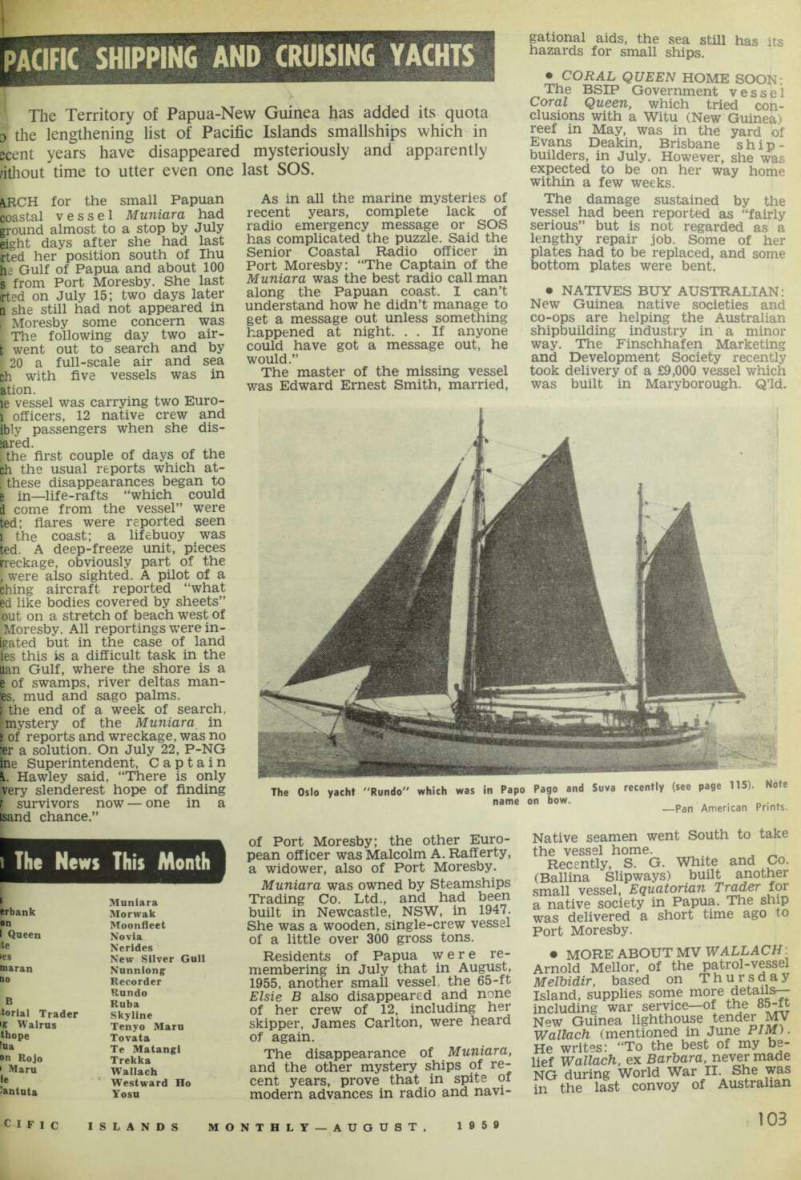
The Oslo yocht "Rondo" which was In Papo Pago and Suva recently (see page 115). Note name on bow. - Pan prints .
Transport small ships which Bimanded from AV Agatha, to [from Brisbane to Lae, but ma, after slowing the Ih convoy to 62 knots, was left nd at Smith Creek, Cairns, with Qe trouble. tnless Wallach has had a new ne since 1952, I am doubtful if made the 7 h knots referred to °IM. Whilst in command of 0 I was seconded to the PCB lost-war years 1951-52 in New lea, and met the Skipper of mra, a WO (1) of Water isport, who had married in lul and settled in the Vitu ids.
Ince Barbara became Wallach, in , and until recently her master Captain Charlie Hart. Charlie, ix-RAN petty officer, and later A.B and bosun on the coastal s in Australia will be missed by arai residents, and the small p fraternity in NG-Papuan irs.
'aptain ‘Digger’ Petersen, of the Ihouse-tender Swingle, Thurs- Island, left TI some months ago ake over the Wallach, whilst our has it that her engineer of iy years standing, Mr. George dns, is being transferred to TI the Swingle. To George this
transfer will be like returning home, as he was previously Skipper - Engineer of the Reggie P (now Gelam ), a 60-ft ‘K’ class vessel owned by the Islands Industries Board of Thursday Island. His son lan is a radio operator at the DNA Base Radio Station.”
Life With The Mother
SHIPS: A Japanese tuna-fleet mother-ship dropped in to Suva at the end of June, bringing with her a strong smell of fish and a wealth of information on mother-ships in general and 1959 operations in par ticular.
The vessel was the 11-year-old, 3,711-ton motor vessel Tenyo Maru No. 3, commanded by Captain K.
Tsuruda and owned by Japan’s largest fishing and whaling organ isation, the Taiyo Fishery Co. of Tokyo.
Aboard her were 174 men, some 50 of whom were crew, and the remainder mainly fish handlers.
These latter were under the con trol of Fishing Manager Nobuyoshi Tanaka. There was also an official of the Japanese Ministry of Agri culture aboard to police the area of operations permitted under the vessel’s licence. The Agricultural Ministry controls fisheries in Japan.
Most prominent feature of this vessel is her twin side-by-side funnels, which are typical of whal ing factory ships—which in fact she was when first built. However, she
[?]o the strict US quarantine regulations [?]ing the importation of livestock into the [?], no shore contact was allowed with [?]o" at Suva or Honolulu. Here the ship's [?] are lowered in a bucket to the Suva when the vessel called for water and [?]inkers in July. See story page 113.
K too small and uneconomic, is converted to her present fin the process the whale [g channel in her square stern
|osed off.
[prominent in more ways than rere the hundreds of shark drying on lines high on her between the pair of powerfully hiotor launches, f mother-ship fleets are re !d at present to waters south degrees North, and eastward >f 170 degrees East. Thus, they iot operate west of a line just of Ocean Island, the New lies, and Norfolk Island. Any e vessels sighted west of this [that is, in New Hebrides, |ons, New Guinea, Australia B are vessels based at Santo ago Pago, or vessels direct [Japan but not attached to
kother-ship fleet.
i year, as last, there will be another-ships operating in the [ Pacific, but there will only bvo separate fleets. Captain Ida’s fleet of 36 long-liners, of 70 to 150 tons and with a of 20-odd, will be taken over • mother-ship Koyo Maru, 7,400 ' about mid-September, when ) Maru No. 3 will head home ike one voyage to the United B with a full load of frozen ; Antarctic whaling season will in January so after a short she will be off south with ies for the company’s three ing fleets and to load pack- I whale-meat for Japan. One 1 trip to the Antarctic will see [haling season through—it ends ly late in March —and it will ime to prepare for another fishing season in the South ic. is is the life cycle of Tenyo \ No. 3. Koyo Maru, in June, far north in the Bering Sea ;ing a salmon fishing fleet, e other mother-ship on the grounds this season is the i new 9,100-ton Nojima Maru . d by an opposition company, on Suisan KK of Tokyo. Early
in June one of her 36 long-liners was reported missing south of Ocean Island—and was still missing a month later.
In operation, a mother-ship lies for days with her engines stopped, drifting in the vicinity of the agreed station. The fishing vessels cruise far and wide within the permitted area, returning as necessary to the mother-ship to unload their fish, take aboard water and fuel oil.
Normally the long-liner’s crew-men stay aboard for as much as six months at a stretch until they re turn to Japan—unless the ship is forced to put into port for urgent repairs.
Two of the Taiyo-owned long liners might come into Suva for slipping and bottom painting this season.
Radio contact is between mother ship and each long-liner every eight
hours. They report their position, weather conditions, the kinds and quantities of fish taken, etc.
Normally, there is an understand ing that mother-ships will not approach one another by less than 600 miles—though there is no re striction on the fishing vessels of one fleet mingling with another, which they in fact do.
In poor visibility the long-liners are guided back to the mother-ship with the aid, first, of that vessel’s radio direction finder, and as they get closer, with the mother-ship’s radar. Very little radio telephone communication was employed be cause there are widely differing dialects in Japan and this involves problems which do not exist with morse —or the Japanese version of it.
The mother-ships maintain con stant radio watch on their fleet frequency as well as on the inter-
[?]ew of the yacht "Nerides” which was in Pago Pago early July and later that month [?]r NZ. From left to right; Athol Rusden (navigator); Edward Copsey (skipper); Tom Prettiman and George Gilkey. —Pan American Prints.
ial calling frequency, there be ur radio officers in each vessel, adio room is, in fact, the nerve s of operations, and the radio •s also have to service the nent of long-liners which come >ide. octor aboard the mother-ship for the 1,000 men of the fleet, Suva, Tenyo Maru No. 3 loaded 750 tons of diesel oil for her engines and for those of her also boiler oil for her st-am s which power her winches leaters —which are very neces jn the Antarctic voyages—and >ns of fresh water, was in Suva for less than 24 and her destination on sail vas 15 degrees South, 1731 es East—or roughly midway en Rotuma and Vila. Four ve long-liners were awaiting and there she will stay until lain fishing activities shift to other central area. Meanwhile la Maru is stationed a little if the Ellice Islands, ile in Suva, Captain Tsuruda, jhalf of the president of the i Co., presented very large in glass cases to the Corn ier of the RNZAF base, to the Medical Officer of the CWM ital, and the Governor of Fiji, gifts were in appreciation of a 7 mission carried out last No er when urgent medical sup were dropped to the mother Koyo Maru by a RNZAF fly oat when a man became seri ill and a certain serum was Jd.
3Uva Is Busy Port: Over
vessels are calling at Suva in ily increasing numbers, and year is likely to show a sub ial rise on last., i’s latest trade report gives the
number of callers from 1954 to 1958, year by year, as 206, 222, 238, 281, 317. The total tonnage rose from 700,000 to 1,162,000 over this period, New overseas connections were established late in 1958 by the Royal Inter-Ocean Line (Dutch), and China Navigation Co. (British) and a new flag was seen regularly in Suva—that of Tonga, worn by Tonga Copra Board’s Aoniu which insti tuted a regular Nukualofa-Suva cargo and passenger service, The P & O Line also made a first appearance. Pilots were provided for 147 vessels inwards and 117 vessels outwards last year. Suva’s Harbour Master is Captain E. L.
James.
• They Stared At This One:
Four Most technically interesting craft to rater Suva for a long time past was the 3,889-ton heavy-lift ship Yosu flying the flag of the Republic South Korea, commanded by Captain You Sang Jun, and under charter to Pacific Islands Ship building Co. Ltd., of Hongkong,
This is the firm which has built a number of ships and barges for South Pacific owners in the past two years. Two such steel barges one weighing 110 tons (the heaviest item aboard), were included in Yosu’s cargo, all of which was con signed to Christian!-Nieslen & Gammon Ltd.
A third barge had been picked up at Singapore. With the exception of the main portion of one crane—for use in the construction of the new Suva PWD slipways—all the cargo of machinery, steel-work, etc., was discharged into these steel barges at Lautoka for use on the big £2,000,000 Lautoka wharf job which is now well under way.
Yosu bunkered and took in water at Suva before proceeding to Lau toka, rigging her 120-ton derrick, and lifting the big barge. She took a 15 degree list as this was swung slowly overside. To prevent all swinging of the heavy items during the lifts, the huge hook was held by four powerful purchases controlled by separate winches.
The ship’s main mast is located in the centre-line and braced by a massive sheerlegs arrangement on the starboard side so that she can work two hatches with the single derrick.
Discharge with this main derrick is thus confined to the port side.
Before commencing loading at Singapore all the gear was subject to stringent survey, and again at Hongkong before lifting the 110-ton barge which was believed to be the heaviest item ever handled by the ship since she was built for Ameri can military operations as Gadsen in 1944.
She received her present name in 1955. She was transferred to the Korea Shipping Corporation a gov ernment organisation, under an American assistance arrangement which requires her to carry f t the time being one American Super- Chief Engineer— Mr. Fred Collins, of Seattle.
All others aboard were Korean.
Captain You spoke no English but
[?]da", first Jamaican yacht to cruise the Pacific, was in Suva in June and reached Australia July. Those aboard were, from right: Mr. and Mrs. Alistair D. Fraser, the owners; Mr. [?]ie Tetiki, a Hutihuti of Takaroa; Mr. Jack G. Russell, a Hollywood "ideas man"; and Mr. Andre Mayet of France.
ung officers had a fair com of it. One of the brightest board was Cadet Officer Ahn [ Sung, who had been at sea is than a year after five years nautical college. He will sit icond Mate’s ticket after two at sea, it is based on Hongkong, and een engaged in recent years ming locomotive engines from to India. She rarely visits her port of Pusan.
Aptain Cook Re-Dis
KS FIJI: Captain Cook pe ered Fiji in July—Captain ir t Cook, great-great-great son of James, and with an un ted Scottish burr in his voice, vessel was the 2,750-ton, year ’reighter Greathope, of New -upon-Tyne, owned by the igin Steam Shipping Co. Ltd., tily one of the company’s four s not laid up at present. Ship conditions in the UK are still slack. ?tain Cook said that he left on last March with a cargo Jgar for Basra, where dates
were loaded for Whampoa, thence ballast to Moji, and cement from there to Darwin for the new jet airstrip.
Clearing in ballast for Auckland the ship was diverted by radio to load sugar at Fiji, for which area she had no charts. A quick call was made at Cairns and the agents there sent a package of charts aboard, but later when they were opened they were found to be the wrong charts.
A rough plan of the approaches to Suva was made with the aid of the Pilot Book information. Adverse weather was then experienced and when the ship finally arrived at reduced speed to be boarded by a pilot well off-shore she was just
about at the end of her oil bunkers, though she had a normal month’s cruising range, Explaining the Scottish accent, Captain Cook said that his grand father had taken the first steam trawler from an English port to Aberdeen and had settled there. He himself was the only member of his family at sea, and it looked as though the tradition might be broken as his own son was training for a life ashore, Greathope was to discharge her sugar cargo at Auckland, load timber at Tauranga for Japan, make per haps another run south to Darwin with cement, and, with luck, be back by October. Under normal condi-
Captain Robert Cook who has been [?] in an ancestor's footsteps and dis the Pacific (see this page). [?]M: Suva's Harbour Master, Captain E. [?] who has been having a busy time re [?]ee story, page 109).
she would be trading only in Sea-Mediterranean waters.
Lterations To Hifofua :
mga Government’s ocean tug ter-passenger craft Hifofua Suva in July being fitted with r type of winch. It was de that the existing winch, in l manfiy for cargo handling so for towage, was unsuitable le job ahead, which will be f towing a big steel oil barge Suva to Nukualofa and per- Apia. Important alterations also being made in Auckland i steel barge as it was con d that the original design be unsatisfactory. Hifofua d south about September when arge may be ready.
'Hat Lamb Chop; To See
of sheep faces staring from portholes of a big passenger is rather surprising, to say the and it is difficult to say which the more interesting sight—
the white woolly faces of the lambs looking out on Suva from Delfino’s port-holes, or the dumbfounded faces of the Japanese crew of Kinkai Maru which Delfino moved close past as she came in to her berth. Captain Uchimura and his men hadn’t been reading the Syd ney papers.
Though a pilot would have been permitted to climb directly to the bridge of Delfino, Captain Lucas made certain that there would be no argument with the United States animal quarantine people by bring ing his ship in and taking her out himself.
The wharf was screened off and only a few officials approached the ship s side to exchange documents by bucket and satchel lowered from the deck.
Friends and relatives of the Fiji born crew and stock-tenders con versed at volume and at a distance.
Visible on the boat deck was the only female in the ship’s personnel.
A veterinary officer who is the wife of the ship’s veterinary surgeon.
Stock-tenders on board said that up to arrival in Suva 180 of the 30,000 lambs had died. The bodies were examined for cause of death before being thrown overboard. Most deaths were thought to be due to lack of sufficient ventilation in some parts of the ship and excessive heat, especially in the tropics, but the number dying was probably not considered excessive and undoubtedly experience would be gained in cor rect management during this first of what is intended to be a series of such voyages from Sydney to California.
Australian frozen mutton is not banned from the United States, but it is the contention of Mr. James Delfino, the Californian who organ ised this trade, that fresh mutton will be in much greater demand than frozen mutton. After arrival the stock will be fattened to American requirements before being slaught ered. What is surprising is that lamb from Australia, after paying all the costs of “on hoof” delivery, can still be sold cheaper than US lamb.
Delfino took aboard only water at Suva and was on her way again within six hours. More water was to be taken at Honolulu. The total voyage would probably take about 24 days to San Diego.
The 10 horses also aboard the ship were reported in good health in their deck pens at Suva.
• Uncrossing The Wires;
Suva’s month of unusual shins in cluded the five-yen r-old British cable ship Recorder, 3.349 tons, comby Captain P. B. Hender son. Based at Singapore, Recorder is flag-ship and newest of the Cable & Wireless fleet which includes the Edward Wilshnw, Norseman . Mirror, Lady Denison Pender, Retriever, and Electra —with another soon to be built.
Recorder repaired the Suva- Fanning No. 1 cable, which had de veloped a “shore end” fault near Fanning Island. She then replaced 50 miles of deep sea cable on the Suva-Norfolk Island leg, which had been temporarily repaired following the 1951 Suva earthquake. Detailed soundings were made of this earth quake fault area on behalf of the Fiji Geological Survey department.
Leaving Fiji, Recorder was to survey a route towards Auckland for a telephone cable which it is expected will be laid within the next few years right across the Pacific from Canada to Australia in parallel with the existing telegraph cables.
• Demoted But Reprieved;
That famous ex-US sub-chaser, now known as Tovata, and laid up many months ago as no longer fit for ser (Over)
[?]tain You Sang Jun of the South Korean [?] ship “Yosu", in Suva recently. And.
Yosu's" 120-ton carqo hook being pre pared for business.
vice in Carpenter’s Fiji fleet, sti of machinery and fittings,, offered for sale as she lay at ings in Suva’s Bay of Islandc bought on tender in July ti A. S. R. Macalister, Suva metal merchant. He intends verting her as a cargo light! towage and storage duties.
• Not At Home: Fiji’S
Lighthouse on its lonely ro miles south of Suva, after 71J of occupation by light-keepei their families, was extinguish July 13. Ten days later it res its winking at passing marinr an automatic gas light.
There was never a radio s there —except perhaps in war-and it was never a popular s with keepers. Deck officers i habit of signalling passing houses may wonder for a whil. there’s no response—but the re Notice to Mariners will explas a way, the change-over was su stone in Fiji’s history.
• Bank Line Shii
TROUBLE: The Bank Line fre Beaverhank, which ran agrouc a reef on the weather sii Fanning Island on July 6, w\ floated on July 24 and was in lulu in early August.
In the first few days of the tn the Master of Beaverhank ha holds flooded to keep her froc ing further onto the reef, and menced to unload some of the? into the Fort Beauharnois, had arrived from Christmas nuclear testing area, to help. T'. perts from Sydney, Captain Bui of Lloyds, and Bank Line M Superintendent Captain Ana left Sydney by air for Suva they were picked up by the R Sunderland. Bad weather di their first attempt to reach Fai A spokesman for the Bank! said in Sydney on July 24 tM understood that a tug from lulu had reached the stn vessel; some of the copra hao unloaded but it was possible some of it would have beer tisoned. An unconfirmed repor: Suva was that coconut oil in Suva had already been jettii Beaverhank, 5,690 tons, an years old, left Suva with 2,50( of coconut oil in her tanks, bags of copra meal and some? for Gilberts and Line Island] eluding new generating madt for Fanning Island Cable stas on June 6. She subsequently * Tonga (according to Sydnea ports) and Tarawa, in the Git where she took on the biggesa E Is. Copra shipment for y* 2,600 tons. She was to top-ru cargo at Fanning Island plant!
Ltd. before sailing for the Whether she had commenced! ing there before the mishap known.
Mr. P. F. D. Palmer, manage Burns Philp of Fanning Is. P c
missed all the excitement as s at present in Brisbane on
antime, Gilberts copra shippers
sitting with fingers crossed
ig the vessel got off before their k was thrown out. It’s insured, urse, but it seems that normal dure is that payment is not
t until the vessel completes
ig at her final port.
,fs of Cruising Yachts
lUNDO OR RUNDOE, is how the 14 ft. x 15 ft. x 8 ft., Colin Archer ketch is named according to the of our various correspondents in Pacific, although our photograph shed page 103) seems to show con sly that it is RUNDO (unless that "e” has got washed overboard en ig Brunborg and Carl Petersen are I the ketch, which left Papeete June Ived at Suva July 14 after a week ;o Pago and a further week in Apia, some Fiji inter-island cruising she continue westward for the New les.
IABOON, a 50-ft. schooner of Acu with John Prisch in control, was ed to head for Tahiti this (southern) f.
ELPIE of Newport Beach, California, by George Minnie, is also expected 'heading for Papeete by now. This 8-ft. schooner.
SKYLINE of Auckland, homeward i with Denis Ryan in command and sompanions Gerry Bradbury and Guy itrick of Canada, and Irishman Mnningan, was in Rarotonga early [E MATANGI and the Fergusons of 8 left Rarotonga for Nukualofa on 29.
FLYING WALRUS of Westview, BC, John, Diana, and Pamela Wells, up in Whangarei, NZ, for over a may remain there for the best part fiber year. Sailing date is now fixed »nt April, 1960, meanwhile John has there.
SOVIA of San Diego, with Lee and Gregg, is likely to remain in Hono ur the forseeable future. The Greggs been in the US, but by now will be living aboard the yacht. Lee was ling there in one of the Trans -6 Race entrants—CLOUD NINE.
HORWAK, with Fred and Malo Bre ere of France, mentioned as outward in last September’s PIM, called the off at Dakar after some mishaps. lUBA, the Spanish-owned Hongkong junk yacht which cleared that port pain on January 17, was skippered se Maria Tey, and crewed by 8 or 9 l. The vessel is of 60 tons. No pro reports to hand yet, nor details of led route.
WESTWARD HO—listed in June PIM IHITI WESTWARD HO, confirmation ed —was reported at Papeete from o via Honolulu in mid-June. No de af crew.
CELESTE, a photo of whose crew ■red in July, was apparently the 40- ’anama cutter sold in Papeete a e of years ago by owner Cosmos to Cameron, crewman of the 69-ft.
Ington, California, ketch CELEBES.
BES made a return run Papeete a-Papeete recently.
NEW SILVER GULL, of Sydney, lies Walu Bay berth in Suva while owner F Scott recuperates from a successful Jion. Mrs. Oceana Scott meanwhile
has put the yacht through a dry-docking and bottom-painting. The Beins flew home to the US. • ADIOS and the Steeles were still lay ing off Millers Boatyard at Suva late July with no particular sailing date posted. • DIDA, of Jamaica, cleared Suva for Noumea early July, with Ken Mildon of Auckland—who earlier planned to help deliver MOONFLEET there—as an added crew member. She arrived in Brisbane July 19 partly disabled (broken drop keel, rudder trouble) after two days battle with cyclonic weather. Reached Sydney end of July. • MOONFLEET continues to air her wings in Suva harbour-cruising at the week-ends, under the caretakership of Allan Akins of Cable and Wireless, Ltd. • HALCON ROJO, the 37-ft. Chilean schooner which we reported in April PIM as having arrived at Papeete last Decem ber, was manned by Alfonso Jaramillo and Waldo Carrasco, according to the Slocum Society. PIM has had no direct informa tion of this yacht or her later move ments. • TREKKA and John Guzwell of Canada were reported at Barbadoes April 21 on the last lap of a circumnavigation. • LA CANTUTA ll—or is it CANTUTA 11, the news agencies don’t care—came up with a radio signal during the first week of July and told a Peruvian radio amateur that the raft was progressing favourably towards Samoa and was “near the Mar quesas”. How near, or which side, PIM has no information. The drift-and-sail voyage of the 29V2-ft. x 16 ft. balsa raft commenced from Callao, Peru, last April 12. In command Eduard Ingris of Czecho slovakia, and with him Messrs. Josef Matous, Joaquin Guerrero, and Jaime Toledo. The raft has a 29-ft. bipod mast forward, an after mast, and a triangular
bowsprit arrangement. She has a rudder and wheel and six leeboards to improve sailing performance. There is also an oul board motor to assist a safe landing at the end of the voyage. There are two lifeboats, one of rubber. There is an electric generator aboard and a great deal of sundry equipment—movie cameras, weather instruments, etc. In tow is a smaller balsa raft 13-ft. long associated with spme experiment requested by Thor Heyerdahl of KON TIKI. By the time this appears the voyage should be close to finished. See Pacific Report. 0 UNION G, 63-ft. motor cruiser ™ ed by » M * f z * ard ? f Metung. Vic ‘or*a* .^ as . ln J" r w °T J c ? urs ® , of
cleared" thlre^uly M headSi®' simaril
Lae, Rabaul, BSIP and home. Crew in eluded Dave Beard who is an experienced yachtsman—originally he sailed in SKAFFIE and later in KOCHAB. This cruiser has the lot—electric stove in the galley, deep-freeze unit, echo sounder and other refinements. • ALSO from Port Moresby comes news G f the catamaran which made some local news when it arrived there in January after being reported lost. (See photo February PIM). Owner, Frenchman Maizonnier who lost his original partner, recruited another, R. Debitt, in Moresby and they left in her mid-April for Samarai. This passage took 12 days but after two days rest the adventurers pushed off again for Cairns but the sou’wester proved too strong and after two suits of sails were blown out were forced to turn back to run before the wind with only staysail. They made the coast near Moresby. Maizonnier left for South by conventional means—to earn there enough money to return and carry on the cruise.