Lovable Rascal
pp. 89-103 · Read in the full issue

He Was The Start Of
Brett Hilder's Profiles
Lovable Rascal Of The Pacific
When James A. Michener, author of Tales of the South
Pacific, was leaving Guadalcanal
in 1949, his only regret was that he hadn’t seen a crocodile there.
Someone consoled him. “Don’t
worry. At Santo you’ll see Tom
Harris.”
NOT until then did I know what had so intrigued me about the set of Tom’s jaw. especially when clamped on a cigar. Apart from Tom, ths New Hebrides are free of crocodiles, in spite of being so close to the Solomons. An old rumour that the tracks of one had been seen on Santo some years ago has never been confirmed, for the tracks may have been made by human hands, after a surfeit of square-face gin.
In any case, every cigar which came into Tom’s hands came to a sticky end. I bought him a box of good cigars from Sydney, and their fascinating fate gave pleasure to us both.
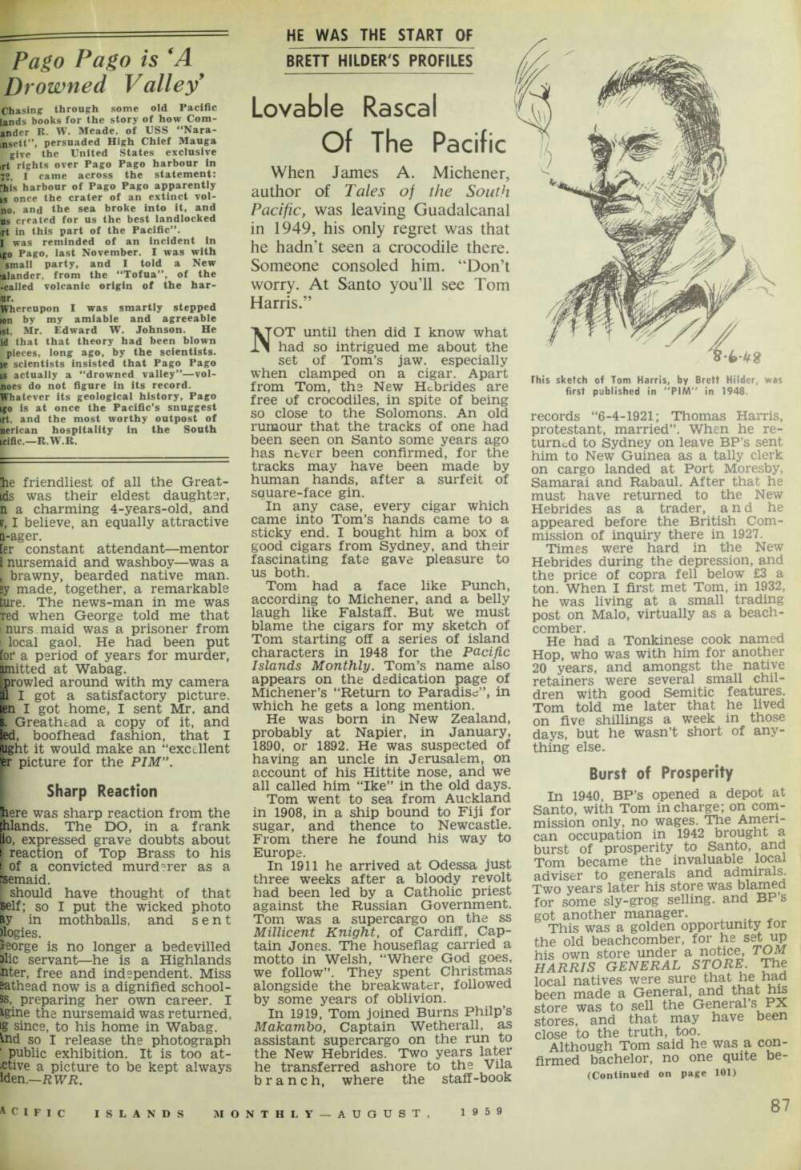
Tom had a face like Punch, according to Michener, and a belly laugh like Falstaff. But we must blame the cigars for my sketch of Tom starting off a series of island characters in 1948 for the Pacific Islands Monthly. Tom’s name also appears on the dedication page of Michener’s “Return to in which he gets a long mention.
He was born in New Zealand, probably at Napier, in January, 1890, or 1892. He was suspected of having an uncle in Jerusalem, on account of his Hittite nose, and we all called him “Ike” in the old days.
Tom went to sea from Auckland in 1908, in a ship bound to Fiji for sugar, and thence to Newcastle.
From there he found his way to Europe.
In 1911 he arrived at Odessa just three weeks after a bloody revolt had been led by a Catholic priest against the Russian Government.
Tom was a supercargo on the ss Millicent Knight, of Cardiff, Cap tain Jones. The houseflag carried a motto in Welsh, “Where God goes, we follow”. They spent Christmas alongside the breakwater, followed by some years of oblivion.
In 1919, Tom joined Burns Philp’s Makambo, Captain Wetherall, as assistant supercargo on the run to the New Hebrides. Two years later he transferred ashore to the Vila branch, where the staff -book
records “6-4-1921; Thomas Harris, protestant, married”. When he re turned to Sydney on leave BP’s sent him to New Guinea as a tally clerk on cargo landed at Port Moresby, Samarai and Rabaul. After that he must have returned to the New Hebrides as a trader, and he appeared before the British Com mission of inquiry there in 1927.
Times were hard in the New Hebrides during the depression, and the price of copra fell below £3 a ton. When I first met Tom, in 1932, he was living at a small trading post on Malo, virtually as a beach comber.
He had a Tonkinese cook named Hop, who was with him for another 20 years, and amongst the native retainers were several small chil dren with good Semitic features.
Tom told me later that he lived on five shillings a week in those days, but he wasn’t short of any thing else.
Burst of Prosperity
In 1940, BP’s opened a depot at Santo, with Tom in charge; on com mission only, no wages. The Ameri can occupation in 1942 brought a burst of prosperity to Santo, and Tom became the invaluable local adviser to generals and admirals.
Two years later his store was blamed for some sly-grog selling, and BP’s got another manager.
This was a golden opportunity for the old beachcomber, for he set up his own store under a notice, TOM
Harris General Store The
local natives were sure that he had been made a General, and that his store was to sell the General s PX stores, and that may have been close to the truth, too.
Although Tom said he was a con firmed bachelor, no one quite be
(Continued on page 101)
This sketch of Tom Harris, by Brett Hilder, was first published in "PIM” in 1948.
I him, for he educated three is Hebridean children, Victor, and Norah. Victor was killed road accident a few years ago, ;he other two are married and children: Alec to a girl of Itephens family, and Norah to enchman named Arnould, at j. til World War 11, Santo was ly known from its first dis y in 1606 by Quiros, because ailed it “Tierra Australis del itu Santo”, thinking that it he Great South Land of Terra
•alis Incognita.
hough it was a Spanish ex ion, Quiros was a Portuguese, ibout 1930 the Portuguese Gov ent offered a prize of £5,000 for relics of Quiros which could >und on Santo,
When Tom heard this he hurried along the beach to Mat Wells’ place on Malo. Before he had breath to tell his story, Mat said. “What do you think of this?” and produced an old box which contained some ancient pewter mugs and other collectors’ items.
After encouraging Tom’s dreams of the £5,000 for a long time, Mat confessed that the relics were only some heirlooms sent to him from his father’s estate!
In 1948, Tom Harris started a cinema at Santo. It was not only with American wartime machines and buildings, but with a Hollywood man as projectionist, Ray Jenkins, the only Yank to come back to Santo after his war service there.
The Cinema Harris” became the focal point of life at Santo for several years. Tom sold it in 1955 and it still flourishes under different ownership.
During the last few years Tom had been suffering from a bad heart and other maladies, making him a frequent patient in the French hospital at Santo, and a virtual in valid at home. His death earlier this year was mercifully sudden, and he was buried with full honours by the Catholic Church. He will continue to be remembered with affectionate relish by all who knew this lovable Rascal of the Pacific. And the island of Espiritu Santo has lost the only live crocodile it is ever likely
to have.