Tinker Missionary
pp. 86-103 · Read in the full issue
A Private Diory Tells of an Unsung Hero of New Brito[?]
Rev. Ben Banks , The Tinker Missionary
By R. W. Robson
Who was New Britain’s first and outstanding hero? Afl dredging through old Methodist records in the Sydney Mitchi Library, I think I should give the palm to a skinny, bewhiskei brass-finisher named Ben Danks.
r [ROUGH a series of unforeseen troubles, this English lad found himself holding the Mission fort in New Britain single-handed, in 1879. Except for his wife, and a dozen devoted Polynesian teachers, he was completely alone among the most treacherous cannibals in the Pacific Islands.
He never knew the moment when he would be tomahawked and eaten by savages, or suffer assault and humiliation at the hands of law less traders and blackbirders. There is a book on Danks’s work but his diary gives us a more intimate story of the man.
He was only 26 when, ordained as the Reverend Benjamin Danks,
he was sent from Sydney toe Hunter (Duke of York Island help the Rev. George Brown, was December, 1878.
Brown had had 15 year, Savai’i, Samoa.
George Brown, First White SI
When he reached Blanche i New Britain, in 1875, and founo. the permanent residents of parts—the great-great grandfa of our present difficult Tolais? chased out Stevens (a wand trader who had tried to settr; Meoko) and two Germans y the enterprising Godeffroys i tried to establish at Matupi, so
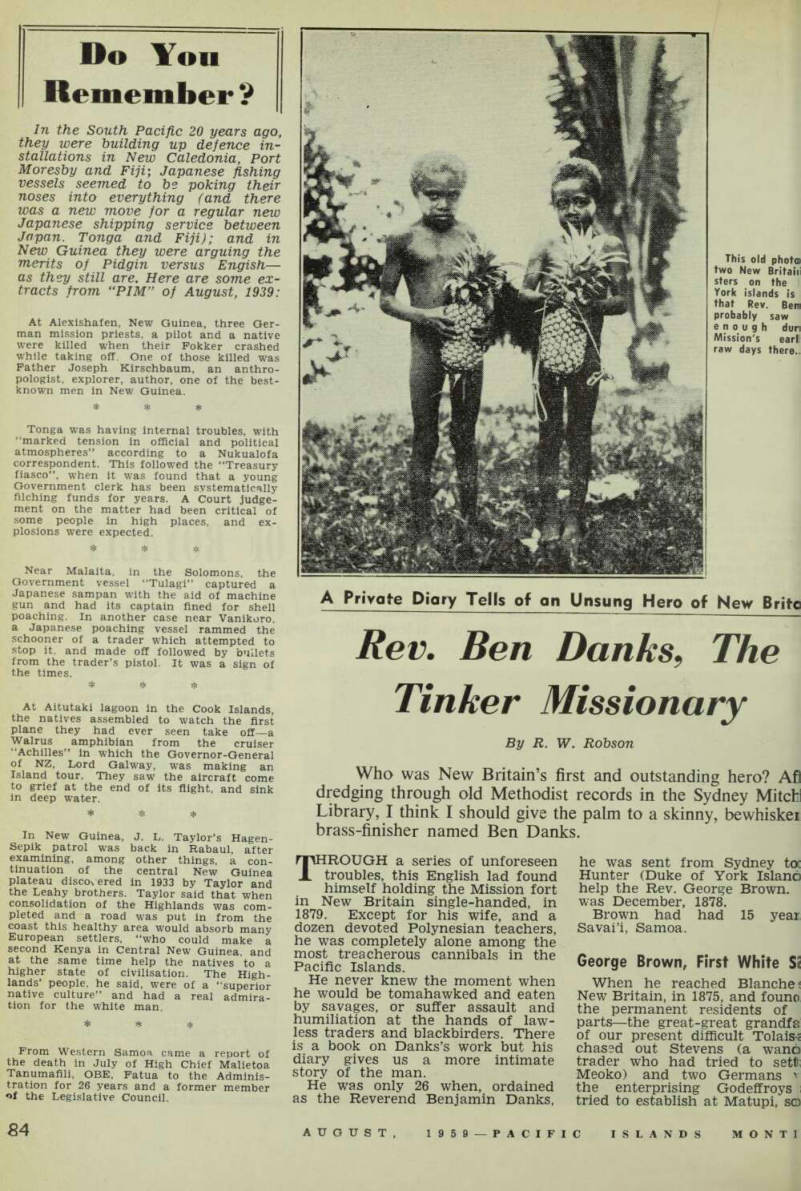
This old photo[?] two New Britai[?] sters on the York islands is that Rev. Bern probably saw enough du[?] Mission's earl[?] raw days there..
ere apparently wasn’t a white in remaining anywhere in the smarcks, Brown must have looked :k on Samoa as a haven of peace d decency.
Heroic Islanders
jrown built his station in Port nter, and from there began to 5 h his heroic Tongans and ians onto the coasts of New land and New Britain. It was irtbreaking work. The savages istantly stalked the newcomers, 1 every so often they killed and . them. But Brown hung on. h 1878, a particularly treacherous i arrogant chief called Talili alili Bay, north of Rabaul, ,tavul-Wunawatung area, where Flived, is named after him) irdered a Fijian minister and his ■ee Fijian helpers and cut up ;ir bodies expertly, and distri ted them among his neighbours, 1 eating.
Jrown with great courage, went and rescued the Fijians’ families; d then, with two white traders id had just settled nearby, he 1 a party into the interior, burned lot of houses and shot some of I worst natives. [t was a wise thing to do, and had a salutary effect on the lili natives —although Talili him f escaped.
But then, as now, unrealistic bblers occupied pulpits and itorial sanctums in Sydney, and ;re was a howl against the heart s missionary who thus would rm the ignorant, defenceless lives. (Someone probably, in the iguage of the ‘Seventies, insisted it the cannibals were “poor, xed-up kids”!) Fhe fevers of those bejungled Dies were really deadly, then, and own already was very sick. He
was rushed South in early 1879, leaving his wife and two children, and his mission station, to the newly-arrived Banks.
Before he was well again, he was hurried off to Fiji, where a dreary team of officials and churchmen argued, lengthily, whether he was guilty of manslaughter. Port Hunter did not see him again for over a year.
The Plight of Danks
Imagine the plight of Banks— wholly inexperienced in Islands work, not knowing a word of the native languages, and a poor mixer amongst whites, isolated among thousands of ferocious cannibals.
Brown got on well with the tough traders, who rarely moved in those days without a gun at hand; but Banks was something quite dif ferent. His intimate private diary shows that he was incredibly shy and reserved, and given to much inward communing with the spirit of faith which ruled his life.
His loneliness was appalling; but, despite fever and native treachery and European jeers, he pressed on tenaciously with his task of con verting the heathen.
There was an endless series of clashes with and between natives —but the English youth never
(Continued on page 97)
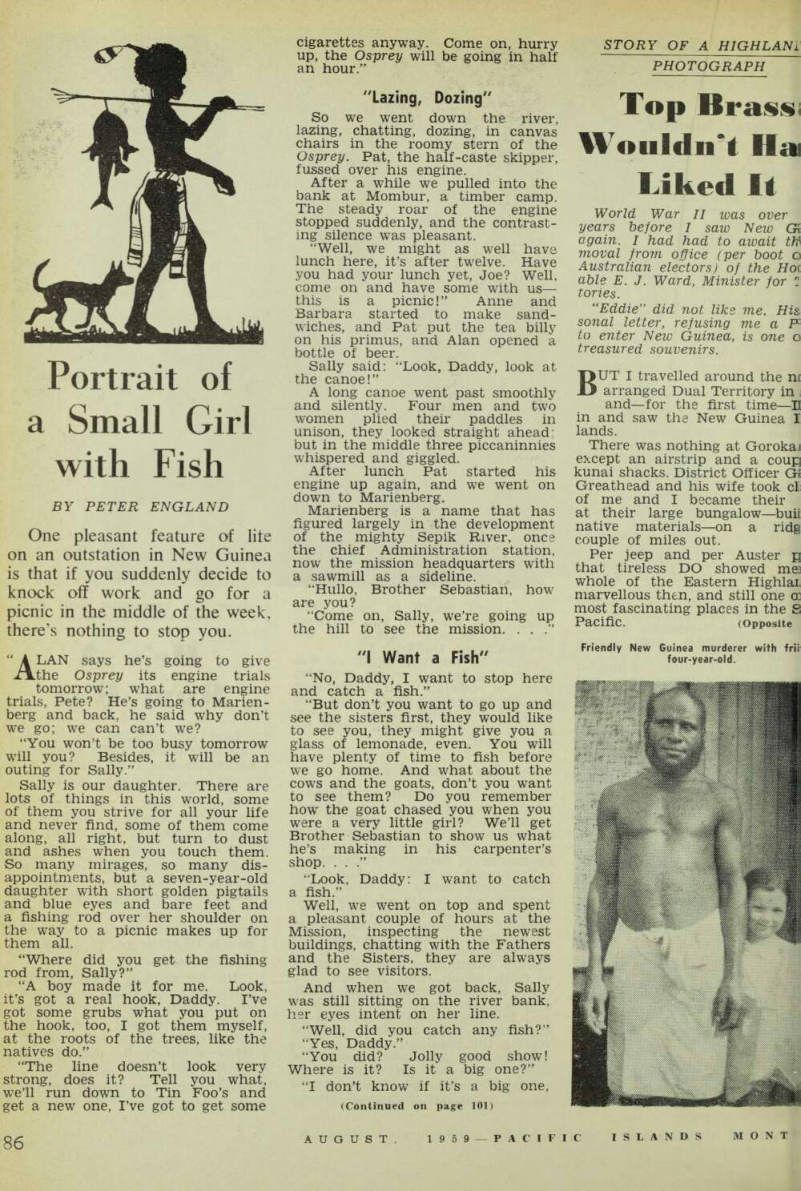
Rev. Ben Danks, as he was late in life.
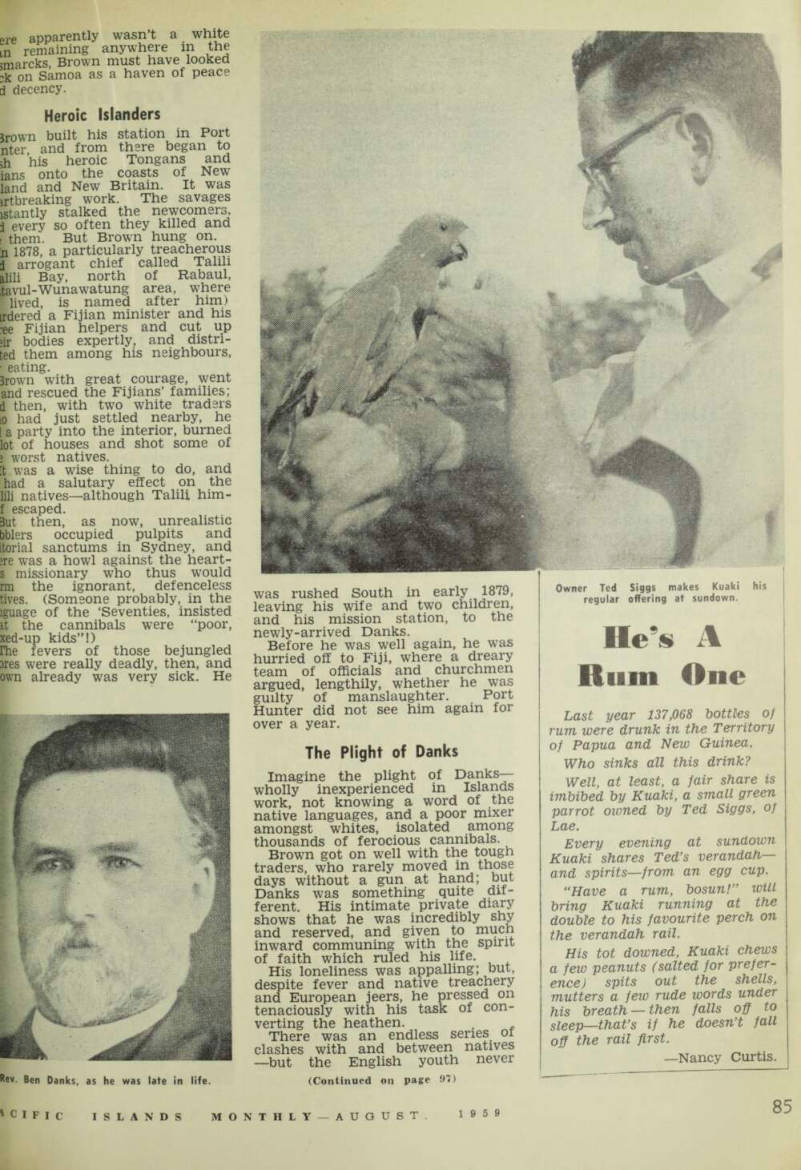
Owner Ted Siggs makes Kuaki his regular offering at sundown.
for weeks, and there was [ng the outraged missionaries I do about it.
Clashes with Whites
was no use appealing to the traders. They were mostly red in “blackbirding” for the lan plantations in Samoa, and s was doing all in his power am the natives against white who tried to tempt them onto
Recruiting vessels.
B traders resented this “mter ce by that damned tinker”. b records the fact bitterly in journal. He says he was it to be a first-class brass ier before he felt the call to nission field—but he was not never had been a tinker.
Bwhere in his diary he com s on “nasty” and “insulting” s received by him from Blohm, sodeffroy manager at Meoko. ieffroys brought in a German list named Kleinschmidt, and d him near Meoko to collect mens for sale overseas, nks clashed with Kleinschmidt ise the latter was buying land imself and building up quarrels the natives in connection with. There was an exchange erce letters, recorded in the Kleinschmidt was brutally ered by natives, soon after 5. those days, they suffered end torture from mosquitoes, and ss sickness from fever; but did not connect the two. At pals of only a few months, of Brown’s small children died fever, and were buried by s.
kurder and Sudden Death
Sunday, October 19, 1879, John >n, second mate, and a Patrick ke were drinking beer on the of the brig Adolph, which was in Meoko harbour. Wilson ed he had had enough, and away and lay down. Bourke ved him and insisted that he nue the drinking. Wilson re 1, and Bourke threw a glass im, and laid his head open.
Ison thereupon leaped upon ke, and threw him to the deck; nered him into insensibility a length of sugar-cane; led him off with a belaying and then, with the help of ate from the steamer Sudsee, t close by, threw Bourke’s body ward. e Reverend Ben, horrified, cted the evidence of murder i witnesses and —entered it culously in his diary! lere was nothing else to be done it it, in those days. There was law in New Britain —the nans did not come in and ;x until five years later. )ing over to Kabaira to a ion station, Banks missed mas Farrell’s trader, Geddes.
He investigated and found that Geddes had died there some days earlier —could have been murdered, but he was not sure. So the missionary buried the remains. He confides to his silent diary that it was a very unpleasant task.
de Ray's Walking Skeletons
Rev. George Brown, honourably discharged from his trial at Fiji, arrived back in Port Hunter in March, 1880; and 10 days later Brown and Banks were staggered by the arrival at their station of a half-dozen starving scarecrows of men who —in wholly insufficient English—begged food and help.
That was the first intimation they had had that the ships of the infamous Marquis de Ray’s “colonis ing expedition” were dumping hundreds of Europeans in a fever ridden hole called Port Breton, at the southern end of New Ireland, and only a few score miles away from Port Hunter.
The story of how Brown and Banks and some of the better-class traders helped the wretched “colonists” would fill a book.
Brown’s health broke again, and he went away, and Banks was again alone.
Farrell had a trader, Berringer, at Kabaira, gathering copra from the natives. Farrell’s cutter, Leolea, Captain Murray, and Farrell's overseer, Anderson, arrived, to load Berringer’s copra. Berringer accused the natives of not delivering copra they had promised. A quarrel developed, and the natives killed the three whites and threw their mutilated bodies into the sea.
Banks told Meoko about it, and the Godeffroy traders went across and recovered and buried the bodies, and repossessed the cutter.
There was reprisal shooting against the natives. One of many such incidents.
Saved By French Doctor
When Banks’s pregnant wife came to confinement, they were completely alone on his station —and the birth went all wrong. The terrified young man did what he could after a dead child was born, and then sent a boat’s crew away to seek aid from a French doctor believed to be among the starving de Ray colonists at Port Breton.
Then, for three days, he sat be side his tortured wife and tried to keep her alive. At intervals, he reported on the matter in his diary. Just when she seemed on the point of expiry, the boat re turned with an emaciated young French doctor; and the Frenchman, displaying skill and resource, did finally save Mrs. Banks’s life.
Those diary entries have lost nothing of their drama and horror since they were written into that old book, 80 years ago.
In 1878, the handwriting in the diary was strong and firm; and
g and firm it remained for wears. Then, although the ian still was under 30, the I begin to waver and shake; the entries are made at longer »als. .
I last entry was on February 82. Some months later, Mr.
Mrs. Danks were shipped out rdney, nearer dead than alive, they recovered, to do much ,ble work later in the Islands
|n field.
ybe he was only a scared sh youth, in a cruel situation.
I never heard of an Islands er with more intestinal ude. One salutes the memory lev. Benjamin Danks, the sr Missionary.