To Chicago
pp. 79-81 · Read in the full issue
A Lifetime's Collection of Treasures
The Pacific's
Best Goes
To Chicago
From Ralph Craih, in San Francisco The world’s last great private collection of Pacific Islands eth nographical articles is now on display in Chicago, after its ac
quisition from the Englishman
who spent his life putting it
together.
THE Chicago Natural History Museum is the new owner of world-famed collection of Cap tain A. W. F. Fuller and his wife.
The museum isn’t saying what it paid or how it acquired the treasures to which the Fullers have devoted their lives. But it is happy to report what it got: 15 tons of crates with 6,500 carefully-documented speci
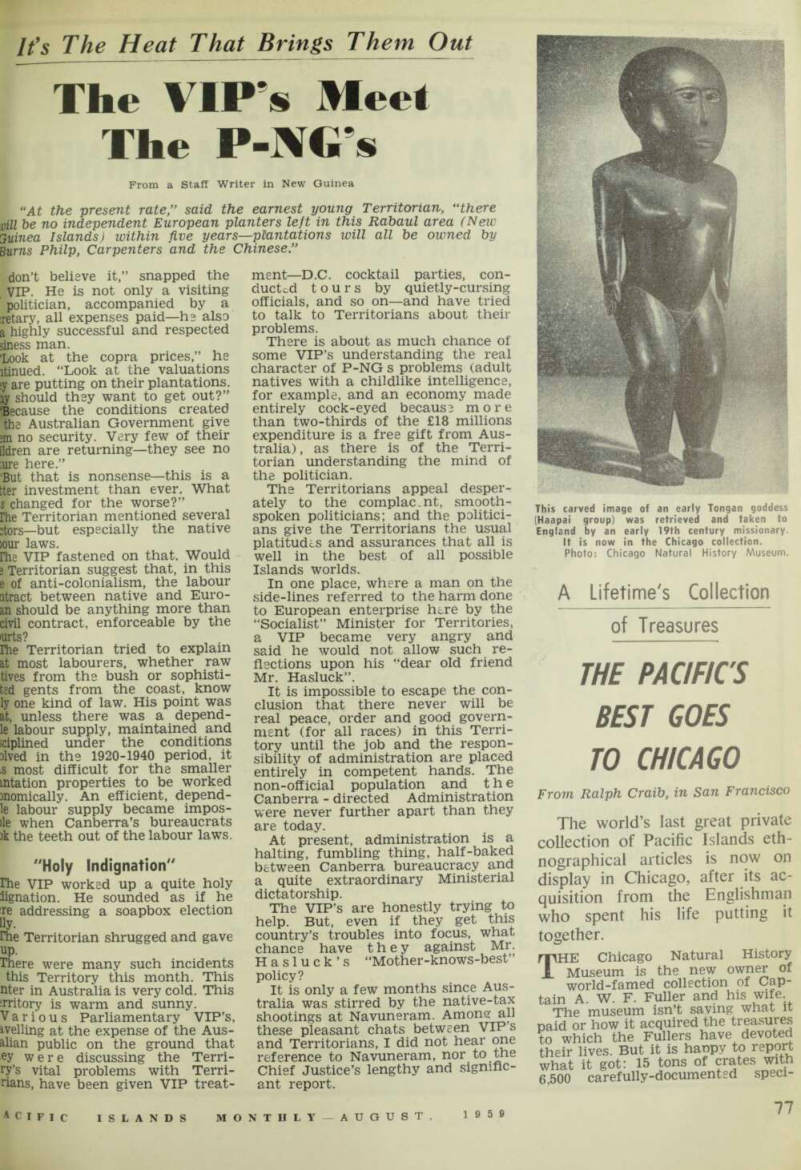
This carved image of an early Tongan goddess (Haapai group) was retrieved and taken to England by an early 19th century missionary.
It is now in the Chicago collection.
Photo: Chicago Natural History Museum.
■ns including some objects that re apparently brought to England the survivors of Captain Cook s rd voyage (1776-1780). >ixty-two years of patience and ney went into the collection, which ran when Fuller, then a teen er attended a London auction h his father. The boy bought a i war club in 1896 and never pped adding after that, ruiler attended auctions persist ;ly, bought articles when small vate or provincial museums were ng closed, and dealt with dealers the United Kingdom and on the otinent. Although trained for the L he gave his loyalties to the lection; the only period not spent tivclv in fostering it was during ; World War I military service.
Early Days
Huch of the collection comes from 8 early days of civilised contact th islanders; some objects were jught back to England by traders, ssionaries and explorers and nded on to their heirs.
Captain Fuller held a position th the British Museum for a mber of years and knows its ex llent collection well. He was a jmber of the Royal Anthro logical Institute Council for ireral years and was an intimate end of many of the great men in thropology.
During World War 11, the collec m escaped possible destruction len many of its most valuable ecimens were stored deep in a elsh coal mine, with British nseum treasures. Bombs levelled uses adjoining that of Captain d Mrs. Fuller and several maged the Fuller home itself.
The collection has found its per cent public home in Chicago— id not in any of the numerous useums elsewhere in the world lich wanted it—because of a series friendships dating back more an half a century.
Scientific Study
Percy Edmunds, a Briton who was e Chilean Government’s repre ntative on Easter Island, was put touch with Capt. Fuller not long ter the turn of the century when s parents, in London, placed a iwspaper advertisement asking for formation about the place their n was stationed. For half of the «t 50 years, Edmund collected for iptain Fuller.
After World War 11, Edmunds re red and moved to Tahiti, where he et Robert Trier, a contributor to ie Chicago Museum of Natural fstory. Trier visited Captain and is. Fuller on a subsequent visit to agland and advised the Museum iat it should acquire the Fuller election. In 1957, Trier made in lines with the Fullers and learned iat they were interested in hous
ing the collection in a major centre where it would be available for ex hibition and scientific study.
The Museum formed a trust fund, soliciting donations for the acquisi tion. Dr. Roland W. Force, of the Museum staff, spent six months in London last year taping records of comments by Captain Fuller about the specimens. Then the big crates were placed aboard the Norwegian freighter Rutenfjell for shipment across the Atlantic and down the new St. Lawrence Seaway to Chicago.
Addition of the collection gives the Chicago Museum one of the world’s best collections on Polynesia, Melanesia and Micronesia.