In Low Cost
pp. 71-73 · Read in the full issue
It's a "Tessyfon"
Ultimate
Houses
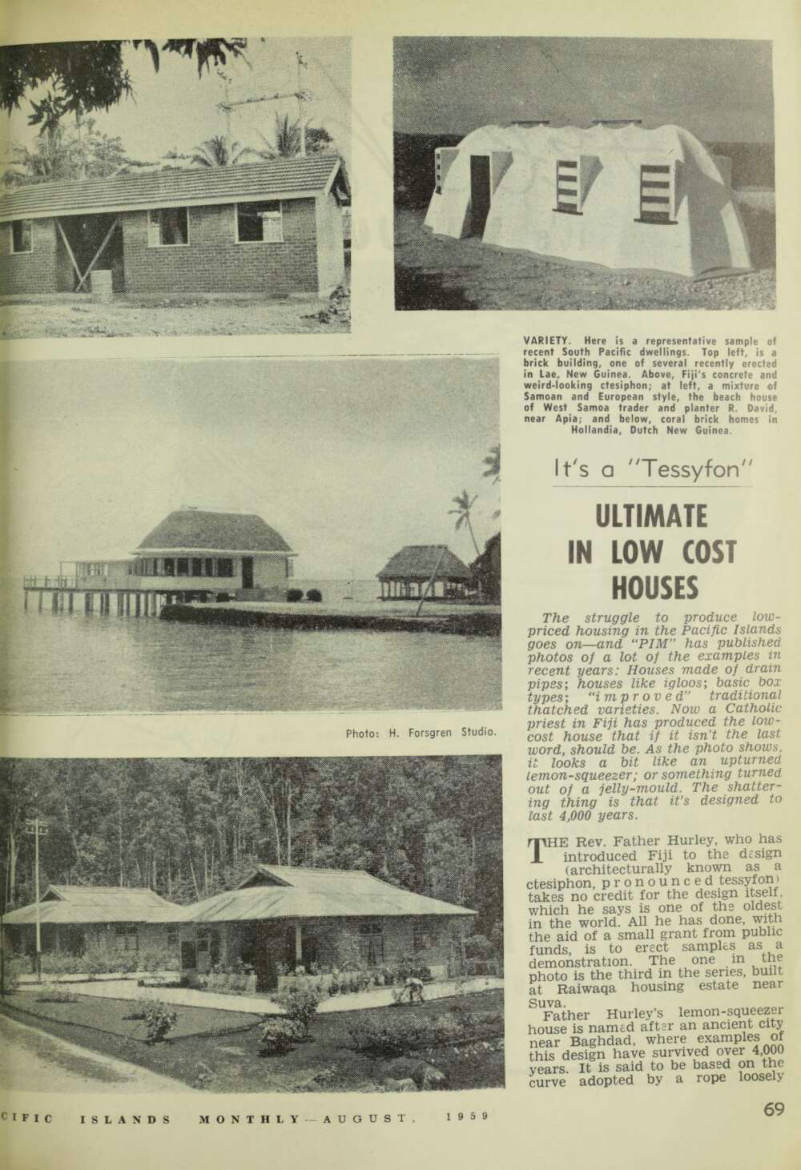
The struggle to produce low priced housing in the Pacific Islands goes on—and “PIM” has published photos of a lot of the examples in recent years: Houses made of drain pipes ; houses like igloos; basic box types; “ improved” traditional thatched varieties. Now a Catholic priest in Fiji has produced the low cost house that if it isn't the last word, should be. As the photo shows, it looks a bit like an upturned lemon-squeezer; or something turned out of a jelly-mould. The shatter ing thing is that it’s designed to last 4,000 years.
THE Rev. Father Hurley, who has introduced Fiji to the design (architecturally known as a
ctesiphon, pronounced tessyfon)
takes no credit for the design itself, which he says is one of the oldest in the world. All he has done, with the aid of a small grant from public funds, is to erect samples as a demonstration. The one in the photo is the third in the series, built at Raiwaqa housing estate near Suva.
Father Hurley’s lemon-squeezer house is named after an ancient city near Baghdad, where examples of this design have survived oyer 4,000 years. It is said to be based on the curve adopted by a rope loosely
Photo: H. Forsgren Studio.
VARIETY. Here is a representative sample of recent South Pacific dwellings. Top left, is a brick building, one of several recently erected in Lae, New Guinea. Above, Fiji's concrete and weird-looking ctesiphon; at left, a mixture of Samoan and European style, the beach house of West Samoa trader and planter R. David, near Apia; and below, coral brick homes in Hollandia, Dutch New Guinea.
jended between two points. By rect proportioning, a building with Is and roof forming a single ye is immensely strong and self pporting. Added longitudinal mgth is also given by adopting ligations. arger or smaller buildings can be ie to suit, but the ratio of width height will always remain the ie, though the length may be reased.
Demonstration
. ctesiphon house was erected as of a large selection of low-cost ises in a demonstration organised New Delhi by the United Nations 1954. It cost one-third the Dunt of the average cost of the er 50 entries.
Secluding the cost of any ex ating for a level site, a concrete siphon house built in Fiji costs <ut 11/- per square foot of floor ce with a concrete floor, or about with an earth floor, instruction is on a prefab ted temporary framing. Over this ming, hessian is laid, and on the sian, successive layers of cement a thickness of about 1* inches. 400-square-foot house can easily built in a few days by largely billed labour.
J 1 that is required is the ervision of one man who under mis the assembly of the template me and sees that ordinary care ;aken in putting on the cement rtar. ’he final result is a one-piece icture of great strength, com ply impervious to borer and rot, 1 calling for only an occasional t of whitewash—or, if it is de
cided to grow creeper over the building even the whitewash is not necessary.
In the Fiji houses the windows are of the louvred type with metal frames. The doors, one on each side, are of wood, but these, too, could be aluminium or other metal at greater or less cost, thus avoiding all painting and maintenance costs.
This house, say its disciples, does not aim to displace more costly buildings; it simply is a basic house of great durability, low upkeep and low cost. Up to now a variety of houses have been designed to meet the needs of the low-income group, but none have come within the means of the lowest-income group —persons earning £5 per week or less.
A ctesiphon is also capable of standing up to a hurricane or earth quake, and a traditional Fiji bure is not.
Special Approval
Because the ctesiphon building is a new conception in housing in Fiji, the present building code makes no provision for such a design. Special permission was granted to erect the demonstration models. But the Housing Authority, much impressed with its possibilities, is now seeking legal provision for the general acceptance of the type.
The house in our photograph, erected at the Raiwaqa housing estate near Suva—where 27 more costly orthodox-type houses suit able for people of a slightly higher income-group are being erected — is to be used as an administrative office for the estate.
Anyone passing through Suva from other Islands territories might profitably spend a few shillings on a taxi fare out to Milverton Road to view the demonstration house.
Whatever their feelings may be re garding the shape—and it’s a bit of a shocker at first —they will be forced to agree that on present-day costs the ctesiphon has something for administrations seeking a solution to low-cost, mass housing problems.
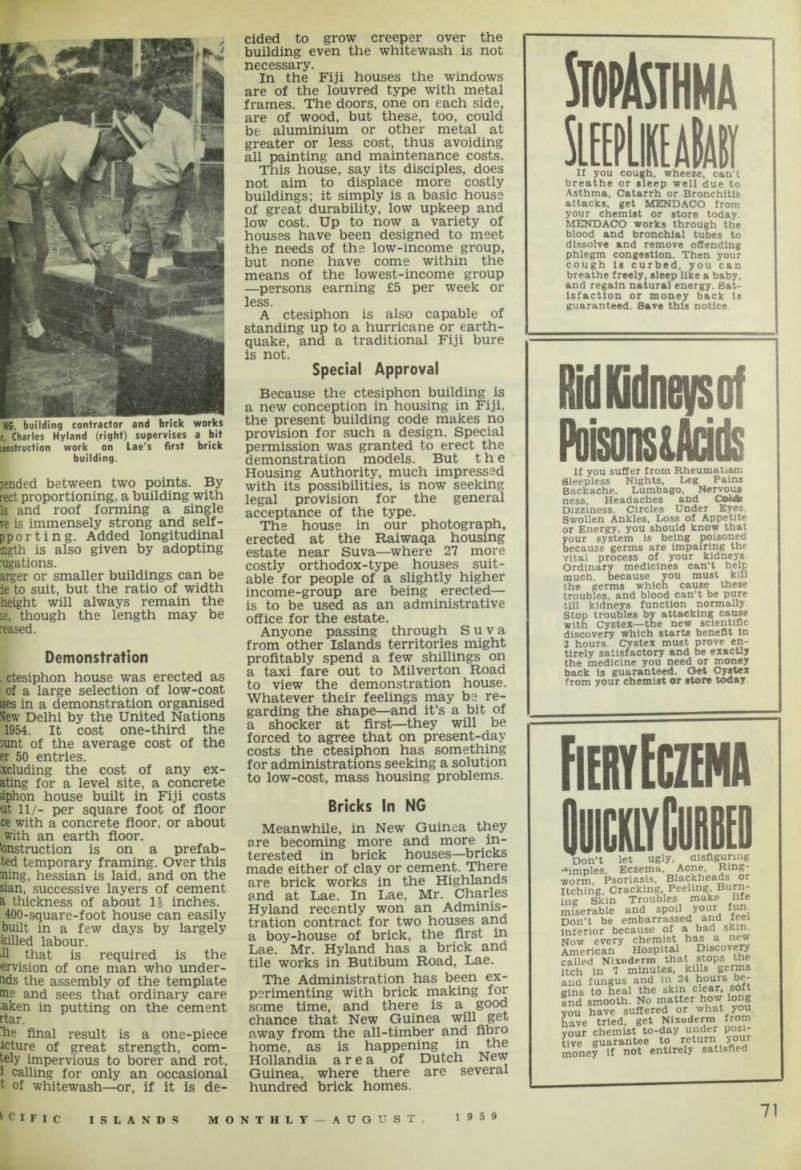
Bricks In NG Meanwhile, in New Guinea they are becoming more and more in terested in brick houses —bricks made either of clay or cement. There are brick works in the Highlands and at Lae. In Lae, Mr. Charles Hyland recently won an Adminis tration contract for two houses and a boy-house of brick, the first in Lae. Mr. Hyland has a brick and tile works in Butibum Road, Lae.
The Administration has been ex perimenting with brick making for some time, and there is a good chance that New Guinea will get away from the all-timber and fibro home, as is happening in the Hollandia area of Dutch New Guinea, where there are several hundred brick homes.
NG, building contractor and brick works [?]r, Charles Hyland (right) supervises a bit construction work on Lae's first brick building.