In Papua-New Guinea, It's
pp. 63-69 · Read in the full issue
R. W. ROBSON REPORTS ON THE TAX WAR
In Papua-New Guinea, It's Mr. Hasluck The Rest
I never have seen, or heard described, a more entertain gg constitutional drama in the Pacific Territories than now 5 in progress in Papua and New Guinea.
I were a sensational journalist, would entitle it, “Hasluck on lis High Horse is Hunted and ried”. However, I am a sober rver and I dislike alliteration. it I weep no tears over Mr. luck. He brought it all on him cannot imagine how this dis sing situation is going to end.
I am inclined to back the New nea rebels. it us set out the events in their jer sequence so that we may er understand the significance developments during July and y August.
Hasluck and Territorians ame time in 1958 Minister luck decided to impose income ition. Some say it was his own sion. Others are sure that he influenced by economic theorists Canberra, and by the Assistant unistrator and the Treasurer, in fc Moresby. In any case, the iciple of taxation for New Guinea been approved by Cabinet as ; ago as 1957 —in secret, rivate enterprise in the Terri r last year urgently and re tedly asked whether the tax was ing. was a reasonable question, ipetent business men must keep r accounts in a stricter, more iful way if their net income is >e taxed. anberra remained all “Hush h”. Mr. Hasluck dodged and ged. He would not give a plain ver in 1958 or early 1959.
Pen when the Legislative Council in Port Moresby in March, it had no information about tax. hen, without any notice, the Tax was popped onto the Council April 20, rushed through to >nd reading, and adjourned until e 22, carrying the provision that tax would operate from July 1, y this procedure, Minister luck treated the unofficial com ity of the Territory—the future payers —as if they were all ksters, to be circumvented by ft and clever official action; and
the Legislative Councillors as if they were a lot of fools.
Maybe those words are not justified.
But that was how the non-official classes saw it. Their resentment turned to anger, and their anger began to burn.
Territorians' Plea
The Tax bill was clumsily, even stupidly drafted. The traders were not given sufficient warning, if it was to operate from July 1.
Chambers of Commerce, elected Councillors, Taxpayers’ Associations, even the public servants’ organisa tion some individually, some in combination —made urgent, repeated requests in Canberra that (a) com petent economists examine the probable effect of income tax on the Territory’s economic structure and (b) the operation of the bill be postponed for one year, so that it could be re-drafted in the light of their findings.
Not then, not at any time, have
these Territorians resisted the idea of income tax—only the method of its introduction by the Minister.
It was all in vain. Mr. Hasluck rode high in the saddle. The Prime Minister was abroad. The other Ministers, in solemn conclave, accepted Mr. Hasluck’s assurance that he knew best.
The economic review was refused; postponement of the tax was re fused; the Legislative Council met on June 22 with uncompromising instructions to put the bill through, to operate on July 1.
The Department’s First Assistant Secretary, Mr. Willoughby, arrived in Port Moresby that day—pre sumably to S3e that Council did what it was told.
Then came the rebellion. The Territory, from end to end. showed strong feeling. It seemed that every non-official Territorian went into action, through the Taxpayers’
Associations.
Officials could take no part; but there was no doubt where their sympathies lay.
Real War Begins On Monday, June 22, elected members James, Downs and Dudley Jones resigned from the Council, as a protest against Hasluckian pro cedures and especially his con temptuous treatment of Territorians’ representatives.
A nominated member (represent ing the Returned Servicemen’s League), Mr. R. F. Bunting, got ready to resign, also. But the others asked him to remain in the Council, so he might be the applicant in an appeal to the Supreme Court. (Over)
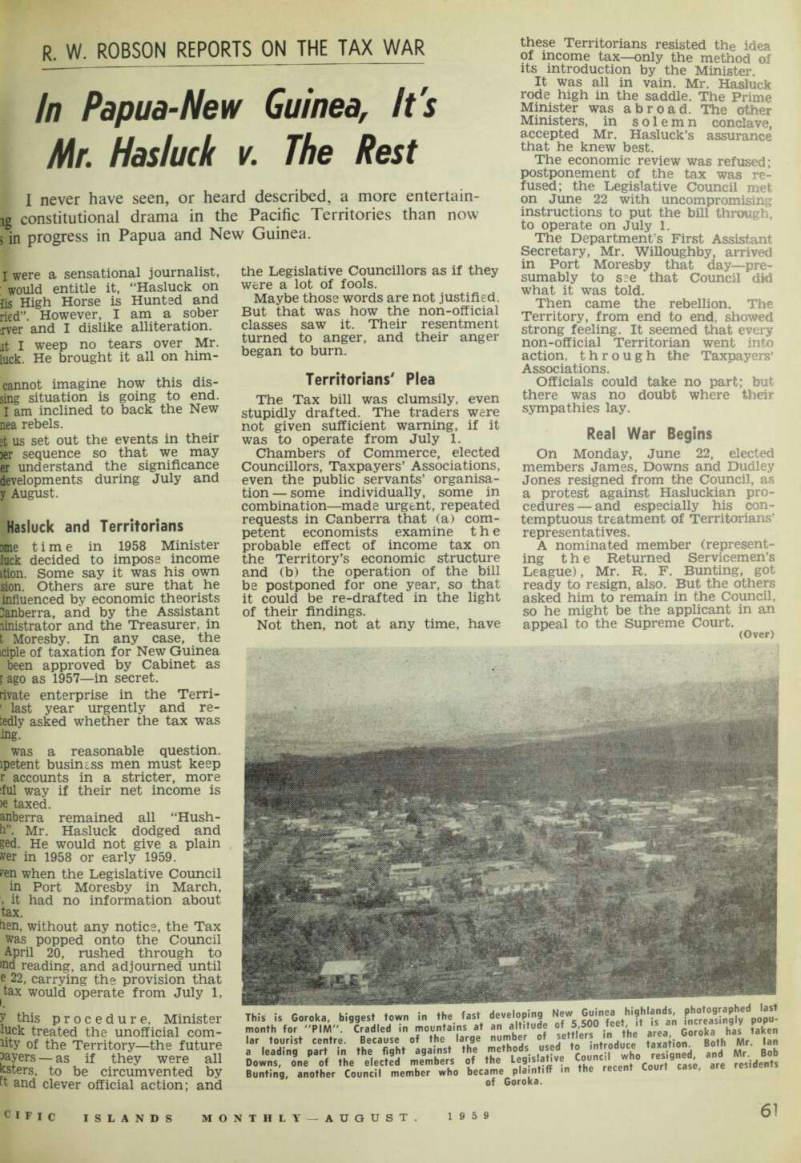
This is Goroka, biggest town in the fast developing New Guinea highlands, photogrphed last month for "PIM". Cradled in mountains at an altitude of 5,500 feet, it is an incresomgly popular tourist centre. Because of the large number of settlers in the area, Goroka taken a leading part in the fight against the methods used to introduce taxation. Both Mr. lan Downs, one of the elected members of the Legislative Council who resigned, and Mr. Bob Bunting, another Council member who became plaintiff in the recent Court case, are residents of Goroka.
On June 23, as Legislative mncillors assembled to pass the *x bill, they were served with its—the Territory’s Supreme Court id been asked to declare the Legco competent, in terms of Section 36 the Papua and New Guinea Act rhich says the Council must in tide three elected members).
The Council went on, dealing with ie bill, and with scores and scores amendments before it —many from ie Government itself, providing bstantial concessions, compared ,th the original proposal.
The concessions did not placate e taxpayers. They stood by their
iginal demand —postponement, an
quiry by economists, and re nting.
The Council put the bill through immittee stage, and adjourned itil July 13, pending a Supreme Durt decision.
A Dramatic Change
Both Government and taxpayers sre represented before the Supreme jurt by Sydney barristers, Messrs.
Mason and D. L. Mahoney.
As it began, the attack was based )on the belief that the Council mild not be constituted without ected members.
Suddenly, the whole character of e proceedings changed.
Barrister Mahoney challenged, >t so much the competency of the )uncil, but the validity of the ipua and New Guinea Act , under iich the Council was created.
Constitutional experts, long ago, id raised the question of whether e Trusteeship Agreement, between nited Nations and Australia, gave istralia authority to set up, in the int administration of Papua and ew Guinea, a body like the Legis tive Council, with the powers ven to Legco under the Papua New Guinea Act.
No one then knew why barrister
Mahoney changed the line of attack. Presumably, he was very sure of the vulnerability of the Papua and New Guinea Act, less sure of the challenge to the competency of th So L fS°doubtiess argued) why not make a certainty of it? The Territory Supreme Court might uphold the P-NG administrative structure, and give a verdict for Government; but he was confident that this verdict would be upset on appeal to the High Court.
And the taxpayers had said again and again that, if defeated in the Supreme Court, they would appeal to the High Court.
But the challenge to the Papua
and New Guinea Act had results of which those who had approved Mr. Mahoney’s course apparently had had no warning,
A Taxpayers' Guns Spiked
A section of the taxpayers more or . less panicked, when they recog nised the legal and political signific ance of it.
Certain highly-placed Canberra ltes had spread the word quickly around Port Moresby; If Papua and New Guinea Act is held invalid, these things could happen: • All the legislation passed by Legco since its creation could be challenged. (Over)
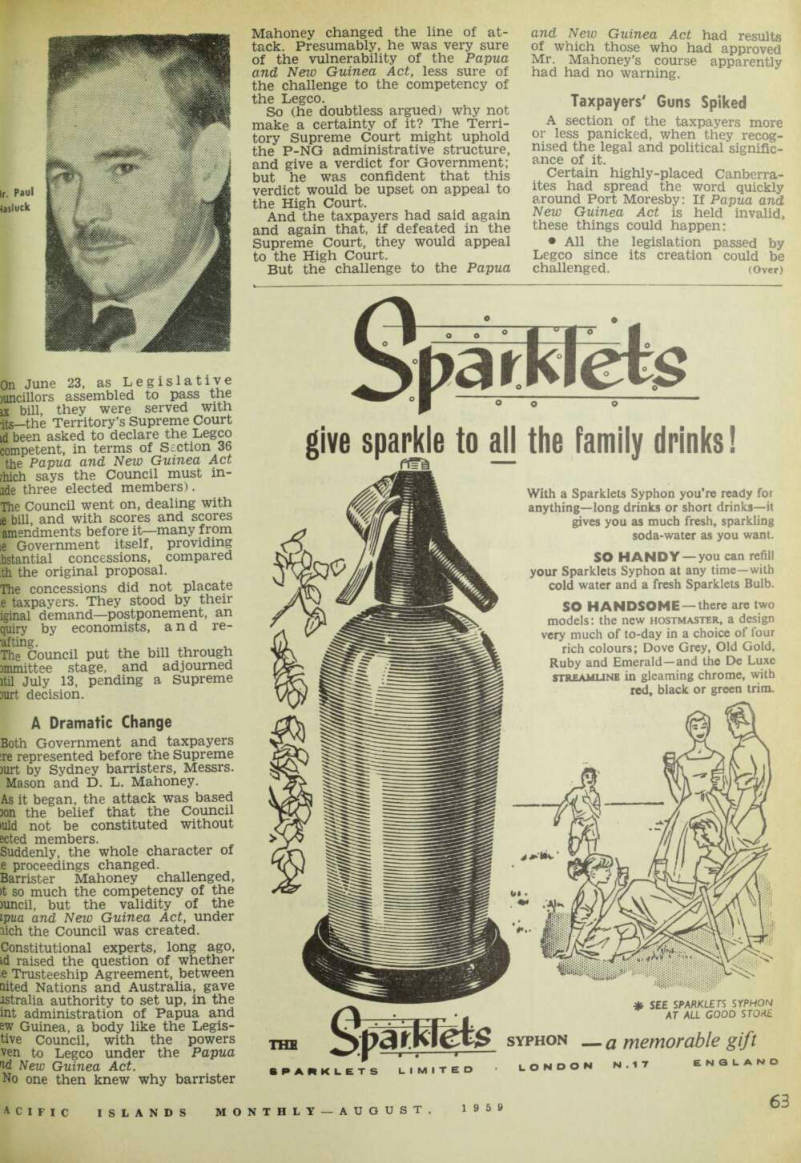
Mr. Paul [?]Hsluck
i It might be found desirable to solve tne administrative union, 1 return Papua and the Trustee p Territory to separate admin •ations. ► Australia could be gravely em rassed in the United Nations, ere certain sections especially * Communists—have often at ked Australia’s policies and plans New Guinea. mmediate reaction came from . Bunting. days before the Supreme art hearing concluded, he an mced that, if the Court’s de ion was against the taxpayers, he, the plaintiff (or applicant for injunction) would not appeal.
I am entirely with the elected mbers and the taxpayers in losing the way in which the oister has introduced this bill 1 ignored the non-official classes 1 the Legco, but I will not be a ty to pulling down the Papua i New Guinea Act , and all that means,” about summed up his itude. ftat also was the view of the trading companies, hitherto ipathetic to taxpayers. Mr. B. C. odsell, who is general manager Burns Philp in P-NG, resigned presidency of the Papua Tax ers.
Ip to that point, the barristers— 1, very probably, the members of Supreme Court —had expected it, whatever the verdict, the case nld go to the High Court, hit when, on July 7, the verdict ne, dismissing the application for injunction, it was apparent im diately that the withdrawal of . Bunting and the split in the flayers had momentarily crippled i anti-Hasluck forces. *apua taxpayers were hesitant.
New Guinea, under Mr. Dudley Jones’s leadership, while still full of fight, lacked sufficient funds to start again de novo.
New Guinea was hamstrung by the retirement of the nominal applicant, Mr. Bunting. It had no appellant, to carry the case on to the High Court.
A Little Jubilation
While taxpayers were rallying their forces, and squabbling a little among themselves, the pro-Hasluck officials—few, but powerful—carried the Tax bills jubilantly forward to completion in the Legislative Council (July 13-15).
They said that, in view of the Court verdict, and Mr. Bunting’s attitude, all this nonsense would soon be over and forgotten.
They announced that the tax would operate from August 1. (They had planned July 1; but when the Supreme Court action forced adjournment to July 13, they apparently could not tax retro spectively : so they postponed operation until August 1.) There now were three vacancies in Legco. Administration solemnly announced three by-elections— nominations closing on August 4, and voting on September 12.
Attending Legco (at the July 13-15 Session) popular “Bob” Bunting was obviously harassed and un happy. His motives —-those of re sponsible citizenship—in refusing to proceed with the appeal were re spected by the belligerent New Guineans; but that did not lessen their anger at being unable to carry on the war against Mr. Hasluck.
At this session, Mr. Bunting criticised the Hasluck regime, the Tax bill, and the Australian Gov ernment’s treatment of Legco, in
ns that tended to blister the
isard record.
dministrator Cleland made a ntive protest. Everyone, he said, blaming the Minister. These ttion decisions were not the ister’s they were made de •ately by Australia’s Cabinet, bservers laughed. They know r Mr. Hasluck, and his influence i the Inner Cabinet. r Bunting, having shed his reme Court status as a possible ellant, now got ready to put in resignation. igh officialdom made urgent :esentations to Mr. Bunting. Just it transpired is not known. ; is believed he finally agreed to r on for “a while”, to see what pened to Legco. Some sections ik that Legco may be re stituted in such a way that isrs. James, Dudley Jones and ms may feel free to accept re tion. The nominated, non :ial members miss them very :h.
The War Goes On i that week of July 13-18, tax ers—under New Guinea drive [ leadership—closed their ranks [renewed the war. hey said this, or something like i; “The tax is now claimed to be t, We say it is not lawful. The ritory’s Supreme Court says it We do not accept that verdict, we have been deprived of the ins of appealing to the High irt.
Sooner or later, tax will be de rided of someone who will refuse •pay. When he is prosecuted, we [ take up his fight and carry it the Supreme Court and, if essary, to the High Court.
We shall challenge the validity the Territory’s Tax Act. We re that the validity of Australia’s rua and New Guinea Act will not involved. But we are going to lUenge the Tax Act, at all costsr Üblic meetings in practically ry centre (including Port resby, where the local branch 1 rallied and re-formed) cheered t resolution.
Ivery meeting put the hat round, 1 the response was generous. “We re plenty of money to carry on legal fight,” announced Rabaul. •lenty of money is necessary. sal and publicity actions up to ;e, including the engagement of ation consultant McKellar White, ?e eaten up over £2,000.
By-Elections Moves
hi under-cover fight between the ministration and the bellicose w Guineans, in relation to the -elections, took shape late in July.
Public opinion throughout the
Territory is so strongly with Messrs.
Dudley Jones, James and Downs that no person of any standing is expected to nominate, to fill their places. “None of us will vote in this election,” it was announced at one meeting.
Then it was reported that high officialdom was trying to induce certain non-official persons to riomN l?ce thUS SaVe ° fflClal "
Rabaul countered promptly: “We
Esmh'ss Sssms
we shall fight for their election.
Then, at the next Council meeting, they will resign.” ...
Then, as July ended, came more drama.
W. M. Fishwick, of the NG Tax payers’ Association, took R. F.
Bunting’s place as legal plaintiff, and appealed directly to the High Court for an injunction restraining the Administrator from proclaiming the Tax Ordinance, while the Court decided the question of whether the Legco actually has power to pass the Tax Ordinance.
At 8 a.m. on July 30, just 21 hours before the Fishwick application came before the High Court in Sydney, the Administrator proclaimed the Ordinance, by Gazette.
But, as July ended, the Fishwick application was still “alive” in the High Court. For the next moves, see page 17.