A Memorial Lighthouse
pp. 51-53 · Read in the full issue

In Shining White
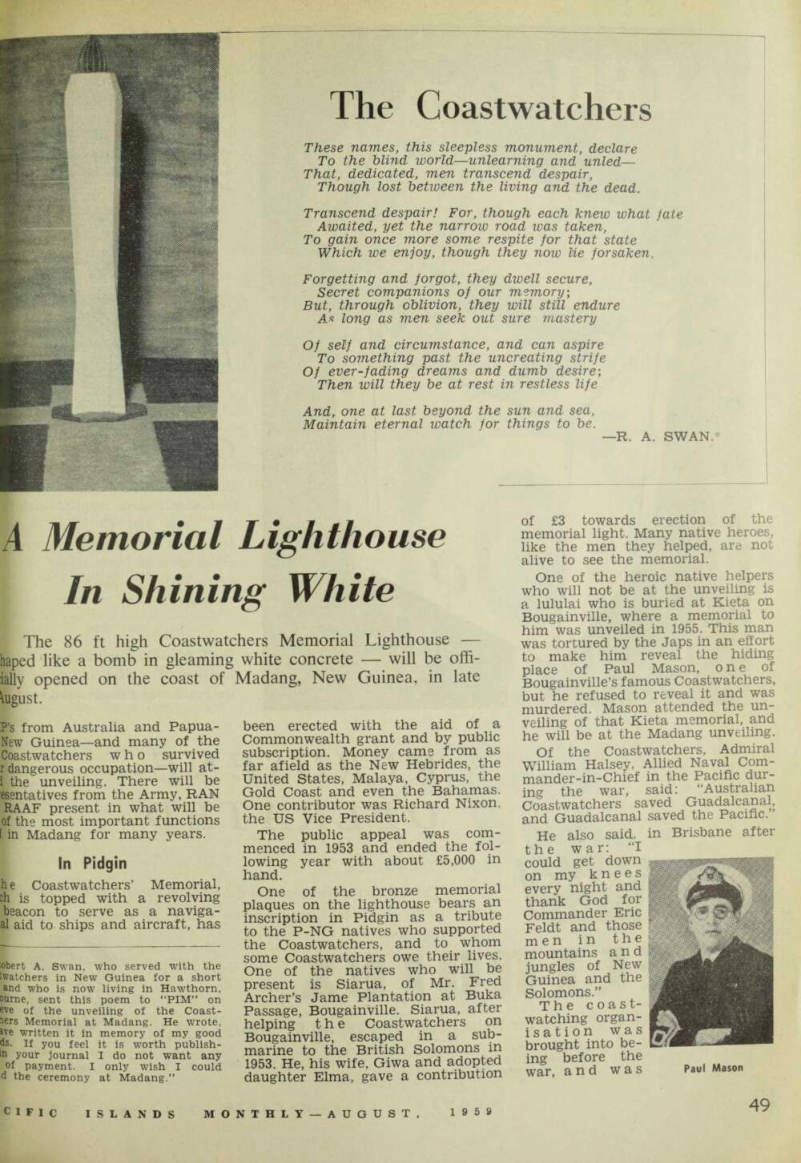
The 86 ft high Coastwatchers Memorial Lighthouse haped like a bomb in gleaming white concrete will be offi ially opened on the coast of Madang, New Guinea, in late
August.
P’s from Australia and Papua- New Guinea —and many of the Coastwatchers who survived r dangerous occupation—will at- I the unveiling. There will be esentatives from the Army, RAN RAAF present in what will be of the most important functions I in Madang for many years.
In Pidgin
he Coastwatchers’ Memorial, ± is topped with a revolving beacon to serve as a naviga al aid to ships and aircraft, has
Robert A. Swan, who served with the Catchers in New Guinea for a short and who is now living in Hawthorn, tmrne, sent this poem to “PIM” on eve of the unveiling of the Coast ers Memorial at Madang. He wrote, ive written it in memory of my good ds. if you feel it is worth publish “ your journal I do not want any of payment. I only wish I could d the ceremony at Madang.”
been erected with the aid of a Commonwealth grant and by public subscription. Money came from as far afield as the New Hebrides, the United States, Malaya, Cyprus, the Gold Coast and even the Bahamas.
One contributor was Richard Nixon, the US Vice President.
The public appeal was com menced in 1953 and ended the fol lowing year with about £5,000 in hand.
One of the bronze memorial plaques on the lighthouse bears an inscription in Pidgin as a tribute to the P-NG natives who supported the Coastwatchers, and to whom some Coastwatchers owe their lives.
One of the natives who will be present is Siarua, of Mr. Fred Archer’s Jame Plantation at Buka Passage, Bougainville. Siarua, after helping the Coastwatchers on Bougainville, escaped in a sub marine to the British Solomons in 1953. He, his wife, Giwa and adopted daughter Elma, gave a contribution
of £3 towards erection of the memorial light. Many native heroes, like the men they helped, are not alive to see the memorial.
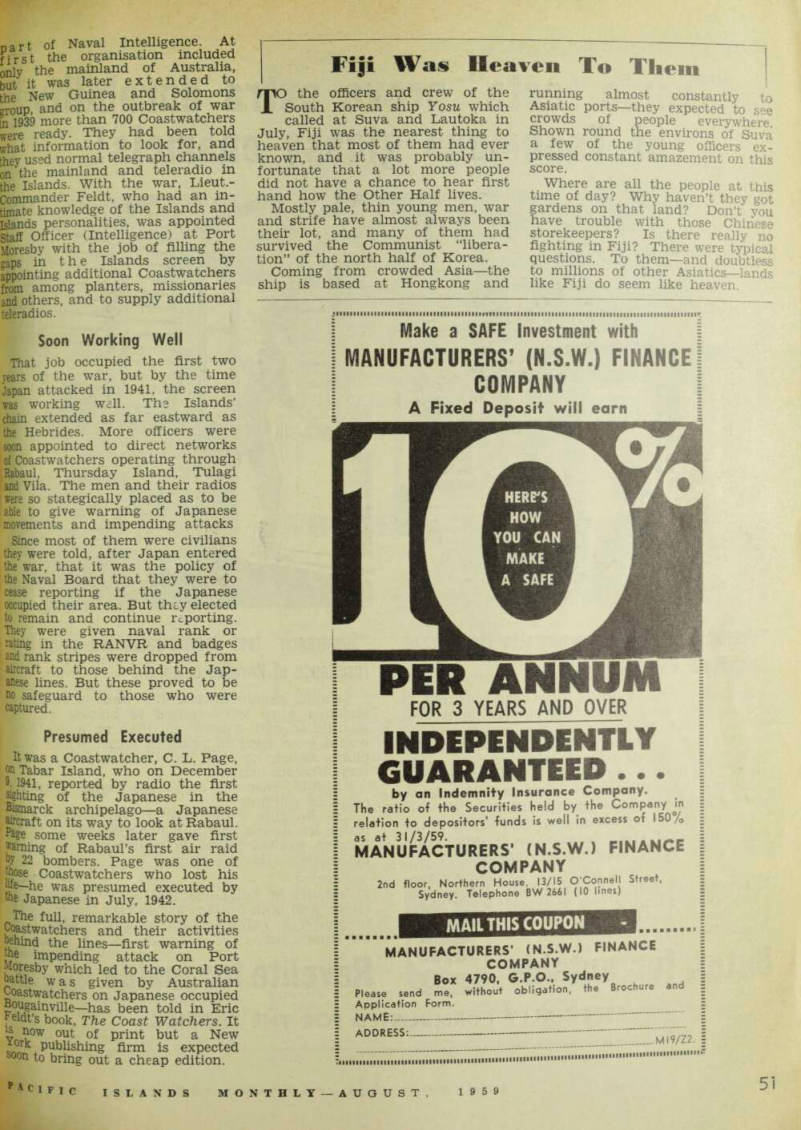
One of the heroic native helpers who will not be at the unveiling is a lululai who is buried at Kieta on Bougainville, where a memorial to him was unveiled in 1955. This man was tortured by the Japs in an effort to make him reveal the hiding place of Paul Mason, one of Bougainville’s famous Coastwatchers, but he refused to reveal it and was murdered. Mason attended the un veiling of that Kieta memorial, and he will be at the Madang unveiling.
Of the Coastwatchers, Admiral William Halsey, Allied Naval Com mander-in-Chief in the Pacific dur ing the war, said: “Australian Coastwatchers saved Guadalcanal, and Guadalcanal saved the Pacific.
He also said, in Brisbane after
the war: ‘I could get down on my knees every night and thank God for Commander Eric Feldt and those men in the mountains and jungles of New Guinea and the Solomons.”
The coast watching organ isation was brought into be ing before the war, and was
Paul Mason
D art of Naval Intelligence. At first the organisation included nnlv the mainland of Australia, but it was later extended to the New Guinea and Solomons n-oup, and on the outbreak of war to 1939 more than 700 Coastwatchers were ready. They had been told what information to look for, and they used normal telegraph channels on the mainland and teleradio in the Islands. With the war, Lieut.- Commander Feldt, who had an in timate knowledge of the Islands and Islands personalities, was appointed Staff Officer (Intelligence) at Port Moresby with the job of filling the gaps in the Islands screen by appointing additional Coastwatchers from among planters, missionaries and others, and to supply additional teleradios.
Soon Working Well That job occupied the first two years of the war, but by the time japan attacked in 1941, the screen was working well. The Islands’ chain extended as far eastward as the Hebrides. More officers were soon appointed to direct networks [of Coastwatchers operating through Rabaul, Thursday Island, Tulagi and Vila. The men and their radios were so stategically placed as to be able to give warning of Japanese movements and impending attacks Since most of them were civilians they were told, after Japan entered the war, that it was the policy of the Naval Board that they were to cease reporting if the Japanese occupied their area. But they elected to remain and continue reporting.
They were given naval rank or rating in the RANVR and badges and rank stripes were dropped from aircraft to those behind the Jap anese lines. But these proved to be no safeguard to those who were captured.
Presumed Executed
It was a Coastwatcher, C. L. Page, on Tabar Island, who on December 9 ; 1941, reported by radio the first jjhting of the Japanese in the Bismarck archipelago—a Japanese aircraft on its way to look at Rabaul.
Page some weeks later gave first warning of Rabaul’s first air raid by 22 bombers. Page was one of those Coastwatchers who lost his [he— he was presumed executed by the Japanese in July, 1942.
The full, remarkable story of the Coastwatchers and their activities behind the lines—first warning of the impending attack on Port Moresby which led to the Coral Sea battle was given by Australian on Japanese occupied wugai nville —h as been told in Eric v eldt’s book, The Coast Watchers. It y ow out of print but a New publishing firm is expected oon to bring out a cheap edition.