Pacific Report
pp. 123-153 · Read in the full issue

The month's round-up of news and pictures of people and events, from PIM correspondents in the South Pacific.
A Look At The
Sights of Tonga
The Governor of Fiji, Sir Kenneth Maddocks, whose responsibility in cludes keeping a friendly eye on happenings in the independent King dom of Tonga, with Lady Maddocks paid his first official visit to the Kingdom in May.
The official reason was to ratify the Treaty of Friendship which was signed by Tonga and the United Kingdom Government on August 26 last year, but he also took in the local sights, carrying his camera over his shoulder like any tourist off the Tofua. They were given a typical friendly Tongan welcome.
The new treaty replaces one made in 1900 and ratified the following year—at a time when Tonga was the only Pacific state not under the control of a foreign power. Tonga has lost none of her independence under the new treaty, but has been given some wider powers, including powers to negotiate her own trade treaties. (PIM, September, 1958).
The signatures on the treaty are of Queen Elizabeth and Queen Salote. During the ceremonies, Prince Tungi handed the Tongan copy, with Queen Salote’s signature —the whole bound in tapa—to Sir Kenneth Maddocks, in the Privy Council Chamber of the Royal Palace, in the presence of mem iers of the Tongan Cabinet. Sir Kenneth in turn handed over the British copy, signed by Queen Elizabeth.
Visits to other parts of the main island followed, including a look at the sacred flying foxes of Tonga— which swarm and squawk in the iron wood trees in the village of Kolovai; a visit to the giant “largis”—large mounds made of huge blocks of volcanic stone —at Mua; a look at the blow holes on the coast at Houma; a picnic at Laulea beach and a visit to the Ha’amonga—a rilithon of volcanic stone whose age and exact purpose is not known.
There was a royal feast and entertainment in the park adjoinhe white, wood Palace, in the shadow of the great pine Tui Malila, the tortoise which Tongan
legend says was brought to Tonga by Captain Cook in the 1770’s, was on hand—roaming the nearby Palace grounds.
Later the Governor’s yacht Ra Marama took the party to Vavau, Tonga’s northern group, where Vavau’s Governor, Laufilitonga, escorted them around more of the sights, including the Swallow’s Cave and the famous underwater cave of Mariner.
Satellite Boffins
Tour South Pacific
An American Military Air Trans port Service Globemaster aircraft made a circuit through Christmas Island, Borabora, Aitutaki, Nadi, and Honiara in June on a special boffin flight.
The technical team of 20 men were apparently investigating suit able sites and local facilities for the establishment of satellite reporting
stations in connection with the American Polar Orbit Satellite Pro ject.
Unlike the various satellites that have been launched so far, a polar orbit satellite would be launched in a true north-south direction, and would thus pass over both Poles on every circuit.
Depending on its distance from the earth and its speed, it could be adjusted to pass directly over every spot on earth at regular recurring
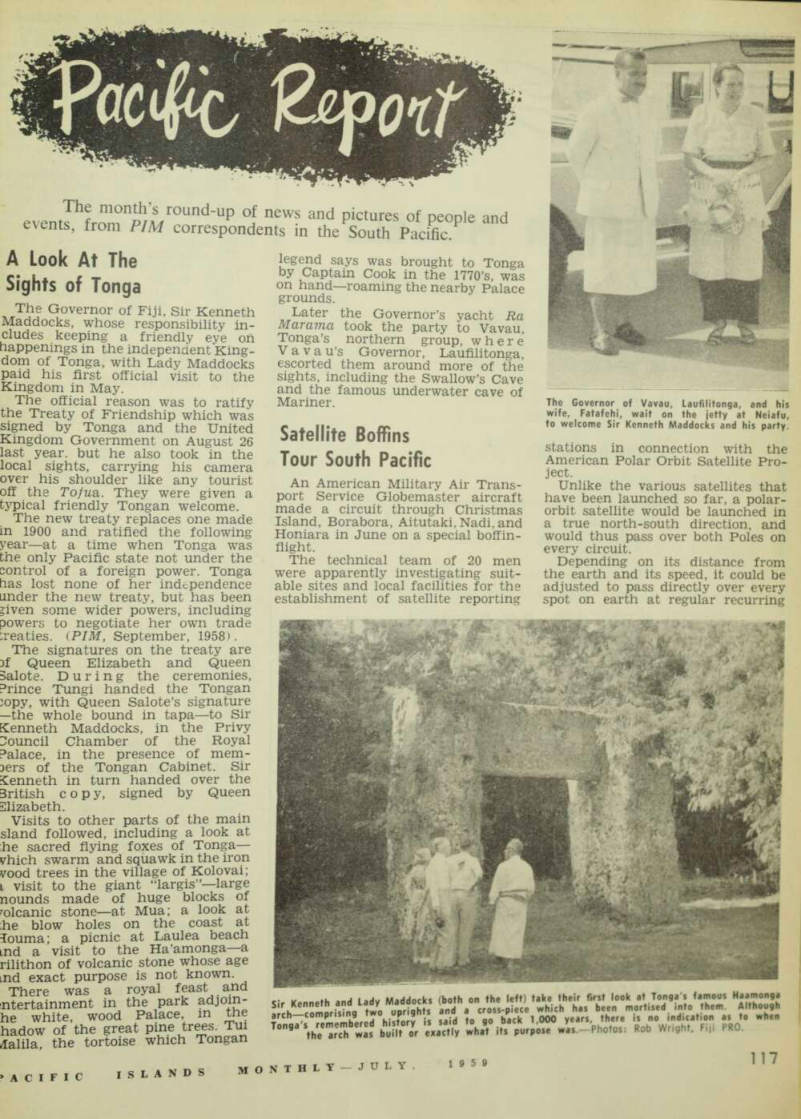
The Governor of Vavau, Laufilitonga, and his wife, Fatafehi, wait on the jetty at Neiafu, to welcome Sir Kenneth Maddocks and his party.
Sir Kenneth and Lady Maddocks (both on the left) take their first look at Tonga's famous Haamonga arch-comprising two uprights and a cross-piece which has been mortised into them. Although Tonga's remembered history is said to go back 1,000 years, there is no indication as to when the arch was built or exactly what its purpose was. -Photos: Rob Wright, Fiji PRO.
intervals. But as it is apparently impossible to predetermine the height and speed it is necessary to check this from ground radio observations once it has gone into orbit. The more observation stations there are located round the earth, the better can this information be precisely determined.
It is understood that Aitutaki re ceived a high rating as one pos sible site.
Once the necessary arrangements are completed, the special radio equipment, almost completely self contained, can be flown in and set up on the selected sites with very little delay.
The Globemaster left Honiara on June 21 on return to Honolulu. En route is passed Nauru, Ocean, and Tarawa, making successful mail drops on behalf of the postal authorities.
Japanese Cement For
Fiji's Rebuilt Airport
Masses of men and millions of money have changed the appearance of Nadi airport, in Fiji.
A criss-cross of very long run ways, and a large terminal building with its roof already on mean that Nadi will be ready for the jet air craft, when shortly they commence coming and going between Aus tralia and North America.
An enormous quantity of cement has been used on these works, and it still is going in. The Burns Philp chief in Fiji, Mr. M. H. Helsen, told PIM that that firm alone, under contract, had supplied over 20,000 tons.
British and Australian cement manufacturers naturally were after these orders, but a large proportion of the cement came from Japan.
The Japanese price, landed in Fiji, was £7 per ton under the English quotation.
How Are They
Sleeping at Nights?
Rabaulites went without their Tuesday night picture show in June to attend instead a tax-fight meet ing.
Mr. Dudley Jones, still then the elected MLC for New Guinea Islands (since then he “walked out” with the other two elected members of Legco, and so is now the ex-MLC), chaired the meeting which was con vened by the New Guinea Tax payers’ Association.
Said Mr. Jones: No member of the Legislative Council of New Guinea is competent to deal in telligently with the Income Tax ation Bill, not even our Treasurer who, when he toured the Territory with Australian Taxation Depart ment expert Kahl, answered none
the questions himself. Why?
No one knew why, and Mr. Jones went on; “We still think it possible for some Government Members of gco to make history by voting according to their conscience against the bill. Perhaps they would like to sleep easy in their beds.”
Subsequent events showed, of course, that none of the official members lived up to these high hopes of them.
Australian Press
Under Fire in NG
Two prominent and highly regarded residents of Papua and New Ginea—Bishop Strong and Mr.
E. Fairfax-Ross—had something thing to say at the Legislative Coincil meeting in June about the ieap, sensational Press” of Aus tralia, and its treatment of news items from the Territory.
They referred especially to the y the Press mishandled matters ecting the relationship between Europeans and natives.
The ill-informed and unjustified comments of a section of Australian commentators, said Mr. Fairfax- Ross could bring about in P-NG very conditions (bad relations between races) which they now prosed to fear.
Every responsible person in this
country is conscious of the problem and obligations created by race plurality; and individuals and bodies on each side are doing much to help the natives to reach our standard of life, in a spirit of freedom and racial tolerance," said Mr.
Fairfax-Ross.
There was no exploitation of the natives - that kind of thing was as dead as the dodo. Australia, for very many years, had put far more into Papua and New Guinea than she had ever taken out.
Referring to the Sear (spleen) case (PIM, June) Mr. Fairfax-Ross said that a number of unions joined the clergy and professors in trench-
ant but uninformed protests.
However sincere their outbursts may have been, they were quite outmatched by the learned judge's long experience and his high and tolerant understanding of his judicial responsibility.
"A few weeks later another dis tinguished member of the clergy was reported to have implied that there was already a rising tide of racial animosity in this country.
“While we might expect ex aggerated comment from a political or national enemy looking for a thin red line to bait with unrest we have a right to hope for en couragement and aid in our pur-
pose from our own nationals.
“If we ever do experience acute racial animosity here, not the least of its background causes will be, though doubtless well meaning, such highly inflammatory comments as those to which I have referred.
“Too often we find a tendency to suggest racial discrimination where none exists.
“Even simple prohibitions which are accepted as part of our daily life in Australia are likely to be come misconstrued in their applica tion to our community.”
The Bishop of New Guinea very strongly supported Mr. Fairfax- Ross.
“It is extremely irritating to have members of the clergy and of the Universities theorising on matters connected with this Territory, of which they have no knowledge,” he said. “It often happens.
“In this case I am not sure that the blame lies with those who made lie statements. I think the blame lies with the Australian Press. The news was given in such a way—it gave a slant to the news that eeaders naturally thought that injustice had been done and that there had been a case of racial discrimination.
“I think the real trouble lies in the attitude of the Australian Press towards the true interests of this Territory.
“The problems arising out of plurality of races here are not well handled by the cheaper section of the Australian Press, because it does not want to do so—it wants sensation.
“Last year, I had not been three hours in Sydney when I got an urgent call from a particular news paper and I was told a most fantastic story about dissatisfaction among New Guinea native people and the imminent danger of a
rising. He wanted my opinion and I gave it.
“I said there was no truth what ever in the statement. I asked if his informants had ever been in
the Territory and he said ‘No’. I asked who they were and he would not tell me.
“He asked how long I had been there and I said 23 years—and I was certain there was no truth in the report. My statement was never published.
“The real blame lies with a cer tain section of the Australian Press which has no sense of responsibility whatever in relation to the true in terests of a Territory such as this.”
Beef Industry Plans
For NNG
The Netherlands New Guinea Administration is pushing ahead steadily with its plans for establish ing a beef and dairy cattle industry in the Territory. (Over)
Exactly a year after her arrival in Suva from a Singapore building yard under Fiji Royal Naval Volunteer Reserve manning, the White Ensign was lowered aboard the Fiji Government motor yacht "Ra Marama" on June 2. A moment later the Fiji Government's Blue Ensign was raised, as shown here. The men removed their naval uniforms and appeared on deck in the Government's marine-section uniform. This was one of the moves in the disbandment of the Fiji RNVR, due to lack of finance.
Dr. A. van Leeuwen, director of animal husbandry at Hollandia, said recently that the cattle-breeding experimental centre in Merauke, southern NNG, was running about 00 head on 600 acres; the area will be increased to 2,500 acres to carry 00 or 700 animals.
To conduct cross-breeding experi ments with local cattle, NNG authorities air freighted a Santa Gertrudis bull, three Brahman cows and five heifers from Australia; the first calves are expected this year.
Dr. Leeuwen thinks that, later on, the Baliem Valley (NNG’s isolated Shangri-la”) might be used for de delopment of the cattle industry, Three Illawarra Shorthorns, two heifers and a bull calf were flown in there last year for the American Christian and Missionary Alliance and appear to be thriving.
Air transport is the only means of communication with Baliem, but the airstrip in the valley is being enlarged now to take DC3 Dakota aircraft with larger cargo capacity than the planes that hitherto have gone in there.
Flying Boats or
Land Planes for RNZAF?
Those sleek jet land-planes and million-dollar expanses of concrete
notwithstanding, a good many people, especially in the Islands, still have a firm affection for the flying boat with its ability to land them right “in town” and its safety factor advantage on trans-ocean flights.
So a visit to Fiji by representatives of the only company in the world specialising in the construc tion of large flying-boats was of more than passing interest, The firm is the Martin-Baltimore company of Baltimore, Maryland, USA, and the representatives—who dropped in to Suva late in June — were Programme Manager Harold Greene, Chief Test Pilot George Rodney, and Chief Electronics En gineer Larry Collins.
They had been in Wellington. NZ, to try to sell replacement flyingboats to the Royal New Zealand Air Force, following which, on the way back Baltimore, they made a side visit from Nadi to Laucala Bay to inspect the existing service facilities RNZAF base.
Mr. Harold Greene said that the NZ government would very shortly be faced with a decision as to replacement aircraft for the existing British-built Sunderland flyingboats, which are no longer in production, and that Martin-Baltimore was the maker of the only possible replacement for the Sunderlands
Here is Henry V as a Fijian. He is Ratu Jone Vuiyasawa photographed during his performance of the Crispin Day speech at the Suva Town Hall concert staged in aid of the Colonial War Memorial Hospital Week. Photo: Christopher Venning.
if it was decided to stick to flying boats.
The Martin company is produc ing only two types—the PSM twin piston-engined anti-submarine type, and the jet P6M Seamaster, mine laying aircraft, the first of which was delivered to the US Navy at the end of June. The PSM is the only one likely to meet the present requirements of the RNZAF.
The PSM has been in production for some years, first exclusively for the US Navy and more recently also for the French Navy; 240 air craft have been built.
PSM has a range of 2,700 nautical miles, at an all-up weight of 80,000 lbs and a cruising speed of 160 knots, The top speed is 218 knots. These speeds are equivalent to 230 and !20 mph respectively. The aircraft is powered by a pair of Wright motors, each of 3,700 bhp.
The company’s other aircraft, the P6M, is the world’s only jet flying boat actually in production. During the development stages two test models broke up in the air. That was the price of research and development, and the trouble proved to be in the design of the tail assembly. This was corrected—and the first of 14 now building for the US Navy will be in service shortly.
Mr. Green cannot see a passenger or cargo version of this jet flyingboat—whatever the future might hold in commercial jet flying-boats, his particular design was strictly a military proposition. But he does not believe that a jet flying-boat would not be designed for competitive commercial service, or that
the essential shape of a flying-boat
hull is incompatible with a high
aerodynamic performance. The main
limitation on commercial flying boats is in loading facilities and the problem of ice in high latitudes and cold climates. For example, there
were many lakes and seaports in the United States where a flyingboat could not safely operate be cause of ice in the winter months.
On the other hand they could be ideal for tropical use and especially in these Island areas, where the use of land-planes was restricted by the scarcity of jet airfields.
The 14 P6M;s now on order will be assigned to the Atlantic area the US Navy but Mr. Greene said is was possible that a later group might be stationed in the Pacific.
New Relics from
Old Mysteries
A Belgian vulcanologist, Haroun Tazief, and a diver, travelling in a French Navy frigate that recently visited Vanikoro, BSIP, is believed to have, in June, relocated the wreck of one of La Perouse’s ships (probably Astrolabe), and to have found other relics of that late-18th century tragedy.
News of the new discoveries trickled through to Sydney in late June—and it’s a pretty fair indication of the isolation of Vanikoro, not only from the rest of the world but from BSIP headquarters, that the story came from the wife of one of the members of the party in
far-away Paris before it could be confirmed in Honiara. Details of what has been found are still lack ing.
However, the new relics are un likely to solve any old mysteries— the mystery of La Perouse’s dis appearance was solved quite con clusively 140 years ago by Captain Peter Dillon of the East India Com pany.
La Perouse, with his vessels Astrolabe and Boussole, arrived at Botany Bay a few days behind Phillip and the First Fleet in 1787.
Within a short time La Perouse sailed again—and disappeared. In 1891, D’entrecatreaux was sent to look for him, but failed, and it was not until many years had passed that Captain Peter Dillon, engaged in the sandalwood trade around the New Hebrides-Solomons area, dis covered on Tikopia, one of the small outlying islands of the Solomons, a sword decorated with the fleur de lys of France. The natives told him it had been traded from Vanikoro.
He immediately bethought him of the mystery disappearance of La Perouse, and when this was reported to his masters, the East India Com pany, the Company supplied him with a small ship to return to the Solomons.
Dumont D’Urville heard of Dillon’s
This painting of a New Guinea singsing was unveiled by the Morobe District Commissioner Mr. H. Niall in the main lounge of the Hotel Cecil, Lae, in June. It is done in oils on three-ply sheets and attached to one wall. Artist was Miss Bette Hays, here seen with Mr. Niall after the unveiling. The painting accurately portrays singsing dress; it shows head-dresses worn by the people of Leron; Bird of Paradise plumes on dancers from the Chimbu-Mini areas; the Cassowary dance being enacted by the Duk Duks, the Cockatoo Men; and men from the Middle Sepik River (waving decorative fishes around); Mr. Niall commented that many old-timers could still recall how an attractive New Guinea girl looked in a grass skirt, but that custom, like the singsing itself, was dying out, and many of the younger people would never see it.
discoveries, in France, and he too set out. Both expeditions reached Vanikoro in the same year, 1828; both men gathered relics from the reef where Astrolabe (or Boussole ) is believed to have struck. Both expeditions visited Sydney on their way back to Europe and there was a lot in the newspapers of that day about the discoveries.
In early 1958, the then French Resident Commissioner of the New Hebrides, M. Pierre Anthonioz, and a party of aqua-lung experts, arranged a private expedition to Vanikoro, and using d’Urville’s old charts recovered relics from the reef —old anchors, buttons, lead balast, etc. This story was told in PIM in the issues of April and May, 1958.
M. Anthonioz sparked a new in terest in La Perouse and his dis appearance, and revived the old stories: It is supposed that his vessels were wrecked on reefs near Vanikoro in a storm and that there were some survivors who lived for a while amongst the natives of
those parts.
The Anthonioz party was not able to prove conclusively that the wreck was the Astrolabe —although it seemed highly probable. Local legend is to the effect that the site of that wreck was North-West of where d’Urville and Dillon found their relics, but it is thought now that this N-W site may have been where the second vessel, Boussole, went up on the reef. How to be sure at this late date whether the remains of the wreck that has been found is Astrolabe or Boussole is something that will have to be left for the experts to fight out.
The current visit of the French frigate to Vanikoro was to survey
the La Perouse monument there, with the idea of replacing it with something more substantial. So far as the BSIP Government is con cerned this is the official reason for the French vessel being in the locality.
However, at end of June it was unofficially reported from Honiara that a party from the frigate had discovered more La Perouse relics; and from Noumea, New Caledonia comes the advice that the relics consist of a ship’s stern-post.
But is the stern-post Astrolabe or Boussole ? That still seems to be the only unsolved mystery. It will be interesting to see whether the latest discoveries can throw any light on the subject.
Fiji's Education Bill
Rises Sharply
Though Fiji’s population has in creased by under 50 per cent, since 1948—was then 260,000 and is now 375,000 —the number of children at tending primary schools has in creased by 653 per cent., the gov ernment education bill has risen by 665 per cent.—and there are still an estimated 11,000 children be tween 6 and 14 years of age who are not attending schools.
That is a summary of the pre sent situation regarding education in Fiji as given by the Director of Education, Mr. J. G. Rodger.
Government expenditure on education had grown from 11/2 per head in 1946 to £2/18/- per head of population in 1958, Mr. Roger said. The above figures are ex clusive of the very considerable ex penditure on education made by
non-government organisations Gov ernment schools were scattered through 53 separate islands of the Fiji Group.
Mr Rodgers said that though con siderable gains had been made in material improvements to the education system in post-war years all was far from well on the scholastic side.
“Something is drastically wrong,” said Mr. Rodger, “when out of 563 Indian children in the Western District sitting the Secondary Schools Entrance Examination, only 65 can achieve half marks or more in a very simple test in English, arithmetic and general knowledge.”
He called for greater effort on the part of individual teachers, and for their full co-operation in making a success of the radio lessons in English. The need for a better grip of the English language was paramount, Mr. Rodger said.
The Manus Believe In The
American Way of Life
American anthropologist Margaret Mead considers that the native fathers of Manus, in the Admiralty Islands of NG, are the best fathers in the world.
Writing in the American mass circulation Sunday newspaper supplement, This Week, Dr. Mead says that Manus fathers “know how to combine discipline and self-reliance” in dealing with their young.
This has enabled, she says, Manus people to come from the Stone Age to the 20th Century more easily.
When I first visited this island in 1929, [She later wrote Growing Up in New Guinea ] I found the inhabitants were still ‘savages,’ ” she wrote. “When I returned in 1953, they had become a modern people.”
Children grew up, she said, know ing how to hold to the best from the past but also able to change with the times.
Tracing the history of the island, she wrote that, after discovery, ships brought traders and missionaries and government officials.
“During World War II, the Ameri cans came —a million of them —and the Manus men watched how these strangers behaved. Because their fathers had brought them up to be strong and capable and sure of themselves and had taught them a little divine discontent, they were able to make discoveries.
“They recognised the superiority of some American things: planes, tanks bulldozers, and hospitals; the way people of different races wore the same uniform and earned the same pay; what the American Army spent to save a single life.”
“And they (the Manus people) were able to change. The young men whose fathers had taught them to be strong and to judge things took the lead. They reorganised
Manus society to make it more like their ideal of American life.”
She suggested that modern Ameri can fathers can learn a lot from the Manus people, chiefly in pre paring their youngsters for a more peaceful world and one that is
changing.
The Fish-Shufflers
Of Polynesia
Over the past couple of years, as PIM has previously reported, United States Fish & Wildlife survey vessels have been transferring a variety of sardine, peculiar to Marquesan waters, from there to Hawaiian waters.
The Hawaiian tuna industry de
pends upon a satisfactory type of small fish-bait, and the only suit able kins in Hawaiian waters have become increasingly scarce, The Marquesan sardine has proved ideal, capable of surviving for lengthy periods in the bait tanks of the tuna boats, and amenable to transplanting to Hawaiian coastal waters where it appears to be mul tiplying. The various consignments brought north have simply been emptied into the open sea in various bays and they have settled down there.
Now, apparently, the Papeete tuna fishermen are also going to try out the Marquesan sardine. Re cently, at the request of the French Polynesia government, the US F&
NS vessel Charles H. Gilbert took 40 buckets of Marquesan sardines to Tahiti, where 20 buckets were released in coastal waters and the remainder released in an enclosed lagoon to see whether they can be conveniently farmed for the use of the local fishing fleet.
Charles H. Gilbert then carried out a survey of nearby waters for other suitable bait fish and took 87 buckets of a Tahitian type of sardine at three places round Tahiti, two bays at Moorea, and a bay at Raiatea. The survival properties of this sardine in the ship’s bait tanks was also reported to be excellent.
On the return volage to Honolulu the survey vessel transferred 50 fresh-water nato —a bass-like river fish which inhabits Tahiti’s mountain streams and has sporting propensities —to a river at Taipi, Nuku [iva Island, in the Marquesas, This transfer was made at the request of the French authorities, the fish surviving the voyage.
NZ-ers Want
Better Bananas
The Cook Islands citrus growers were not the only people who received a warning on fruit quality by the New Zealand importing organisation—as reported in PIM in June.
The Western Samoa banana grow ers were also warned by Mr. C. Ross Walker, general manager of Fruit Distributors Ltd., that the New Zealand banana quota might be reduced rather than increased if the quality of the fruit—which had known a decline in recent months— was not improved.
The Western Samoa Department of Agriculture said that 348,693 cases had been exported and a further ,616 cases rejected on the wharf.
Prior to shipment up to the end of May this year. The production estimate for the July 1 -December period was given in June as about 5,000 cases.
UN Mission Reports
On Mrs. Rasch
Mrs. R. E. Rasch, a Nauru resident gets a mention in the official United Nations report of the recent visiting mission to the island, released in June, but it’s doubtful if she will appreciate it.
Here is how the report tells the story: Petitioner : Mrs. R. E. Rasch stated [to the mission] that the post of matron of the hospital should have been filled by a candidate from Australia, not by Miss Clark, the former Sister-in-Charge of Child and Maternal Welfare: Observations of the Local Authority:
The former matron had got married and her post became vacant; Miss Clark, together with other applic ants in Australia applied for the post and, being fully qualified, was selected for promotion to fill the post by the Minister of State for Territories. A fully qualified sister for Child and Maternal Welfare is being sort at the present time in Australia.
Comments of the Visiting Mission: It was learnt that Miss Clark had had occasion in the past to discipline the petitioner for being absent from her work and getting someone else to sign the attendance book in her name; the complaint thus appeared to be motivated by feminine spite.
The One-Eyed Bombs
Were Kept Hidden
The Rabaul (NG) Apex Club launched a road courtesy week in June, inviting car owners to have a road check. It appeared to get off to a flying start when it was opened at the Palms Theatre by Mr.
Dudley Jones, but a PIM corre spondent later reported that the small number of cars which lined up at the check point next morning seemed to indicate that most of the motorists who heartily applauded the opinions expressed at the Palms were mentally resolving not to get themselves involved.
Less than 10 per cent, of Rabaul’s cars, excluding Administration vehicles, were checked for road worthiness and given an orange “all clear” certificate.
The other 90 per cent, appeared to carefully keep out of the way of the check points, taking the long way round to reach the shopping centre.
The correspondent added: “As Rabaul pedestrians continue to meet the one-eyed ‘bombs’ and search in vain for tail lights that really light up, they are beginning
to feel that compulsory checks are the solution. But on the figures available that would mean Rabaul would be virtually immobilised.”
Queen's Honours in
WPHC Territories
The following Queen’s Birthday Honours and awards for 1959 were announced in Honiara, BSIP, in June:
The Imperial Service
ORDER: Thomas Henry Manning, Comptroller of Posts & Telecom munications, BSIP (Companion).
The Colonial Police Medal
For Meritorious Service:
Thomas Arthur Handford, Chief of Police, BSIP.
The British Empire Medal:
Frederick David Murdoch, Senior Foreman of Works, Gilbert and Ellice Island Colony.
Awards of a Certificate and Badge of Honour were also approved by the High Commissioner to the fol lowing people: .
Benjamin Kevu —HCO District Administration, BSIP.
Peter Sasabule, BEM— Chief Bosun, Marine Department, BSIP.
Tebao Averika —Island Magis-
trate, Island Administration, G &
Eic.
Bauro Rasieta—Assistant Admin istrative Officer, District Adminis tration, G & EIC.
Ioteba Tamuera Uriam—Copra Board Inspector, G & EIC.
The Natives Supported
The Big Show
New Britain’s third Agricultural show, held at Kokopo on a weekend of June, received higher gate takings than previous years, despite the fact that there were fewer Euro peans and Asians. The reason was the greatly increased native at tendance. In view of that, reported a PIM correspondent, the Society might like to provide more amenities for the natives in future shows.
In all other ways the show was bigger, brighter and better, with solid structures replacing last year’s make-shift shelters, and the some times spasmodic ring events of the past tightened up this year by Mr Tom Garrett.
There was wide interest in the art and antiques sections sponsored by the Rabaul Arts Society, with pictures by local artists, and rare china, silver, glassware, jewellery and books on display.
W. Samoa Makes Life
Tougher for Drinkers
Western Samoa’s peculiar system of controlling the sale of alcoholic liquors has been tightened, to the detriment of club finances, and visiting seamen.
Liquor permits, required by all wishing to consume, are issued by the Medical Department on a recognised monthly allocation—
The Rabaul (New Guinea) natives on this page were newsworthy in June.
The two on the left
were photographed
battling it out with pillows at New Britain's Agricul tural Show (the chap at left won).
In the picture be low, truck driver Boeding, of Mala guna, a former cor poral with the Papuan Infantry Battalion, stands in front of his Works Department truck not long after he had pulled a Euro pean out of a burn ing car on the Burma Road. De spite risks to him self, he extinguished the man's blazing clothing and had him taken to hos pital.
Boeding . . . made news. See lines in picture above.
strictly for medicinal purposes, and with the possibility of an additional prescription to meet the health demands of a wedding or other special celebration.
Visitors passing through the territory are also normally granted a prescription for a reasonable quantity—but no one drinks simply by right.
A large number of people in the Apia area normally surrender their prescriptions to one or other of the local clubs, together with the money required to cover the cost of pur chasing the specified quantity of liquor at normal retail rates.
The clubs, however, purchase the liquor at wholesale rates from the Customs Department which handles it, and they pocket the difference as a service charge and as a means of financing club operations.
The system has been open to abuse and there is a good deal of trafficking in permits (or pre scriptions) by persons who do not require their entire allocation of liquor.
This surplus has been sold by clubs to outsiders—odd visitors who haven’t had the time or energy to get a permit—or to club members who consume more than their own allocation: or to persons who, for one reason or another, are debarred from holding permits.
As a result of some recent court action against clubs, it is now going to be a good deal more in convenient for everyone.
As from July 1, liquor is no longer being sold on a wholesale basis to clubs. The individual members will have to make their own purchases at retail rates, then take their bottles along to the club if they wish to consume it there.
It will still be possible for liquor to be consumed illegally by non permit holders or in excess of permits, but no one will be able to make any money from such transactions except by charging in excess of the normal retail price.
At the same time, though bona fide air or sea travellers passing through Apia will be able to obtain permits, visiting seamen will be debarred “because they have a habit of taking their liquor to undesirable places, getting drunk there, and waking up to find their
money has disappeared”—according
to the Samoa Bulletin.
No Ship Yet
From Mr. Nehru A request by Fiji Indians for the provision of a “pilgrim-class” ship for contact with India, which was made to Mr. Nehru, India’s Prime Minister, had received no reply to the end of June.
The petition to Mr. Nehru, con taining some 1,200 signatures, was handed to the Commissioner for India in Fiji on May 11.
Mr. Chimanlal Patel, a Suva ndent agent and principal spokes-
man for the group, said on July 1 that a reply from India was awaited before any other action was taken on the world shipping market.
Before the war, Mr. Patel pointed out, there was a large cargo vessel which used to come to Fiji from India once a year. She brought jute sacks from India for the Colonial Sugar Refinery Co. On the return voyage to India she provided an opportunity for Fiji Indians to visit India at a cheap rate. The standard of accommo dation was low, but it was accept able to many people who otherwise could not afford to visit India.
These people remained there for a year, returning on the next sailing
Mr. Patel said that there was again a demand for such a connec tion. He thought that there must be 10,000 to 15,000 India-born Indians still alive in Fiji, and a high percentage of these would welcome an opportunity to visit India. A percentage of these, he felt, might elect to remain in India He estimated that at least 300 persons would be available immedi ately if a vessel charging a fare of about £50 in troop-ship type of accommodation was made available.
The request for the arrangement for such a ship had been addressed to Mr. Nehru, Mr. Patel said, be cause it was felt that the Govern ment of India might take a sympathetic view and make the
necessary provision. If the request was turned down other possibilities would be investigated and the group would be glad to receive inquiries from overseas ship owners.
Joint Effort in
Coconut Research in BSIP
The BSI Government and Levers’
Pacific Plantations are to under take a joint venture into coconut research in the Solomons.
Levers have already offered por tion of their Russell Islands planta tions as experimental grounds, and also to provide a research
agronomist.
In 1960 this research programme will be provided for in the Govern ment’s Development Plan.
Coconuts from Malaya, Zanzibar and Ceylon are to be imported and comparisons made with the local palms. From this research it is hoped to improve the yield of the Protectorate’s copra crop.
Can't Send Those
Invited Guests Home
Undesirables whose birth-place was any particular island in the Cook Group, could not legally be forced to return to that island from another where their presence had
proved undesirable.
This was explained by the President at a recent meeting of the Rarotonga Island Council following legal advice on the sub ject. Earlier there had been suggestions by members of the Council that such persons, con victed in Rarotonga, should be sent to their home islands for a specified period after serving their sentences.
Following the above report the Council approved a motion that legislation be introduced at the next annual meeting of the Legisla tive Council of the Cook Islands making it legal to send such con victed persons home.
They're Using
Henderson Field Again
Henderson Airfield, Honiara, which has been out of operation since January, when flood waters washed away the Lunga Bridge, is once more in commission.
A temporary bridge, using some of the materials from the damaged bridge, has been placed across the Lunga River about 50 yards further downstream.
The airstrip itself, damaged by the floodwater, has been re-graded.
The giant American Globemaster landed there in June and proved the strip in working order again.
Unfortunately the temporary bridge is by no means out of the flood danger area and heavy rains could disrupt communications be tween Honiara and Henderson Field once more. Since the January deluge, the Qantas weekly DC3 from Lae has been using Kukum airstrip.
Papeete Airport—
They Mean it Now
Well, they really mean it this time,” said a visiting travel agent, homeward bound to San Francisco after paying a visit to Tahiti in June. The agent was Muriel Myers (“never mind about the Miss or Mrs.”), who is “director of sales in centive” for the big Foster Travel Services.
Incentive Director Myers was re ferring to the long-promised Papeete international airport and to tourist facilities there. Work is now going ahead on the airfield. More en gineers and equipment are con stantly arriving, and every spare house within miles of the Tahiti capital has been taken over by staff of the airport contractors.
“As of now,” said Muriel Myers, “there is no top-line tourist accom modation, in the American sense of the word, in Tahiti; but two such hotels will be going up very soon ”
One of these will be the new Tropiques at Faaa adjoining the airport and the existing cottage style Tropiques.
The other hotel is to be erected by Spencer Weaver, operator of a chain of top-line eating houses in Honolulu, who has recently com pleted negotiations with the French Polynesia government. Work on this hotel should start soon, Muriel Myers said.
You'll Pay For
That Ride Soon
Air travellers are due for another shock in the not distant future. In the past, airlines operating in the Australasian-Pacific Islands area have stood the cost of motor trans port from city terminal to airport and vice versa.
International competition is now becoming so keen that this facility is apparently due to cease any time.
TEAL, in Papeete, is now charging extra for transport from Papeete to the new embarkation point at Faaa.
The opposition airline, TAI, is not so charging, yet.
The air passenger in UK, USA and the Continent already pays for airport-to-city terminal bus travel —usually the equivalent of a flat 5/- per trip, which in places like London, where the ride can take up to an hour, cannot be called ex
ISLANDS MUSIC IN SYDNEY. This group of young men from Noumea entertained a meeting of the Polynesian Association in Sydney last month. They are, from left, Rene Girard, Emile Galiene, Bernard Morazaki and Jean Girard. —Te'e-Photo.
cessive. [This five-bob charge is one of the lessor crosses the air-traveller in Europe has to bear, the conduct and amenities of the air services there fall far behind those taken as a matter of fact in places like Aus tralia. The wild scramble for air craft seats in a herd of excitable Italians, rude Frenchmen and push ing Prussians is something the traveller from Down Under, who is used to being issued with a civilised seat check, is not likely to forget in a hurry.] The tendency with airlines, said a TEAL spokesman in Suva in June, is for a general withdrawal of free transport to and from the airport, although as yet there is no universal agreement.
Until a year or so ago TEAL flying-boat passengers were landed by launch at the Papeete wharf, right in the city, but when the loading point was shifted to the site of the planned international airport 4½ miles west of the city it was decided to charge extra for this road transport.
Fijians Want Segregated
Schools Retained
While there is a body of opinion in Fiji that feels that multi-racial schools provide a major contribu tion to harmony and understanding between communities in Fiji, two Fijian members of the Legislative Council made it clear at the June session that they—and, they thought, most Fijians—were opposed to such schools.
The subject came up for debate through a reference made to such schools by the Governor in his opening address. The Governor said that he looked forward to the day when English was so wide-spread that all primary schools could be multi-racial, though this would not be possible for a good many years ahead.
The Governor said also that it might be a good thing if the gov ernment withheld grants from schools which were not going to be multi-racial. He pointed out that because of this racial factor, schools were often not used to best ad vantage. Children of one race and living near a school often had to travel long distances to attend another school of their own race.
Semesa Sikivou, Fifth Fijian Member, while admitting that ad ministratively and from a Christian viewpoint there was virtue in the Governor’s suggestions, said there was one point that he wished to emphasise: “The Fijian people are a minority race. If they should lose their culture —the sum total of things which go to make up their way of life, from the bure to the meke—they will have nothing.
“We must not be too hasty about mixing people up,” Semesa said. In the streets today we see people who
do not have any culture. The look like Fijians but they are really nobody! That is what I am afraid of.”
The Sixth Fijian Member, Ravuama Vunivalu, also disagreed with the Governor's ideas. "Changes in such things as tradition must come when the people are ready to change psychologically and ask for it," he said. He, too, felt that this aspect must over-ride any Christian approach to the subject.
Cathay is in Suva
To Stay
The possibility that Cathay Hotels Ltd., of Singapore, who recently took over the Grand Pacific Hotel at Suva, might pack up and return
home seemed past in July Mrs. Margaret Webb, the manageress, said that an agreement had been reached with the former pro prietors, the Union Steam Ship Co., whereby Cathay had now taken over the existing furnishings on satis factory terms.
The major bone of contention had been the question of the negotiated valuation of the hotel, which was the price agreed to be paid by Cathay. [Several bids had been re ceived for the GPH when tenders closed on March 31, but it went to Cathay Hotels, which signified its willingness to pay “what the Fiji Government had to pay the Union Steam Ship Co ”] The Union Co. had given a valu ation substantially higher than that of the Government and until this
was ironed out Cathay was in possession without having made any payment, and apparently was free to move out again if the negotiated price between Government and Union Co. did not meet with Cathay's approval.
The fact that the furnishings have been purchased seems evidence that Cathay has received an assurance of a satisfactory price for the hotel, though Mrs. Webb would make no statement on this.
Mr. Webb and her daughters arrived in Suva in mid-June to join her, and Sir Percy and Lady McNiece will arrive in mid-July, when there will be a meeting of directors in Suva. Sir Percy is head of the Cathay organisation.
Certain new furnishings are being manufactured in Fiji and Mrs.
Webb said that she had been “most
disappointed” with the standard of workmanship available there as compared with that in Singapore or Malaya.
Rumours and Globemasters
Fly in Honiara Considerable local speculation at tended the event when an American Air Force Globemaster aircraft paid a three-day visit to Honiara, BSIP, during June, With 22 Naval and Air Force per sonnel, the contingent was the biggest party of US servicemen to visit Guadalcanal since the war.
Reason for the visit has not been given officially, but rumours circu lating in the town varied between the setting up of a weather station, a guided missile establishment or
an observation station for tracking rockets and satellites —or a com bination of all three.
Rumour also has it that maybe six American families will eventu ally be posted to Honiara.
The plane flew in from Fiji, and Honiara was a port of call en route to Kwajalein and Honolulu.
When the plane was open for general inspection on June 20, offici ally only from 8-12, it was free for all, and only through the good heartedness of the crew were the queues finally eliminated at five in the afternoon.
Knowing that the plane would probably fly near the Gilberts, arrangements were made for a bag of mail to be dropped over Tarawa.
The operation was later reported successful, and the mail was re ceived undamaged.
The Globemaster also had on board, when she left, the remains of a US soldier, Homer C. Barnes, of Summerfield, Ohio. Several months ago, human bones were dug up by the Public Works Department on the banks of the Matanikau (scene of some of the heaviest fight ing on Guadalcanal) and were identified by an identity disc.
The local police kept them in their possession, pending arrangements for transfer to a US Army base at Honolulu.
Aircraft Too Fast for
Fiji Post Office
The Qantas Boeing 707 jet de livery flight from the United States to Sydney on July 2, made possible the hand delivery in early afternoon in Sydney of a letter actually written in Suva early that same morning.
However, the mail services in Fiji don’t work that fast.
Had the Qantas aircraft been carrying normal mail, it would have been necessary to post that letter by noon of the previous day at Suva, even though there was a Fiji Airways flight across the island to Nadi early on the day of the jet flight. The normal mail across the island from Suva would have travelled by an aircraft at about 3 p.m. on the previous day, and waited, at Nadi for next day’s plane to Australia.
It's Been Dry Again
In Rabaul
Rabaul, New Guinea, in June was in the midst of a dry period, with tanks empty and water tankers working over-time to supply only a minimum of water to residents. Old hands were already beginning to look back and draw comparisons between the current drought and the ones they remembered for
droughts occur every now and again in Rabaul.
With this drought came grass fires, which at times ringed the town.
One Way to Settle
The Tax Bill
The Port Moresby Rotary Club lunched frugally on June 23, and then gathered around the president to hear a short address on the new taxation by visiting expert John MacKellar White. They occupied a screened-off section of Papua Hotel’s big dining-room.
Somewhere, staff work had been bad. Ten feet away, on the other side of the screen, a score of Moresby’s brightest and prettiest matrons were conclaving about something, and talking while they lunched.
What chance had one lone tax ation voice against an excited falsetto chorus of 20! The know ledge-seekers looked pathetically at their chairman.
Chairman glared hopelessly at the screen. In male ears, it was a pleasant noise but mightly em barrassing. Everyone laughed.
Chairman turned stern, and beckoned firmly. A fair young man —probably, in the Rotarian world, the Pursuivant Keeper of Law and Order—stepped forward. One could not hear what the boss said, but his gestures were eloquent.
The young man stared in horror at the screen. He was a good looking lad; but he had not been shaped by nature to cow women.
Under the concentrated glare of 36 earnest Rotarians he wilted, and stepped around the screen. They all noise did not diminish —on the contrary, it rose to a higher key.
It could have been the dying shriek of Pursuivant Order-Keeper. He did not return.
Mr. MacKellar White went on un happily with his address. So far as most were concerned, it consisted of a series of ugly faces. But fair enough. Those expressions repre sented the general opinion of Mr Hasluck’s wretched bill—R.
Japanese Will Support
Levuka Tuna Industry
Japanese tuna fishing interests are keen to buy into a proposed Levuka tuna fishing industry in Fiji - but there are some problems.
This was learnt from Mr. A. G.
McCown, of Levuka prime mover in the proposed company, when he returned to Suva after a visit to Japan in June.
A Japanese company already engaged in tuna fishing in South Pacific waters is fully prepared to provide well in excess of the per missible 49 per cent, of the capital and would handle the marketing of the entire output.
It is believed that the Fiji government is not at present willing to provide any of the Fiji capital.
A meeting of people interested
in the proiect is planned for mid- July after receipt of a detailed statement of expected costs in volved in establishing the shore station had been received from Japan. This meeting will discuss the raising of the local portion of the capital.
Other matters still to be settled:
In Rabaul in June, tankers wait their turn for water to supply townspeople during the drought.
The terms under which Japanese key workers would be allowed in, and the charges to be levied by the Fiji government on the fish im ported and then re-exported— certain concession may be sought.
Once these matters are settled there seems little doubt that the Japanese interests can guarantee the know-how and the fish.
UN Report On
New Guinea
A United Nations Mission which took one of its regular looks at New Guinea in March-April, re leased its report in June. There was the usual criticism of its findings, although some critics weren’t as justified in their remarks as they had been following some missions of previous years. Generally, the latest Mission submitted a pretty accurate summing-up of conditions in the Trust Territory and made fairly intelligent criticism and observations on what Australia has been attempting to do there But first re-action of P-NG Ad ministrator Cleland to the report was that it had been guilty of gross and unwarranted statements. Un-
warranted, he said, was the Mission’s statement that the Administration was unduly conservative about native representation on the Legis lative Council. A gross mis-state ment, he said, was the Mission’s observation that it found too many native people expressing the view that the Territory should be run by a country other than Australia.
Nevertheless, a week or so later when the report came up for dis cussion in the Trusteeship Council in New York, Australian repre sentatives said the report was valu able, if occasionally controversial.
The representatives said the report had “generously” commended Aus tralia for the many things it had done to promote the welfare of the natives; and there were few, if any, fields of activity in the Territory in which Australia had not won the commendation of the Mission.
Here are the more critical and/or controversial sections of the Mission’s report. • There were too many expressions of anti-Administration sentiment from the natives. A leader’s com ment at Baluan was an excellent example. This man had said that the people did not feel that life was satisfying. When Europeans had arrived the people had realised that their life was not as good as that of the Europeans, and they had wanted to adopt the latter, but they did not understand why Europeans
had not helped them achieve this standard of living. They were con fused and did not know how to help themselves. • The multiplicity of religious missions was confusing to the natives and might have in it the seeds of future discords and dis sention. • The Mission appreciated the Administration’s desire for uni-
The big Dutch scientific expedition to the Star Mountains of NNG ran into trouble in May-June. Two Twin Pioneer aircraft were put temporarily out of action, one when its tail assembly was damaged and the other through engine failure. A Qantas Otter was chartered from P-NG to fly a spare engine in. As if that wasn’t enough the crew members of the expedition’s two G-2 Bell helicopters became ill with jaun dice and regular supplies to the expedition failed to get in. The oil company at Sorong air-dropped supplies from a Cata lina. Above, one of the Twin Pioneer air craft photographed in the Sibil Valley after repairs. At left is the scientific leader of the expedition, Dr. L. D. Brongersma.
formity of development in the Territory but it doubted whether it would be possible, despite the Ad ministration’s views. Uniformity of development had been impossible to attain in many areas of the world and there was no reason to expect it in New Guinea, which is noted for its great diversity. The Mission had noticed that those who had benefited most from the Adminis tration seemed to be the unhappiest. • Navuneram had focused at tention on the lack of contact be tween the Administration and the people in other places besides Navuneram. One of the most urgent tasks of the Administration was the bridging of this gulf as speedily as possible. • The Mission heard little from the natives about representation on the Legislative Council, although the president of the Vunamami Local Government Council had said they were dissatisfied with Administration native appointees on the Council and would prefer to elect i person. The Administration, the Mission reported, was unduly con servative in its view regarding the qualifications the indigenous persons should have to serve on the
Legislative Council.
• There was need for more capital to accelerate the economic growth of the Territory. The Mission felt, like its predecessor, that aid might be sought from bodies such as the International Bank. And better use could be made of existing finances if there were an integrated plan of development; the Mission was struck by the absence of such a plan. • After hearing numerous com
plaints, arguments and explana-
tions concerning land, the Mission was quite sure that, regardless of their merits, “considerable uneasiness” did exist about land. Also, the problem of population pressures in the Chimbu region was urgent.
What Offers For
The Nauruans?
Does anybody know of a spare Pacific island? Nauru is looking for one as a future home after the island’s phosphate deposits and economy—fade out.
The problems of the search are recounted by the UN visiting Mission which visited Nauru in March, and released its report in June.
The Mission found the Nauruans “a likeable, friendly people, fully Christianised, with a fairly high degree of inate intelligence. For the most part they are on a cash economy, living in European-type houses . . . many of which are sup plied with electric light, and they
subsist on imported food stuffs . . .
In no other island visited, with the exception of Hawaii and Guam, did the Mission observe such an ad vanced standard of living by the people”.
The Mission felt that it was more in professions such as teaching, medicine, law, and in electrical work and in skilled trades that the majority of the people should equip themselves for the future.
The Nauruans had long discussed their future home and now felt that something more definite had to be done. They had proposed to the Mission that the field of search for a new island be extended to wider parts of the Pacific, and that mem ber countries of the UNO might like to offer suggestions.
The Mission said it was told by
Master Ben . . .
. . . and Buka
the Nauruan Local Government Council that surveys had been made of several islands off New Guinea —Woodlark, Goodenough and Sakar —as well as in the Fiji group.
An officer had visited Rambi, to which the former inhabitants of Ocean islands had been moved.
The Nauru Administration told the Mission it had considered “practically all occupiable areas in the Pacific”. The results of the in vestigation were now being as sembled and would soon be ex amined and discussed with the Nauruans.
The Mission suggested that if an island suitable for re-settlement could not be found, consideration
should be given to the gradual in tegration of the Nauruan com munity into the metropolitan country of one of the three admin istering authorities (Britain, Aus tralia, New Zealand) or in a terri tory of any one of them where the standard of living was comparable to that now enjoyed by the Nauruans.
Govt. Reopens Honiara
Primary School
After continual representations from a very active Parents’ Com mittee, the BSIP Government has reopened the public school for Euro pean-speaking children at Honiara.
This school closed in 1957 and children have had to go to the local Roman Catholic School for primary education.
The Government has now guaran teed that the school will remain open for a period of at least three years, provided a minimum of 12 pupils are on the roll.
The school will provide education for children of any creed or race between the ages of five and ten years who have a reasonable com mand of English.
At present 15 children are in at tendance and the teacher is Mrs.
Proctor, wife of a Government official.
Samoa's £2 Million
Harbour Schemes
The team of engineers from the UK who have surveyed harbour projects at Apia and on the island of Savaii, Western Samoa, com pleted their studies in June.
They recommend that the deep sea harbour should be created on the western side of Apia Bay: while in Savaii the choice would be be tween Asau on the North Coast and Saleloga on the South Coast.
The approximate cost of both pro jects is estimated at £Stg.2 million; it will be necessary to raise a loan to cover costs which include heavy dredging at Apia. Actual cost would, however, be substantially reduced by the reclamation of large areas of land which apart from utilisation by the Government, could be sold to Apia residents and firms.
No Solution to
Viet Namese Problem
What was regarded as a test case was heard in Noumea recently when two Viet Namese petitioned the court to instruct their employer or his agent—in this case the New Caledonian Government —to apply immediately article 22 of their contract; or in default to pay to them the sum of 100,000 Pac. frs.
The two men were recruited in North Viet Nam in 1937 and article 22 refers to the repatriation clause in their agreement.
The Judge in the case was assis ted by a representative of the employers and one of the em ployees, and finally the court declared itself incompetent to judge the case between the two parties involved.
The New Caledonian Government has frequently stated its willing ness to repatriate Viet Namese whenever permission to do so is given by the government of North Viet Nam, but at the moment a solution to the problem seems as far away as ever.
A year or so ago, a delegation from New Caledonia to Honoi was instrumental in getting some sort of a repatriation agreement out of
the North Viet Nam Government, which has otherwise refused to allow its nationals in New Cale donia to return home. However for some reason that has never been explained, this agreement was repudiated by the French Metro pohtan Government when the dele gation got back to Noumea.
At the present time, the French Government is again engaged in negotiations with North Viet Nam and M. Jaques Soustelle, minister assisting Premier Debre, has announced that if these break down, his government will reserve the right to take unilateral action.
No one is sure, except presumably M Soustelle, what unilateral action, in this context, means.
Another factor has entered into the question of Viet Namese re patriation as far as New Caledonia is concerned, and this is the attitude of the Catholic Church.
The Catholic Church is against repatriation of these people—at any rate of the younger people—to a Communistic state. In the last few years this church has made great efforts to hold these people together. There is in New Cale donia a Viet Namese Catholic Church, with its own priests, and the number of adherents is con siderable.