Pacific Shipping And Cruising Yachts
pp. 107-121 · Read in the full issue
In an atmosphere of pure farce, loading the 8,000 tons Delfino, ex Westralia, proceeded off and on in Sydney in the second half of June, and finally got going towards the United States with her cargo of 30,000 sheep (positively guar anteed not to be Merino) on July 2.
LIKE every other new enterprise in Australia, this one had to run the gauntlet of opinion of every self-appointed expert, economist, in terfering old women and, of course, all the trade unions involved. [The new company International Ship ping and Export Agency, is trying this method of shipping to America because, according to the promoters, Yanks don’t like frozen meat. These 30,000 sheep were supposed to be the advance guard of about 200,000 beasts per year.] The wharfies didn’t like the smell, and demanded and got “dirt money”; they said that shipping the animals on the hoof, instead of as lamb cutlets, was taking the bread and butter out of the mouths of poor NSW slaughtermen; that conditions for the sheep on board were terrible; that hundreds had died; and that there were at least 20 Merinos amongst them.
The ship was visited by Govern ment stock inspectors, the police and officers of the RSPCA who singly and collectively insisted that the sheep were living the life of pampered domestic pets, that only a couple had died, and there were positively no Merinos amongst the 30,000 —only a few Cross-Breds, who “looked a bit like Merinos”. (To safeguard Australia’s wool industry,
there is an embargo on the export of Merino sheep).
Other experts went to great lengths to describe the excellent quality of the fodder that would be served to the sheep en route, and how the Master of the vessel had been instructed to sail in concentric circles around the Pacific seeking smooth water for the passage so the sheep would not get sick.
What annoyed maritime unions more than anything else, though, was the employment of “low wage”
Fijian seamen and the transfer of registry of the vessel from Australia to Suva—and thus to British articles for the crew. But at a conference between the interested parties, this aspect of affairs was smoothed with so little apparent fuss, as to be one of the major mysteries of the whole enterprise.
In recent years Australian mari time unions have demanded that when a ship is sold abroad Aus tralian crews shall deliver her and be repatriated at the buyers ex pense. The subject of indemnity payments to the unions, in lieu of these trips abroad, has been the subject of numerous inquiries, of which none had any definite results.
Meantime, the people who have had less to say than anyone, are the Fijians —who are employed as crew and stock-tenders.
It was a real windfall for Suva’s
unemployed seamen—and for others, too—when W. R, Carpenter & Co., as agents for the Australian com pany, called in mid-June for 64 seamen and stock-tenders to join the vessel in Australia for the voyage to the United States. The men left for Sydney by air in several groups.
This is the first occasion for many years that any considerable num ber of sheep has been transported across the Pacific. Fair numbers
have gone from New Zealand and Australia to South America, in past years, but probably never before has a vessel wholly devoted to stock carrying been employed.
Whether it will happen again will depend on the results of the first voyage.
Unlike the 6.923-ton ex-passenger ship Catusha ex Cavina which last year made a memorable cattle run from New Zealand to San Diego and lost 110 of the 1,100 head aboard, Delfino is a motor vessel with a reasonable turn of speed. Catusha
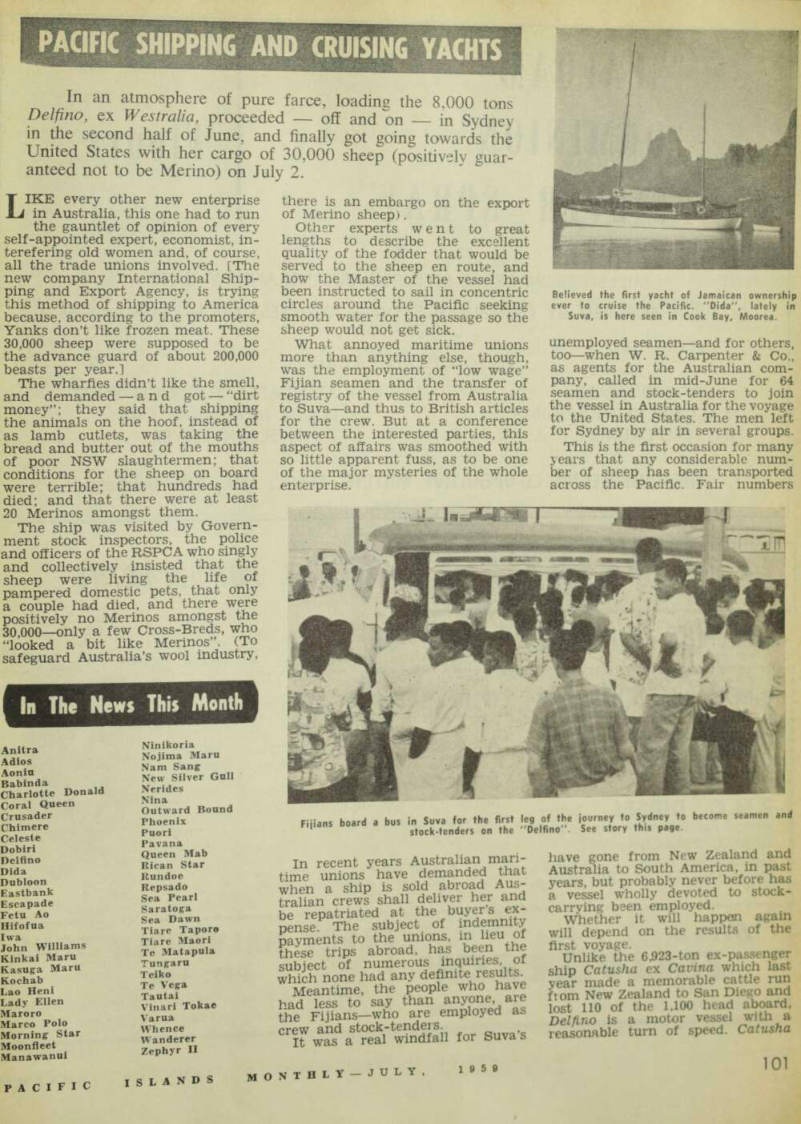
Believed the first yacht of Jamaican ownership ever to cruise the Pacific. "Dida", lately in Suva, is here seen in Cook Bay, Moorea.
Fijians board a bus in Suva for the first leg of the journey to Sydney to become seamen and stock-tenders on the "Delfino". See story this page.
carried vast quantities of coal. Fol lowing that voyage, on behalf of James Delfino, Californian rancher who has arranged the present ship ment of lambs, Catusha proceeded empty to Hongkong and was there broken up.
• Reshuffle Of Owners:
Southern Cross Shipping Co.’s 655ton freighter BAbinda, of Suva registry, normally on the trans- Tasman trade but making her second voyage to Fiji from Australia with explosives and timber for the Vatukoula gold mines in June, was reported in process of a reshuffle of owners.
Captain Ure retains an interest in the vessel but at least two of the Auckland partners have disposed of theirs to a Melbourne firm. The ship will continue in her present trade on the Tasman.
It will be recalled that an associ ated company, South Pacific Ship ping Co., of Suva, with some of the same shareholders, made a similar reshuffle in February with the ownership of the Suva-registered 469-ton tanker Verao, which is also on the Tasman run in the molasses and whale-oil trade. o GOING SOUTH: Tonga Copra Board’s 514-ton freight-andpassenger vessel Aomu, which main tains monthly contact between Nukualofa and Suva, as well as gathering in the copra from Tonga's scattered islands, will head south for her first dry-docking in Auck land in the second half of July. On resuming service the government's passenger-tug Hifofua will follow suit. These will be the first dockings
since the vessels arrived in the Pacific from Holland.
• Gone Foreign: Mr. John
McFadyen, one of Fiji’s smartest marine engineers, who was formerly associated with vessels of the late Harold Gatty’s South Seas Marine Products and has lately been with a milling company, headed for the Persian Gulf in June. It is under stood that he has obtained a lucrative job with an American backed fishing organisation there. It may be recalled that Captain R. L.
Deskin, formerly in the Gatty fish ing fleet and more recently in com mand of Sea Pearl, which burned and sank off New Guinea, subse quently delivered a fishing vessel
from the US to the Persian Gulf, presumably for this same organ isation.
• Transferred West: The
Seventh Day Adventist mission vessel Lao Heni, which has been lying idle at Suva for many months awaiting a decision as to her future cruising ground, was on the move again late June.
Under command of Pastor A. R.
Harrison, President of the Eastern Solomons Mission these past 15 years, and with a crew of five Solomon Islanders, the sturdy Queensland-built, twin-screw wooden vessel cleared for Aore Island, New Hebrides, thence Honiara on June 21.
The Mission’s marine superin tendent, R. Masters, was to board there to supervise a general over haul of hull and engines at Rugen Harbour, New Britain.
Lao Heni was built 1946-47 and went briefly to Papua then to Tonga, where she is no longer re quired. Following survey she will replace Vinari Tokae in the Solomons, and the latter 45-ft craft will be transferred to the Milne Bay-Samarai area of Papua. • HARBOUR BUS: A 32-ft x 8ft water bus was launched from Millers building yard at Suva late June for Mr. Vince Storck, owner
of Suva’s principal harbour-cruise
launch Oolooloo. A strongly built flat-bottom craft with a pleasing sheer, with heart kauri bottom planking, dilo knees, and 3/8-inch plywood sides, the new craft will seat 38 passengers, on foam plastic seats with backs. She is undecked but fitted with a canvas awning extending the full length and is equipped with two outboard motors in line fore-and-aft. The mam unit is a 35-hp Johnson and the other is a lower powered motor for slow cruising. One of these is mounted on the normal transom and the other in a motor recess. With the main outboard fitted the water bus will draw about 15 inches and should be ideal for her job of cruis ing across shallow reefs for the edification of tourists.
• For “Worm” Read
“SNAKE”: With more and more steel craft entering the Islands trade that arch-enemy of the wooden ship owner —the toredo worm—assumes decreasing import ance, but the casing of what must surely have been the father of all toredos was recently dredged up in a piece of rotten timber from Suva's Nubukalou Creek.
Starting as a very small worm, the toredo steadily expands as it eats its way forward, and as it goes it leaves a calceous tunnel be hind. A toredo as thick as a man’s thumb is generally looked on as a whopper, but the casing found in Suva, with all the surrounding wood removed, measured a full two inches in diameter, and the tube wall was close to one quarter inch thick and very strong. The portion discovered was 15 inches long, but there was evidence that it must have been a very long tube in its entirety. NEWS QF TE VEGA . We now learn that the handsome 242-ton steel passenger schooner TeVega, which left the Pacific late last year, is operating under charter to Commander Nicholson, of English Harbour, Antigua.
Commander Nicholson arrived there some years ago in a yacht from England and has since built up a considerable charter business, catering mainly for American tourists who wish to cruise West Indies waters.
He has developed a solid reputa tion for reliability and service in this field and is now very well known. The scope for a vessel of Te Vega’s type is much greater there than at Papeete or Honolulu.
Captain Fred Klebingat recently drew our attention to the fact that Te Vega, formerly named Vega when she first came to the Pacific in 1953, and for a brief interval be lieved to have been named Te Rame before becoming Te Vega, was originally launched in Kiel in 1930 as Etak —the name of the first owner’s wife spelt in reverse. • FIRST FLEET: The first Jap anese tuna fleet of the season—36 long-liners and the mother ship Nojima Maru —was moving south in June. The mother ship transmitted a Safety Signal on June 3 request ing all shipping to keep a close look-out for the long-liner Kasuga Maru, “99 tons, hull grey, bridge white, 23 crew, missing since May 30,” and last reported about 100 miles south of Ocean Island.
• Badly Holed: The Apia
based wooden coaster Tautai, bound for Savaii, went ashore near C.
Faleula during a night in mid-May.
A Union Co. launch was sent to her assistance and dragged the 43-ft craft clear of the reef after her eight tons of cargo had been dis charged. The hull suffered a good deal of damage but Tautai reached Apia for repairs.
• Forbidden Anchorages:
Who fouled up the degrees 30 years ago, is the question which is caus ing a lot of red faces in a cer tain Suva Government Department.
But the person responsible might be dead or living in another country
The Tonga Government's new tuna long-liner "Teiko" will be almost identical to this vessel —except that the Tongan vessel will be given greater headroom for a Tongan crew, which will also call for greater beam to maintain stability. This craft, "Nakamaru No. 8", is from the same Inland Sea shipyard—Goriki Shipyard Co., Ltd., Ujiyamada, Ise Bay, Japan.
Photo by courtesy Tonga Government.
Bill Endean's "Crusader" leaving Devonport wharf Auckland, for Tahiti See page 113.
Photo: John Duder.
since the blunder was made as long ago as 1930.
The question concerns the word ing of the Fiji Quarantine Ordin ance defining the location of the quarantine and medical anchorages in Suva harbour.
The positions given are 051 degrees, distant seven-and-a-half cables, and 072 degrees, distant four and-a-half cables respectively from a certain point.
A plot of these positions places the anchorages slap bang in the middle of the Suva Gaol’s backyard, and in dense bush at the back of the suburb of Lami respectively, both several hundred yards inland —situations which, no doubt, would do little to relieve the ulcer of the most confident ship master.
The quarantine anchorage has since been abolished, but the correct position of the medical anchorage will be amended accordingly to 252 degrees, distant four-and-a-ha1f cables from the Tamavua beacon.
The question being asked at Suva is what would have happened if some ship had anchored for medical or quarantine inspection at places in the harbour other than the recognised spots? Would the master have been liable to prosecution? If so, for what?
• Tomorrow’S Masters,
Mates And Engineers: Only In
the last few years has there been any organised scheme for the train ing of locally-born boys within the South Pacific Islands area, as fully qualified Masters and Engineers to standards acceptable in foreign going deep-water ships.
With the possible exception of Dutch New Guinea, where a well organised system of training is in operation, boys still have to journey to Auckland or Sydney or elsewhere outside the area for the final theoretical training preceding their examinations.
But at least there is now some small provision for boys to gain acceptable sea-time in deep-water vessels trading exclusively within the Islands. Such vessels are those of the High Commissioner for the Western Pacific, Ninikoria, Coral Queen, and Te Matapula. the GEIC Wholesale Society’s Moana Raoi and Tungaru, and the London Missionary Society’s John Williams VI.
Last year the first of the deck cadets, Sila of Nanomea, Ellice Islands, who served his time in John Williams VI, attended a navi gation school in Auckland and subsequently sat and passed the ex amination for Second Mate.
In June he was expected in Suva to join Ninikoria as Mate, and after two more years on foreign Articles he will be able to sit his foreign going Master’s certificate. We be lieve he is the first full Islander to qualify as Second Mate. Other cadets are coming along well, in
both deck and engine-room depart ments of these ships.
Fiji has at least one qualified part-European master, Captain Henry Simpson, and before long the Gilbert Islands may lay claim to one. Mr. Willie Schutz, now serving in a British tramp, will be going ashore for final schooling and ex amination as soon as his ship, the Avishank (owned by the Aviation & Shipping Co., of London, and not a Bank Line vessel) arrives back in the UK. On qualifying, he plans to return to the Islands, if a position is offering.
• Not Like Before: What
most impresses regarding the post war steel ships in the Islands trade is the splendid standard of accom modation for all aboard as com pared with the pre-war Islands “schooner”.
Ninikoria —the ship which was lengthened by 8 ft 9 ins. following trials after launching in Hongkong last year, is an example of the best that is offering in the Islands to day—for officers, crew and for passengers.
Ninikoria, wearing the funnel colours of the Gilbert and Ellice Islands Government —buff, with a circular blue medallion on which is a red shield with a bird flying over a rising (or setting?) sun a blue and white wavy sea—came to Suva in June for drydocking.
One of the indications that she'd come from Hongkong-she was delivered in January last - are her neat, basket-type fenders, woven from rattan cane. Coming south from Tarawa, through a lot of bad
weather, Captain A. B. MacAdie said that calls had been made at a number of islands of the Colony, in cluding South Tabiteuea, where Captain Gerald Douglas, the Marine Superintendent, had been landed to carry out some charting and
beaconing work.
Captain Douglas will be bringing the Government’s Nareau south to Suva for refit about September.
Captain MacAdie said that good progress was being made on the new Betio Harbour project at Tarawa and the job should be com pleted in 12 months.
• That Tongan Long-Liner:
Prince Tungi, of Tonga, supplied further details of the 95-ton tuna
long-liner which his government has now ordered from Goriki Ship yard Co., of Ujiyamada, Ise Bay, in Japan’s Inland Sea.
To be named Teiko, she is a modified version of a standard type, of which Nakamaru No. 8 (see photo) is a recent example launched from the same yard.
The modifications call for greater head-room between decks in the Tongan vessel. This in turn has called for greater beam to maintain stability. The general standard of accommodation will also be higher.
There will be insulation against the sun’s heat, fans, mattresses, etc.
Construction will be of a Japanese kauri known as Inoki, and the power unit will be a Niigata 6-cylinder,
Cruising yacht "Celeste" called at Pago Pago, American Samoa, southbound from Tahiti, in late May. Crew members (left to right): Peter Nelson (skipper), Herbert Knot and Ron Cameron.
Photo: Pan American Prints.
320 bhp, 4-stroke diesel with a normal 390 rpm, capable of operat ing on a mixture of diesel fuel and toiler oil—though only diesel oil will ae used in Tonga. Delivery will be within five months.
Teiko will be equipped with a 300basket, long-line rig.
Each “basket” consists of a 48fathom main line, with five 18fathom drop-lines at 12-fathom intervals. The lines, steel traces, swivels, and hooks for each “basket” cost about £10—so the long-line equipment alone will cost about £3,000, in this case. Modifications to the standard design of the ship will cost an additional £3,000.
Goriki Shipyard Co. delivered a much smaller 20-ton fishing vessel to American Micronesia last year.
Prince Tungi brought back from Japan some interesting statistics on the present make-up of the Japenese fishing fleet.
Excluding small craft with no engines, there are 76,907 vessels in the industry—including tuna craft and those engaged in other types of fishing. The fleet consists of the smaller vessels averaging about 26 tons gross, which are powered with simple “hot-bulb” type diesels, and the larger full-diesel craft averaging 50 tons overall— though some are much bigger.
There are over 43,000 hot-bulb craft totalling 360,404 tons gross; and 33,700 full diesel craft totalling 09,613 tons. By far the greater portion of this huge million-ton fleet is engaged in home waters as
anyone who has approached Japan from the sea can well appreciate. • WHALING is OUT: Prince Tungi said in Suva, in June, that he did not see a commercial whal ing station for Tonga in the near future.
Whaling was much more of a gamble than fishing, and a lot more initial capital was involved. A suc cessful fishing industry does not call for any costly shore establishment in the early stages, but whaling does. It is much easier to build up a fishing industry by stages as re sults warrant.
Meanwhile, at least one primitive commercial whaling venture has appeared in Tonga in a very small way. Last season Mr. Walter Skudder shipped out of the kingdom about 50 drums of whale oil rend ered down in the old way. A lively whale meat industry, perhaps unique in the Pacific, and expanding in re cent years, also exists.
• Nice Charter Job; Maroro
Cruise and Charter Service, owners of Maroro ex Hifofua, secured a nice charter job for the 108-ton ketch in June. Although still undergoing the final touches to her remodelled
accommodation, Maroro sailed on June 19 for the Lau Islands of Fiji with Australian Government geologist, O. N. Warin, aboard.
For three months he will move from island to island in that area assessing small phosphate or guano deposits as part of a South Pacific wide, joint project of the Australian and New Zealand governments which foresee the eventual working out of the important deposits on Ocean, Nauru, and Makatea Islands and the need to perhaps reconsider small and sometimes forgotten low grade deposits elsewhere.
Mr. Warin, of the Bureau of Mineral Resources, Department of National Development, Canberra, last year made a wide investigation of similar deposits in the Papua-New Guinea area and in the Solomons.
It is possible that with Tonga Government approval, a similar search will be made in that Group on completion of the Fiji project.
Mr. Warin estimated that the Tonga investigation would take an additional two months. During the Lau operation, Maroro will act as supply and communications vessel, and at some places Mr. Warin will live aboard. (Over)
Nearing completion—the $79,000 slipway at Pago Pago, American Samoa. It was started in July, 1957, was built by the local Public Works Department and when finished will be able to accommodate ships up to 500 tons. It will be used for local vessels and also for Japanese tuna fishing boats which now operate in those waters.— Photo by Pan American Prints.
A lot of people are beginning to feel that the BSIP Government vessel "Coral Queen" was too appropriately named. Delivered to Honiara from her Hongkong builders only last December, she has already had two bites at the coral-the last time in May on a Witu Reef off New Britain, where she took a hard pounding. She was on a Rabaul slipway, where this photo was taken, in mid- June and was expected to be there for a couple of weeks having temporary repairs made. After this she will go to the Australian coast-Queensland or NSW-for a more extensive job. Several shipyards have been asked to quote, including Ballina Slipway and Engineering Co.(S. G. White Pty., Ltd.). At end of June it was still not known who would do the job. Writes a Rabaul correspondent: "'Coral Queen' seemed to me to have suffered extensive under water damage-what seemed to me to be a fair-sized hole was being dealt with when I saw it. However, Captain G. W. Sharp, who came up from Honiara to attend to affairs, told me tersely that it was NOT a big hole, so I bow to his superior knowledge. Lloyd's sent a marine surveyor from Sydney to look the vessel over."
• Remember That Costa
RICAN?; The Costa Rican flag is rarely seen in the Islands, so when 495-ton steel twin-screw ex Cornelius Vanderbilt yacht named Rican Star called at Suva with a cargo of high-freight explosives from North America for Sydney, several years ago it was news.
Arriving at Sydney minus some crew who had deserted at Honolulu and Suva, and with a broken crankshaft and a hull that was less than acceptable to the Australian authorities, this refrigerated bananacarrier was laid up for a lengthy period.
Finally, last year she was sold to Queensland prawner, apparently for service as a freezer mother-ship.
This project seems to have failed ; Rican Star, now equipped with a lir of 550 bhp GM’s in place of her original 8-cylinder Wintons, was to be auctioned as she lay at Musgrave wharf, Brisbane, on June 17 under instructions from the mortgagees in possession”. Rican Star, ex Samana Queen, ex Elena, ex Lynx, ex Ramona, ex Dolphin, thus seems on the verge of another phase in her eventful career, though she was “passed in” at the auction and private negotiations with some of the bidders is now going on. • SPECIAL JOB: Burns Philp’s 7-ton, Fiji-based Zephyr II , made charter voyage from Suva to lyau island, in the Lau Group, in time to load bagged manganese e by surf-boat from the beach where, on behalf of the Suvagistered Japanese firm of Banno Bothers (Fiji) Ltd. who have a concession on this island.
The manganese together with iron ore from elsewhere in Fiji, was trans-shipped to Kinkai Maru for dispatch to Japan in July.
• Making Hay: While A. B.
Donald & Co.’s 300-ton Charlotte Donald undergoes an extensive refit and a possible transfer to French registry, at Papeete, Captain Hugh Williams’ 135-ton Dobiri is making hay in the Cook Islands, where she is transporting all Donald cargoes, By July, when Charlotte Donald was expected to be ready for work, it is likely that agreement will have been reached with the French and that this ship will remain in French Polynesia, while the company’s 173ton sc hooner Tiare Taporo returns from there to the area where she was so well known in past years
and where she is now apparently adequate for the work offering.
Later in the year, Dobiri will head for dry-docking in Auckland. “No more hurricane seasons in the Cooks for me,” says Captain Williams; I’ve stuck my neck out long enough in four such seasons of trading in those waters.”
• Expensive Noise: South
Pacific Trading Co.’s busy two masted schooner Tiare Maori, on the regular run with petrol and passengers between Rarotonga and Tahiti—with an occasional side trip to the Northern Cooks, suffered a broken generator motor crankshaft in May, soon after sailing from Rarotonga for Aitutaki. She put back and later headed for Papeete for repairs, where she still was in June.
Meanwhile the busy Cooks coco nut-radio circuit carried an item in
The six crew members-"mostly farmers" the say-of the 52 ft. South Australian schooner, "Pavana" which will compete in the Los Angeles-Honolulu yacht race commencing on July 4.
"Pavana" and her crew lost no time in crossing the Pacific, northbound. This photograph was taken in pago pago late May; on June 7 our Honolulu shipping correspondent reported that "Pavana" had called in there but had left again before even the Harbour Office could get much information. Australia's other entry in this blue-water classic, "Anitra", went north by cargo vessel. Shown here, back row: Max Fauser, peter Nolan, Harry Bowden; front row: Wilson Hissey, George Richardson, and George Mayne (skipper).
Photo: Pan American Prints.
May to the effect that Tiare Maori’s owner had purchased a 116-ft tanker on the Pacific Coast of the US, tonnage not stated, but powered with a pair of GM’s, for the trans port of bulk petrol from Papeete to Rarotonga.
Some time ago this company, headed by American, Walter S.
Johnson, Jnr., applied to the Ad ministration for the lease of a piece of land on the Avarua-Avatiu fore shore for the erection of a bulk oil depot, and it is believed that the application was being given a sympathetic official hearing.
• Who Owned The Anchor?:
After the items we have had in this section, in the last year, showing that the Receiver of Wreck never relinquishes his claim on any odd bits and pieces strewn on the reef, we were interested in this little item, passed on to us from the SDA Missionary at Abemama, Gilbert Islands. He says: “During the westerly season here winds sometimes reach 40 knots and we need a strong anchor for the mission ship Fetu Ao. We found that the cost, including freight, would be more than our budget would allow. However, one of our ship’s crew said he thought there was an anchor on a wrecked ship on the reef at Abemama, so we went out, and sure enough, the anchor was there in about «ix feet of water, four feet at low spring tides.
“It took an afternoon to dig away the coral and get the anchor clear of the bottom. We returned later, floated it under a dinghy out to where we had the ship anchored, and then hauled it aboard with a derrick.
“It was most interesting to go down with a diving glass and look at the wreck. It was an old steamer used for trading and was on its way from Tarawa to one of the southern Gilberts one dark night in 1915, when it ran straight onto the reef.
The anchor was still in good con dition and so has saved us quite a lot of money.”
It is a pity our Missionary friend didn’t mention the name of the old steamer. Although she has been there on the reef for 44 years, no doubt she has memories for some one.
• Orient Liner May Visit
AT HONIARA: Mr. J. Stannard, a Marine Superintendent of the Orient Line, paid a short visit to Honiara recently to assess the possibilities of a visit to the Protectorate of a tourist vessel.
Although plans are only in the early stages it seems rather certain that March, 1960, will see Honiara listed as a tourist attraction for a South Pacific Cruise. The Orcades has been mentioned as the liner.
With the “Battle of the 14-day Pacific Cruises” really on, a new name may mean more passengers,
and for the Protectorate—some tourist money would never go astray!
• East Bank Visits Gizo:
After loading approximately 2,000
tons of copra at Honiara and Yandma, the MV Eastbank ran into minor trouble when entering Gizo in the Western Solomons, in June.
The vessel missed the channel into Gizo Harbour and then the
starboard anchor-chain broke; by
the time the port anchor held, the vessel was well inside the usual
Copra Ship anchorage.
Two natives, experienced in shell diving, were sent from Honiara to assist in retrieving the anchor and about ten fathoms of chain.
News of Cruising Yachts
• NEW SILVER GULL of Sydney, moving slowly back towards her home port after a 12-year gadabout, arrived at Suva from Pago Pago on June 7, just as some inquiries were being made as to her where abouts. There had been no word from Pago Pago of the yacht’s arrival there and friends in Suva felt that she was overdue as Harry Scott was known to be in poor health.
Soon after arrival in Suva Mr. Scott, aged 73. entered hospital for surgery while Mrs. Scott very capably remained in command of the yacht which joined the small-craft queue at the entrance to Walu Bay. Mr. and Mrs. W. A. Bein, who joined in the Galapagos, thought they might return to the US by commercial transport from Suva. • DIDA, believed first Jamaica-registered craft to come to the Pacific, arrived in Suva on June 15.
With Mr. and Mrs. Alistair D. Fraser aboard the 52-ft. double-ender ketch were Jack Russell of Hollywood, Cal., who had arrived in Papeete aboard CHIRIQUI last year, and Eddie Tetiki a Hutihuti of Takaroa who joined at Moorea; also Andre Mayet of Saint Laurent du Juan, France, who had come out to Papeete in the liner TAHITIEN last year.
DIDA, built in Dartmouth in 1931, was brought to the West Indies by an American couple and purchased by the Frasers last May in the Bahamas. The yacht is a centre-board type, with an 8-ton castiron keel. With a beam of 14V2 ft. she draws only 4Vz ft. with the centre-board up, and 9 ft. with it down.
The masts are in tabernacles, and the motor —a particular massive model—is a ? hp Glennifer diesel.
The cruise began at Kingston last November. After transiting the Canal, calls were made at most Galapagos islands, icnce Marquesas, Takaroa, Papeete, after which some local French Polynesian cruising was done before clearing May 19.
Calls were then made at Moorea, Pago Pago, and Apia. • KOCHAB with Dr. Franklen-Evans and crew was still cruising Fiji’s outer islands at the end of June. • MOONFLEET went on a Suva slip late June and plans were to clear for Auckland in July under Ken Mildon. However, no crew were available so Mildon transferred to DIDA, and will help crew that yacht to Sydney. • RUNDOE, of Norway with Carl Peter, son and Irling Brunberg aboard, which left Moorea early June westbound, is re ported back in Papeete repairing a leak. le is described as a 45-ft. Colin Archer pe.
* REPASADO, the U.S, motor yacht of "about 80 ft.’’ exchanged for the Auckland motor-sailer MANAWANUI at Papeete in May, and which sailed from there for westward, put back with engine trouble and leaking after reaching Borabora. She should sail again with her New Zealand owner and assorted crew in July. This craft reached Papeete from the US about a year ago. Owner Ray Kline’s wife and two children returned home by commercial transport at the end of 1958. Powered by twin diesels. REPASADO is about 14 ft beam.
MANAWANUI again changed hands in June. Ray Kline, who was preparing to sail her to Honolulu, is reported to have sold her—new owner not stated. • NEREIDES, 52-ft. Auckland ketch, was reported in Papeete preparing to move
west again in mid-June. Mr. Athol Rusden, a former part-owner of MANAWANUI was reported to have joined her. • ADIOS and the Steeles were reported at Aitutakl in June and heading towards Suva via probably Tonga. • VARUA and American W. A. Robinson, based at Papeete, were outward bound again—for Honolulu this time—in May where he arrived 31st. • CRUSADER, 47-ft. Auckland ketch, skippered by owner Bill Endean. and with Warwick Davies, John Ewing, Rex Hill and writer Major Bill Moss aboard, cleared Auckland June 14 for San Francisco via Papeete. • WANDERER of Auckland, details un known, was expected to sail for Suva in July.
• NINA of Auckland, reported last month, has now postponed her voyage to Fiji until the end of the year due to personal reasons of the owner. • DUBLOON, 40-ft. Los Angeles ketch ?th the Gladson family aboard was in a Csta Rican port in April and about to ?ear for Cocos Island and the Galapagos and maybe Polynesia. • CHIMERE of France, which we reported tward from Tarawa for Japan via ports May “PIM”, nearly ended her own career and that of one of her owners at Tarawa. The Bluches decided to sit the yacht on the lagoon beach for bottom cleaning, but failed to adequately support her on the falling tide. At low tide, while the owners were working under the yacht, she suddenly started to go over. They just had time to get clear before she lied, breaking her mainmast and narrowly missing the Bluches. • OUTWARD BOUND was reported mid tie by John Caldwell, who is sailing with wife Mary and their two young sons, to at Cooktown, bound next for Thursday and.
» Los Angeles - Honolulu Yacht
RACE: There were about 45 yachts entered in this race up to mid-June, ranging in e from a 160 ft. schooner to a 36 ft. op. They will get away from Los Angeles on July 4. Australia will have an interest in it this year in the entry of . South Australian yacht PAVAND (page ) and in Trygve Halvorsen’s ANITRA; and so will New Guinea in Des Ashton, District Officer, Lae, who will sail in ANITRA as a crew member.
At least three of the race yachts, NAM
Ng, Escapade And Queen Mab Will
be heading Tahitiwards after the race.
PUORI, ex-GOLDEN RULE, returned Honolulu in late May after an eightmonths’ cruise in French Polynesian waters. Owner-skipper Gene Bettengill is assisted by nephew Wayne and Ron Quail.
Left Honolulu for south-west US on June 9. • WHENCE, 28 ft. Bahama sloop, with owner Gordon Lopez, wife and daughter, left Honolulu late May for Tahiti. • LADY ELLEN, the big Australian yacht that was sailed across the Pacific by the Horn couple and their crew last year, was not sold in the US as hoped.
Recently they took her down to the Carib bean. • SEA DAWN, a 36 ft. yawl owned by Glen Lowden, wife and two children, ar rived in Honolulu from Acapulco, Mexico, at end of May. They sailed in company with TOREA (owned by Mr. and Mrs.
Clark Scarbora) and AGIS (owned by Mr. and Mrs. Eugene Di Maio). • Earle L. Reynolds, owner-skipper of yacht PHOENIX plans to continue his journey to Japan sometime in the future, pending outcome of appeal to US Court of Appeals in San Francisco on his Hono lulu sentence for sailing his yacht into the H-bomb testing zone. July 1, 1958. He has recently returned from a two-months’ tour on the US mainland, lecturing on radioactive fallout and the PHOENIX case. • IWA, 32-ft. ketch, departed Honolulu for the Society Islands on June 4. Owner skipper is Mr. Eugene Yatsunoff. His wife accompanied him. • The disabled yacht MORNING STAR with five persons aboard was towed into San Diego June 11. The Coast Guard said a propeller shaft bearing had burned out. • Aksel Pederson. Danish skipper-owner of the ketch MARCO POLO sailing from New Zealand to Denmark, left Honolulu alone June 17 on an expected 40-day trip to San Diego. He plans to leave San Diego in November for Panama, thence across the Atlantic to Scandinavia. He believes the trip will take approximately one year.
On board “New Silver Gull” when she reached Suva in June were: William A. Bein and wife Marjorie; Mrs. Newton-Scott, and owner skipper of the yacht Harry Newton-Scott. See story p. 113.
Photo: Pan American Prints.