The Month's New Reading
pp. 94-105 · Read in the full issue

With Judy Tudor
Every age has its hazards; and those of our own being mowed down in a road accident or getting an overdose of Strontium 90 — seem tame in comparison with those of the 17th century: The risk of being poisoned by foe, friend or family; set upon by assassins; thrown into prison and left to rot; guillotined; burned at the stake; hanged from the nearest public gallows; plus, of course, more orthodox methods of shuffling off this mortal coil, such as being taken by the plague, or some odd fever.
SO short was the expectancy of life, so few the artificial pleasures, in these stirring times, it is probably no wonder then that the people indulged, large-scale and lavishly, in what in Biblical parlance is referred to as fornication. And as a hay-loft-by hay-loft, and bed-by-bed descrip tion of the practice, as carried out in Louis XIV’s France, Angelique (by “Sergeanne” Golon, translated by Rita Baisse) is a complete reference library in itself.
It could be that when the time comes to write the complete history of the current millenium, our century will go down as the one in which there was the most talk about sex; with the 16th and 17th centuries as those in which most was done about it. In those years, before Freud and psychiatrists who have a name for everything, if a female got herself into any sort of odd situation vis-a-vis the opposite sex, she expected to be raped, and it says much for the vigour of the gentlemen of the period that her expectations seldom went unfulfilled.
Nor were the ladies unduly put out about this state of affairs, and some, including our Angelique, appeared even to have enjoyed it.
Angelique is a huge book of over 700 pages; Cineramic in scope, it is rich in colour and swift action and in the technical perfection of the writing—carried out by what appears to be a husband-and-wife team. (“Sergeanne” is the com posite name of Anne and Serge Golon).
The novel has all the ingredients of a best-seller and critics overseas are already seeing it as another Gone With the Wind or Anthony Adverse. Angelique has many of the characteristics of Scarlett O’Hara— personality and inner strength that occasionally combine in a fictional or real character to show that the female can be more enduring than the male.
Beautiful with red-gold hair and green eyes, she was one of the numerous offspring of the im poverished Baron de Sance de Monteloup. The crumbling chateau,
perched on the edge of the northern marshes, had changed little since the middle ages. Her playmates were the local peasant children who taught her much that was to be useful later, At 18 she was married by proxy to a wealthy nobleman, the Comte de Peyrac, of Toulouse. He had been maimed and disfigured as a child, and at first filled Angelique with revulsion but later won her
completely, and became the father of her two sons.
Unfortunately Jeffrey de Peyrac’s skill as a lover was equalled by his knowledge as a scientist, and his understanding of metallurgy was so far in advance of his century that he was regarded as little better than a sorcerer.
This was the peg on which the hat was hung, and when he dis appeared into the Bastille during the Nuptial festivities of Louis XIV and the Infanta of Spain, to await the pleasure of Church and State, he emerged again only to be the central figure at the public executioner’s bonfire.
With de Peyrac’s downfall, the doors of the Louvre were closed to Angelique and a great deal of the novel is devoted to her slow crawl from the gutters and garrets of Paris back again to walk beside Louis XIV in the gardens of Versailles.
If that crawl took in a lot of the beds in Paris, then it was part of the customs of the times—customs that, if we are frank about it, pro vide the element with which modern alchemists turn a dry-as-dust school history-book into a best selling historical novel. (ANGELIQUE. Published by Wm. Heine mann, Ltd. Australian price, 31/-.)
Russian Unexplained
IN spite of a sprightly manner of writing and a large subject, John Brown’s Russia Explored leaves a great deal about himself, and the USSR, unexplained.
Brown was one of the first “dis illusioned Marxists”. After a spell on the dole in the 1930’s, he won scholarships to Oxford and Yale but emerged still a meddlesome socialist, until Lord Nuffield offered him a trip to Russia to study Communism.
Evidently Nuffield thought that he would be cured, and in this he was right.
In 1957, Brown returned to the USSR for a visit, this time with his wife. Russia Explored covers that trip, and is a sort of a cross between a travel book and something more penetrating. It manages to be not completely convincing in either de partment, but, here, are some of the more interesting angles on life in modern Russia, as Brown saw it: • Ever since the first Five Years Plan, a fantastic effort has been made to build up the engineer as the archetype of advanced humanity. The films, books, drama and ballet were brought into service, and the results were soon apparent.
The graduate engineer enjoys the prestige of a film star in the West. • Industrial discipline is far better than in the capitalist countries. Strikes are illegal, and if you are more than 20 minutes late for work three times in a month you are liable to a prison sentence . . If you are a good time-keeper
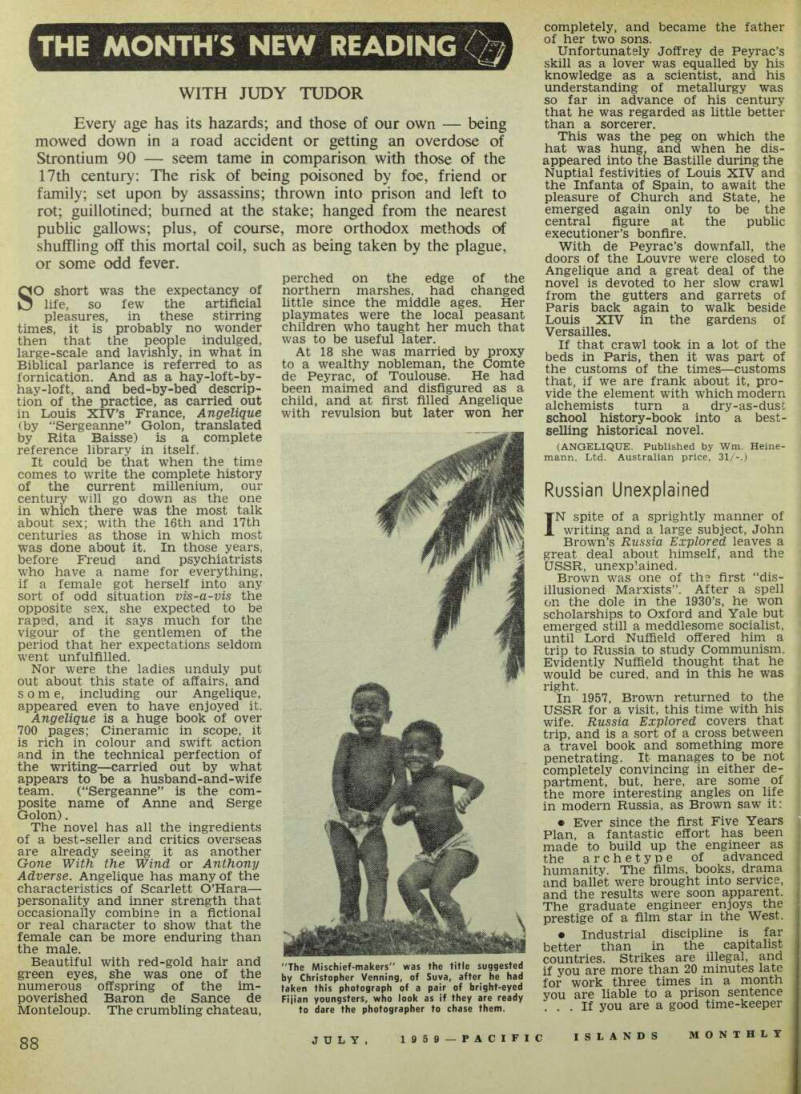
"The Mischief-makers" was the title suggested by Christopher Venning, of Suva, after he had taken this photograph of a pair of bright-eyed Fijian youngsters, who look as if they are ready to dare the photographer to chase them.
—and who isn’t—you get your paid fortnight’s holiday a year. • In the crowded tenement blocks . . . The passages are choked with wood, coal, bottles, paraffin and spirit stoves. There may be some one guarding the precious fuel and as sure as fate a quarrel will be in progress, for where people live so closely packed as this, there are feuds on every floor. The big back sides of the Russian women jam the passers-by against the walls as the struggle to prepare a meal goes on in an atmosphere of farce . . . The effect on the children is to make them want to escape, so they work hard from an early age . . . There is a family bonus, but it is paid only after the birth of the fifth child.
After the birth of the eighth child the woman gets a medal; and after the eleventh she becomes a “Hero of Motherhood” with special privileges.
She is granted paid leave from her factory or collective for a few weeks before and after the birth of her child. • The planes skim low over the ground at 300 or 400 feet. This is not only more fun for the pas sengers but helps the pilots, as they can find they way better when rivers and main highways are just below. Everyone brings his own food parcel, the luggage is piled in the aisle, there are no safety belts, and no night flying. • Pravda is housed in an enormous building and has an editorial staff of many hundreds . . . There seems to be a reporter for every comma . . . who spend their time going over articles and news items, substituting a word here, cutting a stress there . . .
The result is the dullest newspaper in the world. Russian papers eschew all sensationalism. If their latest Tsar died tomorrow there would be a bare announcement and a brief biography. Even in the case of an important speech by one of the party leaders, there is delay for editing and checking and for the omission of the bits that have been the subject of second thoughts.
Like most observers of the Russian scene, Brown makes no comment on where all this beaverlike activity is getting the Russians in the material sense. For at least 15 years, all of them, men and eomen, have been toiling in factories and farms producing goods for what amounts to bare subsistence. Does supply ever catch up with demand? Impossible as it might seem, it evidently does not.
Or, in Russia, does working in a fac-
ory—probably producing nuts for
thingamebobs—constitute an end in itself? (RUSSIA EXPLORED. Published by Hodder and Stoughton. Australian price, 14/3.)
The 2/16th
Went to War
IT'S a slow process but in the end it is unlikely that any phase of Australia's service in the Second world War will go un documented. Of the dozen official histories of the armed services, about half have already been pub lished, and there have been private accounts of phases of the fighting —such as Raymond Pauli’s Retreat from Kokoda.
But Malcolm Uren is the first to produce a battalion history, and his 1000 Men at War, the story of the West Australian-raised 2/16th AIF, breaks new ground to that extent.
He does not set out to prove that “the 16th won the war”; nor is the book concerned with battle tactics
and grand strategy, but confines itself to the exploits of individuals and units in the long war which the Battalion fought from the Middle East to Balikpapan.
Of them Uren writes: “There probably were a few swashbuckling adventurers among them but, in the main, they went to war as men go to work. While they were at war they enjoyed themselves as much and as often as they could. Like other Australian battalions, military discipline at first sat uneasily upon them. As training progressed and experience was gained they matured individually and collectively, and on all occasions that mattered, particularly in battle they displayed the discipline of elite troops”.
Originally the battalion was composed of West Australian troops but
as the war went on casualties, re placements, reinforcements, etc altered the composition and the final roll found plenty of NX, VX, QX and SX numbers mixed in with the original WX’s. After peace came, finding the Battalion at Balikpapan, surviving original members of each company were photographed, and in Headquarters, A, B, C and Don companies there were around 80 men.
The Battalion fought in Pales tine, the Western Desert and Syria; from Port Moresby across the Kokoda Trail to Gona; in the Markham Valley, the Ramu and up Shaggy Ridge; and finally took part in the sea-borne assault on Balikpapan.
The story has been pieced together from the composite memories of members of the outfit —memories which after 15 years are apt to—as Uren puts it—push the horrors and discomforts into the background and remember mostly the riotous good fellowship.
To Uren himself, a leading Wesralian journalist in civilian life, goes the credit for having woven it all together into a compact and very readable account of one Battalion’s war.
There are eight maps, and numerous photographs — which prove again that Australians can do more awful things to a Digger tat than its designer must ever have imagined possible; and that under the stress of battle, the Aussie’s disreputable appearance and his cheerfulness must both constitute some sort of all-armies, all-time, record. (1,000 MEN AT WAR. Published by Wm. einemann, Ltd. Australian price, 30/-.)
The Tax That
Didn't Take
Over - Simplification Of
events in school history books scarcely prepares the way for the wallops and disillusionments contained in more advanced tomes ir adult reading.
Any dilligent researcher these days can, at the drop of a hat, prove that Good Queen Bess was slightly less good than she was acked up to be; that Richard the Lion-Heart would have been better employed seeing to things at home than in sticking his nose into foreign problems; or even that transportation to Botany Bay was not such a bad thing as some people y to make out.
The misrepresented historical in cident which we are most concerned with at the moment is the Boston Tea Party, which, as every schoolboy knows, happened when the cked English put a tax on tea supported by the North American colonists. The colonists, very annoyed, dressed up as Red Indians, ;nt on board the ship and tossed the tea into Boston Harbour. This
led to the War of Independence and proved one and forever that there should be No Taxation Without Representation.
It was all as simple as that. But now comes British historian Brian Connell with a book called The Plains of Abraham in which he proves that it wasn’t simple at all and if anyone failed to do the right thing in the earliest days of North American colonisation, it was the colonists themselves and not the English.
The Plains of Abraham— also as any schoolboy knows—was where Wolfe beat Montcalm and captured Quebec, and so put an end to 100 years of struggle between the French and the English for the
possession of the North American continent.
With the French menace removed from behind the Appalachian Range, the whole continent was open to the English—or should have been—but it was the colonists south of the St. Lawrence who rushed in to fill the vacuum, leaving the question of their protection, as usual, to the British regulars.
The French had been vanquished at a cost of £60 million—real money in those days, to which the colonists had not contributed one penny piece—but the Indians were still very much there and when “it was considered not unreasonable that the colonies should contribute to the cost of their protection” by
means of direct taxation, the colonists begged to differ, and the seeds of the American Revolution were sown.
Connell paints the colonists as balky, unco-operative, interested only in being let alone to get richer, unable to see further than the boarish pump. But whether the reader accepts this version or not, the author manages to make his point that the battle on the Plains of Abraham was a turning point in history.
(The Plains Of Abraham. Published
by Hodder and Stoughton. Australian price, 31/9.)
Bony Goes
Out West
ALTHOUGH cosily dug in somewhere around Bowral, NSW, these days, author Arthur Up ield has his unfortunate part Aborigine detective, Napoleon Bonaparte, moving so fast around the big Australian Continent the poor bloke gets scarcely any time to sleep in his own bed —which is in Queensland somewhere.
A couple of months ago he was solving a mystery in Broken Hill (Bachelors of Broken Hill ) but for the purpose of the current epic Bony and the Mouse) he has taken a job as yardman in a one-pub town in the dust belt, north of Kalgoorlie, WA.
Someone in the town had mur dered three people—an aboriginal girl, a respectable middle-aged housewife and a garage attendant.
The crimes had all taken place while the local natives—including the police tracker—were on walkabout. It is a crime just down Bony's street, and he solves it with his usual equanimity but not before Upfield has painted another characteristic portrait of the Great Australian Outback. (BONY AND THE MOUSE. Published by Wm. Heinemann Ltd. Australian price, 15/6.)
Juvenile
Department
FOR the very small fry, Trumpet Churchdog makes his bow alongside Peter Churchmouse which appeared a couple of months ago. Again written and delightfully illustrated by Margot Austin, Trum pet is a limp-eared baby spaniel who comes to join Peter Church mouse and Gabriel Churchkitten in Parson Pease-Porridge’s church and learns to make up poems.
All children who like to play house—and there must be few children who do not—will be de lighted with The Littlest House, a special effort for the under-10's by Elizabeth Coatsworth, who has grafted some exciting adventures onto a real town and a real house. (TRUMPET CHURCHDOG. Australian
Price, 10/9; The Littlest House, Aus
tralian price, 13/3. Both published by World’s Work.)
Only The Vet's
Daughter—But
EMOTIONAL commotion affects different people in different ways but what made Alice Row lands slightly unique was that it caused her to float around the ceiling amongst the gas-lights, often with devastating effect on the mantles.
This occut gift of levitation— which went out of fashion about the same time as witchcraft—is the theme of a weird novel called The Vet's Daughter , by Barbara Comyn.
Although thick with Victorian atmosphere, complete with bullying father (the Vet), his tubercular mistresses and the assorted miseries of down-trodden Alice, it is not meant to be regarded as a serious literary exercise—and can, in fact, be polished off in a couple of hours.
This is nice timing on the part of the author: Any more would be too much, but by cutting the dose to size it is just possible to swallow the impression that Alice may have had this strange urge to float, and the talent for putting it into practice.
Alice’s undoing was when father found out, and always being a man who seized the main chance, de cided that she should put on a public turn on Clapham Common.
Alice floated alright, but when she descended the too - enthusiastic spectators trampled her to death. (THE VET’S DAUGHTER. Published by Wm. Heinemann. Australian price, 17/-.)
Whimsy Amongst
the Pineapples
ELEANOR DARK has written far far better than she does now in a would-be whimsical clutter of pieces called Lantana Lane.
Her Timeless Land and Storm of Time were historical novels of im portance that contributed some thing to our knowledge of early Australia: the current lot don’t even contribute much to the present chapter, although each item is a sketch of some character who lives in Lantana Lane, a pineapple growing community somewhere in eastern Queensland.
Supposed to be humorous and Australian, they may appear to be
o if read in Stoke Poges or Bir mingham. But read on a wet winter afternoon in Sydney, they did nothing to lift the prevailing gloom. (LANTANA LANE. Published by Collins, Australian price, 18/9.)
Whodunnit
with Atoms
AN author has to hump himself to get any new gimmick into a thriller these days but Christopher Hodder-Williams has managed it with a smart number called appropriately, Chain Reaction.
The whole shemozzle started when it was found that some hundreds of thousands of cans of a certain brand of baked beans had become radio-active to the point of causing radiation sickness . two points as far apart as Oxford and East Africa. Who or what was the culprit?
Two years previously, at a
government “atoms for peaceful
purposes” reactor in Scotland, an experiment had got out of hand, and the reactor had overheated, exhaustive tests lasting months had failed to show that any radio-active h had got loose about the country it all clues led to the conclusion at this was the source of the contamination of Mr. Sydney (igett’s canned beans.
With this as a nucleus, the author works up a swift moving )ry of suspense, human fraility, eed, a couple of love affairs and mixed-up marriage problem, and ings it all to a successful conclusion—although not before he ised the doubt in this readers mind as to whether our atomsplitting scientists are not messing about with something they don't t fully understand.
CHAIN REACTION. Published by Hodder and Stoughton. Australian price, 9.)
What's New In
Paper Jackets
SOME interesting sidelights on the
modern paper-back book inindustry - a phrase of the game that is altering the whole concep tion of book-publishing—came with a circular for the Pan Giant edition of Peyton Place, the Grace Metalious novel that took America by storm a couple of years ago, and which is still banned in the American and Italian editions in Australia.
This explosive best-seller about
American small town life, has sold seven million copies in the
American paper-back edition, and
Pan expects to ultimately produce
something like 1,000,000 for British Commonwealth market. Their first
edition was just over 400,000 copies,
with another 100,000 coming up.
Out of this little lot the author will receive over £Stg.5,000 in royalties and retailers will make
£Stg.21,000, and although the pub-
lishers’ profit is not stated, no doubt they will do very nicely.
Pan’s Peyton Place was available in Australia in June at 5/-.
MAN MEETS DOG, by Konrad Z. Lorenz, author of another best-seller animal book, “King Solomon’s Ring”. The present book tells how and why dog became man’s best friend, even though dog appears to have descended from some sort of jackal.
(Great Pan).
The Last Voyage Of The Lusi
TANIA, by A. A. and M. Hoehling. It is hard to believe that any more juice could be wrung from this incident, but possibly it is as well to be reminded again that civilisation reached some point-of-no return on May 8, 1915, when this Cunarder was sunk with the loss of over 1,000 men. women and children. This was the first real intimation that war had taken a turn for the worse, and had become Total.
(Great Pan).
THE WAY OF A SURGEON, by George Sava, one of the more famous of the doctors who tell. “Intimate case histories revealed,” for those who take an interest in operations and innards. (GREAT PAN).
THE GOWN OF GLORY, by Agnes Slight Turnbull, whose novels about parsons in recent years have done something to show that even they can be interesting and even glamorous people. (FONTANA, yellow).
Modern American Humour Col
lected works of humour are not everyone’s dish, humour being something that one catches on the wing or not at all, and not designed to be swallowed in large cold slabs. But for people who like this sort of thing it’s all here—from Ogden Nash to James Thurber. (GREAT PAN).
THE PROTAGONISTS, by James Barlow.
This one might have been called murder in three parts as it Is first recounted by the victim. Olwen. who was seduced; by her seducer, the all-conquering male; and then for Superintendent MacIndoe who is faced with the strangled body of Olwen. and begins to put the pieces together.
(Pan Giant).
Complete And Free, By Eric
Williams, turning to family travel and ad
enture in post-war Europe after a series true, war-time escape stories of which "Wooden Horse” is probably the most famous. (GREAT PAN).
TOWARDS ZERO, one of the mid-period Christies, when Agatha was at her Whodunnit best (this one first published in 1944). However, a somewhat different bristle as it contains neither Poirot nor Miss Marple and, as Mr. Treves said murder comes at the end and not the benning. (FONTANA, yellow).
GUNS UP by Charles Neider is, as the the suggests, a Western, but a slightly different Western in that the author has employed the technique of the tough American thriller writer in order to put er his story. (GREAT PAN).
Dust And The Curious Boy, By
;ter Graaf. Tough school of crime plus reasonably good characterisation. Scene: mdon —but could be anywhere in USA.
Great Pan).
From Russia With Love, By Lan
Fleming, also tough school, graduation iss —with James Bond pitting his wits against SMERSH (meaning “Death to ies”) the Soviet organisation of “inter gration torture and death”. Says the blurb on the back: Weak nerves will be shredded by it. (GREAT PAN).
The Hunted Priest—The Auto-
biography of John Gerard, a Jesuit priest Elizabethan England when to be a Catholic at all was to risk torture and imprisonment. Gerard, an Englishman, one of a family which had remained Catholic after the Reformation and when had entered the priesthood travelled >ut the country disguised as a country gentleman in order to administer in secret his flock. His was a life of priest-holes 1 hideouts and narrow escapes, and illy he was caught and imprisoned in Tower of London. His escape from the Tower was the climax of his life in England. He crossed the Channel in 1606 and from then until his death in 1637 d on the Continent—mostly in Belgium for the last 10 years in Rome. His final story was written in Latin, from which it was translated and published by her Philip Caraman, SJ, in 1951. )NTANA, black).
The Siege At Dancing Bird, By
n Le May, a story of pioneering in the
American south-west, which has recently been made into a film. (FONTANA, yellow).
THE LONG NIGHT, by Hartley Howard.
The phone rings on Glenn Bowman's bed side table at 2 a.m. An unknown voice calls him darling says she’s got trouble and her apartment is 621 Gilford St. He dresses, goes out in the rain and finds a cab which takes him to Gifford St. . . . and then it’s on! This sort of thing appears to be happening all the time in America, but, thank God, it doesn’t seem to happen anywhere else - (FONTANA, yellow).
THE NARROW SEARCH, by Andrew Garve, who, as usual, produces something unique in the way of psychological thrillers. (Fontana, yellow).
THE DOCTOR DISAGREES, by Elizabeth
Selfert, for those who like to mix stories about doctors with stories about romance.
One might imagine that Dr. Carr could have rightly expected trouble when he went off to serve in Korea leaving his practice to the tender care of another young doctor and his own beautiful wife.
But some people (including doctors) just never seem to learn. (Fontana, yellow).
BATTLE FOR THE MIND, by William Sargant. This should fill one of those “long-felt wants” caused by the vacuum of modern living—it explains how beliefs good or bad, can be implanted in the human brain (Indoctrination). And al tentatively, how arbitrary beliefs can be completely switched (Brainwashing). There is even a piece on modern evangelists.
This is a fascinating book, although slightly terrifying, particularly for those who adhere to the I’m the Captain of my Fate school of thought. (Great Pan).