The South Pacific Now
pp. 92-105 · Read in the full issue
"MAYBE THEY'LL OWN IT ALL ONE DAY"
The South Pacific Now Has 200,000 Asians
There are over 200,000 Asians in the South Pacific Islands—not very many when the population of Asia is counted in thousands of millions—but large enough in an area of naturally small populations.
All the Asian transplantations into the South Seas have interesting beginnings, including that of the present Chinese community in French Polynesia.
AT the last census in French Polynesia in 1956 there were over 6,700 Chinese in the group —about half of them in Tahiti.
How did these alien people become established there?
Few people outside of the terri tory know, and few there know the whole story, now told at consider able length in a book by an Aus tralian, Robert Langdon, called Island of Love, which was reviewed in June PIM.
The reason for the implantation of Asian communities in the Pacific Islands, with one possible exception, all had the one cause: The wish of some European or group of Euro peans, to get a supply of labour which the Islanders themselves were not enthusiastic about supplying. In no case were the Islanders —not Tahitians, New Guineans or Fijians —consulted in the matter although may of them have had something to say about it in recent years.
The fact that there are Chinese in French Polynesia today is the direct result of the American Civil War which, for four bloody years, disrupted the flow of cotton to the mills of Manchester and gave numerous communities in the South Seas the idea of getting rich quick on this crop.
In 1861, raw cotton was 7d per lb; by 1864 it was 2/6 and rising; moreover, the plant is a quick growing shrub —it is not necessary to wait seven years for it, like a coconut tree.
One of those who wanted to be in on this new notion of becoming wealthy from cotton was a William Stewart, according to Langdon, an Irishman who spent some time in Australia, learned a trick or two, and then left for the Pacific Islands one hop ahead of the authorities.
King Cotton in Tahiti
Stewart conceived the idea of growing cotton in Tahiti and in this project he was able to enlist the aid of the Governor who promised him a concession of 12,000 acres of land in the Atimaono and adjacent areas not far from Papeete.
The capital for the project was forthcoming in England—and only
the native Tahitians were unwilling.
They were finally coerced into parting with their land although nothing would persuade them to contribute their labour as well.
Because of this labour problem, Stewart got permission to recruit 1,000 Chinese labourers from Hongkong, under contracts of up to seven years, after which they had the option of being repatriated, renewing their contracts or seeking permission to remain in the colony on their own account.
The planting-up of the cotton acres went on at prodigious speed, and a year after it had all begun the first Tahiti cotton was sold and brought a record price of between 3/4 and 3/7 per pound.
By the end of that year, over 200,000 pounds weight of cotton had been exported and the future prospects looked bright, indeed.
Stewart may have been a scoundrel —and Langdon shows that in many respects he was—but he had enterprise, drive, unbounded energy, and his enthusiasm created a gigantic
asset out of the wilderness in the space of three short years.
But he had a talent for making enemies as well as for getting the ear of people in high places, and in the end his enemies dragged him down.
In 1868, he became involved in a law-suit with his own brother and the two judges who heard the case and its appeal were so biased against him that they saw to it he was financially ruined.
At the same time, the American Deep South was recovering from the disastrous years of civil war and the bottom dropped out of the South Seas cotton market.
By 1868, Stewart’s plantations around Atimaono were producing over 700,000 lbs of cotton a year, but the price fell steadily year by year and in 1874, 10 years after it had commenced, the Tahitian Cotton and Coffee Plantation Com pany was declared insolvent. Stewart soon after died of a haemorrhage.
Stewart's Legacy
“Nowadays,” writes Langdon, “all that remains of Stewart’s mag nificent enterprise is a tall mango tree which he planted on the plateau near the site of the Countess de la Ronciere’s ‘Maison de cam pagne’. [Stewart had built this house for the Governor’s lady].
“The house itself and all the other buildings have long since fallen down or been removed and most of the estate has returned to its virgin state. Even the name of William Stewart has been forgotten.
But the legacy he left Tahiti is everywhere apparent. This legacy is the island’s Chinese population.
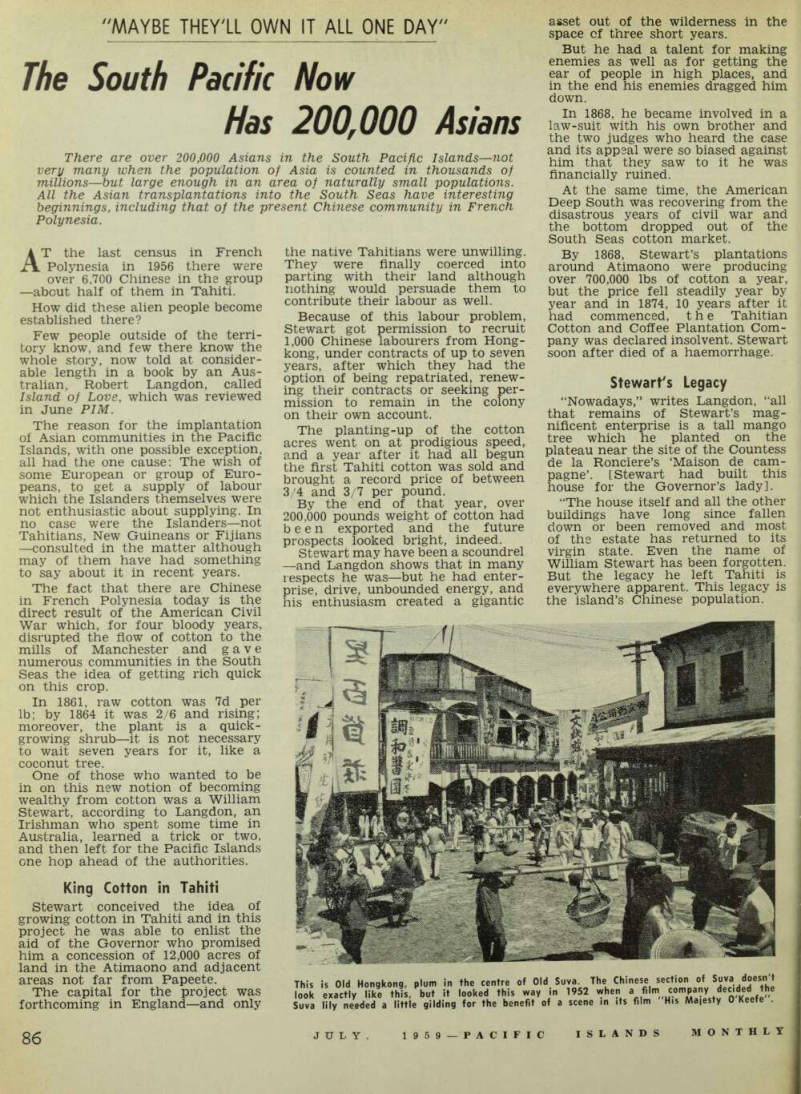
This is Old Hongkong, plum in the centre of Old Suva. The Chinese section Suva doesn't look exactly like this, but it looked this way in 1952 when a film company decided the Suva lily needed a little gilding for the benefit of a scene in its film "His Majesty O'Keefe".
last chaotic year of Stewart’s life, officialdom conveni ently forgot that the Chinese labour ers at Atimaono were due to be sent home. So the chinese stayed on and as their master’s empire fell into rums around them, they took to growing vegetables for the Papeete market. Gradually they acquired wealth, shifted to Papeete and elsewhere, and became merchants.
“Nowadays, almost all the small stores of Tahiti and the other islands of French Oceania are in the hands of the 7,000 descendants of Stewart’s coolies. And one day— so some people think—all those islands will be entirely Chinese.”
Asians in Strange Places
That is what author Langdon has to say about Asians in Tahiti.
He does not discuss them in other places. However, of the other Asian communities which were introduced to the Pacific Islands, only Western Samoa (the Germans introduced Chinese coolies to work the coconut plantations) ruthlessly disposed of its problem by repatriating the Chinese before and after the last war. In New Caledonia, the Tonkinese (now referred to as Viet- Namese) introduced to work in the nickel mines and smelters have become a political as well as an economic problem. The same people, in New Hebrides, have been allowed to become free settlers, under French protection, and at the same time uneasy hostages to fortune that no one attempts to do much about.
The origin of the Chinese com munity in New Guinea was, again, the unwillingness of the local natives to work the coconut plantations established by the Germans. Today, the Chinese have become the merch ant and tradesman class and have graduated also to the wealthy plant ation and ship-owning class. Some European residents of the Terri tory feel that they constitute a ‘problem”, but in comparison with other problems in other Islands, they make only a half-pint-sized splash in the Pacific Ocean.
The Surprise Chinese Community
The “Indian problem” of Fiji is about the most publicised of all these problems —real, acute and growing, and seemingly impossible to solve. There are 184,000 of them now in that small group of islands -certainly not all descendants of the first Indians brought in to work in the sugar fields, but certainly .ll there because Fiji has a sugar industry and that, in the beginning, there was no one there to lo the vast amount of manual labour required for such an enterprise.
The large number of Indians
(Continued on page 99)
ays blinds the observer to the t that, also in Fiji, there is a large community of Chinese —about 00 of them at the last estimate in 1958—that is, 2,000 more than in New Guinea.
The Chinese in Fiji are generally the merchant class—highly respected, quiet, law abiding and Ltically causing not so much as ripple on the millpond, How did such a large community there? No one ever seems to have told their story, although it would be an interesting one. Of the Asian communities in the Pacific, the Fiji Chinese alone were brought in to supply cheap labour in the cotton fields, the sugar Is or the coconut plantations. for want of a better explanation, they appear just to have come as ; migrants.