Building Gets
pp. 67-69 · Read in the full issue
Bigger, Better Than Mascot!
Fiji's Airport Building Gets It's Roof On
From a Staff Writer at Nadi For some reason known
possibly to science and the high
gods of administration the
Government of Fiji is building at
the new airport of Nadi a terminal
building that, literally and meta
phorically, leaves that of Sydney’s
Mascot airport quite in the shade.
Every now and again, Sydney's newspapers go out and look at . . Sydney’s very busy airport, which has been built in fits and starts and by catch-as-catch-can methods, and then they hold up Mascot to public ridicule and shame.
Meanwhile, the Fiji Government —as Fiji’s official contribution to the new international airport at Nadi (Australia, New Zealand, Canada and United Kingdom have provided millions for the job)—is spending £300,000 on this modern concrete building of two storeys, less than a half-mile away from the present terminal.
Fiji, in 1958, undertook to erect the building in 15 months. The job is being done by the Fiji Public Works Department; and, (Over)
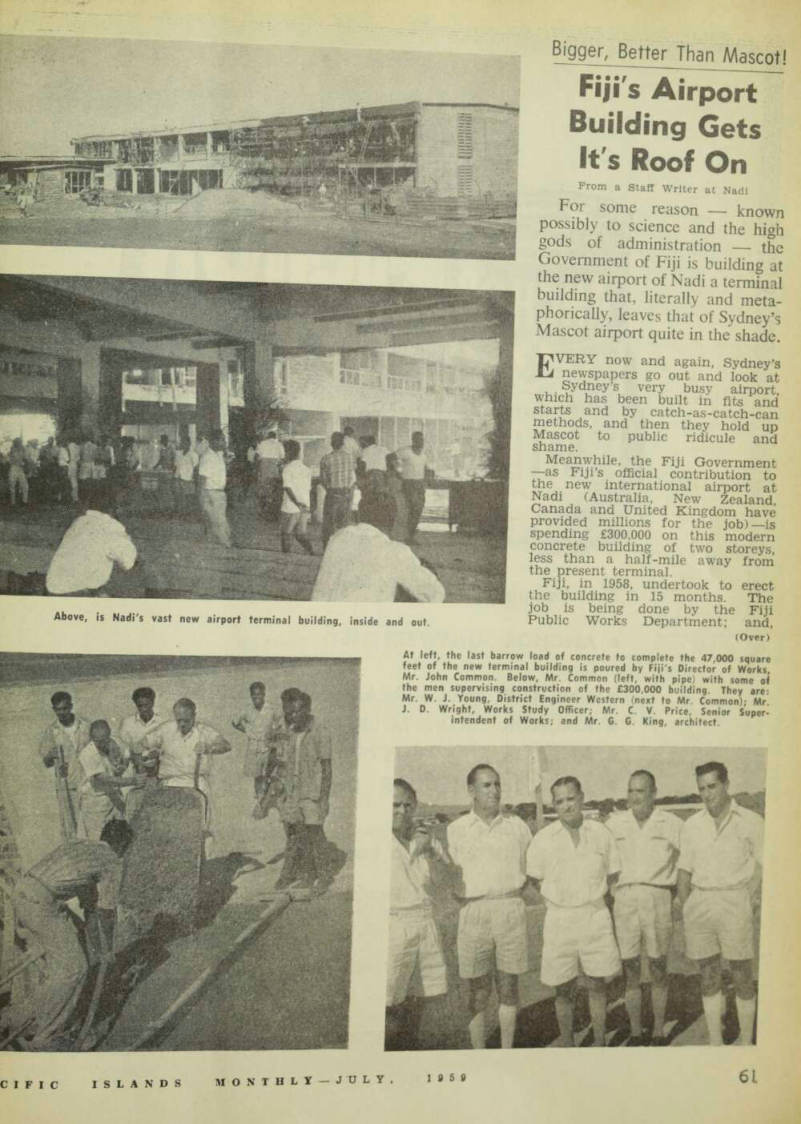
Above, is Nadi's vast new airport terminal building, inside and out.
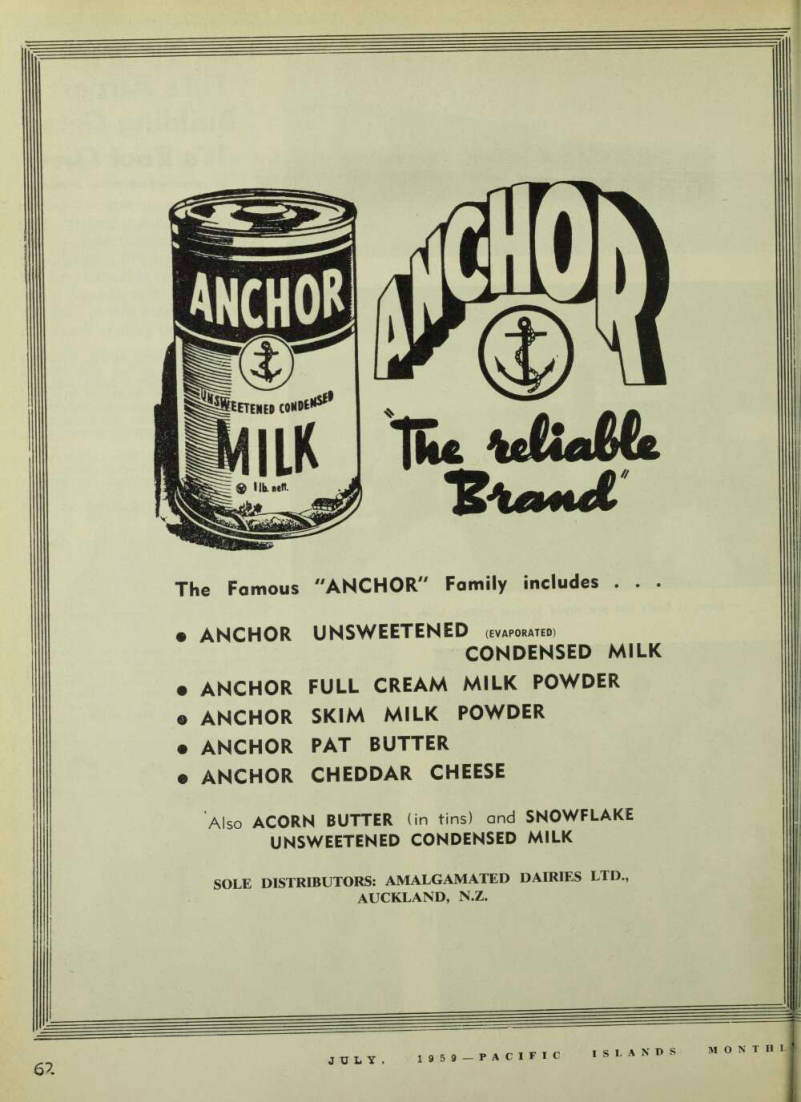
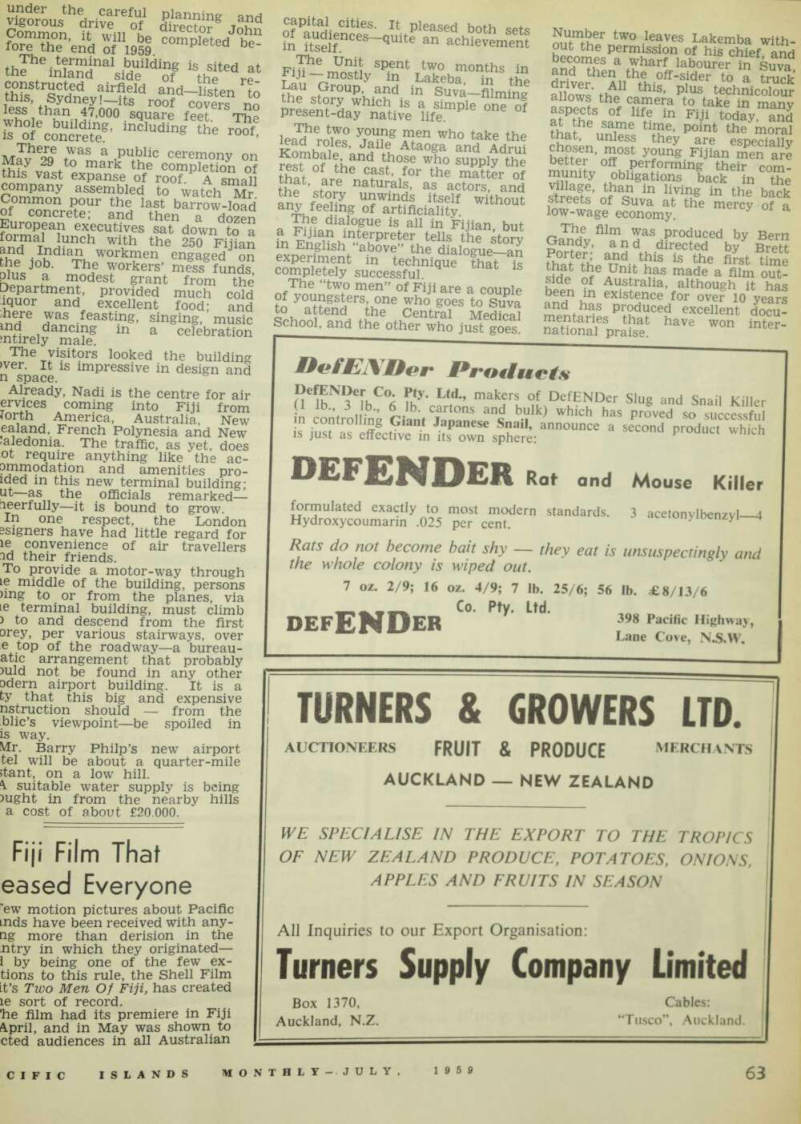
At left, the last barrow load of concrete to complete the 47,000 square feet of the new terminal building is poured by Fiji's Director of Works, Mr. John Common. Below, Mr. Common (left, with pipe) with some of the men supervising construction of the £300,000 building. They are- Mr. W. J. Young, District Engineer Western (next to Mr. Common); Mr.
J. D. Wright, Works Study Officer; Mr. C. V. Price, Senior Super intendent of Works; and Mr. G. G. King, architect.
under the careful planning and vigorous drive of director John Common, it will be completed be fore the end of 1959.
The terminal building is sited at the inland side of the re constructed airfield and—listen to this, Sydney!—its roof covers no less than 47,000 square feet. The whole building, including the roof, is of concrete.
There was a public ceremony on May 29 to mark the completion of this vast expanse of roof. A small company assembled to watch Mr.
Common pour the last barrow-load of concrete; and then a dozen European executives sat down to a formal lunch with the 250 Fijian and Indian workmen engaged on the job. The workers’ mess funds, plus a modest grant from the Department, provided much cold liquor and excellent food; and there was feasting, singing, music and dancing in a celebration entirely male.
The visitors looked the building over. It is impressive in design and in space.
Already, Nadi is the centre for air services coming into Fiji from North America, Australia, New Zealand, French Polynesia and New Caledonia. The traffic, as yet, does not require anything like the accommodation and amenities proideed in this new terminal building; but —as the officials remarked— cheerfully—it is bound to grow.
In one respect, the London designers have had little regard for the convenience of air travellers and their friends.
To provide a motor-way through the middle of the building, persons moving to or from the planes, via the terminal building, must climb ) to and descend from the first storey, per various stairways, over the top of the roadway—a bureaucratic arrangement that probably would not be found in any other modern airport building. It is a ty that this big and expensive construction should — from the public’s viewpoint—be spoiled in this way, Mr. Barry Philp’s new airport hotel will be about a quarter-mile distant, on a low hill.
A suitable water supply is being bought in from the nearby hills at a cost of about £20,000.