Niue Builds Again
pp. 59-62 · Read in the full issue

It’s An Ill Wind . . .
“No project on such a scale has ever been attempted so far as I know, in any Pacific Islands Territory in peace time,” said the New Zealand minister of Island Territories, Mr. Mathi son, in announcing a vast re-building programme for Niue in June.
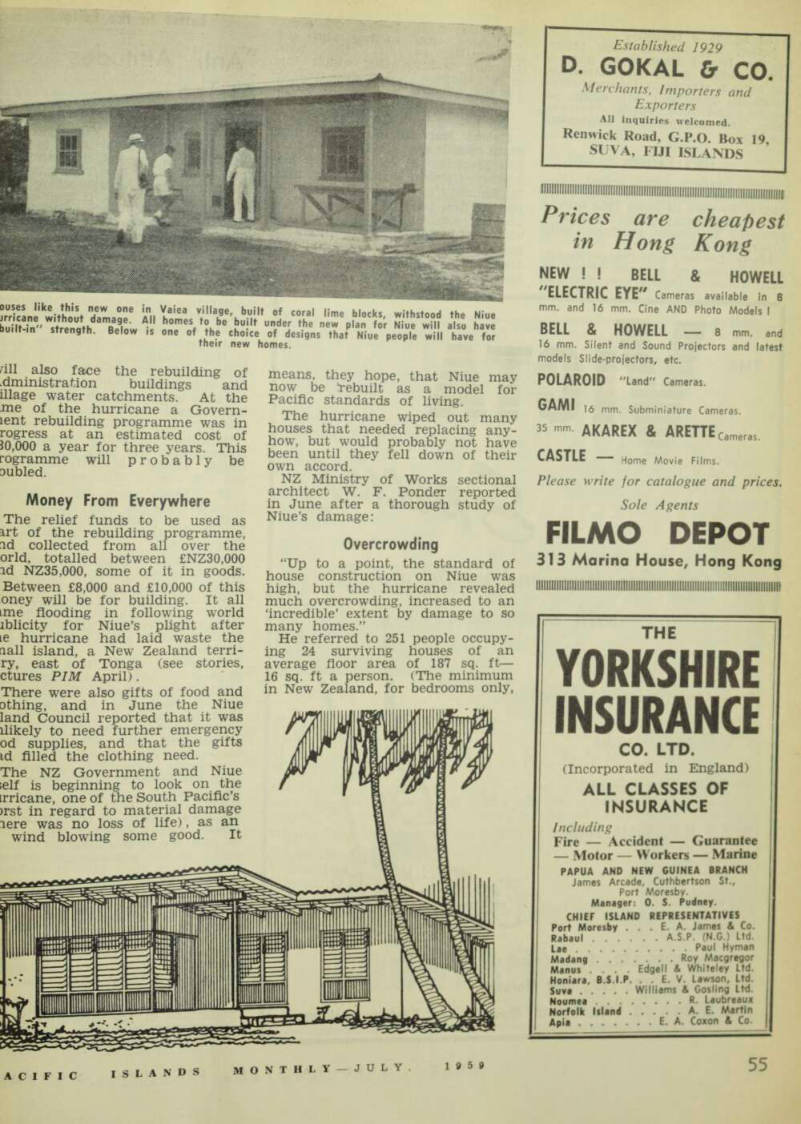
THE men of Niue Island are to . build their people 514 new homes under a £72,000 “aided self-help” project to restore and replace dwellings devastated in February’s hurricane.
More than half Niue’s 4,700 people are now living in tents, improvised crude shelters or houses that cannot be properly repaired.
The programme, gigantic for such an isolated island, involves • A New Zealand Government n of £24,000 a year for three years provide building materials and equipment; ► Expenditure of relief funds ascribed all over the world, to be reimbursed to all home-builders by the Niue Island Council; ► Maximum use of local timber and coral lime; and A co-operative system of age group labour under skilled New Zealand supervisors.
Niue Island Council, representing t 12 villages, will have the aid and advice of village councils in administering the Government n, allotting for each house £150 worth of the building materials shipped from New Zealand.
These individual loans will be extinguished on repayment of £100 within ten years, plus £5 towards
a group insurance fund to cover such contingencies as the extinction of the debt on the death of the head of a family.
Plans Prepared
From relief funds, the Island Council will also build several small detached rent-free units for old people, provide £3,000 by discounts on the cost of materials to all islanders, and make grants to wipe out immediately loans to widows and others who need homes but will be unable to meet repayments.
A range of house plans has been prepared by the architectural division of the New Zealand Ministry of Works. Offering a choice of designs, they incorporate adequate health and accommoda tion standards and ability to withstand maximum-force winds, while making full use of local timber and lime with simple con struction methods that can be used by the unskilled building groups under supervision.
The average cost of bought materials for each of the 514 houses (480 of which will require loan money) is estimated at £150, including a 400-gallon tank for each home plus a share of cartage and freight costs.
Two expert overseers will be seconded from New Zealand to supervise the erection of demon stration houses and superintend the scheme itself. Village housing committees are already advising the Island Council on total needs and priorities.
Building Teams
Each village will have, according to its population, several groups of six to 12 men who, in addition to building their own homes as teams, will provide houses for widows and families who are un able to share in the work. At the same time the villagers will need to cultivate their subsistence crops, and provision will need to be made for those in regular employment to contribute their share of work.
Administration contributions will include the arrangement of cartage of materials, and the use of the well-equipped sawmill and coral concrete block-making plant.
Other block-making apparatus is being bought to enable blocks to be made of coral and most build ing supplies, including asbestos corrugated roofing, will be of New Zealand make.
The New Zealand Government
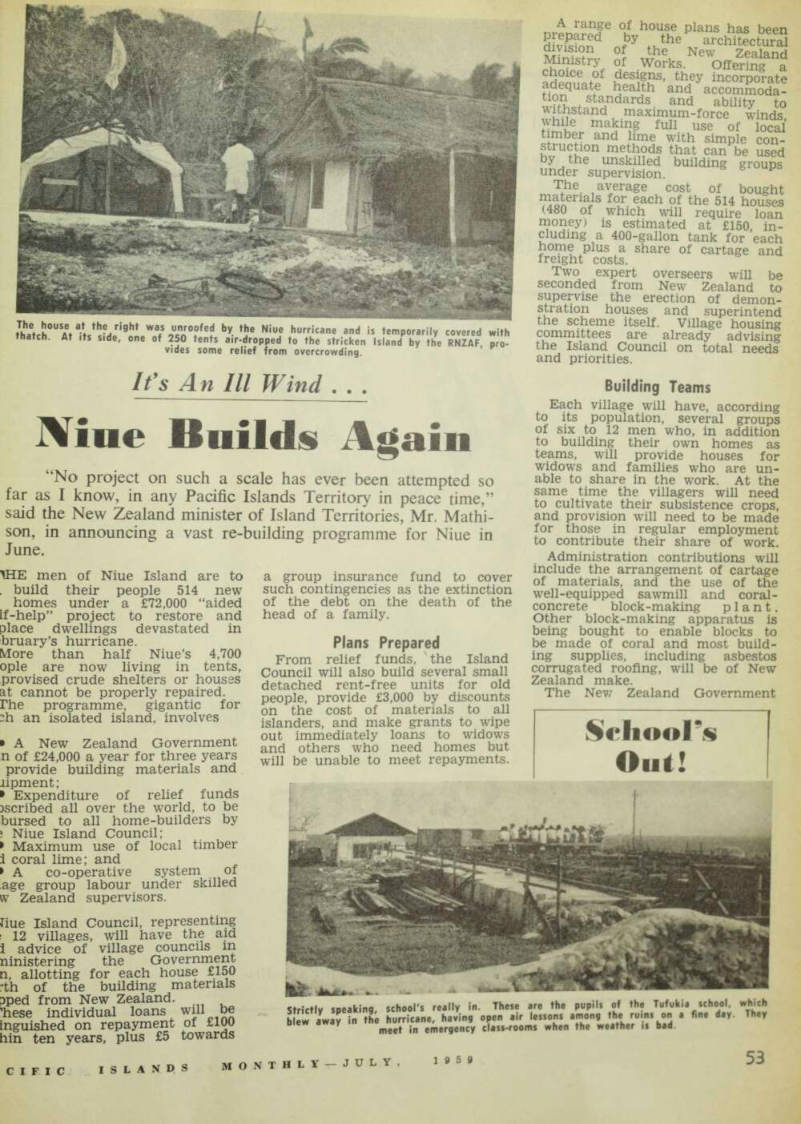
The house at the right was unroofed by the Niue hurricane and is temporarily covered with thatch. At its side, one of 250 tents air-dropped to the stricken Island by the RNZAF, pro vides some relief from overcrowding.
will also face the rebuilding of administration buildings and village water catchments. At the time of the hurricane a Governmeent rebuilding programme was in progress at an estimated cost of 10,000 a year for three years. This programme will probably be doubled.
Money From Everywhere
The relief funds to be used as part of the rebuilding programme, and collected from all over the world, totalled between £NZ30,000 and NZ35,000, some of it in goods.
Between £8,000 and £10,000 of this money will be for building. It all came flooding in following world publicity for Niue’s plight after the hurricane had laid waste the small island, a New Zealand territory, east of Tonga (see stories, ctures PIM April).
There were also gifts of food and clothing, and in June the Niue Island Council reported that it was unlikely to need further emergency food supplies, and that the gifts had filled the clothing need.
The NZ Government and Niue itself is beginning to look on the hurricane, one of the South Pacific’s worst in regard to material damage there was no loss of life), as an wind blowing some good. It
means, they hope, that Niue may now be ‘rebuilt as a model for Pacific standards of living.
The hurricane wiped out many houses that needed replacing any how, but would probably not have been until they fell down of their own accord.
NZ Ministry of Works sectional architect W. F. Ponder reported in June after a thorough study of Niue’s damage:
Overcrowding
“Up to a point, the standard of house construction on Niue was high, but the hurricane revealed much overcrowding, increased to an ‘incredible’ extent by damage to so many homes.”
He referred to 251 people occupy ing 24 surviving houses of an average floor area of 187 sq. ft— -16 sq. ft a person. (The minimum in New Zealand, for bedrooms only,
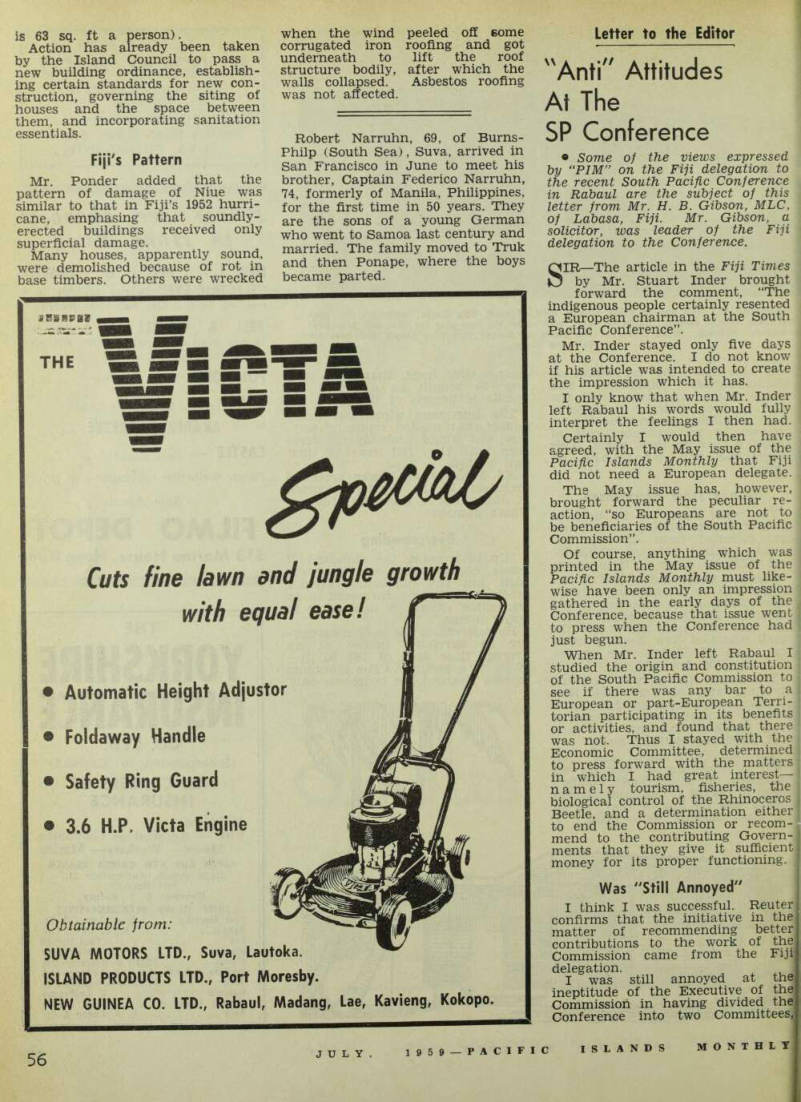
Houses like this new one in Vaiea village, built of coral lime blocks, withstood the Niue hurricane without damage. All homes to be built under the new plan for Niue will also have "built-in" strength. Below is one of the choice of designs that Niue people will have for their new homes.
is 63 sq. ft a person).
Action has already been taken by the Island Council to pass a new building ordinance, establish ing certain standards for new con struction, governing the siting of houses and the space between them, and incorporating sanitation essentials.
Fiji's Pattern
Mr. Ponder added that the pattern of damage of Niue was similar to that in Fiji’s 1952 hurri cane, emphasing that soundly erected buildings received only superficial damage.
Many houses, apparently sound, were demolished because of rot in base timbers. Others were wrecked
when the wind peeled off some corrugated iron roofing and got underneath to lift the roof structure bodily, after which the walls collapsed. Asbestos roofing was not affected.
Robert Narruhn, 69, of Burns- Philp (South Sea), Suva, arrived in San Francisco in June to meet his brother, Captain Federico Narruhn, 74, formerly of Manila, Philippines, for the first time in 50 years. They are the sons of a young German who went to Samoa last century and married. The family moved to Truk and then Ponape, where the boys
became parted.