Burns Commission Off To
p. 22 · Read in the full issue
A Good Start
Following months of preliminary research in the UK, the Burns Commission on the development of Fiji started field work in the Colony in July.
THE Chairman, Sir Alan Burns, made many friends for the Commission right at the beginning with a sane summing up of what the Commission would and would not do.
He said that he had heard rumours that the Commission would disregard assurances given in the past about Fijian land. But any recommendation would take earlier assurances into account.
Sir Alan also warned against rumours of what he or his colleagues might supposedly say during their inquiry. Such statements should be disregarded unless they were from an authoritative source. People should remember, too, that if the Commissioners’ questions should sometimes seem pointed, it might merely mean that they were testing reaction—not that they had made up their minds on anything.
The Commission has received 500 letters containing suggestions from the public. The Fijian and Indian communities have also presented in written form their official submissions.
Main Submissions The Fijian submissions were signed by the five paramount chiefs and five chiefs representative of the commoners. The Indian submissions were signed by five Indian members of the Legislative Council and 100 other leading Indians representative of the Legislative Council and 100 Hindu and Muslim. These two groups are not always unanimous in political matters.
Broadly, the Fijian submissions cover the following points: The promises made under the Deed of Cession regarding Fijian control of land must be adhered to.
Having regard to the increasing
Fijian section of the population, there is no worthwhile land in ex cess of Fijian requirements, Lack of finance, and not the Fijian way of life, is the principal reason for failure by the Fijians to make the fullest use of their land, Finance for this purpose in the form of grants or loans from the British Government is petitioned, Because of the limited amount of good land, greater attention should be paid to the development of secondary industries. Greater oppor tunity to be provided for Fijians in commerce and industry, and greater educational facilities provided in technical colleges and universities — preferably in England “for social and political reasons”—to fit them for these tasks, The limitation of population in crease by birth-control methods and the provision of greater public ex penditure on the dissemination of birth control information, though this is “unfortunately not a cure but only a palliative for possible future ills . . . (but) essential to the welfare of the Colony.”
The Indian submissions are, very broadly; The land of Fiji is capable of great development and if full use is of it there is no danger in the near future of any over-popula tion problem. Nevertheless the Indians would support any pro gramme of artificial birth control so long as such is not directed solely at Indians as a racial group, and is entirely on a voluntary basis.
To develop the land, substantial funds be made available and terms of land-tenure liberalised in the case of leased lands. Land tax urged.
Greater diversification of agricul
ture, and better local and overseas marketing organisations.
Greater educational facilities and the removal of all fees in primary education.
It is maintained that “the Indians were introduced in the Colony for permanent colonisation, and they were given solemn promise by Her Majesty that their rights . . . would be ‘no whit inferior to those of any other race’”, and that such pledge has not been fulfilled . . . “in the matter of land utilisation and hold ings.” This should be corrected.
Greater representation for Indians in the legislature and local govern ment, and the removal of discrim ination in all spheres of their life.
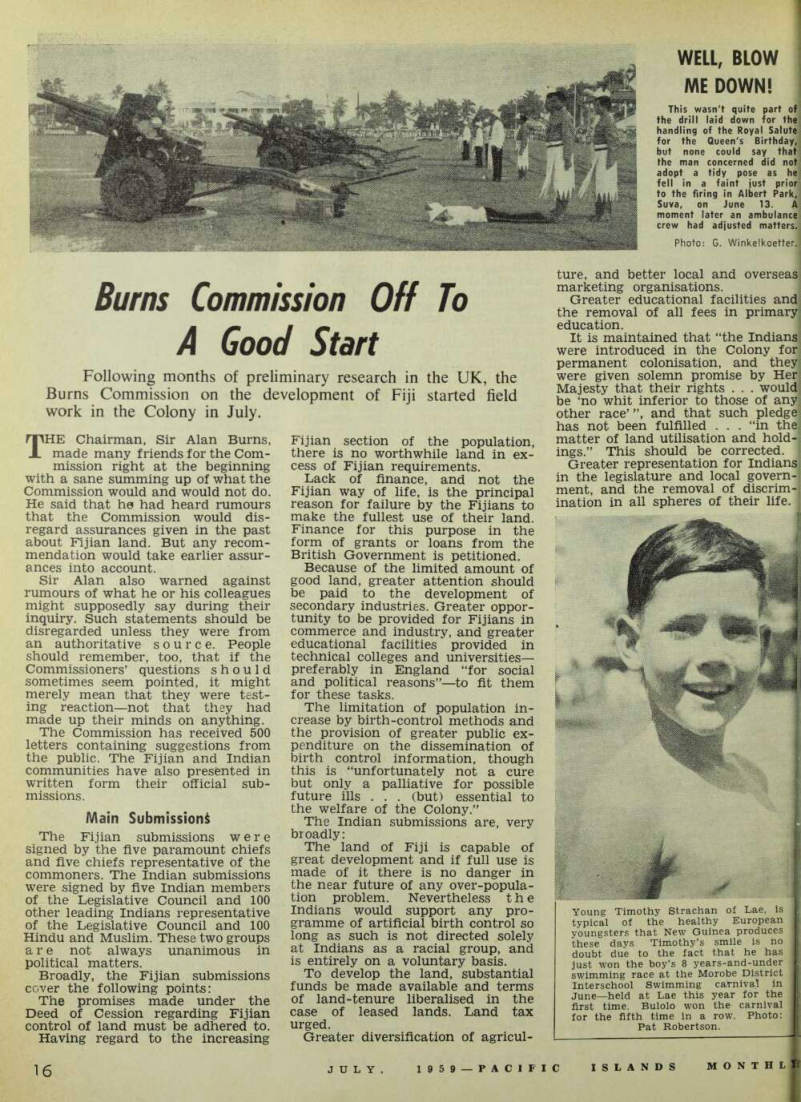
Well, Blow
Me Down!
This wasn't quite part of the drill laid down for the handling of the Royal Salute for the Queen's Birthday, but none could say that the man concerned did not adopt a tidy pose as he fell in a faint just prior to the firing in Albert Park, Suva, on June 13. A moment later an ambulance crew had adjusted matters.
Photo: G. Winkelkoetter.
Young Timothy Strachan of Lae, is typical of the healthy European youngsters that New Guinea produces these days Timothy’s smile is no doubt due to the fact that he has just won the boy’s 8 years-and-under swimming race at the Morobe District Interschool Swimming carnival in June—held at Lae this year for the first time. Bulolo won the carnival for the fifth time in a row. Photo: Pat Robertson.