A Constitutional Challenge
pp. 19-157 · Read in the full issue
The Showdown Gomes!
New Guinea Tax Issue Leads To A Constitutional Challenge
The stubborn refusal of Australian Minister for Territories Hasluck to meet the almost unanjmous wishes of the non-official residents of Papua and New Guinea, in regard to the character and timing of his plan to introduce income taxation there, has led to a grave constitutional position which may affect the status of the Territory.
UNTIL Friday, June 26, the issue was fairly simple. If Minister Hasluck had allowed an ill wn Taxation bill to stand over another year, pending recon ation between Government and payers—and possibly some re fting of the awkward measure— s probable that the Taxpayers’
Association would have withdrawn challenge to the validity of the Legislative Council; and all would have been peace.
But the Government, from April to June 27, went on with its taxation bill plan, blindly and stubbornly; and then suddenly, on June 26, the proceedings before the Territory’s Full Court became no :er an attack on the validity of Council, but challenge to the dity of the Papua and New Guinea Act of 1949, under which the whole structure of government of the Territory has been built.
The Supreme Court’s rejection of Bunting application on July 7 not remove the danger. If Canberra insists income tax shall ate from July 1, there will be a challenge to P-NG Act, which go through to the High Court, would appear that, when the ck on the Papua and New lea Act began on June 26 be the Full Bench of the Supreme t of Papua and New Guinea, e things were called into question.
The meaning and application the Trusteeship Agreement between the United Nations and Australia, as it affects former German New Guinea.
The “constitutionality” of the a and New Guinea Act of 1949.
The character and scope of the i between the old Australian tory of Papua and the Trust tory of New Guinea.
The validity of the Legislative Council which was created under » and NG Act.
The legality of all the laws d by the Legislative Council its inauguration. . er the Tax bills were introinto Legislative Council on
April 20, a sort of politico-economic legalistic storm developed quickly in three dimensions. They are— In Legco —Government presses on with bills, despite resignation of three elected members; receives several scores of suggested amend ments; and then adjourns until July 13, so that amendments may be submitted for consideration by Min ister Hasluck.
In P-NG Supreme Court— Urgent application made for injunction re straining Council from passing Tax bills, on ground that the Council without elected members is uncon stitutional; but proceedings un expectedly develop into an attack on validity of Papua and New Guinea Act.
In Hush-Hush Section —The at tack on P-NG Act in Supreme Court causes alarm among persons in Australia concerned with mainten ance of Australian Trusteeship in New Guinea. There were significant and highly secret radiophone con versations between Port Moresby and Canberra. These were followed
by discussions in Canberra and Mel bourne.
The situation as this issue goes to press is— The Australian Government, as far as is known, still supports Min ister Hasluck in his determination to pass the Tax bill on July 13, and impose the tax as from July 1.
Supreme Court has rejected Mr.
Bunting’s challenge to validity of Legco; and Bunting refuses to appeal to High Court because this may endanger the whole Papua and New Guinea Act.
Trust Territory interests may now inaugurate new action in Supreme Court, with view to ultimately challenging P-NG Act before High Court. (Over)
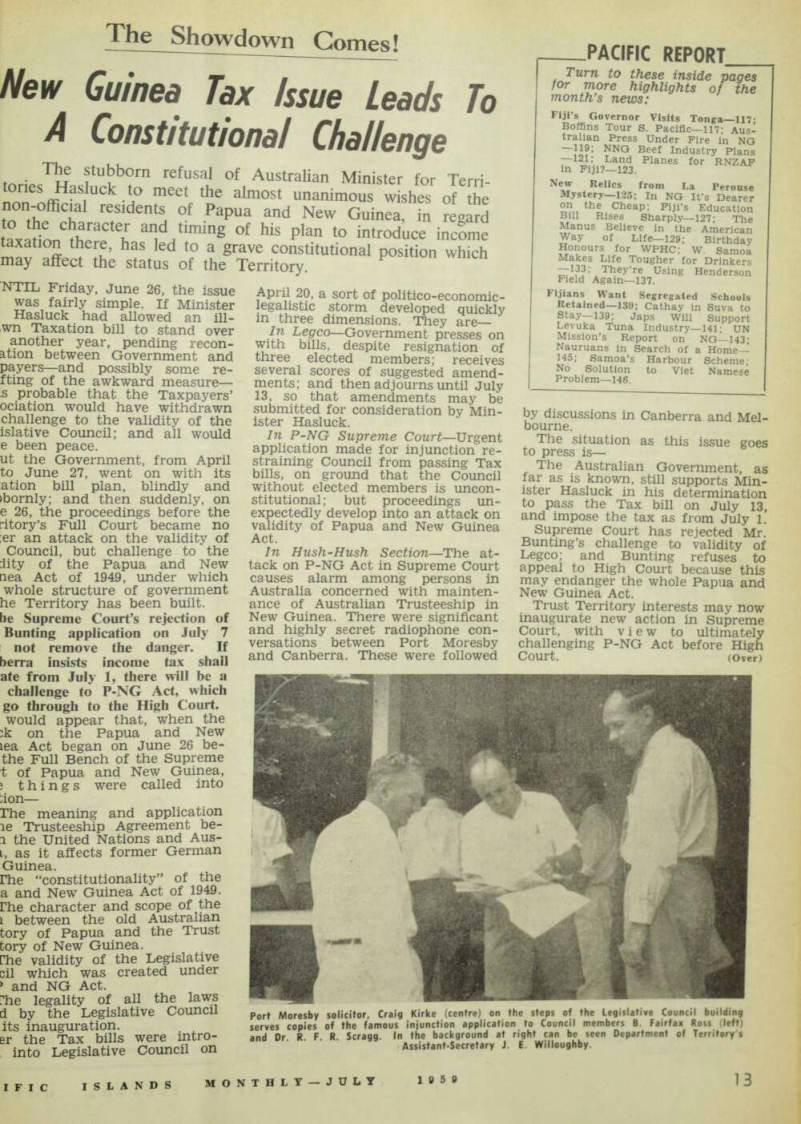
Port Moresby solicitor, Craig Kirke (centre) on the steps of the Legislative Council building serves copies of the famous injunction application to Council members B. Fairfax Ross (left) and Dr. R. F. R. Scragg. In the background at right can be seen Department of Territory's Assistant-Secretary J. E. Willoughby.
To understand what had occurred —and still is going on—it is neces sary to describe all these strange events, in their sequence.
The P-NG Legco, after adjourn ment in April, met on June 22, to proceed with the second reading of the Tax bill.
Elected Members' Resign
Territorians, expecting fireworks, gathered in the Council Chamber (the Red Cross Hall) with the sooth ing waves of Ela Beach on one side, and the screaming main road traffic on the other. But all was quiet, dull and anti-climactic.
The bill did not come up, that day. Actually, the venue of the fight had changed. There were no elected members present.
At 11 a.m. that day the three elected members (Messrs. Dudley Jones, of Rabaul, E. A. James, of Port Moresby, and Ian Downs, of Goroka) who had already given notice that they would retire as soon as the bill reached a certain stage, drove to the office of the Administrator (and President of the Council) and handed in their resignations. In a joint statement they said they took this course be cause— • The Income Tax bills had been introduced without the prior inquiry demanded by all non-official mem bers and the overwhelming majority of the residents.
• The people of the Territory had not been given adequate Coun cil representation. • The proposed bills were “so complicated and full of anomalies and inequities” that it was not proper to ask the Council to accept them—that was why they had de cided not to remain in Council and consider suggested amendments. The bills should be re-drafted. • They would not accept nomin ation for re-election until the people were given a more effective voice in the Council.
Council's Status Challenged
But the sting of the announce ment was in its tail; “We have re ceived the advice of Queen’s Counsel that the Legislative Council cannot pass valid laws until the vacancies created by our resignations have been filled.”
What did this mean?
The Port Moresby-Canberra radio ran hot.
It soon was known that eminent constitutional lawyers, who had been consulted by the Taxpayers’ Associ ation, held that, if the Council was not constituted in accordance with Section 36 of the Papua and New Guinea Act (see panel) it could not pass a valid law; and that this applied to the Taxation bills.
On the evening of the 22nd, Port Moresby seethed with rumours. It was a period of huddles among lawyers, constitutional know-alls, amateur experts and others —with an eye on the two notable strangers who had come up from South with the homing Legco members on the Saturday plane Mr. J. E.
Willoughby, First Assistant Secre tary in the Department of Terri tories, who was proceeding to sit in conspicuously and watch events; and Mr. John McKellar White, top ranking taxation consultant in Syd ney, who was there to assist and advise the Territory’s hard-fighting Taxpayers’ Association.
Everyone wanted to know: What was the next step?
'Bob' Bunting as 'Plaintiff'
It came as the Council assembled on the morning of the 23rd. At 10 o’clock a little team of amateur process-servers appeared, under the direction of lawyer Craig Kirke; and two documents of formidable appearance were served on each of the 26 surviving members of the Council (except Keith McCarthy, who is absent on leave, and Robert Frederick Bunting, who appeared on the documents as “plaintiff”).
It was all very puzzling to the deeply interested spectators.
It had been thought that Mr.
Bunting, one of the nominated non-official members, and important because of his leadership of the Returned Soldiers’ League, would resign with the elected members, who carried his sympathy and
support. But the director of tactic asked him to stay in the Council to act for them there.
To him had been given the joy of challenging the validity of the Council, as constituted without three elected members.
The documents initiated an action in the Supreme Court. Mr. Bunting now was applying to the Court for an injunction, restraining the Legis lative Council from proceeding with the Taxation bills, or any other business, on the ground that it 1 not properly constituted, in accord ance with Section 36 of the Act.
Speaking from the chair, the president of the Council said that Members had been served with copies of the notice of motion, and supporting affidavits; and the Crown Law Office would “enter an appear ance” for them.
Mr. Bunting then presented a petition to the Council, praying that Mr. John McKellar White be per mitted to address the Council from “the bar of the House”, and presett Taxpayers’ Association argument against the bill.
The petition was rejected on the
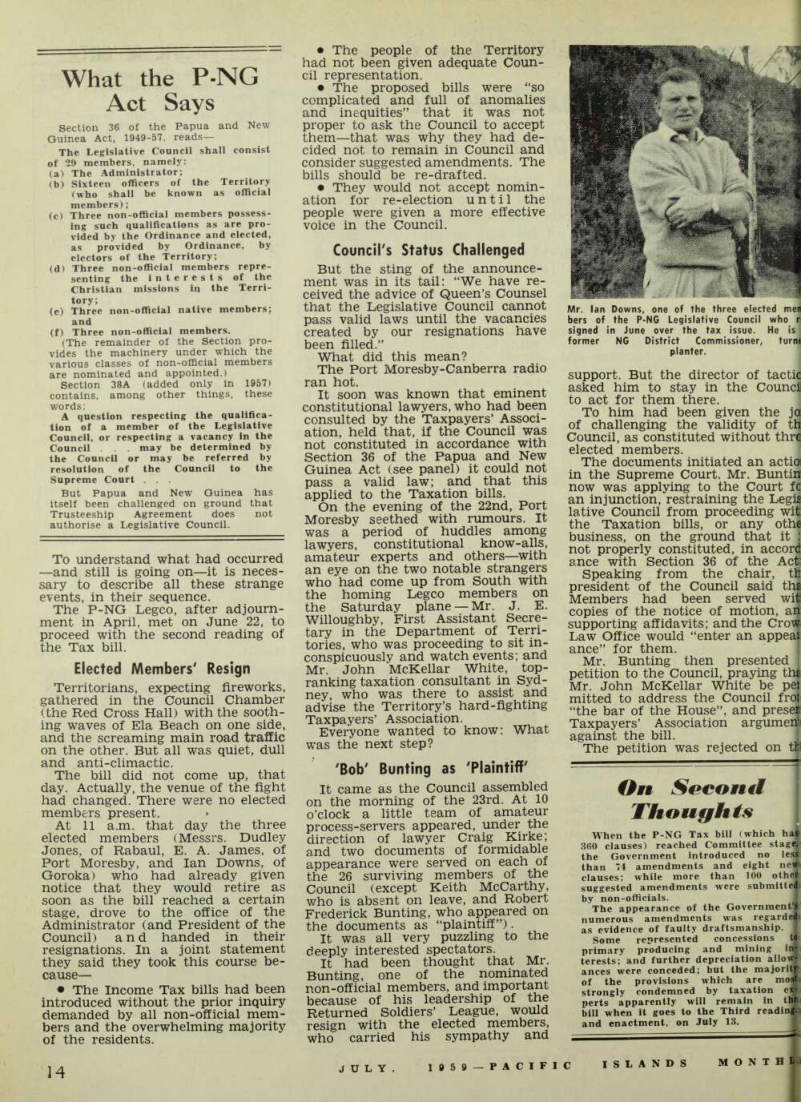
Mr. Ian Downs, one of the three elected mem bers of the P-NG Legislative Council who re signed in June over the tax issue. He is former NG District Commissioner, turned planter.
jes and Council resumed the ond reading debate on the Tax ?. ed by Mr. Fairfax-Ross, all the non-official members made im passive, well-reasoned speeches, not against the principle of income tax, but against the Minister’s method pf introducing the measure, xcept for the Treasurer’s state it, not one word was said in mce of the measure by either cial or non-official members. i the back of the hall, among spectators, was Mr. E. A. James. ? other two ex-MLC’s (Downs Dudley Jones), had left by y planes for their homes.
Supreme Court Takes Over The next move in the curious ma came next day (Wednesday) the Supreme Court, high officialdom affected to treat tly the elected members’ chal lenge to the Council, in view of Section 38A; but Canberra must be been kept closely advised; because that (Wednesday) morning’s plane from South brought Mr. A. F. on, a young Sydney barrister apparently had some official ding, but who sat inconspicu ously in the back of the Court with Willoughby.
Chief Justice Mann had Judges e and Kelly on the Supreme Court Bench with him. The proceedings were brief. le Court asked Mr. Kirke to ? the application for an inter- ?tory injunction, and save time oing straight to the main point, Mr. Kirke said he could not do —he was awaiting legal aid from Australia. Meantime, Legco was g ahead, and the Tax bills could assed by an incompetent body, Mr. Watkins (Crown Law Officer) behalf of the Government gave positive assurance that the bill d not be carried past the com ee stage until the challenge had disposed of.
Mr. Kirke still wanted an interory injunction; so it was de -1 to hear his application for it next day. next morning the same Court lembled; but by now Crown Law er Watkins was sitting on the lines, and Sydney barrister on, representing the Australian of the Crown, had taken over.
Mr. Kirke stated that Mr. oney, a barrister associated Mr McFarlane (the QC who advised the Taxpayers’ Associ ation) was en route from Sydney, he sought an adjournment, ing Mr. Mahoney’s arrival, e application for an inter
locutory injunction was stood over accordingly until Friday, June 26.
By now, the Court side of these proceedings was beginning to assume a stern and forbidding appearance.
No Laughing Matter Now And meanwhile the Legislative Council was fighting for air, almost smothered under a mass of pro posed amendments.
All day Wednesday, the remaining non-official members tried to get the amendments (many of which covered similar ground) into some sort of order, and to reduce their number.
All Thursday the Council (“in committee”) took each clause of the bill separately, and considered it in relation to amendments.
As each amendment survived, the President announced that it now was “deferred for further consid eration” —in other words, for sub mission to Canberra.
Apparently, nothing could be done there without Canberra’s approval.
Watching the farce from the back of the hall, Mr. E. A. James remarked in an aside: “Do you wonder I resigned? What’s the use of the Council, in this form?”
When they adjourned at noon for lunch, the councillors had dealt with 36 clauses in two hours. There are 360 clauses in the bill.
“I thought I might get home for
the week-end,” moaned a New Guinea official. Nobody laughed. By now, Hasluck’s wretched Taxation bill—cursed by the community, challenged by scores of amendments, and now shrinking under a gather ing Supreme Court storm—was no longer a laughing matter.
Main Act Now Challenged On Friday, June 26, while Legco struggled wearily with masses of bill amendments (which achieved noth ing, because they all had to go to Canberra for vetting, anyway) the centre of interest changed sharply and definitely to the Supreme Court.
A young Sydney barrister, Mr.
D. L. Mahoney, who had received his instructions in Sydney only 36 hours before, came off the all-night plane—where he had slept in his clothes—and went straight into action in the Supreme Court.
Within an hour, official Port Moresby was buzzing with excite ment. Mr. Mahoney was not follow ing Mr. Kirke’s line of questioning the authority of Legco, under Section 36 —he was attacking the validity of the Papua and New Guinea Act itself.
It has been known, for ten years, that some experts in constitutional law express doubts about the validity of this Act. They question the pos sibility of combining the old Aus tralian Territory of Papua with the Trust Territory of New Guinea, in view of the way in which the gov ernment of the latter is defined by the Trusteeship Agreement between the United Nations and Australia, made on December 13, 1946.
The Agreement allows “a customs,
(Continued on 149)
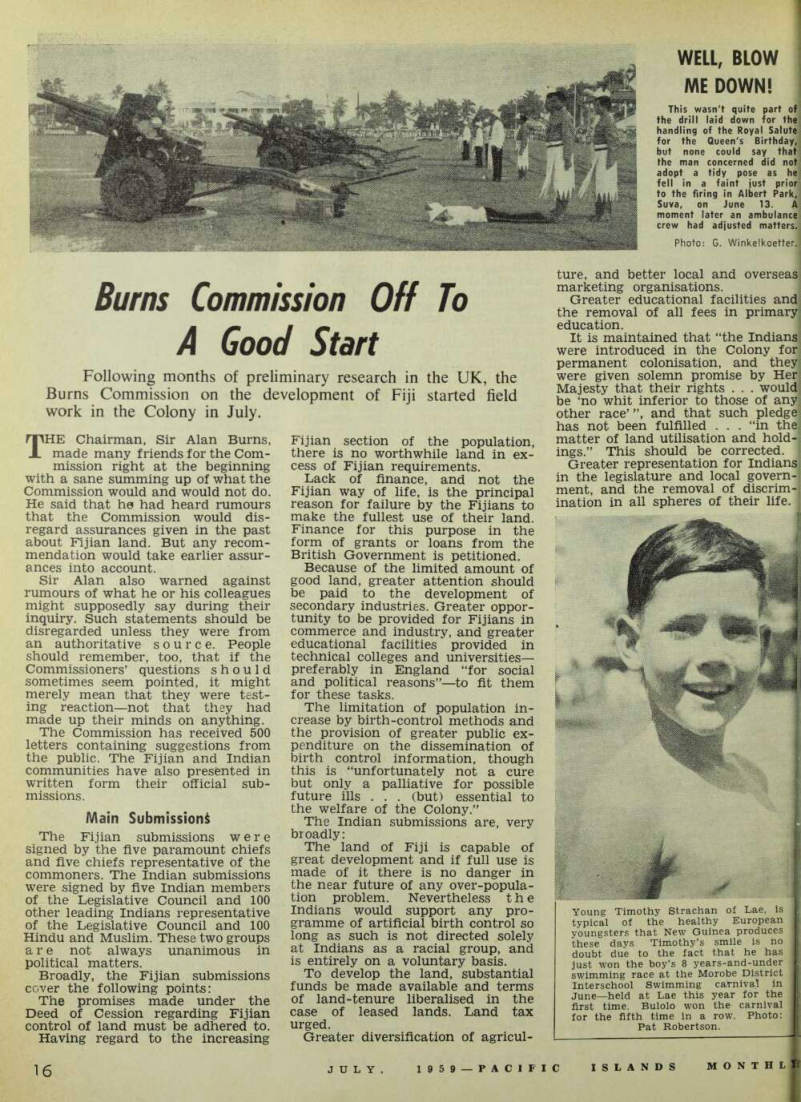
Another who resigned is Mr. Dudley Jones, Rabaul barrister and solicitor who has been a driving force and forthright counsellor among the Taxpayers' Associations of P-NG.
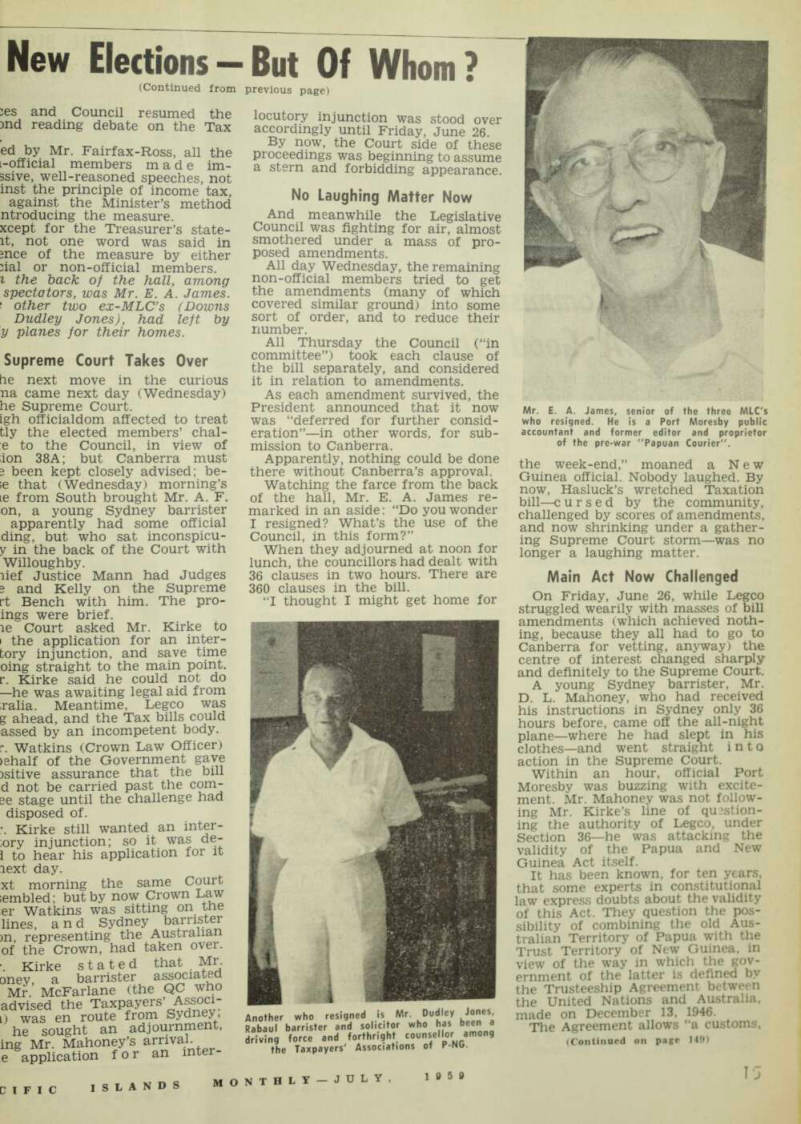
Mr. E. A. James, senior of the three MLC's who resigned. He is a Port Moresby public accountant and former editor and proprietor of the pre-war "Papuan Courier".
fiscal or administrative union with other dependent territories”; but (it has been argued) it does not allow of the creation of a legislature functioning after the manner of the present P-NG Legco.
Obviously, if the Papua and New Guinea Act is successfully chal lenged, the whole of the govern ment machinery of the Territory will be thrown out of gear.
Some say it could mean that Papua and New Guinea would have to return to their pre-war status, as separate territories.
Perturbation in Both Camps
High officials, smiling confidently on Monday, were now, on this Black Friday, grim and thoughtful.
The radiophone between Moresby and Canberra, was more than busy.
Emphatically, there were responsible Ministers who did not like this de velopment. They pointed out that, even if the P-NG Act survived the Supreme Court challenge, the re percussions could reach right back onto the Trusteeship Council and the United Nations, and cause acute embarrassment.
But—strangely enough—the non official sections who had invoked the Supreme Court seemed equally embarrassed.
They were all after the hide of Mr. Hasluck, whether by Court injunction or otherwise: but they certainly did not want to upset the whole Governmental structure by pulling down the P-NG Act.
And that presented intelligent observers with another question— which has not yet been answered.
Under whose instructions did Mr.
Mahoney make his clever, wellreasoned and impressive attack upon the P-NG Act, instead of confining the challenge to the competency of the Legislative Council, as defined by Section 36 of the P-NG Act?
Mr. Mahoney’s attack on the Act, and Mr. Mason’s equally wellreasoned defence of the measure, kept the Court engaged until Wednesday afternoon, July 1. J At this stage it was learned that Mr. Bunting, evidently impressed by the general alarm caused in Papua by the threat to the P-NG Act, had announced he would not be a party to any appeal to the High Court.
Taxpayers’ officials now looked arassed, and high officialdom a little brighter.
Shock for Officials
The Legislative Council, still try ing to make the masses of proposed amendments line up with particular clauses, had struggled on until noon on Saturday, June 27; referred the last of the amendments to (as one weary Councillor expressed it)
"Hasluck, hell and high-water”; and then adjourned until July 13.
At that stage, none could guess what would happen then.
On Friday, July 3, in Port Moresby, one conscientious prospective tax payer, believing he was “liable” as from July 1, went along to the Treasury and asked for the neces sary Wages or Provisional Tax stamps, as described in the bill.
The officials stared at him as if he were a ghost.
Actually, among a number of amendments to the Tax bill pro posed by the Government (and therefore presumably approved by the Minister) is one which alters the date of operation from July 1, 1959, to “a date to be approved by the Minister”.
There are some other “official” amendments which indicate a con siderable change in favour of the taxpayers, in various sections.
But the people were in such con fusion, with one thing and another, that they did not know whether they were liable for tax, or when, or how much.
Court Refuses Injunction The Court, on July 6, announced its verdict: • That the absence of the three elected members, as pro vided for in Section 36 of P-NG Act, did not affect the validity of the Legislative Council. —Majority verdict, with Judge Kelly dis senting. • That the challenge to the validity of the Papua and New
Guinea Act of 1949 had not been sustained. —Verdict unanimous.
The applications for an in junction restraining the Council from passing the Tax bill, lodged by Mr. Bunting, were dismissed, ac cordingly.
More-or-less official announce ments then were made, in Port Moresby and in Canberra, that the Council would meet on July 13, and pass the Tax bill, with amend ments, and with tax payable as from July 1, 1959.
The verdict was expected by the Taxpayers Associations, and it was anticipated that they would im mediately give notice of an appeal to the High Court.
Will There Be Appeal?
But, on July 7, two difficulties appeared. A section of the Tax payers’ organisations was unwilling to proceed with an appeal, If it meant that the Papua and New Guinea Act would be placed in jeopardy. Mr. Bunting, who was the nominal applicant (or plaintiff) and who therefore would have to become the appellant, refused to proceed further.
This crippled the Taxpayers’ Asso ciations. Whether they wanted to appeal or not (and it was reported that New Guinea did, and Papua did not) they clearly could not pro ceed further in an appeal to the High Court without the nominal plaintiff or applicant (Mr. Bunt ing).
That was the end of the Bunting action; and the Council met on July 13, to proceed with the Tax bills.
But by then it appeared probable that, if the Tax bills were to operate from July 1, the New Guinea section of Taxpayers (at least) will initiate a new action —probably by way of
another application to the Supreme Court for an injunction and then when the Supreme Court again rejects it, the action to be carried on by the new applicant by wav of appeal to the High Court.
Meanwhile, Administration pro cedure and machinery is grinding steadily along.
There now are three vacancies in the Council, caused by three resignations of elected members Administrator Cleland announced in early July that elections to fill
these vacancies (one each for Papua, NG Mainland and NG Islands) will take place on Sep tember 12. Nominations close on August 3 and rolls are being re vised.
New Guinea is now waiting to see whether any citizen of worth will accept nomination.
What Led to Present Situation On April 13, this year, after almost 12 months of rumours, it was announced that the Federal Govern ment had decided to introduce in come taxation to the Territory of Papua and New Guinea from July 1 this year; and that the necessary bills would be introduced at the Legislative Council meeting com nencing in Port Moresby on April 20.
This announcement followed close upon a visit to Canberra of a delegation of Territorians who waited upon Mr. Hasluck and asked him to defer the introduction of taxation until a full, independent in quiry could be held in the Territory.
The taxation bills were intro duced at the April meeting of the Legislative Council, carried to the second reading stage and adjourned to the meeting on June 22.
Between April and June the people who challenged the good sense and propriety of Minister Hasluck’s Tax bill had tried in every way to halt it. They had fought it in the Council, challenged it in the newspapers, appealed by special deputations to the Australian
Government, petitioned the Gover-
nor-General.
They got nowhere. The answer in substance always was the same namely, income tax would operate from July 1; but Government would give the fullest consideration to all representations made either directly or through the Legislative Council, and would amend the bill, if con-
sidered desirable.
In spite of every effort to unseat him, Minister Hasluck sat high in the saddle.