Pacific Report
pp. 117-148 · Read in the full issue
The month’s round-up of news and pictures of people and ents, from PIM correspondents in the South Pacific,
tep Up War On
Teal Diseases
to malaria, probably the wide-spread disease in the I Seas 30 years ago was hook , but the painstaking work of ;al men (like famous Dr. S. M. >ert, for instance) and the ad i of scientific drugs have gone g way towards changing this, fadays, while hookworm disease II prevalent in the Pacific, it I the scourge it once was. 3 of the most modern weapons ; fight against hookworm, both mans and in animals, is a drug n as Alcopar. This new form atment will be one of the most tant produced at new £2,000,000 itories at Beckenham, outside m, to be opened this month by Vellcome Foundation, to step the fight against tropical >es. ter virus vaccines to be pro i will be for polio, influenza fellow fever. Research at the itories will be continued by the iation into malaria, dysentery lancer. >okworm is the lay name for ongue-twister Ankylostomiasis presence of parasitic worms in nail intestine that cause severe nia by sucking blood from the Inal walls).
sing Tonga's
\ Read Book
acknowledged authority on c languages, Dr. C. Maxwell :hward, MA, DLit., returned to i in April to begin a two years of translating the Bible into rn Tongan. i work was first done over 100 ago, but in the past 50 years jes have taken place in the m alphabet and orthography dw there is wide difference be i the Tongan taught today and oeing read in the Bible.
II church groups in Tonga cyan, Free Churches, Anglican, Mormon, etc.) have agreed on eed for revision and will share xpenses in proportion to their ■ents. The British and Foreign
Bible Society, which will bear the publishing costs later on, will also make a substantial donation towards translation costs.
Dr. Churchward served as a Methodist missionary in Fiji for 15 years and completed a Rotuman Grammar and Dictionary and, later, a New Fijian Grammar. From 1948 until 1954, he was in Tonga compil ing a Tongan Grammar and a Tongan-English Dictionary, both published by the Government.
In most Pacific territories, the Bible is one of the few books avail able in the vernacular and, con sequently, the most read.
Do-lt-Yaurself
Airstrip
When Unevangelised Fields Mission worker R. J. Donaldson de cided recently to build an airstrip at Orokana station, Erave, in the Southern Highlands District, Papua, he found the surrounding country so mountainous that he could not bring in any normal earth-moving equipment.
So, ingeniously, he dismantled a Yeoman garden rotary hoe and carried it piece by piece to the site, reassembled it and used it to clear a strip 500 yds. long and 132 ft. wide.
It took six months, but he got his airstrip.
Knots and Shipping
Against Nl Timber Trade
A proposal to export a trial 50,000 super feet of pine logs from Norfolk Island to Australia was re jected by the local Advisory Council in April.
The plan was the outcome of a year’s investigations into NI timber to endeavour to bolster up the ex port trade.
Mr. Norman Wallis, probably the
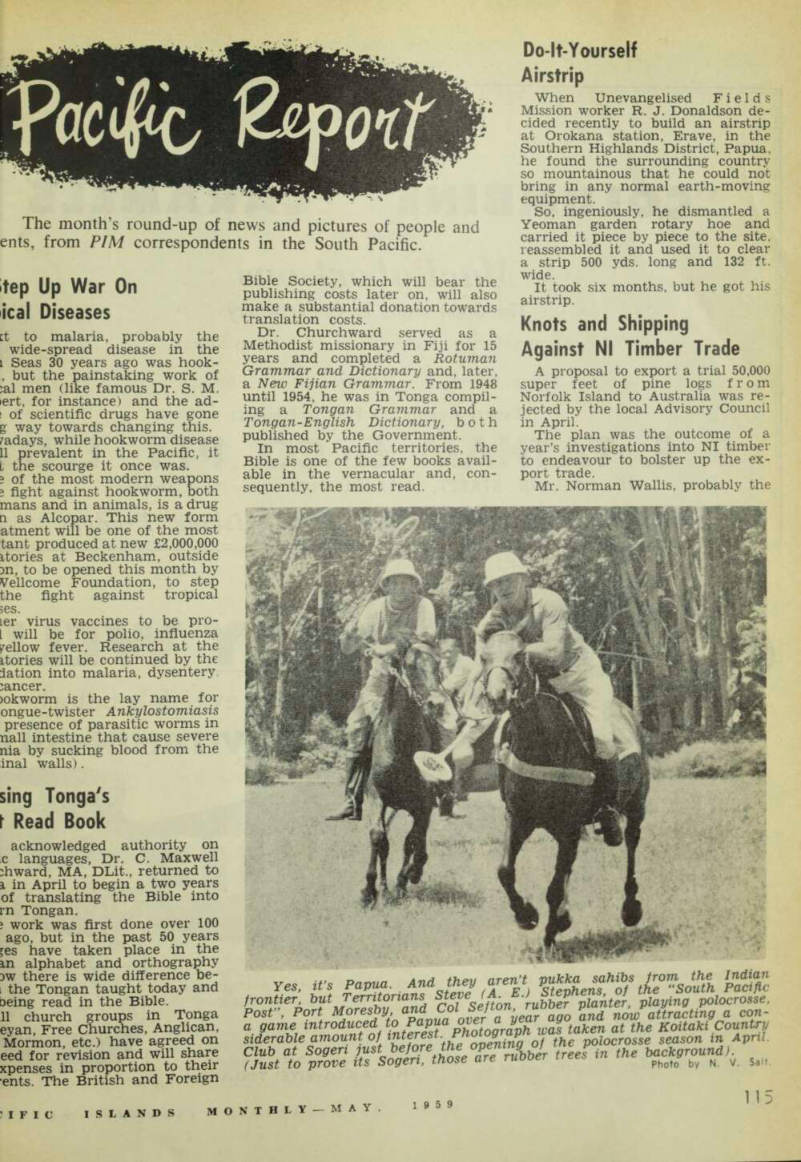
Yes, it’s Pupua. And they aren't pukka sahibs from the Indian frontier, but Territorians Steve (A. E.) Stephens of the "South Pacific Post", Port Moresby, and Col Sefton, rubber planter, playing polocrosse, a game introduced to Papua over a year ago and now attracting a con- Club at Sogeri just before the opering of the polocrosse season in Spril. (Just to prove its Sogeri, those are rubber trees in the background), Photo by N.v. Salt.
;t knowledgeable and experienced a in the trade with Pacific bers, went to NI for the Terri es Department last year and ie a thorough report. In his lion, the internal knots in NI ber precluded profitable export jawn boards, but there should be larket for logs for veneers. He coned on a net return to NI of and 40/- per 100 sup. ft. he Commonwealth Forestry and iber Bureau, in an aerial survey, mated the NI stands of pine to bain over 70,000,000 sup. ft.; ,1 sawmillers (who use 150,000 , ft. a year) said this was ormally high. The Board calcu d that the nearly 1,200 acres of ist reserves on the island should iuce about 1,000,000 sup. ft. a r, provided mature trees past r prime were removed.
Dssibilities for an export trade ;ed promising, particularly as a ;me of controlled re-afforesta . (such as in force in Bulolo, G) would safeguard future ids, but councillors thought jrwise. l any case, shipping logs from leltered, harbourless Norfolk Id be a hazardous job—a change vind could scatter a shipment r across the Pacific before it loaded.
gross and More
nation for Fijians
Bill to revise the Fijian Affairs inance was passed at the April 30 meeting in Suva. Its result be the imposition of certain taxes on Fijians, and its inten is to produce funds for the ngthening of the Fijian Affairs linistration in its work of ve development. ie Bill follows recommenda s made by Mr. R. S. McDougall r a survey made at the request he government. ie additional funds will be ved from taxes on the sale of cultural produce, timber Jties, rents, profits from land, The actual items taxed may
In the case of copra the new tax will be additional to the present cess levied under the Fijian Development Fund Ordinance.
The new tax will be “a demonstration by the Fijians that they are ready to help themselves", and, it is hoped, will be a further inducement to the British Government to make further grants, perhaps for the specific aid of the Fijian section of the community, from the Colonial Development and Welfare Fund.
Although Fijian MLC’s acknowledged that there was naturally opposition to any increase in taxauppuomuu ia, j
tion on the part of the Fijian people, none of them offered any serious opposition to the adoption of the Bill during the debate.
The date on which it will come into force has still to be set by the Governor, and the actual rates of taxation of the various items have still to be worked out by the Fijian Affairs Board.
In Lautoka It's
"Our Wharf"
The main topic of conversation in Lautoka in April was Our Wharf as that major construction job got under way.
In town the most evident signs were a few vehicles scurrying about with the unfamiliar name of the contracting firm on their sides, a smart new name plate at the entrance to an office block in the main street, and —down at the harbour —a barge moored well off shore with a small drilling rig mounted on it.
Up in his office Mr. W. M. S.
Houston, BSc., MICE, Manager of Christiani-Nielsen and Gammon Ltd., the newly formed Fiji com pany, explained how the partners came to be associated in the con tract.
A number of companies were invited to tender and these in
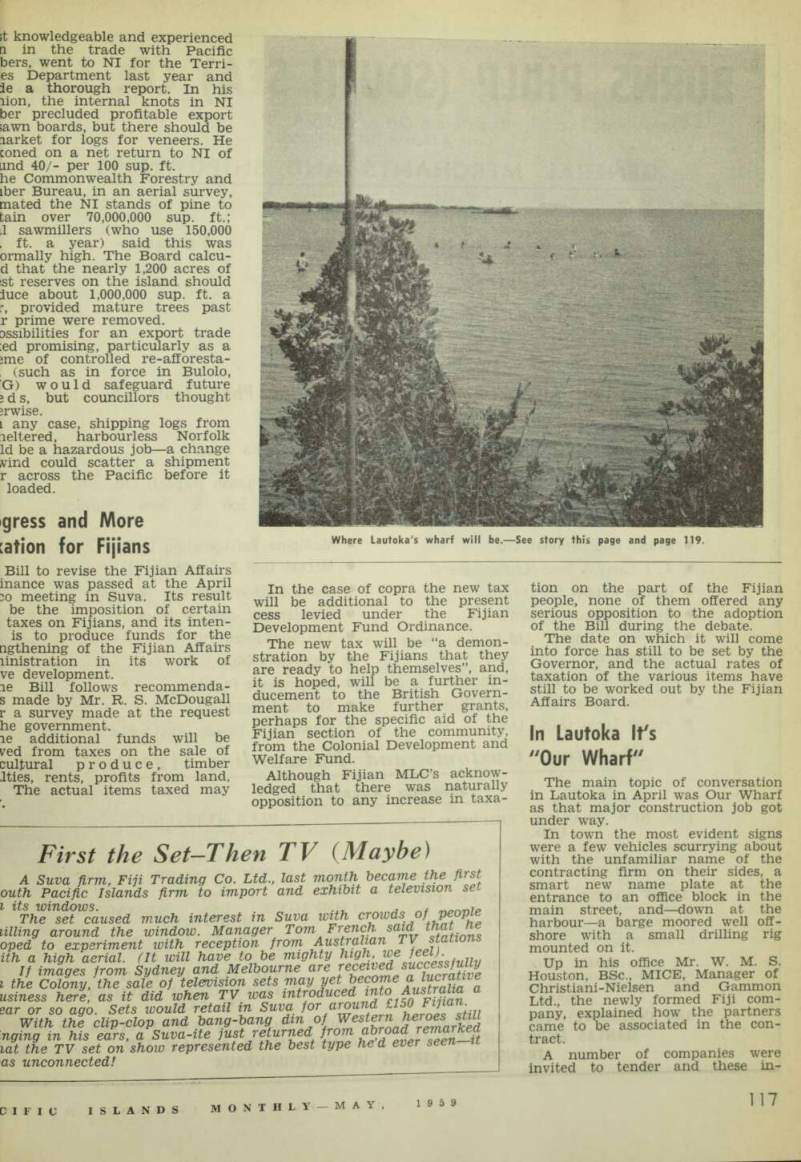
Where Lautoka's wharf will be.—See story this page and page 119.
led Gammon (Malaya) Ltd. and •Istiani-Nielsen (Guernsey) Ltd. parent company of the latter ig of Copenhagen, Denmark, nmons have been in the Far t for the past 35 or 40 years, a tish company with public res in Singapore. Christiani- Isen is a world-wide company, he two were working together a big project in Malaya and re seemed no point in them tting each other’s throats” on ; Fiji job—so they formed the sent new company in Fiji after ring a successful joint tender, he company will employ about people directly when the work files its peak. s of mid-April the only company pie in Fiji were Mr. Houston . Mr. P. Gernow, of Denmark, >se official title is Sub-Agent, n to arrive from furlough in 7 Zealand will be Mr. P. hardson, a civil engineer, ventually there will be seven or it engineers, five or six Euro n foreman, some recruited illy and some from New Zealand, r or five Asiatic surveyors, and ut 20 Asiatic key workers ex enced in the type of pile driving lired and the heavy equipment idling. These will come from ?apore. The remainder will be ,1 people. ate in June a specially rtered Korean ship, equipped i a heavy-lift derrick, will arrive i all the machinery, some from japore and the remainder from igkong. Some other equipment come from Copenhagen, [eanwhile, there is a lot of laratory work to be done, fiiere the wharf will be, a big iy of Fijians were busy drawing r fishing nets when PIM viewed site in April. At the roadside the water’s edge a striped iron driven into the ground, marked of the borders of the two-year, )0,000 project. (See photo, p. o Mr. Houston it will be just ther job, and not a particularly one. For the past three years has been on the Kai Tak jet ield job at Hongkong. Three *s prior to that were spent at japore building godowns and harf for the Shell Co., and for three years preceding that he building refinery extensions for oil company in Indonesia, irst impressions of Fiji? “The n impression of a quick visit Suva was that it is a little bit ;er than Singapore at the lent time. As for things here orally—well, I think that once ?et our houses fixed up and our is here we will enjoy it”.
With a
rich Touch
ew Caledonia, like a lot of other ific territories, was having a
+vl^T^ s^e ri 1 * c -i n April. And although they call it something different there— grippe —it feels the same as influenza does anywhere.
Hundreds of school children were victims; they took it home, and then the working population began to go down with it.
The story is that it was brought into Noumea by two air travellers who arrived from France A month or so ago, the same sort of ’flu was raging in Paris, and it was announced that the Pasteur Institute was able to make an effective vaccine for it. The vaccine will be distributed in Paris next September—traditional month for Parisian influenza—but it seems a pity some of it couldn’t have been sent to New Caledonia where con-
tinual rain and a cold snap have helped the wog to do its worst, ■ r , u
IH IM. Lai., Happy
r a •
Llays LOtTie Again
. , T Contra cts have been signed with & ai ? ese fin P s for XT the supply of £* c . kel ora from New Caledonia, ** 18 that almost 700,000 tons of ore Wlll be shl PP ed this year, Seven Jap ships were scheduled to arrive in April to lift ore. A good deal of this is already “at grass”, but an increased activity in the working of the mines is certain.
All this is good news for New Caledonians as is also the fact that deposits in the Post Office savings
bank are on the increase afto dropping steadily over the pai year.
Further evidence of New Cali donia’s economic recovery is th fact that the Nickel Co. has in tM last few weeks re-engaged over 1( workers and that in the mines soin 300 workers have found work. Ne mines have also opened.
Papeete's Airport Now
Looks Like Happening
It really begins to look as thoug Papeete will get that airport afh all. Tahiti is to have the benel of the fact that the big Yate Dai project in New Caledonia is no completed.
When the Messageries Maritime chartered vessel Melanesien le: Noumea in April, she carried diesi trucks, pre-fabricated houses, light ing equipment, air-compressor mechanical shovels, cranes an sheet iron, all of which have bee used at Yate. They will now t used on the construction of Tahiti international airport.
Fresh Beef Supply
For Ft. Moresby
A Santa Gertrudis bull, bought a Sydney Royal Easter Show sales and 10 assorted heifers (all in calf: were landed from the Slevik, e: Sydney, on April 15, for Eriams Estates Ltd., to form the nucleu of the first cattle stud in P-NG.
At Tiaba estate, 20 miles fron Moresby, the Company already hai 1,000 head of beef cattle, and it own killing works and chilling room were completed early in May. Th(
:toir gives Port Moresby and ounding areas their first regular )ly of fresh meat since before war; at present, Port Moresby ives most of its meat, frozen, i Australia. he new stock were selected by Mr. mr Millard, studstock buyer for ma, who said that the estate was led up two years ago for cattle ding development. Of Tiaba’s ) acres, 500 have been sown to roved pastures, 350 are under mts, 100 each of sorghum and hant grass, 60 maize, and 30 :ated lucerne. l addition to the £7,000 Slevik ment, Eriama proposes to buy Zebu-cross stud bulls and 20 s stud heifers in Queensland, to g the stud strength to six bulls 42 heifers. Also at Tiaba are n Aberdeen-Angus herd bulls, Poll Shorthorn herd heifers, and Zebu-cross heifers; remainder store and fat cattle.
im" Frequencies
Hy To Be Cut
•obably the most enthusiastic ;tising hobbyists in the South fic are the 100 or so amateur i o operators in Papua-New lea, Fiji and (sparsely) other ids groups.
Dt much is heard publicly about n, unless an emergency crops in peacetime or war—but they
un hampered
by the distances that separate them.
It was not surprising, therefore, to find that one of the keenest ex- New Guinea “hams” attended the recent Silver Jubilee Conference of the Wireless Institute of Australia (the amateurs’ exclusive organisation), held in Melbourne, as proxy representative for P-NG. He is Mr.
Ron Chugg, formerly of the Territones’ Medical Department, now of Victoria.
The conference voiced deep concern over the likelihood of further reductions in the wave-lengths available to amateurs. Over the years, the “ham” wave-length has been whittled down for the benefit
of commercial and government in terests for broadcasting, police, radio-controlled taxis and trucks, etc. The right to use “ham” fre quencies is the only one in radio left to the private citizen, The question of future wave lengths will be decided by the International Telecommunications Union Conference starting at Geneva on August 17. Conferences are held every 11 years at which all nations present their views and recommend ations.
The Wireless Institute is energet ically attempting to persuade the Commonwealth Government to agree to an unaltered “ham” fre quencies policy at the Conference,
[?] e hula hoop craze may not [?]e hit some Island areas yet ; in [?] rs it’s already on the wane, but Fiji it’s still the occasion for [?] lie contests. This little lady, [?] lis Reymond, shows how it’s [?]e as she sways into the finals [?] ne of the events in the Suva [?] m Hall in April. —Stinson's.
it has a hard row to hoe since re are influential pressure groups dous to pare down the “ham” id still further. ‘he subject has also been brought in Federal Parliament by Hon. in Fairhall (NSW), one-time lister for Interior and himself competent “ham” operator, but Commonwealth Government has yet finally made up its mind on line it will take at Geneva.
j Hits Central
cific Groups
iji’s position at the cross-roads the Pacific often means more n just a convenient stopping off ce for tourists and dollars: it Id mean a convenient place which to off-load a ’flu bug ler from a ship or aircraft.
'his may be the cause of the ony’s recent ’flu outbreak and er epidemics in recent years, ry second person was convinced
t the poliomyelitis epidemic last
r was brought in by one of the
thousands of passengers passing through Suva or Nadi.
This could or could not be true, but the fact remains that Fiji has been beset by more outbreaks of ’flu since the war than at any stage previously.
The recent outbreak was reported from the other Island groups (Samoa, Cooks and Tahiti) also. They all reported similar symptoms—head aches, vomiting and a nausea.
Several days in bed seems to be the only answer.
Some years ago correspondence passed between the Samoan and Fiji Governments concerning an outbreak of ’flu then affecting the two groups. Samoa said that the “bug” had been brought from Fiji and Fiji replied that the ’flu germ had in fact been introduced from Samoa and quoted a list of ship ping dates, comparing them with the dates of the first reports of the sickness. Samoa came back with an equally impressive list and so it went on, eventually waning with the outbreak some weeks later.
20 Flu Deaths
In Tonga
What is believed to be a form of Asian ’flu swept through Tonga in March and April. The Nukualofa Mormon School was the first to feel the effects and it soon spread to every village and home in the three groups of the Kingdom.
All but a few schools were closed, and stores found it difficult to re main open with most of the staff ill.
Over 20 people died from pneumonia following the outbreak—more than in the polio epidemic last year.
Easter-time in Tonga was one of the quietest known. Youth camps were cancelled, churches were half empty, and choirs and bands which seem to practise nearly every night of the week were silent.
Mr. and Mrs. Miles king and Mr. p. Lightband who passed through Fiji in a pril on a sales promotion flight to samoa and Tahiti. Repre senting Rural Aviation, Ltd., New Plymouth, NZ, and Rex Aviation of Sudney, they are South pacific agents for Cessna aircraft and had flown directly form new plymouth to Nadi.
king It Difficult
Leave Home
i official notice appearing in the k Islands official daily news ntly informed the local people ; only under very special cir istances would travelling per > to New Zealand be issued to i who were leaving a wife and ie or more children in the Cook nds. tie announcement said that over years many broken marriages deserted families have resulted i such departures. Living costs lew Zealand are high and for a i without money leaving the nds to attempt to find per lent work, rent or build a house, save enough money to pay the s of his family was often an ossible task taking years. Dur the waiting period many wives 3 forgotten. he announcement said that nd Councillors and Church lers agreed with the Resident imissioner in this ruling.
)t. Gillespie Ltd.
ms at Brisbane
branch office at 334 Queen St., ibane, was opened in April by iert Gillespie Pty. Ltd., Islands chants, Sydney. In charge is Wallace C. Thorogood, formerly -known in Papua-New Guinea Islands traveller for Needham !0., Brisbane. he expansion is of interest to FG and BSI residents, since a ving share of their import trade r originates in Queensland — ipers estimate that 25 per cent, goods for those territories are plied through Brisbane firms, ight rates are similar to ney’s, but firms find that ship ? documents handled on the t in Brisbane make for less
delays at Islands ports and, in addition, “last in” cargo from Q’ld means “first out”.
Growth of Robt. Gillespie Pty.
Ltd. since its formation in 1941 is indicated by its five Pacific branches —Robt. Gillespie (NG) Ltd. at Lae (Bill McCully, manager), Rabaul (Charlie McMillan), Port Moresby (Ray Bossom) and Madang (Wally Nayman); and Robt. Gillespie (Fiji) Ltd. at Suva (Leo Thomas). With a combined staff of 55 (from three originally), Gillespie’s covers all territories from Dutch New Guinea in the west to Tahiti in eastern Pacific.
rcn nl n
CSR Plans Boost
n* r*
KICG OrOWing
Provided it is able to obtain sufficient protection against impor ted rice, the Colonial Sugar Re fining Co. Ltd. plans to set up a wholly-owned subsidiary early next y ear to establish a large rice in dustry in Rewa area, south-east Vit i Levu, Fiji, Government experts are examin ing the proposals and, if they are acceptable, measures to protect the local industry will go before the
This silting beside the Government wharf at Rabaul, New Guinea, top photo, could cause a lot of trouble. Recently the Administration opened up land in the foothills behind Rabaul for residential purposes and, apparently unwittingly, created a lot of new drainage problems, Shortly afterwards, Rabaul had some tremendous downpourses eight feet deep in suburban streets and deposited this silt at the harbour side.
Lower photo shows where a lot of the silt came from-a watercourse torn out of Brennan Street in the residential quarter. Most od Rabaul's fine soil is decomposed pumice dust-it's fertile, but it floats and where there is lack of drainage and when there is phemnomenal rain it scours out in a most spectacular fashion-as it has here. Photo: J. A. Fulford.
ie Legislative Council meeting.
Tie new rice drying, milling and rketing organisation is an mipt by CSR Co. to assist Rewa ar cane farmers in a change r from cane-growing to rice ;n Nausori mill closes at the ! of 1959 crushing season, he Co. is prepared to purchase 1960 padi production from 5,000 es of land which formerly grew e (about half the present total e acreage) at a contract price £3O per ton, faq. Within a few rs, the new organisation could orb rice crops from practically the 10,000 acres of cane land Rewa Valley, which is quite suit s for rice-growing, lodern equipment, different in ign to present Fiji rice-mills, ild be installed, and storage for K) tons of padi provided, in the inning. The new mill would not ipete with existing mills oper
atmg on a toll basis mainly for gr 2^ ers 9 WI requirements. —.TT 16 . P ro Ject could eventually make Fiji largely independent of rice imports and save the Colony the tunds now going overseas—in 1958, 4,320 tons of rice were imported, at £F323,580. Probably, £F150,000 could be saved in the first year. . .
RabaUl Cenotaph
r
Unveiled on Anzac Dav
1 The biggest Anzac Day march Rabaul has had preceded the unveiling of a newly-erected Cenotaph. on April 25, by the P-NG Administrator, Brigadier D. M.
Cleland, CBE.
Topped by a bronze torch,
electrically-lit, the 9 ft high Ceno taph is constructed of Scottish Balmoral granite, has bronze Swords of Sacrifice at each end. and bears a simple front inscrip tion-plaque: “To the men and women who gave their lives in the Allied Cause, 1914-18: 1939-45”.
It cost £l,OOO, and was pre fabricated in Brisbane. QEA paid for the memorial to be shipped from Rabaul—originally, when told it weighed 400 lb, they offered to airfreight it free to NG, but it turned out to weigh 4,000 lb so it went by sea.
Anzac Day ceremonies were held also at Port Moresby, Lae and other P-NG centres; and at Suva, Fiji, where the Governor (Sir Kenneth Maddocks) took the salute at Albert Park. (Over)
In Noumea, New Caledon French soldiers and sailors form the Guard of Honour when tr Australian Consul, Mr. R. Hodgso placed a wreath on the W Memorial. New Zealand was repn sented by Mr. T. Smith, Secrets General of the South Pacific Con mission.
The French High Commission was represented by the Secrets General of the New Caledonii Government, M. Gagnon.
Aust. Could Do Better
In Fiji—Maybe
Although Australia’s share c Fiji’s import trade has tended t increase in recent years there i still room for greater expansioi said Mr. H. C. Menzies, followin two recent visits to the Colony.
Mr. Menzies has had somethin to say about the entry of Fi. bananas into Australia in receiJ months (PIM for January an April); he is Australian Senic Trade Commissioner in Wellington NZ.
In addition to importing its owi requirements, Fiji is a distributio) point for other Pacific territories he stated in an article in Oversea Trading, the Commonwealth De partment of Trade’s periodical, an urged Australian manufacturers t make special efforts to have Aus tralian goods placed in the hand of Suva merchants with that pur pose in mind.
Mr. Menzies believes that Aus; tralian trade with Fiji could b stepped up greatly by the provision of regular shipping, with refrigerj ated space available and prepares to work other ports than Suva especially Lautoka.
NZ, for instance, has gained con. siderable benefit, particularly ii
Mr. H. C. Menzies.
perishable foodstuffs line, from regular shipments to Fiji. Aus ia, with more ships but with less ilarity and less desire on the ; of shipowners to allocate space Fiji, has suffered because im ;ers have not been able to de i on regular and frequent vals of goods to enable them to se their deliveries to the market, ne weakness, from the Aus ian point of view, is that Fiji i the main route from Australia ISA and Canada and that ships ling in both directions tend to ;entrate on goods for terminal harge rather than for inter late loadings. istralian exporters, too, are often in completing and supplying [fled invoices and certificates of in, both required by Fiji ;oms Department. The Fiji tariff two column one; British Pre ntial and General—too fre itly, details are not completed tie proper fashion and thus are accorded preferential duties, le largest slice of the Fiji trade i naturally goes to the United *dom, since Fiji is a British vn Colony, and UK suppliers ; been active in taking advant of traditional ties, whereas iralia, with new goods to offer, not been as progressive in Fiji n other parts of her trading ire. It may be necessary, sug s Mr. Menzies, for new dis iting avenues to be sought, as t of the large Fiji firms already ; connections with established
suppliers in countries other than Australia.
Mr. Menzies said there appears to be scope in Fiji for more Australian vegetables, confectionery, margarine, dairy products, rice, onions, canned baking powder, whisky, gin, peanut oil, paints, fertilisers, film, elec trical supplies, batteries, machinery and hardware.
As Mr. Menzies pointed out, Fiji has strong financial ties with Aus tralia—the sugar industry is wholly owned and controlled by the Colonial Sugar Refining Co. Ltd., of Sydney; the two most important trading groups, Burns Philp & Co. and W. R. Carpenter & Co. (each with half a dozen subsidiaries) are
Australian-owned; the soap factory and biscuit factory are controlled by the Sydney firm of Hackshalls Ltd.; the cement pipe industry by Hume Pipe Co. of Australia; and the gold mining industry by a group of Australian mining interests.
The two last overseas loans raised by the Fiji Government have been underwritten and filled on the Aus tralian money market.
One point not stressed by Mr.
Menzies, however, is that Fiji has a substantial unfavourable trade bal ance with Australia—her exports to Australia are far below the value of her imports from the Common wealth. Unless Australia is prepared to absorb more of Fiji’s products,
[?] eliclano Achica, 87, had the honour of [?] the flag at Pago Pago at this year's [?] Day, April 17, which commemorates the that Eastern Samoa became American in 1900. Mr. Achica is probably the non-Samoan in the Territory and has the [?] tion of being the first Filipino to have in the US Navy. He still works at his of tailoring, and has never had a day's [?] illness, except when he was wounded in the Spanish-American war.
Photo: Pan American Prints.
attempt to increase trade in Colony and so further widen jap probably would be regarded y in official circles in Fiji.
Marquesan Fish
en't Biting
i behalf of the Hawaii tuna ig industry a San Diego tuna er made an exploratory cruise Marquesas waters in March, but results were disappointing •ding to the US Fish & Wildlife ce. e tuna clipper Cape Falcon,
nanded by Captain Syerre
aard, and with Mr. Tom Hilda, ;hery biologist from Honolulu rd, first loaded 24,000 lb of live fish at Almejas Bay, Mexico, ■e heading westward, fortunately, the bait-fish proved arge for the type of tuna en tered and only 16 tons of tuna taken, though from the num )f schools of tuna sighted, this the best season for a number ears, and fishing was by the rican live-bait surface-fishing tod. About 200 schools of tuna sighted.
7 Mountains Keep
ir Secret Still
r the second time in three :h s a Dutch Administration >l, led by Patrol Officer Dr. >alves, made an attempt to i the wreck of a Short Sealand hibious plane, which crashed ic Central Highlands four years (Jan. PIM, page 121).
The twin-engined plane was the property of the American Christian and Missionary Alliance. As the air craft had crashed in what seemed inaccessible mountains, in an area which up till now has not been
bought under Administration con trol, recovery of the remains of the pilot were then considered im possible.
However, since the establishment in December, 1957, of an Adminis tration Post in the Baliem Valley, patrols have been made into the mountainous regions and at the end of last year a Dutch patrol set out from Wamena Post in an endeavour to reach the wreck, thought to be at a height of more than 10,000 feet.
Bad weather, fog and heavy rainfall compelled the patrol to give up and return to the Administration Post.
The second attempt was made in March after thorough preparation.
Previous to the patrol, Dr. Gonsalves made a reconnaissance flight by Cessna aircraft to find the exact position of the wreck and the best way to reach it. To reduce the quantity of food to be carried by the patrol an air-drop of food was planned on the plateau.
The patrol reached the spot on the third day, after climbing through dense jungle, crossing rivers and deep ravines, and climb -
[?] ked correctly between signs— [?]a rather unorthodox position for rather more than the [?] lated hou r—was this Suva [?]r truck which turned turtle [?] failing to negotiate a curve. driver made a remarkable [?] e and no one was hurt, except [?] owner of the truck when m [?]ed of the accident! —Stinson's.
id gliding down wet mountain often knee-deep in mud.
Gonsalves made an effort to the top on the same day of 1. After a strenuous climb he ided. His altimeter indicated e less than 12,000 feet, found a human skeleton on immit, but concluded that this te remains of a native, accord i the position of the teeth in :ull and the absence of tooth s. jrrific hail-storm stopped this ttempt. The two Dani guides panying the Patrol Officer, sd by cold and pain, felt sure would die and were looking sheltered spot to expire peace- Dr. Gonsalves had to use all rsuasive powers to induce them irn with him to the camp be- Patrol Officer made five attempts on successive days ery time rain, fog, clouds and
hailstorms forced him to return to camp unsuccessfully.
Seeking Jap Fishermen
For Levuka
Mr. A. G. McCown, of Levuka, Fiji, passed through Sydney early in May, en route to Japan. This is the next logical step in his plan for the establishment of a large fishing industry in Levuka. (March PIM).
He hopes, in Japan, to make arrangements under which Japanese fishermen, under contract, will supply fish mainly tuna— to Levuka.
Mr. McCown (who is accompanied by Mrs. McCown) will return to Fiji via New Guinea in June and, if the supply arrangements are complete, steps will be taken to establish, in Levuka, works for freezing and, eventually, for canning the fish. He looks to other Pacific countries —especially Canada for a market. A . , Mr. McCown said that, before he
left Fiji, final arrangements had been made for registration of a company in the name of Levuka Canning Co. Ltd., with a nominal capital of £150,000. He expected that he would be chairman and that members of the Co. would include Messrs. Vince Costello, Les Martin, E. Ashley, Billy Obed, Jack War, Arthur Robinson, H. B. Gibson, Ricketts and Reg Patterson.
The thoughts and energies of the group appear to be directed at this stage more towards restoring an economic backbone to the failing port-town of Levuka, than towards profits.
Specimens of An
Ancient Currency
Currency notes with face values from one Dollar to 50 Dollars which were issued about 1870 by the then Kingdom of Fiji (pre-British), are being offered for sale by an old Fiji resident, Mr. N. S. Chalmers, whose address is PO Box 7, Lautoka, Fiji. He also wishes to sell a 10-Dollars Debenture note, dated 1872.
These notes were issued 85 years ago by the then King of Fiji in an attempt to raise funds to pay the compensation demanded by United States in respect of American citizens who were murdered by the Fijians on Kadavu Island.
Anyone interested should write to Mr. Chalmers.
Copra Windfalls For
G&E Islands Colony
“The Government of the Gilbert and Ellice Islands Colony must be vefy happy these days,” said a visitor from the Central Pacific, as he looked at the May 4 price of copra (£B7/5/- on the wharf, Suva), as published in Fiji Times.
“That Administration collects an export tax of no less than 25 per cent, of the value of copra. The Colony produces from 7,000 to 10,000 tons of copra a year. The export value of that, on the rates of recent months, could be £BOO,OOO per annum—of which the Govern ment would collect some £200,000.
Very easy to take!
“Our old friends, BP’s, must now be gathering a lot of copra from their big plantations on Fanning
TOP The SPC Conference, from the outside looking in. The colour and spectacle of the opening day attracted the interest of thousands of New Britain natives, including the Tolais and the Navunerams.
They poked their nodes into windows and doorways to see what all the talkingf was about LEFT: Marcus Kaisiepo, who ted the Netherlands New Guinea delegation to the South, Pacific Conference. (For main story and pictures, see pages 17, 18, 19).
d. The G&E Colony has done little for Fanning but, for nistrative purposes, Fanning d is part of the Colony, le Burns Philp policy is never squeal when dealing with nments. But one would like now their secret thoughts as pay out 25 per cent, tax on Fanning Island copra!”
Residents Refuse
[ Brainwashing"
er a lot of hoo-hah in Lae, Guinea, at the end of April, a projected meeting at which EL H. Reeve, Treasurer, and esent acting Assistant Admin or, was to meet the folks and t questions on income taxation long as they were not about ' —the whole show was called Vlr. Reeve couldn’t make it. it was the official excuse. Lae nts knew better. The president 2 local Chamber of Commerce Larised local feeling when he to inform the District Com mer that his Council had de not to attend the meeting and ommend all members and the generally not to attend, ir reason was the very thing hey were not permitted to dis ivith Mr. Reeve and the Aus n taxation department expert accompanied him —t hat is, ts of policy. The president e C in C held that this was rux of the matter. He said: 2 consider that the manner in . the Administration has been icted to rush the necessary ition and steam r o 11 all 4ons, is unworthy of any :ratically elected Minister or ■nment. Furthermore, we con the belated attempt to appease brainwash the community is clumsy and offensive.” /as announced later that any /ho wanted to see Mr. Reeve do so in the District Office 1 hour and a half on May 5. 2 Public Service Association iers and three private citizens
Two ofthem Mesws rSil tln J£
B Purnell f¥;Jf ahy t 3
Mr whether able from income, as in Australia! and whether mission earnings made in competition with private individuals were taxable.
L * n cases, was n L P ahy pointed out that aal f “ ls ,l l fs ru ? s da^ ry , and beef P a „ ? local sale and lately had . boa ts and wharf facilities]. two Territorians considered that both matters were subjects for amendments to the tax bill.
The PSA , member s learned from Mr. Reeve that of a lump-sum retirement cheque, only 5 per cent. was taxable; and that officers taking leave end of May can take a
f^ ni ShVs salary and then carry the balance of leave payments into next f aX period in other words, spread leaVe P&Y ° Ver tWO tax periods c*** m i* ■ ■
Fiji Muslims Celebrate
r j, n i
End Ot Ramadan
On April 10, Fiji Muslims, like good Muslims everywhere, celebrated the festival of Id-ul-fltr the triumphant culmination of the 30 days of abstinence called Ramadan, According to tradition, the Lady Ayesha, consort of the Prophet Mohammed, recorded that on the 14th night of Shabaan, the Holy Prophet experienced Divine revela tions, which he later pronounced to his followers, and subsequently founded the religious school of
m. ifteen days after Shabe Baraat ics the new moon of Ramadan to Muslims it brings a period religious and spiritual observ e. he fast of Ramadan, which lasts 30 days, is kept in every good
Muslim, except infants, according to the rites prescribed by the Koran.
During the period no Muslim is allowed to eat or drink during the hours of the day. although they are, however, permitted to eat and drink after sunset and before sunrise. , . , . .
This period, when food and drink may be taken, is generally called Xftaar— fast-breaking. But while the sun is visible in the sky, no food and drink of any nature is taken; not even the saliva of the mouth is deliberately swallowed Those who keep the fast also take a vow to abstain from all evil actions and thoughts; nor do they indulge in untrue speech of enter tain unchaste desires. They lead a life of piety and chastity while fastm Every evening during the fasting period, Muslims visit the nearby Mosque and offer prayers.
The climax of the month-long fasting is reached during the last 10 days of Ramadan and this period is devoted to complete seclusion and with constant offerings of large numbers at the ■p’s stine now becomes stricter than in the preceding 20 days and many divorce P themselves from mate** things to concentrate on devotional
a «^$MatU SSi dur-
L n a g ila th Q e ad 2 r 7t o h r »a°nd g? as
SMes
divinely revealed to the noiy
Prophet Mohammed at Mount Hira.
At the end of 30 days of Rama dan, which coincides with the first night of the new moon, the fast is triumphantly ended in great rejoic ings. This day is called the Id-ul- Fitr.
Muslims put on their best or, if possible, new garments, and in large numbers visit the mosques in thanksgiving to Allah, and offer alms to the poor, who gather in large numbres at the mosques.
The festival ends after the Muslims and their friends have ex changed gifts and enjoyed lavishly prepared succulent dishes of traditional foods. (Oven
Guess Who? It’s Abel Tasman— but not the one who sailed around Fiji, New Guinea, Tonga and other Pacific Islands in 1640-odd. This is an indirect descendent, who was in Australia recently as the guest of Trans Australia Airlines —see story page 87.
Mirk Ipahv fiptc
iitiv LCdny ueis
His Tick Damanps
ma ntiv UdmdytJS The Administration of Papua- New Guinea failed to enter an appeal by the due date, and the finding of Mr. Justice Mann for Mr. Mick Leahy, in the celebrated "tick” case, stands.
Mr. Leahy thereby gets damages of £4,055 and all costs in the action, [Mr. Leahy’s case was that employees of the Department of Agriculture had failed to control an infestation of ticks on his cattle when they had entered into a contract to do so, and when they had insisted that they perform the job which Leahy wanted to perform himself; as a result of their failure
t 0 control the ticks, he claimed that infestation had spread amongst the Leahy herd resulting in heavy losses through red-water fever].
On his way through Sydney, with Mrs. Leahy, in late April after two months in the United States, Mick Leahy was delighted with the final results of the case—which is about the first time anyone has sued the P-NG Administration and managed to win, or even survive.
He was also delighted with their holiday in the United States and Hawaii, but more than ever con vinced that New Guinea “is the most wonderful country in the world”—if certain gentlemen in Canberra can only be persuaded to leave it alone, The only cloud on the Leahy
horizon was P-NG Income Tax. E had, he said, poured everything K had ever owned into his Zena property, and intended to put even thing he was likely to earn in th forseeable future back into th same place. He doesn’t feel thfc he needs any curb in the way t income taxation —and scores o pioneers in P-NG will agree witt him.
Mick Leahy went to the Unite States primarily to attend Generr Douglas MacArthur’s birthday party; after that he and his wit. were passed from one friend i another, mostly men Mick had me during the Pacific war, north an south, east and west all over tW United States. They visited tW King Ranch in Texas and wen fascinated alike by the ranch, te owner Kleberg (“who still gets on there and ropes cattle”) and by th Santa Gertrudis breed whin Kleberg established.
In Hawaii, the Leahys spent sorrn time with Baron Goto, the coff© expert who visited New Guinea some years ago to advise planter?'
March 13 in Haapai, Tonga, was a day to remember, because this year (she was 59) Queen Salote chose to spend her birthday with the people of these islands to which she has a special ancestral relationship.
There are 10,000 people in the 16 scattered islands of the Group, and a large proportion of them converged on Lifuka, the main island, for the occa sion. They arrived in cutters of all sizes, launches and canoes; some went by horse; and those who lived on the nearest island waited for low tide and then walked and waded over. All came loaded with gifts of food and 150 fine mats which were ceremonially presented.
The day began with a church service, and was followed by a feast, a cere monial Kava ring, dancing and presenta tion of gifts.
The Queen travelled from Nukualofa to Lifuka in the new "Hifofua" to give the people of Haapai their first look at their new ship.
also saw something of ranching he US’s 50th State. d they feel the North American er? No they did not —they warm clothes with them and i’t use them. Houses, trains, were heated, to such an extent the Leahys declared themselves lydrated”. They were looking 'ard to getting back for Lttle cool air 4,000 ft up at ig. id that’s where they went with losing any time. They got into ley from Honolulu on April 20 left for New Guinea by Qantas :he 21st.
List of Kuru
fims is Growing
ie mystery of the fatal kuru ise of the Okapa area, 40 miles i Kainantu, NG Eastern High s, is no further towards being id. though the population has re led static the mortality rate risen. There have been 300 stered deaths since records were ted, and 300 patients at present suffering with the mystery sise, according to Dr. Vincent s, of Kainantu, who first carried medical investigations on kuru who has recently returned i a 12 months tour of America Europe, studying various aspects he problem. hile in America he helped ,nise an exhibition by the onal Institute of Health, which /ed, with the aid of pictures and s, and medical data, some of problems which science has to
s°Jve if it is to identify the disease.
The exhibition toured the States, where the medical profession saw it, and it is now about to open in Eng- D r - Zigas hopes that the exhibition will eventually come to Australia and Papua and New Guinea.
“We have already got many hints and tips from it,” said Dr. Zigas.
“That is one of the reasons for it.”
Meanwhile, at Oka pa, two doctors are still working especially on the disease—Dr. A. Gray, and Dr. K.
Aurchit. Dr. Zigas takes as great an interest as ever, but he also has the additional work of looking after the health of this area for the Administration, and there are other medical problems here besides kuru.
But one of the particular kuru problems that is exercising him at
the moment is the tragic one of looking after small babies suffering from gross malnutrition as a result of the deaths or illness of their mothers from kuru. The babies don’t get proper attention in the villages.
Dr. Zigas has at Kainantu, 12 babies of about 12 months old whom he is getting back to health. But as a long-term arrangement he wants to build anew hospital especially for kuru victims, The site would be about 20 miles from Okapa, which is now known to be more in the centre of the stricken area than is the Okapa post itself.
The would be an Admin istration one of 60 beds but the Lutheran Mission has promised three nurses to staff it. (Over)
samples of kuru victims being put in a plane by Dr. Zigas, at Kainantu.
T he present hospital at Okapa s not now take kuru victims, ause so many of them are re ring attention, and other cases e to be dealt with, too.
ey're Looking For
w Business
ritain’s Colonial Development poration, a body which likes to I private capital to help it run Iness ventures on behalf of the ;ish Government, has been tak an interest in Fiji and the BSIP iy egotiations in the BSIP have dly begun, but there are some igs already happening in Fiji.
Corporation is interested in muts, cocoa and timber—and laps rice. suggested to the Colonial Sugar Ining Co. that that company ht like the CDC to help finance sugar company’s plans for a growing venture for Rewa tiers. But the CSR apparently lot interested. It can finance scheme itself, and doesn’t need more capital, le CDC is doing better on the ir side of Viti Levu above Nadi, re it is interested in joining a ■ Zealand firm in the logging nixed timber. id another scheme it has pro d is one for the interplanting
of cocoa with coconuts on Vanua Levu. The Fiji Government is all for Governmental cocoa planting.
It thinks it can offer the CDC about 1,700 acres of land along the Hibiscus Highway, in Navonu Valley, not far from Buca Bay.
The CDC would possibly go into
the venture using some CDC funds plus funds from the Fijian land holders and perhaps the Fiji De velopment Fund. It 'would, to begin with, provide European planting ex perts for a pilot scheme, This scheme would be a good one for the Hibiscus Highway at any
fifth anniversary of the founding of Fiji [?]ment Press Credit Union was marked by [?]tail party and dinner recently, photograph shows the founder of the onion movement in Fiji (Father Ganey) ig the Union.
rate. This must be the only good road in the South Pacific that sits around waiting for traffic. Most of the plantations along the road still get their produce out by ship.
Cocoa is not a new crop in Fiji— it was first introduced about 1880.
But after a very severe hurricane in 1912, plus low prices, production was abandoned, and there was not a revival of interest until as recently as World War 11.
An expert, D. H. Urquhart, brought out by the South Pacific Commission, gave a real impetus to cocoa planting in 1952, and now about 1,400 farmers, mostly Fijian, have plantings in many islands.
In Fiji it is hoped that the pro posed CDC scheme will give it even a greater push. The CDC has not previously put any money into Fiji or the BSIP. although it has been doing developmental work in the African colonies since the war, help ing to take the strain off local budgets, Mnro Iclanrlarc Inr more ISianaerS TOF Miccinn TacLc idbRS With pioneering mission work generally regarded as completed in Central Pacific Territories, the Churches look now more towards
consolidated their position rathf than proselytising. Increasingly, tl tendency is for Islanders to 1 accepted into the Church hierarcH for what may be termed the “secon stage” task among their own peopl< Latest step in this direction wr the establishment in April, by tl Roman Catholic Missions of tl Society of Brothers of St. Josepc at Cawaci, Fiji. It is an extensio of an earlier Fiji brotherhoo (Little Brothers of Mary) and wt provide trained Brothers for Fii Tonga and Samoa.
In these three vicariates, native Marist priests are alreao ministering and several more aj candidates for priesthood.
More than 120 Fiji and Rotuma girls have become Sisters of Ot Lady of Nazareth, and this con gregation has recently been opem to young women from Tonga an Samoa.
Fiji Whaling Station-
Yes, No Or Maybe
After three seasons of caref whale-spotting, coupled with son whale marking, W. R. Carpenter Co. (Fiji) Ltd. will not carry ot any spotting this year—but thi does not mean that the resull have necessarily been disappointin or that no whaling station will 1 established in Fiji.
Mr. W. G. Johnson, managiß director of the firm, said at the en of April that a great deal of useff information had been acquired K the firm during its survey. This in formation had cost money—and wa therefore not for general release a this stage.
There were no new developments; no immediate plans for the estaH lishment of any industry—at leas, not this year. And that was a that Mr. Johnson could say at thr stage.
Bread is Higher,
Tempers Shorter
New Caledonians (and especial New Caledoniennes, who have ! do the housekeeping) are annoy* at the rate at which the price ( bread is going up. All are hear eaters of bread and when the priti soars to the equivalent of 2/- Aua tralian for a 2-lb loaf, it is regarde as just a bit much.
Reason for the price is said j be the price of French flour whio is now the equivalent for £A23O p< ton landed in Noumea.
New Caledonians take a lot I convincing of the truth of t| Government announcement thatj would be dearer if it came froi Australia (because of the recei devaluation of the franc). It hard to believe, says a cor ref;
dent, that flour dragged from >ss the other side of the world be cheaper than flour brought 1 Australia just 800 miles away, ’rice of a 2-lb loaf in Sydney /3; of a ton of flour, £A4O. If 3al. bakers can make a 2/- loaf of flour at £230 per ton, they’re icle workers).
v Senator and
v Deputy for N. Cal.
“college” of 67 voters elected r Caledonia’s new representative he French Senate on April 26. tiose eligible to vote were the cibers of the Assembly Terri ile, members of Noumea’s ucipal council, presidents of the itry municipal commissions, the Caledonia-New Hebrides uty to the French Parliament the retiring Senator (M. sn). le first scrutiny showed three lidates M. Henri Lafleur, M. Ohlen, Lenor id’s Union Caledonienne; and rges Chatenay, Union New üblic. Results were: Lafleur 33, m 18, and Chatenay 16. As 2 of the candidates had received number of votes necessary for ictory (one half plus one) a nd “scrutiny” took place, the I candidate retiring and asking supporters to vote for Lafleur. ic results was unexpected: sur was elected, with 38 votes,there was a tremendous drift Chatenay’s supporters, and sn received 28 votes, metheless, the election of Lafleur popular one. He is well-educa and cultured, although a self e man—he made his money in ng—and knows how to present Caledonia to Paris. He has e before represented New Cale a in the French Senate, ections for the Deputy to esent New Caledonia and New' 'ides (French nationals only) he French parliament will be on May 24. the last election, in 1956, over er cent, of those eligible to vote
failed to do so. Lenormand won that contest, polling more than 5,000 votes more that his opponent.
Sing-Sing To End
All Sing-Sings?
Prospect of a mass walk-out by Chimbu labourers, employed in the Western Highlands, NG, to attend one last immense sing-sing (tribal dance feast) later this year has perturbed coffee planters in the area.
Thousands of Chimbus (Eastern Highlanders) are reported to be preparing for the sing-sing, which, it is said, will mark the end of their primitive way of life and their acknowledgment and adoption of European clothes and customs.
Already, in some parts, planters complain that there is an inter mittent drift of labour from the plantations and that Chimbu head men have been canvassing coffee estates in the Western Highlands, urging their people to return home for the sing-sing.
After they have discarded their plumes and ceremonial dress, the Chimbus say they do not intend to work on European plantations in the Western Highlands, but will grow coffee in their own districts for the benefit of their own native councils.
At Port Moresby headquarters.
Director of Native Affairs, A. A.
Roberts, commented that the Ad ministration was aware of the move to start a sing-sing but that “it would not be a very big thing”.
Other officials, however, believed the Chimbus plan to slaughter thousands of pigs and make the sing-sing the biggest in the history of the Highlands.
Komdrom, a Chimbu leader, was being brought to Moresby by the Administration for briefing and would be sent back to the planta tions to talk the labourers out of their demands to return home for the sing-sing, according to one published report in April.
New Samoa Urgently
Seeking Professionals
Western Samoa may face a seri ous position with its health and medical services later this year.
Terms of appointment of its three overseas doctors, including that of the Director of Health Services, Dr.
R. W. B. Maxwell, expire within the next few months, None of them is seeking to renew his contract.
For six weeks the Public Service Commissioner has been advertising for a surgeon-specialist to replace Dr. M. Heycock, who completes his term of appointment in June. But no one has applied. His present salary—and that being offered the new appointees—is roughly £4OO a year below the basic scale, with post allowances, fixed by the South Pacific Health Service. (Over)
The yacht club at Hollandia, Netherlands New Guinea—a new building in pleasant surround ings that has become the social centre for Dutch residents.
suiting of medical staff for 3rn Samoa has for some years undertaken through the South c Health Service; but adver is now being extended to New nd. stern Samoa may need a cian specialist—a post not at it existing—as well as a Dn specialist but difficulty be found in filling these posi- Two main obstacles are the ractive salary offered to highly led men needed for this work, the changing status of the irn Samoa Government.
Heycock finishes his term of utment in June; Dr. M. B. ir is expected to relinquish his ly; and Dr. Maxwell goes in er. That leaves, on the al staff, apart from over 40 >, Dr. J. C. Thieme (present al superintendent) and Dr. . Williams, who recently re i to Samoa after fully qualify ,nd practising as a medical • in New Zealand. Both were n Samoa, but Dr. Thieme lived any years in Germany. 3 E. L. Cochrane, matron of Hospital, is completing ippointment next December, hief health inspector, Mr. R. goes to New Zealand very ;o take up a position at Wan- No one is yet in sight to fill )sition. rage number of beds occupied day in the Apia Hospital is 280. Last year’s intake of An te was 4,707 and out-patient lances were 56,198. Surgical ions totalled 691, plus 482 operations. There were 908 nity deliveries and 3,439 minor itient operations, re is not only the question lere Samoa is going to get ed medical staff, particularly lists, under the new condi but also the question of pro an adequate supply of pro lal men and technicians, once government” takes
Honolulu-Pago Pago
Air Link Popular
Tftjnsocean Airlines Boeing Stratocruiser service from Honolulu to Pago Pago, now operating on the basis of a return flight every second Wednesday, is proving popular—69 passengers boarded at Pago Pago on the flight April 24.
Pan American Airways have ad justed their flights from Nadi to Pago Pago to a day earlier than previously—each second Thursday.
Pago Pago date, as from the May 7 flight.
Fiji's Fund for
Sugar Development
Under a Bill passed by the Fiji Legislative Council in April, the sum of will be transferred from the Sugar Price Stabilisation Fund
to a Sugar Capital Development Fund.
At the beginning of 1947, when the sugar price was £2l/13/- per ton —an uneconomic figure in British producing areas —the United King dom Government agreed to subsidise the price to bring it up to £26/18 per ton, on the condition that £3/6 of the subsidy be paid into a stab ilisation fund, and £l/19/- be diverted to the sugar industry.
In the case of Fiji, it was agreed that this be modified to the extent that £l/15/- went into the stabilisa tion fund. £3 to the industry, and
[?] ter Ben . . .
It was big news last month in Fiji when Cathay Hotels of Singapore took over the famous Grand Pacific Hotel in Suva. (See page 69, this issue). Fiji residents will probably like to see what the Cathay establishment is like in Singapore—this is the Cathay building which combines hotel, picture theatre and restaurant.
. . . and Buka
10/- to a special export duty.
In January, 1955, the amount payable to the stabilisation fund in Fiji was reduced to £l/5/-. The special export duty allocation remained at 10/-, and the remainder of the subsidy was diverted to the industry.
This has been the position since January, 1955, to the present time, the actual subsidy being negotiated ea ch year.
Through this subsidy Fiji received nearly £lO per ton higher than the world price in each year up to 1958, with the exception of 1957 when the free market price rose substantially to £5/6/9 above the Commonwealth Agreement price.
This year the latter has been fixed at £45/2/- per ton, which is substantially above the free market price.
The Bill just passed in Suva makes provision for the appoint ment of a three-man board. The board could not be representative of all the interests involved as it would be unmanageable in the view of the Financial Secretary who pre sented the Bill on behalf of the government. If the sugar unions reached agreement and federated, the government would, however, consider such representation on this capital development fund board, Various members of the Legis lative Council put forward a sug gestion on how the fund should be employed. These ranged from pro posals that the fund be employed entirely in loans to farmers and millers; to the suggestion that funds for hospital building might be de rived from this source.
Growers in the Nausori area w r be excluded from the use of to fund as the government intern making special provision for the as a result of the projected closiii down of the CSR mill in that an this year.
Two speakers—Mr. Vishnu U (Indian member for the Southed Division, who is interested in scheme to keep on growing sugs in the Rewa, and Semesa Sikiv\ (fourth Fijian member) —consider! that money from the fund shorn be made available for the establish ment of a proposed new mill.
Tonga's Hospitals Ceiebratt
Golden Jubilee
To mark the 50th anniversary the founding of a Governme hospital at Vavau, this yeas annual conference of the Ton Medical Department was held Vavau in April, instead Nukualofa where it usually sits.
Originally a wooden cbttage-ty( building (now used as staff qus ters), the hospital now is imposing concrete block, high the hill overlooking Neiafu. Wi up-to-date X-ray, pathology aj dental departments, it caters f the 12,000 Tongans there. Staff all Tongan, apart from Dr. Farqu Matheson, who acts in an advise capacity in his retirement.