Pacific Shipping And Cruising Yachts
pp. 103-113 · Read in the full issue
The new Fiona, recently reported by the Suva newspaper :> be well on the way to completion, turns out to be a real ream-ship but a very detailed one.
HEN PIM rang Sydney office of the Colonial Sugar Refining Co. for a “photo of the new a”, we found a spokesman for company’s shipping department too ready to talk—but not in j the way we had expected, le Fiji Times story that started fuss said: ; CSR Co.’s new motor ship, "Fiona”, tly carried out successful sea trials e United Kingdom.
It to replace the old "Fiona”, which between Fiji, Australia and New nd, mainly In the molasses trade for years, the new ship was built at the land Dockyard, Middlesborough. ! has been specially designed to carry ises in bulk and sugar from the com s mills in the Colony to its refineries istralia. * "Fiona” is 373 ft. long with a beam ft. > can carry up to 10,400 tons of cargo ;r four cantilever frame-styled holds. hen this appeared in the Times, of March 30, no one, it lars, was more surprised than Colonial Sugar Refining Co. it- Letters and signals flew back forth between Sydney and i and the furphy tracked to its ce: The Fiji Times had got it i the Fiji Government Public tions Office and the PRO had it from (a) a visiting ship’s er who had read it in a nautical azine; or (b) from a nautical azine direct (we are not too : on this point).
>R Co. Shipping Department
esman in Sydney says; Their new vessel has not under gone successful sea trials; They haven’t got a new vessel; A replacement for the old Fiona
has been discussed “in the office” but not beyond. No shipyards have been approached; (d) The Company knows nothing of Cleveland Dockyard, Middles borough, building a ship for them.
in 1945, and the preparation of old Japanese and American warships for the atomic tests in Bikini lagoon later. Much of her work has been in Micronesian waters, but some of her bigger jobs have also been in the ice-bound waters of the far north. Recent service has been mainly in the. Far East.
The present visit to the South Pacific was to examine a wreck at Pago Pago.
On October 7, 1949, USS Chehalis, an AOG-type tanker of 4,300 tons loaded displacement and with a cargo of gasoline aboard, was lying at the oil berth there when she caught fire and exploded, and was
And that appears to be, very mysteriously, that. Maybe someone is planning to give the CSR Co. a “surprise” new ship for its next birthday (105 years old, on January 1, 1960).
• She Lives By Trouble: An
unusual visitor to the South Pacific in these days of peace was the US Navy repair and salvage ship Current (RS-22), which was in Pago Pago and Suva in March- April.
Of 2,000 tons and measuring 213 ft x 40 ft, Current is a diesel elec tric twin-screw vessel, fully equipped for salvage and towage Her two main engines each produg 3,000 hp. She is based at Pearl Harbour but her duties have taken her all over the North Pacific since she was commissioned in June, mainly on work associated with WorM War II and the Korean War but also on jobs occasioned by typhoons and marine disasters to US naval craft.
Much of her work has been of a routine and comparatively un interesting nature but this has been
interspersed with more spectacular
events—assistance to the battle rinmaeed USS Houston ana Übb CcSblrra in 1944. the USS Manzane
scuttled or sank just off the berth in 165 ft of water.
She has been lying there ever since—gathering in the occasional anchor and cable from other ships which have been berthing.
Some time ago the American Samoa government purchased the wreck from the Navy for $5O, but in the view of Lieutenant-Com mander Harold R. Minard, USN, commander of the Current, it will cost them a few more dollars than that to get her up. He considers it would require three similar AR ships to raise Chehalis, after a lot of preparatory work, and would certainly not be a commercial pro position from the point of view of salvaging the scrap.
Current’s 16 divers made a
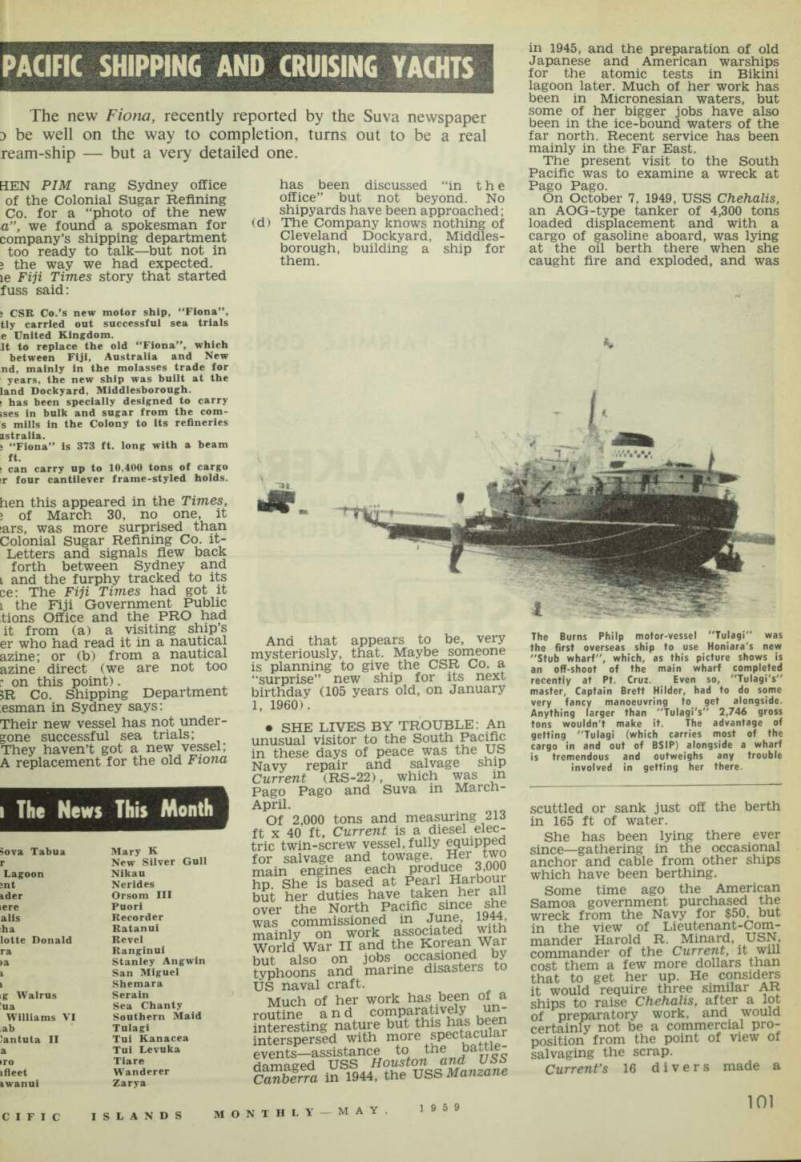
The Borns Philp motor-vessel "Tulagi" was the first overseas ship to use Honiara's new "Stub wharf", which, as this picture shows is an off-shoot of the main wharf completed recently at Pt. Cruz. Even so, "Tolagi's" master, Captain Brett Milder, had to do some very fancy manoeuvring to get alongside.
Anything larger than "Tulagi's" 2,746 gross tons wouldn't make it. The advantage of getting "Tulagi (which carries most of the cargo in and out of BSIP) alongside a wharf is tremendous and outweighs any trouble involved in getting her there.
ugh examination of the tanker g the three weeks at Pago It is possible that the vessel be raised at some future date purely naval exercise but this ilikely to happen soon. 0 aboard the Current with her al complement of six officers 13 men were some passengers— >ans serving in the Armed ;s in Hawaii who were given opportunity of some leave at iving Pago Pago the ship called iva for a recreational break on 9-10, before departing for Harbour, where she was due pril 20.
VIORE GROPING: Another 1 dealing with trouble of a dif t type—and flying the British -is expected in Suva in early from Singapore. This is the fear-old cable ship Recorder, tons gross, Captain R. E. will be recalled that extensive ige was caused to the ocean raph cables near Suva by the sarthquake several years ago. these were repaired by lew cable ship Stanley Angwin, some of this work was of a orary nature. corder will now replace a m of the Suva-Norfolk cable Suva, and will then proceed r anning Island to repair a 5d “shore-end” —the heavy iured cable which leads from i to deep water, e deep-sea portion is only t an inch thick and un >ured. It is little effected by and ocean currents, but the 5-end is constantly moved by in shallower waters and is ;ct to wear on rocky bottoms, spite of the protection of a tape wrapping, these portions the location of most of the )le in ocean cables except i some fishing trawler slices its through the off-shore sections, rery rarely—when some sperm
whale plays havoc, as recently mentioned here.
• Strange Flag Coming’
And another unusual ship is ex pected in Fiji waters late in June.
Perhaps the first Korean-flag vessel ever to enter a Fiji port, this is a heavy-lift vessel with a 120-ton derrick and understood to be of about 5,000 tons gross, which is bringing the machinery from Singa pore and Hongkong to Lautoka for the big new wharf contract. No further details of this specially chartered vessel were available in Fiji in mid-April.
• Tough Times In New
CALEDONIA; A Noumea corre
spondent reports that the coastal shipping situation is becoming acute in New Caledonia.
One of the two small ships on the coastal run, Gaitcha, has been sold to a Tahitian syndicate and leaves shortly for those waters.
Former owners of the vessel de clare that it was impossible to make a go of the business due to lack of subsidy from the Government, and because increased wages and social charges were too heavy.
Certain parts of New Caledonia can only be serviced by ship.
• Tug’S Long Voyage: The
45 ft ex-Army tug which has been used by the Papua-New Guinea Copra Marketing Board for work
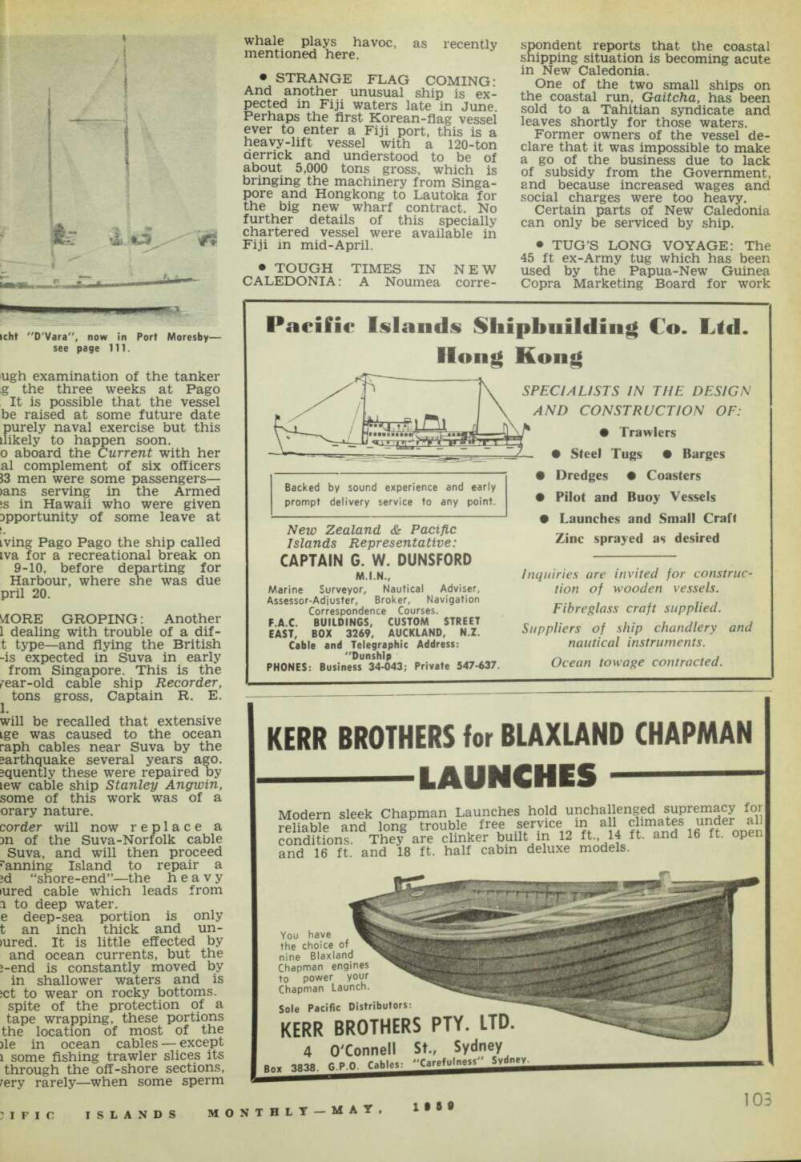
[?]chr "D'Vara", now in Port Moresby see page 111.
i Rabaul, but was purchased annard Bros., of Sydney, a of months ago, was on its 0 the latter port, via North sland ports, in April. ter Goddard, of Palm Beach, cted to get it to Sydney and fed the necessary crew, mard Bros, own a large fleet ter-taxis, launches and tugs they operate around Sydney ur and waterways.
Educed Canvas: Burns
> 120-ton ketch Moala, which ed to the New Hebrides in iry after refitting in Suva, e topmast section of her fore shortly after resuming work it area, according to a Vila . About 16 ft of the mast down. The vessel was sailing motoring—in a fresh breeze time.
3E’Ll Fill The Bill: With
creasing tourist trade to Fiji, le desire of many visitors to the islands off the present track, a new shipping venture should ably meet require tain Stan Brown, formerly of / vessels and lately of Suva, [r. Norman Williams, lately of ji Department of Agriculture, entered partnership to pur the Tonga Government’s old try ketch Hifofua ( PIM, fua, on completion of survey iterations to meet the new ; trade, will re-enter service Suva registry and with the of Maroro —meaning “flying -and will be equipped to carry ssengers in two-berth cabins still retaining her cargo hold 'd, and crew’s quarters in re will be regular cruises to and Kadavu; or charter will be accepted to anywhere . or outside the Group, oro is being registered as a g vessel and not as a yacht, ill be maintained and staffed ingly, and should be ready for rst cruise in May.
Osing Business; While
awaits the new Public Works tment slipways, the existing y is working to full capacity
although the Slipmaster
jes the work to the best ad ?e of ship-owners, there is > a waiting list and often some and some work turned away, ecent months a few Japanese 1 vessels —some steel and wood—have been serviced va on the PWD slipway and private firms doing the work, are reports that others were ig but could not be accepted. [1 now be interesting to see many more of the 20 to 30 n vessels, each of 75 to 150 gross, which will be around r ear during the June to Oc tuna season, will be dealt with,
These vessels belong to the Taiyo Fishery Co. of Tokyo, which sends a fleet to waters near Fiji each year, headed by a mother-ship.
Millers Ltd., of Suva, have been negotiating the servicing of these vessels which would provide a good deal of work to the Suva shiprepairing industry. The owners are agreeable and it now seems to rest with the PWD slipway’s capabiliti es H ‘ , . ...
Dredgmg is proceeding at the site of the slipway intended for handlmg the PWD’s own vessels, and pile driving will commence soon; but thf, new commercial slipways are still very much in the paper stage.
It seems likely that between now and the time that they are ready a great deal of possible business will have been lost to Suva where
ships from many Island groups con verge for repairs,
• He Bought Some Trouble;
Sitting on Miller’s small slipway, past , s l x ex-RNZAF crash-boat 276 . She wa S offered for tender a year ago an J T successful tenderer was f Z^T^ ving m an m “
own -
What his intentions were are not known in Fiji. If he had the vessel surveyed before tendering, his ad viser was “off the beam’’, as investi gation has shown Bought at a reported £6OO, it would cost some thousands to make her seaworthy. There are extensive areas of rot. The two 600-hp Hall- Scott motors which operate on aviation gasoline are virtually worthless, except as scrap, as no one
[ afford to operate them com ially. d now, before “276” can be re plied she will have to be ped of all equipment and iinery to lighten her up, as the en hull, with all its holes, i not otherwise float long jh to let her reach a marine syard off Suva. \ VARIED LIFE: For sale in in April was W. R. Carpenter d.’s Adi Sova Tabua, which 3d life as an American war picket-boat, later traded on r anua Levu coast, and last year employed by her owners in the 3-marking programme near tea. d in April was Morris Hed i & Co.’s Tui Kanacea, 43 tons, [assan Rajah, owner of Tui k,a. Tui Kanacea, the Register s, was built by Marlows in in 1930 and rebuilt by Millers 152, and is a 48 ft auxiliary r with a Lister diesel.
*Ot Privateering: There
curious goings-on in a Suva ard one morning in April. l to the jetty was Morris trom & Co.’s 260-ton Altair. ay was a pile of 4-inch shells. 3 were being hauled by hand to the ship’s upper after deck jh there was no gun visible up . The ship however was not iring for a privateering voyage, shells were old cast iron ice shells purchased from the j as ideal ship-ballast. Altair being given a stability test to laying 4 tons of asphalt to leaks in the deck-head.
\Luminium Boats Have
BLEMS: Aluminium ship’s i and launches possess the es of lightness, but there are ems. At a Suva shipyard in , undergoing repairs, was a
smart-looking aluminium launch belonging to the new Tongan ocean tug Hifofua.
Vibration of the motor had caused many of the aluminium rivets to loosen or shear off. These were being replaced by stronger rivets. • LEADING ANGEL: Captain S E. Gaskin, a well known Pacific mariner—he spent 30 years with the Union Co. and four recent years as master of the London Missionary Society’s John Williams Vl —has been appointed Manager-Secretary of Suva’s new Flying Angel Missions to Seamen headquarters.
Good progress is being made on the building, which should be opened at the end of June. Captain Gaskin was due in Suva in mid-May to oversee the completion work. • SPRUCING-UP: The French Navy’s Noumea-based patrol vessel Tiare, a YMS-type, and an lin
proved version of her predecessor of the same name, went to Suva for refit in April, commanded by Lieu tenant de Vaisseau Y. Cerbelaud, and with Enseigne de Vaisseau de Ist Class F. Charollais as second in command, and a total ship’s company of 38, plus a white terrier bitch named Lili, her black-and white son, named Gas Oil, and a white cat named Volta.
Lili is Portuguese, having joined at Lisbon when the ship was bound for Noumea two years ago. Gas Oil’s nationality is doubtful, but he received his baptism on falling into a drum of oil when only a few days old. Volta is a New Caledonian.
One of the crew is from Tahiti, one from Senegal, and the re mainder French.
Built in the US in about 1943, Tiare —ex Petunia —is of 320 metric tons loaded displacement. The main differences from the old Tiare are that this one is specially equipped for tropical service. She has better ventilation, five refrigerators, and can carry stores for three weeks at sea.
She has a service speed of about ten knots and a maximum speed of about 15 knots. She also has a large chart room equipped for oceano graphic work and, together with Orsom 111, has carried out certain IGY work since her arrival in the Pacific. She has also done some hydrographic charting work round New Caledonia. She has a 250fathom sounding wire and two echo sounders.
While on the Suva PWD slip half the ship’s company were quartered at the RNZAF base at Laucala Bay, the two sections alternating.
• Old Tiare In Trade: Lieu
tenant Cerbelaud reported that the old Tiare, decommissioned, and re cently reported as for sale, has now been sold as a trading vessel.
The purchaser is believed to be Captain Elbing. of Noumea, whose intention is thought to be to operate her on the Noumea-Loyalty Island
[?] Current", the repair and salvage ship which carried out investigations of a Pago Page wreck in March-April Photo: US Navy.
es "Recorder", 3,350 tons, one of the fleet of cable repair ships owned by Cable and Wireless Ltd., which will soon be seen in the Pacific—see page 103.
; after alterations. She should bering that service when this rs. [tenant Cerbelaud said that lew New Caledonia Public ; Department slipway near ea is still uncompleted. PIM id progress reports on its con ion. So for the time being has still to come to Suva for s.
Ishing Launch For
OKA: Lautoka is not looked a ship-building port but there deal of activity on the road tiere not far from where the harf will be, in April, tbuilders Mario Lorosio, of ta, and Apinisa Momo were ng out major alterations to unch Elenoa, 30 ft x 9 ft, for ’om Pickering, who plans to er back into service in mid is Lautoka’s only commercial j launch —though there are small outboard craft at pre- Lshing. hull, of dakoa timber, has fitted with bilge-keels to re rolling, and a new Oregon ■roof has been built; there is rkins diesel. Mr. Pickering >perates the towing launches Wind and Ella.
Reparing For Season;
in Trevor Withers was visit sw Zealand recently while his Lagoon, one of the few com il cruise-launches operating Islands, was on a Suva slip aving a general overhaul prior 1959 tourist season. ?d at Lautoka, Blue Lagoon es an attractive cruise to the r a Islands near by. Built in ilia as the Royal Flight, the came to Fiji some years ago charter to a film company ng “Blue Lagoon”. was purchased from those s by a former Governor of vho used her for fishing ex ns. On his departure, she was p for sale and purchased by in Withers.
ERSONAL; Captain Bottoms, r master of A. B. Donald & Cook Islands-based Charlotte d and earlier of the mission ohn Williams VI, was reported in hospital in Auckland as isult of an accident in April,
tain J. McKenzie;-Arnot is
laster of John Williams VI.
D. A. Butler, lately manager Union Steam Ship Co.’s Suva h, has retired after 37 years 3 with the company. He is well i at most Island ports east of He plans to live in Auckland sending his departure from r as acting as temporary man
of Suva’s Union Co-operated
1 Pacific Hotel until that was handed over to new con t the end of April. tain Henry Simpson, of Suva, n command of Burns Philp s mi on a voyage to AitutaKi
with aviation gasoline in April. On his return he expected to be trans ferred to Nikau.
Captain J. L. Lumsdale, formerly of the Union Steam Ship Co., a former Assistant Harbour Master at Suva, and latterly master of Burns Philp’s Fiji-based vessel Yanawai, died in Suva on April 6 after a long Illness.
Captain D. MacCullum arrived from New Zealand in April to take command of the new Tongan ocean tug Hifofua.
• Russians Returning: The
three-masted Russian schooner Zarya, which was on IGY business in the South Pacific and Austral asian waters last year, will be re turning.
She is expected to visit Welling ton, NZ, and probably other places, in July.
Built in 1928, and now used by the Russian Academy of Science, the anti-magnetic vessel is continu ing her study of the earth’s mag netic field.
• More Work For Tonga:
small Kingdom of Tonga, ir the enthusiastic direction of remier, Prince Tungi, is follow a, more vigorous programme of building than any of the other fic territories. >art from larger vessels, built seas, smaller craft are being in New Zealand. In April, good ress was being made on the 0-gallon steel oil barge and the len pilot launch being built in dand by A. & G. Price Ltd. te launch will be powered by a and diesel and is now planked the joinery well under way. stallation of bulk oil tanks in *a was discussed recently by ce Tungi in Suva and Sydney these will receive oil from the e, which will be towed by the Hifofua from Suva. te Auckland manager of A. & *rice, Mr. E. A. Cook, will leave dand on May 12 for a three :s visit to Tonga and Western oa in connection with the ch and the barge.
Cattle To The Philip
ES: Over 1,000 head of Short i cattle left Whangarei, NZ, on 1 11 on the San Miguel (March ) reported to be one of the best )inted cattle ships in the world. le shipment is part of a plan the Philippine Government to )ck the country after its heavy le losses during the Japanese pation. At least two further ments are envisaged, if suitable s is available at competitive es.