On The Sepik
pp. 90-99 · Read in the full issue



River Reflections There's More Than Crocodiles On The Sepik
To be a professional crocodile shooter is one thing; to write whimsy is another. Or so one might think. But PETER ENGLAND manages to combine the two talents. The river that claims his attention in New Guinea’s Sepik . . .
I¥/-HEREVER you go on the River ff nowadays you meet natives driving fast single or double canoes powered with outboard motors.
A very short while ago it was nothing to paddle steadily for six or seven days to cover a couple of hundred miles, but who’s going to do that now when he sees the Joneses race past in their latest model Sepik Sedan!
The more elaborate models have cabins roofed with thatch, canvas, or galvanised iron, and remote control for the steersman up for’ard. B The sporting models are light single canoes which achieve high speeds. No matter what the type, every craft on every trip is filled to capacity with enthusiastic passengers.
There is no privacy on the river.
In native life itself there is no privacy, so I suppose it is a sort of compliment that when my canoe pulls in to a village and ties up for the night the whole population should come and sit on the bank, displaying the deepest interest in my toilet, my evening meal, my strange addictions to typewriter and radio.
Only when I have turned out the light and apparently gone to sleep doesi the last of the audience fade away.
Cunningly, I wait for half-an hour till the coast is clear and then turn the light on again . . .
Double Canoe
j n Flood-time Q ne of the most exciting ex periences you can have, if you like excitement, or alarming if you are a nerV ous type, is to travel down a narrow Sepik tributary at flood time in a high-powered double canoe w ith a native helmsman. nf n bPlmsman as I “™?ratl22s th !“ lr t ° roncerSrate J° a nd stoer a Jo°k ahead ' true course.
A native helmsman is con stitutionally unable to concentrate, and looks straight ahead only when he is not occupied in scratching his b£tck, talking to his myites, pooling a stick of sugar cane, pointing to a kokoinor flying overhead, waving to friends, at a passing village, or just thinking of something.
Alternatively, he also has faculty of looking straight ah< and seeing nothing.
His course can only be compaj to that steered by a drunk ridf the Cresta Run on a fast bobsle; —the course having first b« liberally sprinkled with snags in shape of tree trunks sticking at odd intervals down the fairw Drunks and natives are alw\
cheerfully optimistic.
Crash! There goes another she
pin . . . !
Tiny Girl
in Pul-pul Skirt The children! No matter w opinion one may have of the ao native of these islands —and sor times, in moods of exasperation have the gloomiest—children the same the world over. If oc they would never grow up.
These kiddies on the Ken River are delightful, the boys, scraps of gaily coloured lap-lap: torn towels —one in a bright strii football jersey down to his km and the girls in tiny pulpul gi skirts, the fibres dyed and knotr just like big sister’s.
A little awed at first, they o: need a smile to respond w laughing and chattering and flat ing of white teeth, unspoiled as by the universal betel-nut. Thj learn to paddle a canoe as soonj they can walk.
Ambidextrous
Engine Roy
Gulembi, my engine-boy, is vi good. I have had him for so years and he knows more ab; (Continued on page 97)
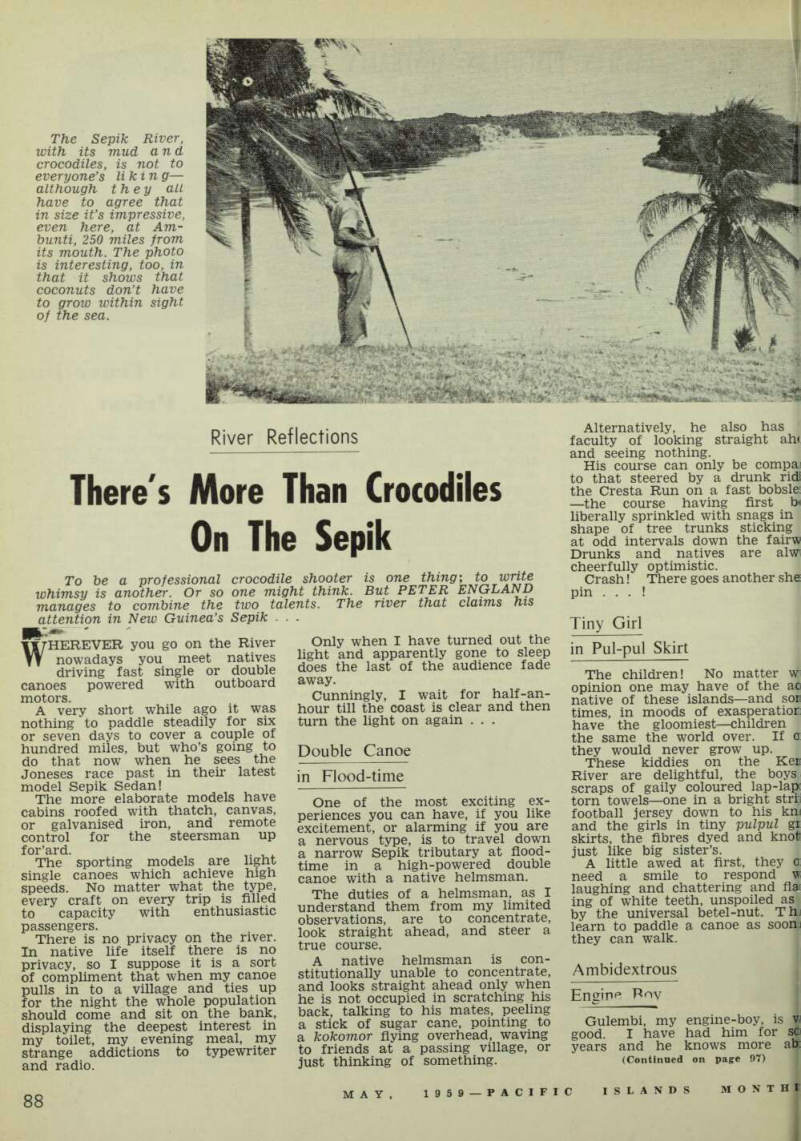
The Sepik River, with its mud and crocodiles, is not to everyone’s likin g— although they all have to agree that in size it’s impressive, even here, at Am bunti, 250 miles from its mouth. The photo is interesting, too, in that it shows that coconuts don’t have to grow within sight of the sea.
outboard motors than I do myself.
If he has a fault it is his in ability to distinguish a right-hand from a left-hand thread. To simplify matters I tell him that all screws have right-hand threads, but, when he wants to loosen a nut and finds it will not respond readily to the first pull of the spanner, he will still try it the other way.
This naturally means a stripped thread now and then. I am sure that if he was given a clock on which the hands rotated in an anti-clockwise direction he would have no difficulty in telling the time. He thinks ambidextrously.
On occasion I have to do some thing to the off-side wheels of a truck, on which the wheel-nuts are left-handed, and, to make sure, I do it myself. When I turn around Gulembi is standing just behind, looking at me reproachfully . . .
The Sepik
Slap-habit
The river people, although brought up from infancy in a land which is never free of mosquitoes, are far more susceptible to their bites than the average European.
They automatically brush, slap, scratch, lift one leg to rub the other, and emit sotto voce exclama tions ranging from “tch, tch!” to “aie-ee-aa!” .
A Sepik is quite unable to stand still on two feet for a minute at a stretch, even if there are no mosquitoes; he will go on slapping from force of habit.
He will approach a complete stranger and say “Excuse me, sir, you have a mosquito on your ankle”, and bend down to remove it for you. , . .
Or, without excusing himself at
all, he will come up behind you and clap you on the back of the neck: “Master, nat-nat!”