It's An Industry Should
pp. 88-89 · Read in the full issue
Problems of the Shell Button Business It's An Industry Should Bet Your Shirt On!
By J. P. Short All
Milord, and not milady, will decide the fate of the Pacific shell industry; though as spring breaks in Paris, Rome, and Dublin all eyes are turned in the direction of the fashion salons to see what assistance can be expected from the men who de cide what the ladies will wear in the year ahead. But whatever shell trimmings milady's outfit may carry, and unless the dic tators have decreed the liberal use of small buttons, it will be what goes on milord’s shirt front that really counts, as in the past.
rLAT is the real substance of New York shell broker Paul A.
Rie’s latest assessment of the industry. Reports of secret military uses for pulverised shell powder to the contrary, those who follow the fate of the sea shell from lagoon to ultimate destination are emphatic that by far the greater proportion end up as small buttons —and for a long time past men have been the main users of such buttons.
American pearl shell consumers, the Australian MOP industry, and the Australian Government have united in a recent drive to publicise the genuine pearl button, its distinctive beauty, and its prestige value over synthetics.
The story of the Australian shell industry has been written up lately by a well known American writer on the sea and fishing. His writings are appearing in American maga zines totalling millions in circula tion. The same ground has been covered photographically for the big-circulation Argosy magazine by Mr. Ken Heyman. McCall’s maga zine sent a group of fashion models to Australia where they were photo graphed against simulated back grounds aboard the former lugger Saratoga in Sydney Harbour and also at several tourist resorts.
Balmain's Tour In April the Paris designer Pierre Balmain was to set out with three of his models on a world tour which could have tremendous implications for the shell industry. When this was written it was not known how much or what form of shell decora tions had been incorporated into the various creations which will be displayed to the fashion concious women of the world. Balmain’s whims could at least have an im portant bearing on the price of white MOP in the year ahead.
As the publicity programme has
Australian backing it may be assumed that the emphasis will be on white MOP shell—and not on the blacklip of French Polynesia and the Cooks, or on trochus, though these too might benefit.
But unless the fashion emphasis is on small shell buttons as well as large, the benefit will be strictly limited. Even now there is no great trouble in disposing of the shell suitable for the manufacture of large buttons, but this represents only about one-third of the total.
Most of the important remaining two-thirds goes into small buttons —and at present small buttons mean men’s shirts. Balmain and his companions could alter all that.
It has to be remembered though that it is precisely in this field that
the plastics have made greatest! roads.
Good as plastics now are, t: still cannot completely deceive: large sizes, but in shirt-button si it is almost impossible for an exp[ to differentiate at three feet ay —and the plastic button, what e failings it may have, is much 1 costly.
"Prestige"
The fate of the small button 1 day rests largely on prestige. T is the angle that is be emphasised in the United State the well-dressed gentleman will! seen in nothing but the best, genuine ocean pearl-buttoned sh After all, the difference in cost a shirt is not very great.
The thing is to convince end men that the genuine article worth that little extra. In fiercely competitive shirt manuf turing trade of the United Sti the manufacturers who count not easily convinced on that sc And no one has yet thought: any other mass use for the defec: shells and the excessively cue portions unsuitable for Is buttons.
The recent publicity appears have been concentrated entirely sales promotion in the garir trade; but is it not possible t there may be other sales fie' The building trade for instanc«
Building Use?
In the huge modern streamli public buildings of today all ki of decorative materials are u Surely mother-of-pearl shell we have its place, perhaps embo( in murals or terazzo work, trimmings to the great doors such buildings, or in the stain
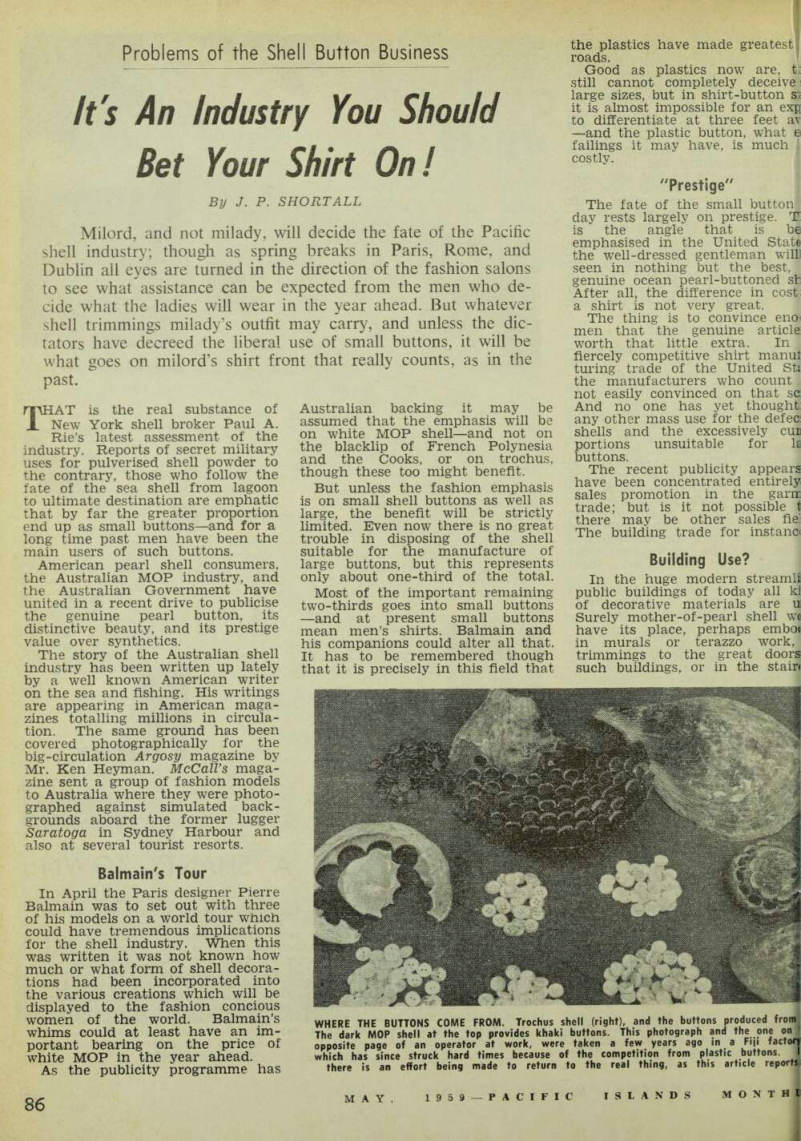
WHERE THE BUTTONS COME FROM. Trochus shell (right), and the buttons produced from The dark MOP shell at the top provides khaki buttons. This photograph and the one on opposite page of an operator at work, were taken a few years ago in a Fi|i factor which has since struck hard times because of the competition from plastic buttons, there is an effort being made to return to the real thing, as this article reports
ings, or in many other appllca is well known to the leading tiitects of today ever searching new and more novel ideas, he use of shells in the building le would appear to be particu y applicable in the case of •ine insurance and shipping ipany establishments, which are n the most lavish in their costly here would also seem to be very nite applications in the public ns of today’s great ocean liners. d can say how much shell all might absorb if the right ideas s sold to the right architects, n the smallest pieces of shell, ;essed or unprocessed, might be )le. l the larger panels no plastic yet approach the unique beauty mother-of-pearl. Even the cal trochus, its outer surface shed, might be usable in this Such applications might be basis of an Islands industry the partial processing of such Is to the shapes and sizes re ed for specific jobs.
No Promotion > far as the Islands are con ied, there is no sales promotion inisation whatever, and this tit well be a high-priority stion of the Administration u-y departments which are lually appearing in the different tories. At least the matter is ;h some serious thought to the c Islands and French Polynesia re the type of shell —MOP— y to be most suitable for the ling trade is produced. ie building trade, like the curio e, may not absorb a major unt of shell—its price in corn son with other materials of .1 beauty would be the deciding )r —but any outlet is worth e investigating, and now cer ly seems to be the time for it.
Even in the matter of men’s shirt buttons sales in Australia and New Zealand could probably be sub stantially boosted if the prestige angle was well played. At present it is virtually impossible to buy an MOP pearl button in New Zealand at least.
With teen-age clothing at a stage of evolution where literally any thing goes in extremes of colour, shape, and decoration to male (and female) garments, there would seem to be plenty of scope for clever sales promotion in that direction alone, in Australia, New Zealand and more so in the United States and Europe where the big markets lie.
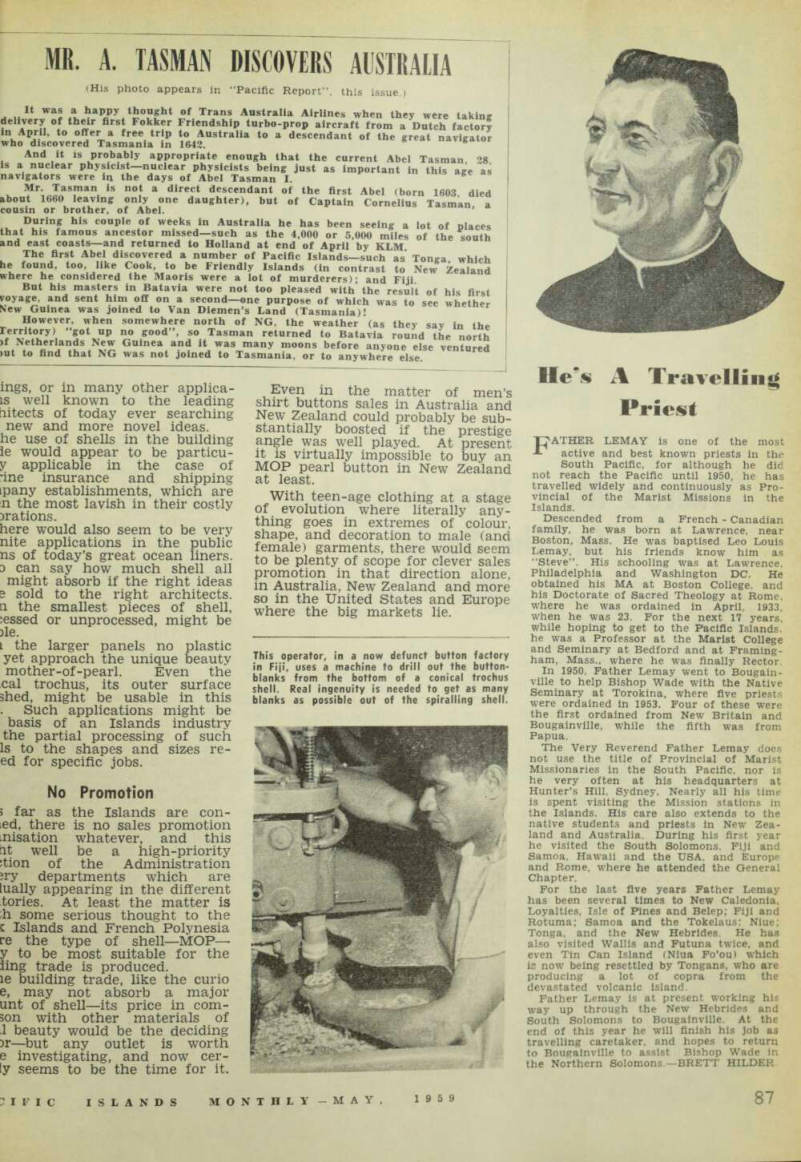
This operator, in a now defunct button factory in Fiji, uses a machine to drill out the button blanks from the bottom of a conical trochus shell. Real ingenuity is needed to get as many blanks as possible out of the spiralling shell.