High Seas
pp. 86-99 · Read in the full issue
A Horrible Story from the Annals of the Blackbirders Butchery On The
Compiled by R. W. Robson, From Old Records There was in Melbourne, in 1871, a peculiarly unpleasant: specimen of humanity named James Patrick Murray. He appears to have been a qualified physician, and he was rich; and he: decided to seek adventure by running his own ship among the South Pacific Islands.
IN June, 1871, he left Melbourne in the 167-tons brig Carl. With him, as passengers, were a Mr.
Wilson and a Mr. Scott. Captain Joseph Armstrong was master. A man named Dowden, a friend of Dr. Murray, was a crew-man.
The party went directly to Levuka, in Fiji. Fiji and most Polynesian islands then were grow ing cotton, and the new planters were yelling for labour. Fijians and Polynesians were undependable workers. Ship-masters who recruited labour in Melanesia, for the islands eastward, made small fortunes.
The Carl sailed off to the Southern New Hebrides and tried to induce natives there to “make paper”. But many outrages had been committed by “blackbirders”, and the natives, urgently warned by missionaries, were either shy and unresponsive, or very hostile.
The Carl party had no success.
So, at Paama Island, one of Dr.
Murray’s friends was dressed as a missionary, and rowed onto a beach, where he led his boat’s crew in hymn-singing.
The natives came around, and the “missionary” tried to persuade them to visit the ship. But they refused.
Bashed Into Quietness
The disconsolate Carl went on to Malekula, and sent a boat ashore. A small fleet of native canoes attacked it.
The Carl opened fire, most of the canoes fled, and the brig then ran down three canoes, spilling the natives into the water. The brig’s boats went out and grabbed 12 men, and put them in the hold.
Thus developed the Carls special technique. She went from island to island, and on into the Solomons.
When canoes came around, some to trade, some to attack, they were
run down, or smashed by throwing pig-iron into them, and the struggling swimmers pulled into the boats, bashed into quietness, and dumped in the hold.
Thus, they “recruited” men in Santa Anna, Ysabel, Bougainville and Buka. With a score of fierce black boys from Buka, the brig filled her requirement (80 potential labourers) and set sail for Levuka, direct.
Two nights out from Buka, in mid-September, 1871, a fearful row began among the 80 natives imprisoned in the hold. The crew tried to quieten them by firing pistols over them; but the men had armed themselves by tearing down the timbers from which tiers of bunks had been made, and using them as spears.
They repeatedly charged up the ladder to the hatch, at which they battered wildly. As there seemed a danger of their breaking through, guns were served out to all hands,
the hatch was removed, and steady fire was directed into t hold.
There seemed to be fighting 1 tween groups of natives —they ca: from several different localitien but enough of them were defyi the crew to prevent any of t latter entering the hold.
The Carls people maintained t shooting, all night. Evider gathered later indicated they ma a sport of it.
Dr. Murray handled his musl with gusto and, as he fired in the hold, he sang “Marchi] Through Georgia”.
Just before dawn, the sounds defiance from the hold lessen and Scott volunteered to go do 1 and arrange a truce. But he h descended only two rungs of t ladder when he was stabbed in t chest by a sharpened pole. He v dragged back, and the firing v resumed. To assist the marksmi Wilson kept throwing lights ii the hold.
After daylight, the hold was qui It was decided that an effort made to save the uninjured for t labour trade. The natives wc invited to come up on deck.
Only Five Came Up
Five men came up without he The remainder still able to me had to be helped. There were men wounded, 16 badly and ni slightly.
They were put under gua: while Dr. Murray and Scott we down and inspected the hold. The was blood everywhere, and abQ 50 corpses.
A team of crew-men was c ganised. The bodies were broug up one at a time, and thrown ove board. The team then was set] work, cleaning the hold.
Meanwhile, Dr, Murray and 1 merry men discussed the situatij on deck. They had five nativ unwounded, nine who probal] could be patched up, and 16 injur] apparently beyond repair.
The meeting debated a plan ]
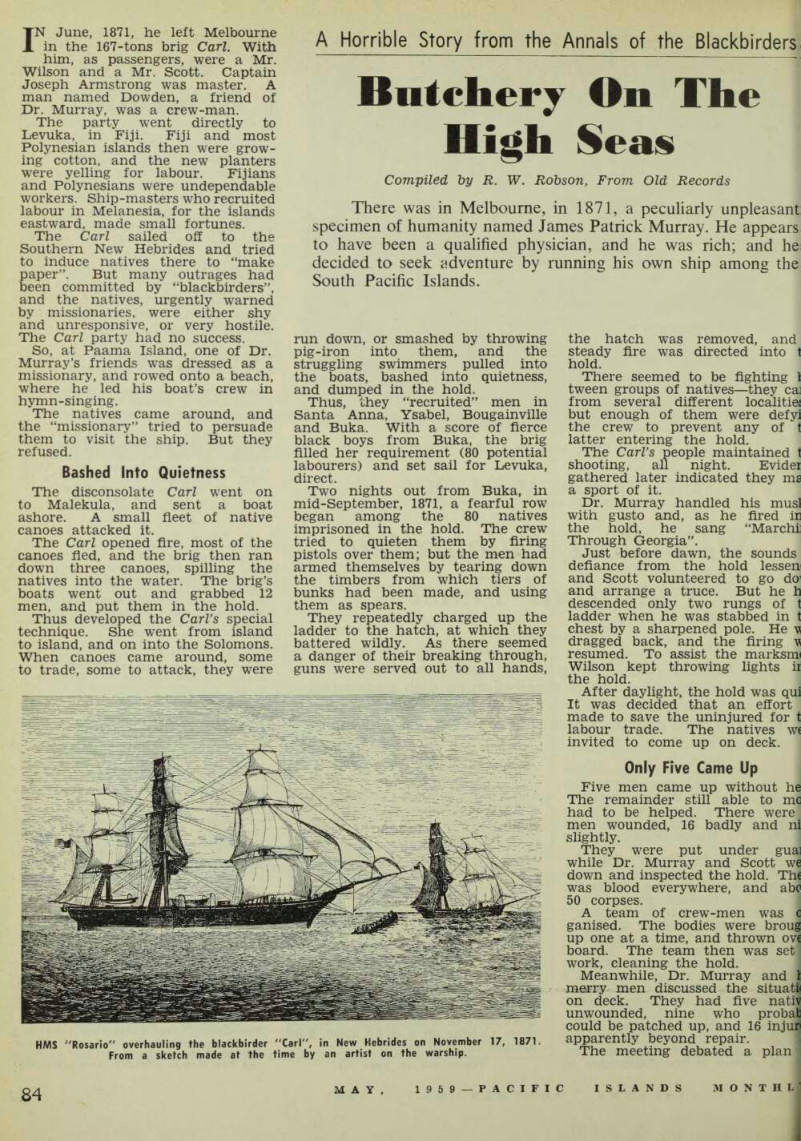
HMS "Rosario” overhauling the blackbirder "Carl", in New Hebrides on November 17,1871.
From a sketch made at the time by an artist on the warship.
)w these last into the sea. erboard with them!” shouted :ray, and he himself indicated se whom they should keep. The were tossed overside, ome of the injured men had ugh life in them to swim. They 3 left swimming. The brig was of sight of land.
Tiile the crew were scrubbing white-washing the hold, and remaining 14 natives were sent c there, Dr. Murray and his panions sat in the main cabin bemoaned their evil luck, in ing lost over 60 of the labourers r had gathered with such pains, le Carl, in the next two months, 1 November, 1871, engaged in her cruising to collect grist for labour mill—yet retribution of irt appeared to be on the way.
Public Anger
i many stories of outrages corn ed by “blackbirders” in the fic Islands had reached news ;rs and Parliaments in the late ies that the British Navy led on special measures. HMS irio, a wooden sloop of 637 , was commissioned by Com der A. H. Markham, in Sydney, )ctober, 1871, and sent out to :e the native-labour recruiting 3 in the South-west Pacific. ie book which her commander e (The Cruise of the Rosario, a collector’s piece, published i shows that the Rosario had ist of the more notorious ers”, and hunted them •ously. ie next incident in the Carl’s nous journey is taken from mander Markham’s account: the morning of November 17, a brig )bserved under close-reefed topsails. :r weather quarter. We hoisted our s, and a signal for her to heave-to. replied by showing the English en but taking no notice of our signal, was fired which quickly brought her topsail to the mast, second lieutenant was sent on board he proved to be the “Carl”, of Mel e, having on board 70 natives—we ict call them slaves—whom she was ng across, to dispose of for labour. i cotton plantations. second lieutenant had strict orders ike a most rigorous and careful in ation of the ship and her papers, is return he reported to me that hing appeared to be formal and cor ind, as far as he could make out the passengers, that they were all ard of their own free will and con and that between decks she was for a slaver and freshly white d. boat was then hoisted up, and the allowed to proceed on her course, tly well pleased to be rid of her itive and troublesome friend. can be imagined what con ilations the charming Dr. ay must have heaped on him as he realised he had bluffed aiuch feared warship so soon the terrible massacre. Yet as not really out of trouble.
(Continued on page 97)
When the Carl arrived in Levuka, Dr. Murray was very ill, and his control over his company was re moved, accordingly.
Some of the crew talked of the horrible incident in Sepcemoer, and Levuka officials began to ask questions. When Murray recovered, and learned that inquiries were afoot, he panicked, and ran to the British Consul, Mr. W. T. Pritchard, and turned Queen’s evidence.
Queen's Evidence
The Carl and her crew were arrested; the wretched “recruits” were, as far as possible, returned to their homes in the New Hebrides and Solomons: and the brig and her company were sent under guard to Melbourne, where the trial was very fully reported in the newspapers of 1872.
Captain Armstrong and crew-man Dowden were sentenced to death, but this later was changed to long
imprisonment.
The evidence of Wilson, and of other members of the company showed that the indescribable Dr.
Murray was the real leader of the party, and the instigator of the worst crimes: but, because he gave the original evidence which con victed his companions, he escaped
all punishment.
Why (wails the Rosario’s com mander in his book) did some of those people, who declared at the trial that they were afraid of Murray and hated the things he made them do, not complain to the Rosario’s boarding party on November 17?
If they had, Murray would have hung.