NG’s Most Celebrated
pp. 85-101 · Read in the full issue
A Closer Look At The Facts
NG’s Most Celebrated Cannibal Feast
By Lew Priday
A hundred years have gone by since Australians heard or the first time of a case of cannibalism on such a scale that : allowed journalists to make a periodical sensation of it ever ince. The latest example appeared in a Sydney afternoon paper ot long ago.
IE event was the disappearance of most of the crew and all but one of the 317 Chinese passeng of the three-mast French joner Saint Paul, after she was :ked on Rossel Island in the isiades ut in one important particular story the writers so like to em ish has gone astray. With the ulish excitement that horrors ly inspire, they invariably assert i the Chinese victims were kept the natives in a sort of pen or •al and systematically fattened for subsequent consumption at steady rate of one or two a his part of the story, though 7 may not know it, derives from letter written 12 years after shipwreck by G. P. Heath, who served in the Rattlesnake dur a survey of the Louisiades by
Captain Owen Stanley. He wrote; “ Then, if I remember rightly, a vessel with Chinese emigrants was wrecked somewhere at the Louisiades some years ago, and it was that the natives penned the Chinese up like sheep, and daily came to select the one in best condition for the table, the last survivor being rescued by some passing vessel.
They Ate Them The Rossel islanders undoubtedly pursued, slew and cooked and ate the poor Chinese as and where they found them; but any suggestion that thev had the necessary re straint f the stocks of food needed to fatten their human cattle and fne ability to organise and draft out their victims on a dally scale, goes beyond rational belief.
(Continued on page 91)
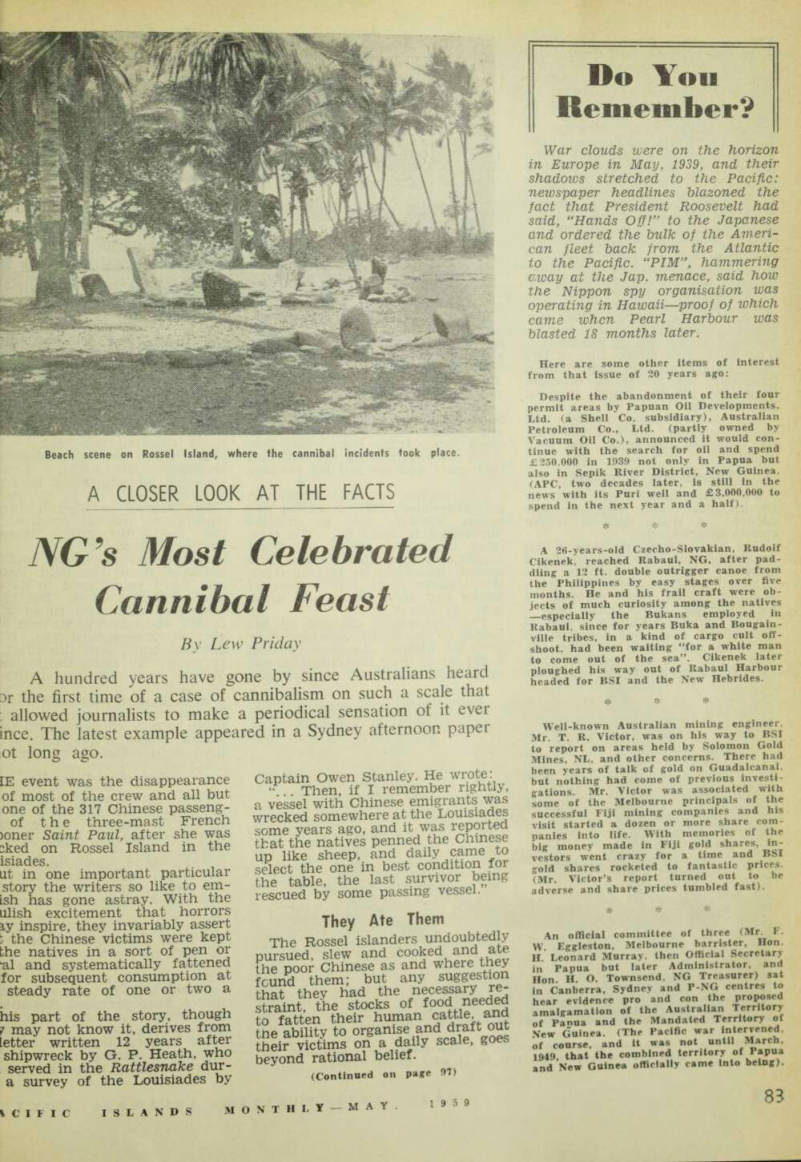
Beach scene on Rossel Island, where the cannibal incidents took place.
Jo nr, rpncnn whv the There is nc * rea ®°fv j n journalists should not be better in formed. A long, factually w . into. th fa?fhip Wa S V ma^is b ?epl h rt written
under t£ ti
pophagie a Vile Rossel, dans I Arctupel de la Louisiade, m a ,„ publication, Le (Vol. IV. second quarter l»bu pages 81-94), after the Styx returned to France. . HII in
rfenc howl's as an
appendix in a book on Rossel Island, written bv W E. Armstrong, a Assistant Government Anthropologist, Territory of Papua, u £ lish l d £ 1928 by the Cambridge University Press.
Ran Aground
Jn December> i B 5B, the schooner p T ince of Denmark picked up seven French sailors in the Coral Sea, sur r f the Saint Pa ul. and took to Port de France (Noumea), The Saint Paul, they said, had left Hongkong in July with a crew
!0 and 327 Chinese passengers id for the Australian goldfields, iproaching the Solomons she held up by headwinds and is, so the captain decided, in i of sailing round to the east, it through the group. Approach the Louisiades the weather be e so rough that for three days lould not shoot the sun; and e hours before dawn on a par arly dirty night the Saint Paul on a coral reef under mountain jungle-clad Rossel. tssengers and crew landed on a I isle which the Styx named Isle Refuge. Part of the crew left tie whaleboat to go to Australia succour, and these were the the Prince of Denmark came i. lose left behind for a time kept y the savages, in their canoes. . shots from one or two old kets. Then food from the wreck out and shellfish proved in luate, so parties were forced to pt lifts to the mainland, inding parties from the Styx with a hostile reception. But found awaiting them in an ly of fear “the last survivor”, a * naked Chinese standing in jr up to his middle signalling to rescuers. He threw away in dis a shell collar and bracelet with ;h the natives had adorned him. dead” were the first words he i (in English) as he threw him into the captain’s arms, it he made them understand four men of the Saint Paul ; still alive —apparently, like self, adopted by the chiefs. It surmised that one of these was ship’s carpenter, a big Prussian r had recruited in Hongkong. To :e him one of themselves the ves had stuck a bone through cartilage of his nose. But re exactly he and the other pos ; survivors were could not be rtained. le natives were hostile; landing ies were attacked whenever they i to carry their investigations nd. At the mouth of one creek r came upon discarded clothing a number of pigtails which had arently been cut off as a pre nary to preparation for the pot. i truth, the story was terrible igh without any need to invent irge-scale abbatoir.
Didn't Believe It r William Macgregor tried not >elieve it; he leaned towards a ve account that they were not nibals and that the Chinese had t rafts and proceeded north ds. Besides, 300 Chinese, he ight, could have conquered the ad with such weapons as they e able to pick up. ut the bulk of evidence is inst him. The Lieutenant-Gov- Dr of Papua, J. H. P. Murray, re ed after a visit to Rossel in 1911;
‘ Various old men were seen who said that they remembered that the Chinese survivors of the Saint Paul were eaten, but they were all too young at the time to have taken part in the feast. The interpretation was not clear enough to enable me to obtain a clear account of the manner in which the Chinamen were enticed off their island. The ordinary way of preparing them, I was informed, was to cut them up and disembowel them, and to cook them on stones covered up with leaves.”
Over the intervening years there were finds, of coins and other things, affording some confirmation
of the massacre. They are referred to in a lengthy appendix to the Armstrong book, In his introduction to that book, Dr. A. C. Hadden says that at the time of the shipwreck, a certain “chief” named Muwo was a wild disorderly person, and the dumping of this cargo of live stock came very opportunely for him and seems also to have been the means of aggravating his craving for anthro pophagy. It was, to say the least of it, unfortunate that the shipwreck took place when that particular man was powerful, or the fate of the Chinese might have been very different.”