Tropicalities
pp. 83-84 · Read in the full issue
Pacific Islands Monthly
Magazine Section
You Can Shoot 'em But Not Eat 'em r amendment to existing laws governing destruction of crops by wandering stock was passed recent Rarotonga Island Council :ing, which means it is now per ible for a landowner to take >n against pigs and goats, ider the amendment a land sr, or a member of his family— le owner of a gun accompanied ne of these persons, may shoot espassing animal, but the body : be returned to the owners of animal. This law applies only to and goats.
Unholy Water
EWS from the New Hebrides?” said a Suva ship-master to a PIM man in April. “Well I t know; there was the tidal 5 over there recently, from some srsea eruption or earthquake or ;thing. You heard about the padre at Tanna, of course?”
M hadn’t heard that one. fell this tidal-wave-thing hit at night, and the way the padre it, it was quite a laugh. He ! slowly from a very deep sleep gradually became conscious of nbling and swaying and a great Ing of waters as he lay on his mder his mosquito net. There’s lace for the River Styx in his logy, but he was ready to admit this seemed something pretty it after sneaking his hand over side of the bed and feeling the rs rushing by. This sort of ; just doesn’t happen in a e well back from the beach well above high water. But in ay he was happy enough to se that it was the elements and fie theology which was at fault le came to full conciousness. id happened.”
Pigs-Tusks Enter
High-Fashion
DKING somewhat less than ter usual charming self, ’ountess Ingeborg de Beausacq photographed for The Sydney ing Herald recently, wearing ;klace of pigs’ tusks strung on wary’s sinews, and a bonnet itella Frankel (some sort of ler) who was “inspired by a e head-dress”.
The inspiration was obviously quite genuine. The hat has a strik ing resemblance to the bark hoods worn by Kukukukus—although in the millinery sense it is not calcu lated to do much for the wearer, Madame de Beausacq has spent the last nine months cruising up and down the Sepik River of New Guinea, and along the more remote coasts of Netherlands New Guinea, buying native artifacts, and en couraging the natives to make others. She recently shipped 22 crates of this native art to New York.
Whatever one may think about the native curio trade—and there are several conflicting views on the subject—one must give Madame de Beausacq full marks for earning her living the hard way. Few women with her background would volun tarily choose to spend their time travelling by canoes and slopping through the mud of primitive native villages. If she makes a few bob out of it, most people would agree that she deserves it.
She was in Sydney in early April and is now on her way back to New York.
P-NG—A Good Place
For Accountants NOW that the Hasluck-Reeve dictatorship has thrown its ready made income taxation scheme—obviously patterned on Australia’s system—over Papua and New Guinea, there is a big and profitable field opening up there immediately for accountants skilled in company and taxation law.
Hitherto, individuals and corpora tions operating in P-NG have kept their accounts according to the system which our grandfathers fol lowed, before income tax introduced a flood of iniquities, and measures necessary to combat those iniquities.
If they follow the same system now, they will be slaughtered.
It all boils down to what a horde of taxation officials will, or will not, allow as “deductible items” when calculating taxable income.
Theoretically, the trader keeps a set of accounts for his own guid ance, so he may know whether or not he is making a profit, and how much. If he is wise and honest, he uses his own good judgment in deciding upon what he shall charge as the legitimate costs of earning his income.
So far, in New Guinea, he has followed his own safe rules in com piling his annual balance-sheet— in fixing such items as depreciation, general expenses, travelling costs,
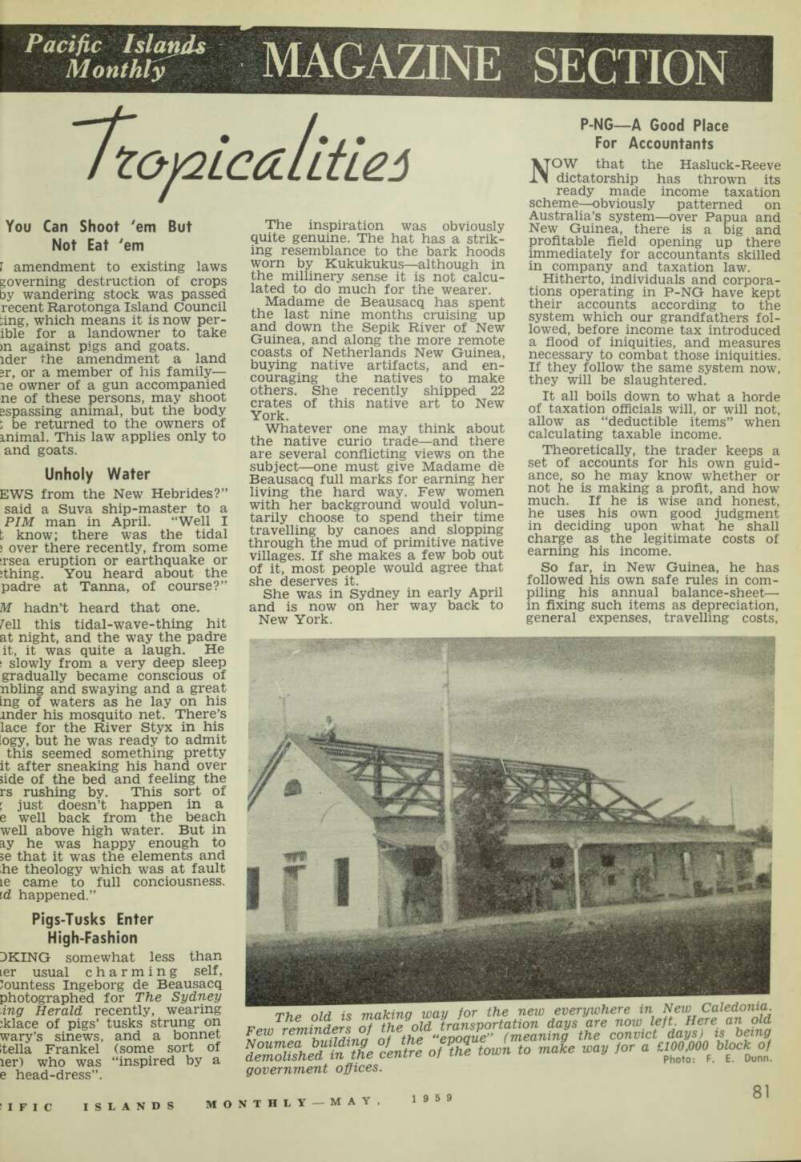
The old is making way for ther new everwher in New Caledonia.
Few reminders of the old transportation days are now left. Here an old Noumaea building of the "epoque" (meaning the convict days) is being demolished in the centre of the town to make way for a £100,000 block of government offices. Photo: F. E. Dunn.
and in deciding what is capital and what is current expenditure. The only authority to check and guide him has been his accountant, and his own commonsense.
In future, he must study and calculate every item of his annual balance-sheet in accordance with new rules. Otherwise, he will find that items of cost which he regards as perfectly legitimate are dis allowed by tax collectors with arbitrary powers, and that he is faced with a demand for tax far in excess of anything he has provided for. A “provisional tax for companies” can be a most vicious thing.
In Australia, today, the keeping of accounts and the compilation of tax returns have become so complex, as the result of endless laws and arbitrary “interpretations” of laws, that no trader dare produce a balance-sheet or return of income without the help of an accountant who knows his taxation laws thoroughly.
Hitherto, trading in P-NG has
been out in the open. Now, it becomes subject to a completely new set of rules, devised for the bedevilment of commerce by bureau crats who, for the most part, hate private enterprise and regard profit-making as a crime.
They Come From A Remote
Pacific Island
Well-known Kai viti, j. s. k.
Borron, who has just returned home to Mago Island, Lau Group of Fiji, with Mrs. Borron, after over 12 months abroad, can always be relied on to see life with a well-developed sense of the ridiculous.
Because they live about 200 miles out in the Koro Sea, the Borrons apparently have some special dis pensation in the matter of US visas (they come into the category of “remote Pacific Island”), and as a result Fiji is apparently unknown to some members of the US instru mentality that deals with migra tion.
According to the Borron si when they were crossing 1 Canada into the US some ma ago, the Borron passports cami for more than usual attention.
The official puzzled about iti a bit, then with a big thumb pressed to the word “FIJI”, c over and said; “Say, tell me tl what’s this F-one-J-one busine
When Tame Boys Become
Really Wild
YOUNG Norman Payne, a bud sawmiller, of Talasea, Guinea—now South, enjoying a of leave—perpetrated it.
Friends asked him about the head tax of £2 per annum, the native labourers they empl at Talasea have to pay it?
“It is paid by the beach b said Norman. “But the wild be that is, the boys from the bust the back of us—do not havt pay.
“We employ a lot of boys from bush. The Government make distinction between beach boys wild boys.
“Yes, acting for the governn we usually collect the tax on days from the beach boys, makes them real wild —so wile fact, that they ought to be ci wild boys, and let off the altogether!”
Great Tribes From Small
Beginnings Grow
UNDER the intriguing hea< “Farm Lad Founded an Is!
Tribe”, the following advert ment appeared in a March issu the Melbourne Herald.
Recent visitors to a group of re Pacific islands have found settlemen' light-skinned natives who all speak En with a heavy Gloucestershire dialect, natives are Christians, and most hav< same surname—Marsters.
In other island groups, throughoul Pacific similar light-skinned people, the same name, are found.
In all, there are about 6,000 na called Marsters.
And they all trace their ancestry t adventuring young English farm William Marsters, who ran away Gloucestershire to find his own ii paradise.
The story of Marsters, and his i: brides, is one of the most romantic tales of the Pacific.
It is told for the first time in “ tralasian Post” on sale now.
Well—not for the first t PIM has been telling the storj and on throughout the whole years of its existence and it old enough when we came into picture.
And although the orig Marsters got a head-start with several brides, and the rest of t have been a prolific lot, we d< whether there are 6,000 pe around about in the Cook Isk calling themselves Marsters. La population figure for Palmeri Is. (the Masters’ home base) is