To Ship Nh Sulphur
pp. 79-81 · Read in the full issue

In The Days When Enterprise Was Very Free
Real Hell-Fire Thwarted Attempt
From a Special Correspondent A French attempt at exploitation of the sulphur deposits Vanua Lava, Banks Group, New Hebrides, ended in a unplete fiasco and was one of the events that clouded the st days of the flamboyant company promoter, John Higginson.
AS reminded of this recently rhen I read an interesting rticle, “Volcanoes—far more 1 than destructive”, by the dis ished French geologist, E. rt de la Rue, in a recent ier of the UNESCO “Courier”, i has a world-wide circulation. 3 of the author’s illustrations > a deposit of pure sulphur in ulphur spring on Vanua Lava, ie Banks, a deposit to which has on occasion drawn at >n. man who knew the story of nson’s venture, was that fine renchman Captain Morin, who i his part in the development i group before he became chief at Noumea. was the German planter, el, later killed at Santo in who came across the Vanua deposit on the river Ngusin, on a recruiting expedition. He a partnership with Chevillard, rst mayor of Port Vila —then Franceville—where they were >ping a big plantation and ng bananas for the Sydney st. pfel went back to the Banks ought the deposit from a local the purchase being registered mmea. s Societe Francaise, successor gginson’s original New Hebri company, investigated, and it the deposit from Chevillard. ; company decided to exploit large scale, employing 50 Con or ticket-of-leave men from Caledonia. ;se men were landed on Vanua with a lot of machinery, tram trucks, and so on. ivicts With Yellow Faces en they arrived, Vila’s in mts held a protest meeting, ey had been assured that no convicts would be sent to the by Higginson, Ballandes, or big planters or employers, they were assured that the vould only be employed at the ur mine, would not be allowed ittle on other islands, and be sent back to Noumea when work was done.
Thpv wprp cprif hooi- fUoo D
survived—soonCT* 1 ThS
climate proved so uSthy ' malaria so prevalent that they were returned to Noumea on the same schooner, “La Perouse”, that had landed them some month* hpforp
inntw ! f olTo T before,
as yeUow as the sulphur they had made an attempt to work.
The project was abandoned in such haste that the machinery was left behind to rust, which it did with amazing speed in the sulphur fumes and thp salt spa air lumes ana me salt sea air.
But although not a ton of sulphur ever reached Noumea, let alone France, a trial shipment was loaded, on a three-masted auxiliary schooner of which Captain Morin was skipper.
About 30 miles after leaving Vanua Lava, off Meralav or Star Peak, the south-eastern isle of the Banks group—a striking volcanic peak some 3,000 feet high—the cargo caught fire. Real hell-fire brim stone fumes began to choke the crew, who lowered their two boats and took off across the sea.
Rowing all day under a broiling sun, and nearly mad with thirst— for they hadn’t time to take any water with them—they reached Hog Harbour, Santo, 40 miles from where they abandoned ship, at 10 o’clock at night.
It was such a dead calm they had to pull all the way, sails being useless. When their hoarse cries woke the people on the Thomas brothers plantation, they had been 14 hours in their boats.
This disaster was one of the reasons why the French company pioneered by Higginson went into voluntary liquidation. On February 27, 1902, a meeting of creditors was held at the Noumea Chamber of Commerce. The liquidator, M. de Verteuil, a Noumea lawyer, ex plained the steps he was taking after paying two visits to the group to investigate the company’s affairs.
He had wound up branches that were proving unprofitable, but was retaining and strengthening those which produced satisfactory results.
The French Government also came to the company’s assistance, with the result that the French hold
(Continued on page 79)
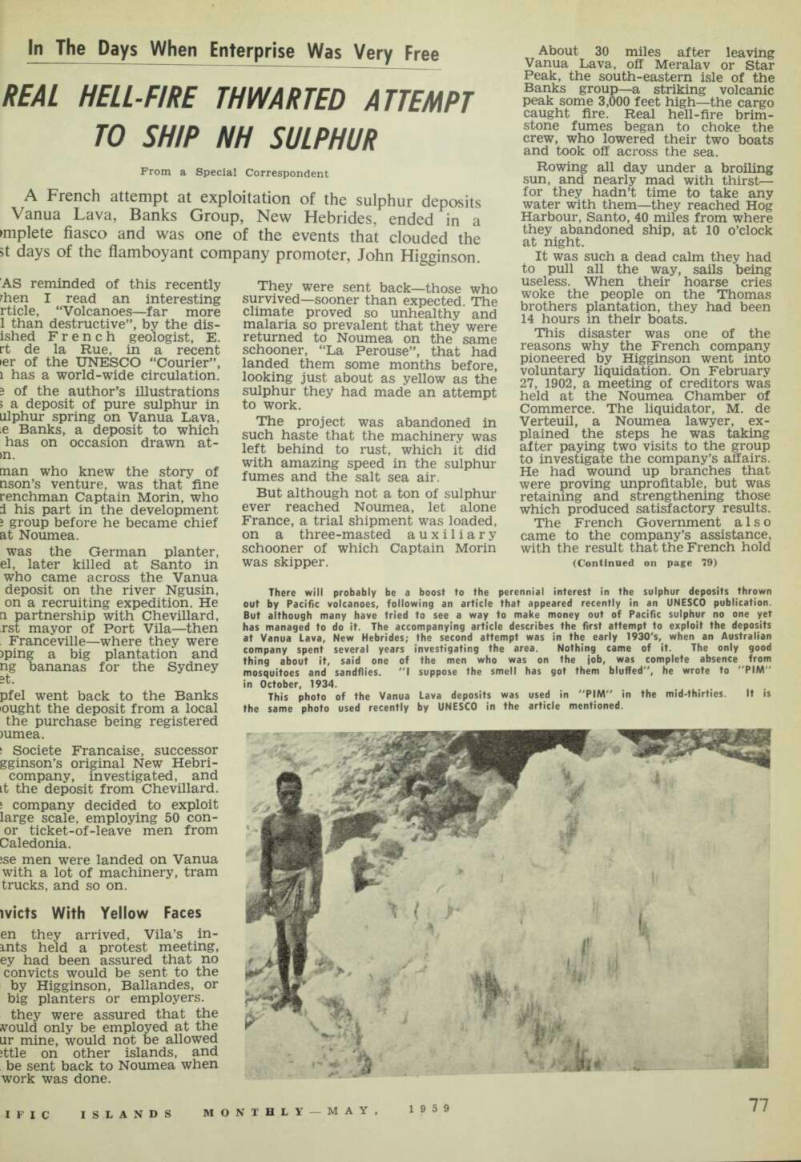
There will probably be a boost to the perennial interest in the sulphur deposits thrown out by Pacific volcanoes, following an article that appeared recently in an UNESCO publication.
But although many have tried to see a way to make money out of Pacific sulphur no one yet has managed to do it. The accompanying article describes the first attempt to exploit the deposits at Vanua Lava, New Hebrides; the second attempt was in the early 1930'S0, when an Australian company spent several years investigating the area. Nothing came of it. The only good thing about it, said one of the men who was on the job, was complete absence from mosquitoes and sandflies. "I suppose the smell has got them bluffed", he wrote to "PIM" in October, 1934.
This photo of the Vanua Lava deposits was used in "PIM" in the mid-thirties. It is the same photo used recently by UNESCO in the article mentioned.
the groups took the pattern ;h has continued ever since, iptain Morin was afterwards ter of the Societe Francaise ner France ; he did great service le December before World War rescuing two or three hundred ves from Ambrym when that id blew up—as recently de led in the pages of PIM.
The Non-Stop Roundabout
iis fine old marin was a great nteur; the lone navigator Alain Dault related in one of his books , during his stay in the Hebrides, ised to sit into the small hours ning to his stories, le story the old captain used to against himself was of another :o, a commercial venture in e, in the Loyalty Group, with first roundabout the islanders e had seen. The excitement was ise; the roundabout, set up in •ch grounds, ran non-stop so as it would go. But, unfor itely, arrangements to collect ey for the rides broke down; ng with delight the natives took imerable rides “for free”, as the ks say. le horses also had all their tails ;n. The venture, in fact, was ;ad loss.