[?] Non-Eating Week To
pp. 63-67 · Read in the full issue
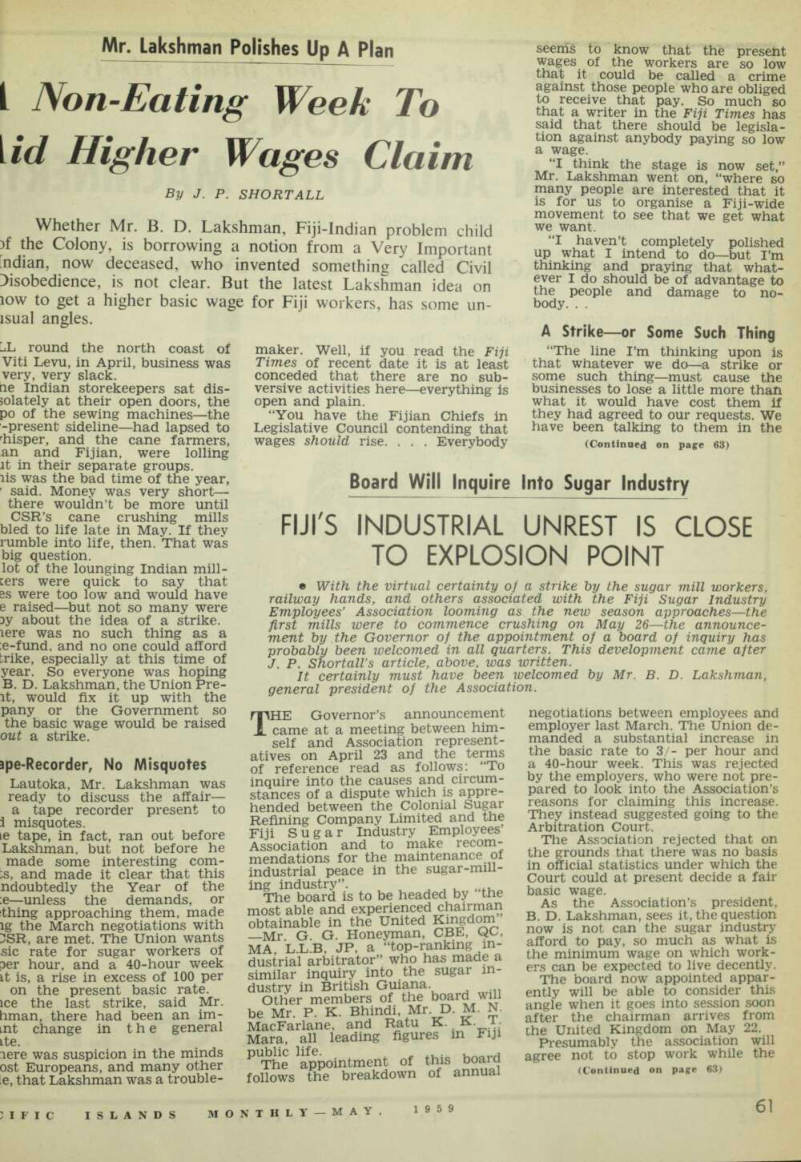
Mr. Lakshman Polishes Up Plan [?] Non-Eating Week To [?]id Higher Wages Claim
By J. P. Shortall
Whether Mr. B. D. Lakshman, Fiji-Indian problem child )f the Colony, is borrowing a notion from a Very Important Indian, now deceased, who invented something called Civil disobedience, is not clear. But the latest Lakshman idea on low to get a higher basic wage for Fiji workers, has some un isual angles.
LL round the north coast of Viti Levu, in April, business was very, very slack. ne Indian storekeepers sat dis solately at their open doors, the poof the sewing machines—the -present sideline—had lapsed to r hisper, and the cane farmers, an and Fijian, were lolling it in their separate groups, lis was the bad time of the year, r said. Money was very short— there wouldn’t be more until CSR’s cane crushing mills bled to life late in May. If they rumble into life, then. That was big question. lot of the lounging Indian mill ers were quick to say that ss were too low and would have e raised —but not so many were iy about the idea of a strike, lere was no such thing as a :e-fund. and no one could afford trike, especially at this time of year. So everyone was hoping B. D. Lakshman, the Union Pre it, would fix it up with the pany or the Government so the basic wage would be raised out a strike.
jpe-Recorder, No Misquotes
Lautoka, Mr. Lakshman was ready to discuss the affair — a tape recorder present to
i misquotes.
ie tape, in fact, ran out before Lakshman, but not before he made some interesting com :s, and made it clear that this ndoubtedly the Year of the :e—unless the demands, or thing approaching them, made ig the March negotiations with 3SR, are met. The Union wants sic rate for sugar workers of per hour, and a 40-hour week it is, a rise in excess of 100 per on the present basic rate, ice the last strike, said Mr. hman, there had been an im mt change in the general ite. lere was suspicion in the minds ost Europeans, and many other ;e, that Lakshman was a trouble
maker. Well, if you read the Fiji Times of recent date it is at least conceded that there are no sub versive activities here—everything is open and plain.
“You have the Fijian Chiefs in Legislative Council contending that wages should rise. . . . Everybody
seems to know that the preseht wages of the workers are so low that it could be called a crime against those people who are obliged to receive that pay. So much so that a writer in the Fiji Times has said that there should be legisla tion against anybody paying so low a wage.
“I think the stage is now set,”
Mr. Lakshman went on, “where so many people are interested that it is for us to organise a Fiji-wide movement to see that we get what we want.
“I haven’t completely polished up what I intend to do—but I’m thinking and praying that what ever I do should be of advantage to the people and damage to no body. . .
A Strike—or Some Such Thing “The line I’m thinking upon is that whatever we do —a strike or some such thing—must cause the businesses to lose a little more than what it would have cost them if they had agreed to our requests. We have been talking to them in the
(Continued on page 63)
id-table conference language, persuasion language which do not understand—or do not t to understand. Now we’re go to talk to them in the strike uage.” lere was a difficulty, of course, eded Mr. Lakshman: “The dif ty is in devising a method of ing such a strike. I reckon that iy line of thinking is all right have the sympathy of all the
Moderates. I think I’ll be able to recruit all parties—social workers, and even employers.
“When the times comes we might have to appeal to everyone like this: ‘For a whole week though you can afford to eat, and have meat in your refrigerator, you won’t have a cook to cook it. Go hungry’.
“There’ll be no violence of any kind—but we’ll appeal to His Ex cellency the Governor, and to his cook, not to give him the meals that he should eat. Let him go hungry for a whole week.
“We’ll ask the Judges in Fiji; we’ll ask all the employers; we’ll ask all the Churches to pray for the solution of this.
“We’ll ask the ships: ‘Please go back. We don’t want any guests because we’re not in normal times.’
“We’ll ask the aeroplanes not to land in Fiji because there’ll be nobody to attend to them—they must fly back, you see, for a whole week.”
Coolly and Calmly
MH.Lakshman wasn’t sure how the Government would react to all this—but he assured everyone, in
advance, that everything was going to be done “coolly and calmly” in the best traditions of non-violence.
Even more important, perhaps, is whether the Fiji work force would follow Mr. Lakshman into this odd kind of “leave-it-in-your-refrig erator-and-don’t-cook-it” strike.
He estimates that 10,000 workers on the Fiji North Coast would, any way, and a further 5,000 in the Suva area, if he gave the word.
A day or two after this interest ing discussion there was a report that the Governor was to meet rep resentatives of the Sugar Industry Employees’ Association and the CSR in the last days of April.
The outcome of that meeting was awaited with a great deal of in terest.
The Public Works Department employees were threatening to strike, too, for a higher basic wage.
Better Off In Gaol It was now not just a matter of the sugar industry but of every in dustry in the Colony, and Mr.
Lakshman was probably right in be lieving that a good many moderates, with no axe to grind, would support a rise in the basic wage, or at least feel that the present rate is too low.
What is the basis on which Mr.
Lakshman calculates a fair basic wage?
Reaching for the Labour Depart ment’s latest Annual Report, deal
with the cost of maintaining a mer in one of the Colony’s 3, Mr. Lakshman turned to a ■ which set out, item by item, cost per man of the various s issued to each prisoner, ing these figures, and working he basis of two children equal one adult, he showed what it i to feed an average Fiji family svo adults and five children, here you are,” he says. “You a family is better off in prison y than on the basic wage, even he government’s own figures.” hatever may be thought of Mr.
D. Lakshman, and however ;erous his activities may be rds the economy of Fiji, he i the impression of being firmly inced of the justice of his e. ist one other thing I ask you üblicise and about which PIM .s to have the wrong im ;ion,” was Mr. Lakshman’s ng shot, as I left, “put it on •and that I have never been paid ly life by any association or n, except travelling expenses.”