[?]erritorians Take
pp. 47-49 · Read in the full issue
Reactions [?]erritorians Take [?] look At Tax
In the last weeks in April, la-New Guinea residents were hinking about income tax, and )me of them, in their first re m, were saying (and some of i were): (, lt could have been a wrse” —you can write that down he fact that they’ve been too in an untaxed country. This le beginning of tax—not the Five years from now, Ter Ti ns won’t be so naive over tax. ? of them aren’t now. Here is oss-section of opinion, gleaned “PIM” staff member who was -NG in those first weeks: 3INESS in the Territory, bad n the last six months, now will »e worse. Here are the opinions isiness men: Port Moresby; "For months just been keeping going. People been buying necessities, and else. Property values are go lown. Houses worth £7,000 last now can’t be sold for £5,000.”
Lae: “Everybody is feeling it. dy can see it picking up. No buys houses any more. They them.”
Rabaul: "Some contractor 3rs are hard put to it. There ot enough work for some ied tradesmen. And that’s just ess generally. I can’t see any settling down until July, when 111 know the details of import xport duties. And then it might en worse for a time.” big Territory contracting firm i different view. Its manager "We don’t know about the ;, but there has been some big 7 spent lately by businesses g new buildings up before the as announced. I don’t know they think they will get out but they must have reasons.” (Over)
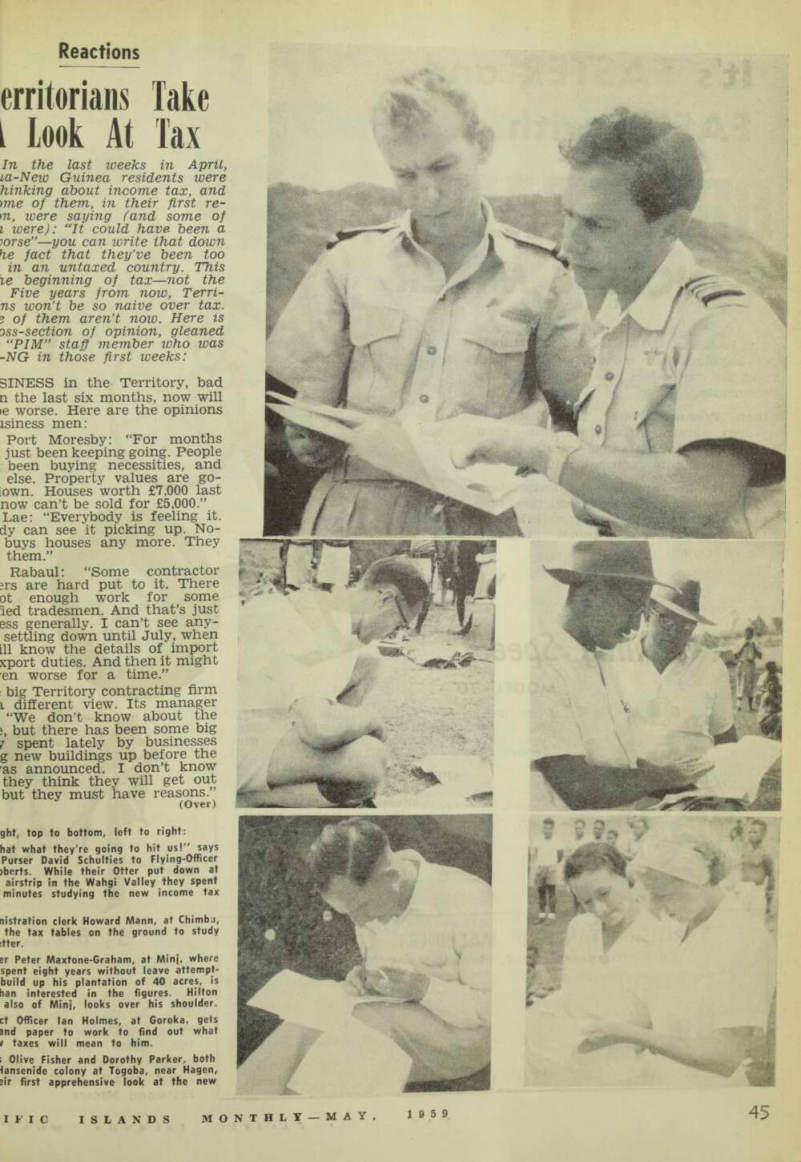
[?]ght, top to bottom, left to right: [?]hat what they're going to hit us!" says [?]Purser David Schulties to Flying-Officer [?]berts. While their Otter put down at [?]airstrip in the Wahgi Valley they spent minutes studying the new income tax
[?]nistration clerk Howard Mann, at Chimbu, the tax tables on the ground to study [?]itter.
[?]er Peter Maxtone-Graham, at Mini, where [?]spent eight years without leave attempt [?]build up his plantation of 40 acres, is [?]han interested in the figures. Hilton also of Minj, looks over his shoulder. [?]ct Officer lan Holmes, at Goroka, gets [?]and paper to work to find out what [?]taxes will mean to him. [?] Olive Fisher and Dorothy Parker, both [?]ansenide colony at Togoba, near Hagen, air first apprehensive look at the new
5 New Guinea planter, who has up his interests over many , has decided that he will ex no more.
feet on Private Enterprise
lave interests in Australia, and I look after them, and spend time there,” he said. “I have jutting all my money back into place, but it isn’t worth the ,ny more. jan get good returns for my 7 in Australia, without risk, safe country. is is a native country. We own it and we don’t know the bureaucrats will do with m one day to the next. We just seen that proved in the ative Council.
'iously, I’m not talking now jr the sake of talking. I mean ve finished expanding here, d this is the place I have up twice. I walked out of it Saturday morning when the :ame—l was ordered out. The nment didn’t care. We could starved then and our kids, too, . anybody cared. started from scratch again the war, and have just built again. I’ve finished, now.” it he said in his own words is the New Guinea Chamber of erce said in an official state a few days later: is clear that the purpose of Dmmonwealth Government is courage and slow up private rise in the Territory. Argu about the equity of the prin □f income tax serve only to attention from this main >e. . . . We maintain that the ;ed legislation reflects a short i, unimaginative view, in that nsors have failed to take into it the serious national and in ional dangers of deliberately raging private enterprise in jrritory.”
Wage Plug Doesn't Worry
the daily P-NG wage plug, ywhere, doesn’t always take consideration the future tiy of the country, or its long policies. There he certainly ts, with enthusiasm, the stand by the elected and nominated ;rs of the Legislative Council test at the methods followed oduce income tax. But in the still comes back to a matter ,t will it cost him. r studying the tax tables and g out his deductions he’s de hat Treasurer Reeve is some near the truth when he says x deductions are less than in Australia, although he agree with Mr. Reeve that
, Ancf 6 7 0nly 50 per cent< of those in Australia.
The cost of living in the Territorv is a lot higher, and the Territorial! spends money on a servant. He gets no deduction, although he regards a servant as a necessity, not a luxury The main deductions the in dividual taxpayer can make are a personal allowance of £286 (every tax payer is entitled to this, for the privilege of living in the Territory) * £230 for a wholly dependent wife; £l3O for each child under 16; medical expenses up to £150; life assurance and superannuation up to £3oo* education expenses up to £l5O, and medical and hospital fund contri butions in full.
Those who get education allow ances paid by the Administration for children at school in Australia will still be entitled to them.
The {Treat hndv of Territnrv wad-p £l,OOO and £1,500 a year.
A man on £1,400 with a wife arid two children would be left with £624 after deducting allowances for him self and them, and would pay £2l/16/- in tax. Presumably he dnrtinm: 6 t 0 additional de " ductions, too.
Most people in P-NG who look at those figures are fairly pleased fv-»of fv-ipv «rp e-pttine - off “so that they are getting on so ngntiy .
Some of the Traps!
But not all of them are assum ing that that Is the way it is always going to be—and how wise they are!
There are some things that are not clear yet—such as whether hous
sasrs
inflated “paper” figures (some Ad ministration people at present pav less than £1 a week for homes cost ing as much as £4,000); whether leave allowances earned in previous * eara > b V lt not y et taken, will be taxed when the man eventually takes his leave : and just what effect on mcornes the alterations to im- SoS}c?d Whe " announcea in June - This last is important. The Ad ministration has announced that there will be a “net reduction” in import duties, but nobody knows yet if that means a big reduction on P u tty knives and a big increase on items that will more closely affect the cost of living, Increases in import duties could be passed on to the consumer. So could other charges that business houses will be forced to bear be cause of company tax, such as additional costs of handling the vast paper work that will be involved in aII the new tax procedures.
For all practical purposes no price
machinery
SSoS o?i
to^controf somethingsucliasbread
T h e?eicould b£ T Period of fluctuat-’
S nSS? in the next twe^ve
months, bringing headaches to the wage pl ’ ug . ~. , , . , there is one more hard fact which may yet turn out to be more than Mr ReeV e’s “50 per cent, of the Commonwealth «main at „p y P e hl ,c introri Ternto y s next bud £ et 18 introduced.
Income tax rates are surely made to be increased.