[?]Amoa Prepares Uneasily
pp. 39-41 · Read in the full issue

After the Party, Second Thoughts
For 1960
From Our Correspondents in Western Samoa.
The talking and the magnificent feasting are over; the scial Mission from UN Trusteeship Council (which came here discuss the plan for giving Western Samoa complete self /ernment) departed on April 16; and now all classes are itemplating a little grimly and uncomfortably the socio [ideal picture that has emerged.
it appears, just around the corner. But I the talk —and especially the Tank discussions which have place between the chief men UN Mission, and the Samoan s—have induced the more in nt members of each com y here to ask themselves: ow much better off are we go ig to be as an independent ttle nation of 100,000 people? i it possible that this political eedom which we now are romised is surrounded by ;onomic traps? the last few years, Western t has been hurried towards >vernment in a remarkable Samoans, a proud section of ilynesian race, envious perhaps ependent Tonga (their next leighbour), always had been for self-government. But, in 890, their internecine wars them into the arms of Ger :olonialism. r World War I, and the Mau on, self-government seemed way off. . . ienly, after World War 11, ealand began actively to pro the idea of self-government.
The UNO people, and anti-colonial ists, and visionaries generally, applauded warmly. They planned that Western Samoa would appear before the gratified Western world as the first Trust Territory in the Pacific Islands to achieve self-gov ernment. What a feather in the cap of UN Trusteeship!
Self-Government in a Hurry
With NZ’s cordial co-operation, the Samoans since 1953 have taken more and more self-government.
In 1957, elections were held for a greatly enlarged Legislative As sembly; the Executive Council was also reconstituted and enlarged; the old Fono of Faipule (Samoan Par liament) was abolished; a Council of Ministers—each responsible for some aspect of Government —was established; a Speaker was appointed to preside over the Legislative As sembly and the functions of the High Commissioner were redefined.
This was a trial or temporary set up. Self-government, said NZ com fortingly, might be expected in 1960.
The first signs of political discom fort appeared in 1958. The Samoans found the paraphernalia of self government very pleasant to the taste—but it all cost a lot of money.
Where were funds to come from.
The New Zealanders were bland and friendly. Samoa had rich re sources, the Samoans must pro mote industry—increased industry would provide funds.
Some Samoans began to look rather wildly into the future. Euro pean and Part-European property owners began to liquidate certain assets, and funds began to trickle quietly away to Fiji, New Zealand and Australia.
But the march towards self-gov ernment went on.
UN Trusteeship Council appointed a Mission to go to Samoa and give the plan its final shape—Mr. Arthur Lall, an able Indian statesman; Sir Andrew Cohen, a wise Englishman, who got his experience in the Colonial Office; Mr. Loutfi, of the very new United Arab Republic; and M. Kosciusko Morizet, an ex perienced French official, whose term in Trusteeship Council did not destroy his natural commonsense.
Problems for the Samoans
The Mission has just completed three weeks in Samoa, and departed.
It did its job well and conscienti ously. It brought the Samoans right down to hard earth.
It left behind a clear-cut pro cedure and plan for the establish ment of self-government. But it has left also, with the Samoans, a new appreciation of the fact that self government cannot function unless it is solvent, and solvency means an income to meet expenditure, and an income has to be earned.
Here are the matters which the Mission has left with the Samoans, to be dealt with in a practical way before the final move towards self government is taken:
All Samoans Must Vote For It
It it provided in the UN Charter that, before self-government is granted, the wishes of the people must be ascertained, “by plebiscite”.
The Mission said this meant a referen dum, of individual Samoans. The Samoans argued strongly for a vote by the Matais (heads of family groups) in accordance with Samoan custom and tradition.
The Mission insisted on a referendum in which all persons over 21 would vote; and this was finally agreed to; and the Apia government must now arrange to take the referendum accordingly.
A New Constitution
The Samoans must draft (for submis sion to the people so as to ascertain their wish by popular vote) a Constitution under which the new Samoa will be governed, either as an independent State, or in association by Treaty with some other State.
Relations With New Zealand
The Samoans, at this stage, must de fine what they wish to be the future relationship between New Zealand and the new State.
Heads Of New State
The Samoans must decide on who is to be the head of the new State, and how he is to be selected and maintained. Some thing of this, presumably, is to be written into the Constitution.
The Economic Problem
The numerous problems associated with the financing of the new State were dis
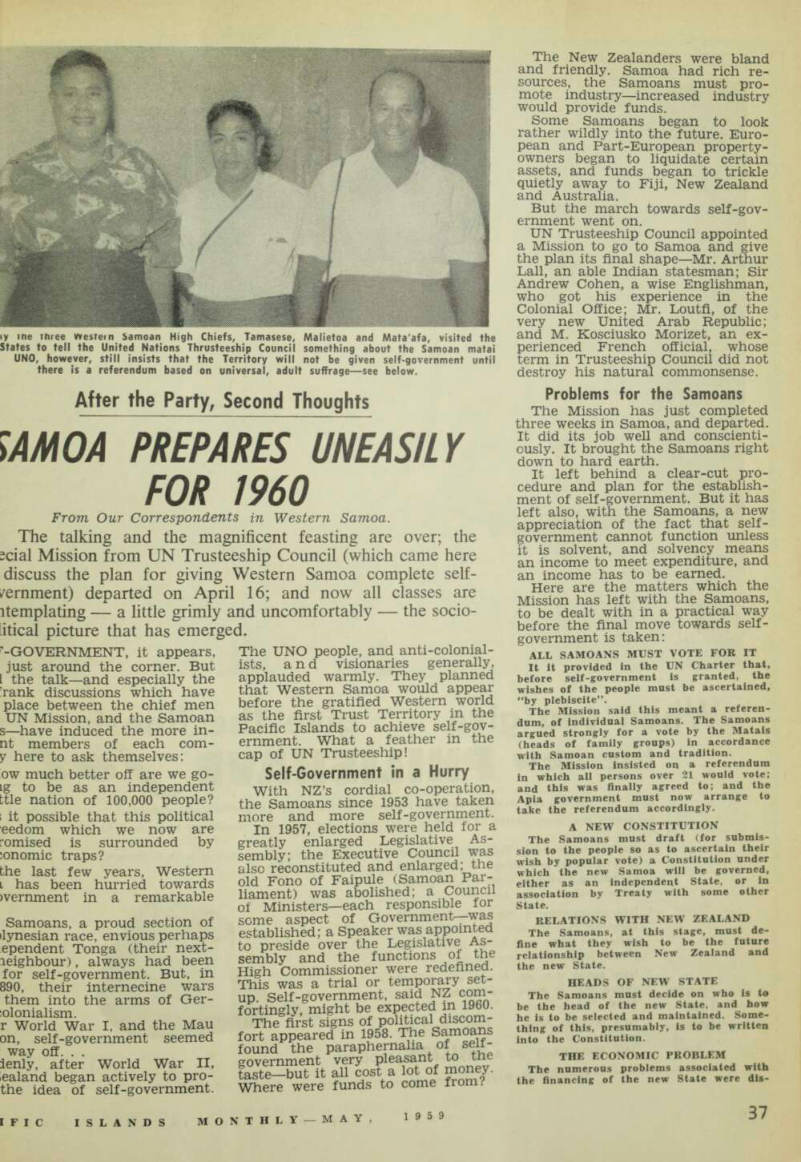
`[?]y me three western Samoan High Chiefs, Tamasese, Malietoa and Mata'afa, visited the [?]States to tell the United Nations Thrusteeship Council something about the Samoan matai UNO, however, still insists that the Territory will not be given self-government until there is a referendum based on universal, adult suffrage—see below.
at length between Mission and in leaders. A definite plan for the must be produced, before UN will ?e the new State.
The Public Service
Mission also discussed the numerous ms associated with the wish of the ms to provide their own trained men e public service, especially profes practitioners and technicians. There je practical planning by the Samoans ard to this matter also.
Justice For Minorities
oans must decide now—so that it be written into the Constitution— the system to be adopted to protect operty rights and the personal free f minorities. This necessarily entails r definition of the qualifications and of citizenship.
Another Look at NZ
e practical, down-to-earth Ing of Mr. Lall and Sir Andrew n has been an immense help to Samoans. The latter realise, that self-government means work and sacrifices, is no exaggeration to say that lamoans now are looking very jhtfully at New Zealand—and different light. ce World War I, there have many Samoans who regarded Zealand as the hated con ir. the white boss, the exploiter ieir wealth. Now they are be ng to see it a little differently, v they begin to understand New Zealand has shown such igness to help them to self- Timent. so many words, New Zealand jh has acute financial problems i own) would be very glad to be if the Trusteeship of Western >a. into which she has poured ia t deal of money since 1921.
Falealili Is Forthright
e chief men of Falealili an rtant community on the south of Upolu) told the Mission frankly that they were opposed ‘lf-government and independ at this stage—they thought should remain in the care of or another seven or 10 years, they had men who knew how n the country. i residents point out, with In b, that the Falealili people, back le ’Twenties, flatly refused to ssociated in any way with the NZ Mau movement, appears that an increasing )er of more thoughtful Samoans wondering whether that 1960 for self-government is not too in view of the immense mt to be done before self-gov icnt can hope to function suc ully. appears, also, that members of Mission are thinking somewhat ; the same lines, can be assumed, from state rs made by Mr. Lall in his final ;hes, that when the petition of
the Samoans for self-government finally reaches the United Nations Assembly, the whole plan will be carefully scrutinised against the background of Samoa’s peculiar dif ficulties, as presented by the report of the Mission.
There is no doubt that the Mission had noted some of the wild and woolly statements by Tualauleilei and certain Malietoa supporters, of what they hoped to do when they got independence.
The United Nations people almost certainly will demand, in the new Constitution, safeguards over the personal and property rights of cer tain classes who are entitled, by birth and residence, to Samoan citizenship.
They March On!
However, nothing now will stop the movement. There will be a referendum in which all Samoans over 21 will vote, and it will be overwhelmingly for self-government.
The United Nations will have a long and tedious session over the new Constitution.
The real struggle will come when the various interests try to draft the inevitable “Treaty of Friend ship” with New Zealand.
Western Samoa, virtually since 1914 (45 years) has been kept going with New Zealand money. The Samoans, naturally, will want to go along as an “independent State”, with its hand still in NZ’s pocket.
There is also the question of a market for Samoa’s products.
Bananas, for example, worth about £1,000,000 per annum, can be sold only to New Zealand. New Zealand can buy them also from Cook Islands, Tonga or Fiji. If New Zea land, under a Treaty of Friendship, is going to supply Samoa with loans and other services, and buy her bananas, what will Samoa give New Zealand in return?
The prophecy of one experienced observer here is: (a) Having been swung into this movement by vociferous politicians and self-seekers, the Samoans now cannot draw back, and will go on to seek self-government and independ ence in 1960, as promised. (b) They will have great trouble in obtaining either funds or tra:ined nersonnel, to enable them to live in accordance with the style tp which they have been accustomed . (c) Unless they show an un exnected genius for industry and development, they must experience pponomic retrogression under tne new conditions g with a correspond ing fall in the standard of living. (d) This in turn will .lead to
political unrest and recriminations^
Samoa at any time could split into factions led by Malietoa, Mataate and Tamasese, and the rajtag an bobtail behind Tualauleilei.
It would not be at all surprising