Aust'n Income Tax System
pp. 22-149 · Read in the full issue
The End of An Era Aust'n Income Tax System Extended To New Guinea
Residents of Papua and New Guinea now have some idea of what faces them. The new taxation Bills came before the Legislative Council on April 20. No important amendment is likely. They will be finally passed by the official majority in Legco in June.
All taxation of exports ends on June 30. There will be “substantial” reduction in import duties as from July I—but no details will be published until the end of June.
TAXATION of the incomes of persons and corporations in Papua and New Guinea will commence on July 1, 1959.
Except that the rates will not be so high, the system will be practically the same as that em ployed in Australia. No classes are exempt—income tax will be paid by public servants, missionaries, and natives (assuming the latter have incomes of taxable size). The head tax, £2 per annum, introduced last year, will be deducted from income tax payable. [Commercial enter prises of Missions are apparently tax exempt. See page 135.] The more oppressive features of Australian companies’ income taxa tion will be applied in P-NG, namely— • Double taxation (the company’s profit is taxed, and then the share
holder’s dividend is taxed again, as part of his income). • Any balance remaining in the hands of private companies after dividends are paid and a small retention allowance is provided for, will be subjected to an “undistributed profits” tax of 10/- in the £.
Two regulations new to Australia are introduced. Any company with fewer than 20 members may be classified as a private company: and all individual traders and companies—as well as individuals — must pay provisional tax. In the first taxation year (1959-60) the persons and corporations concerned will make a declaration setting out what they consider their income to be, and they will pay provisional tax on that; and such payments will be adjusted to their assessments at the end of the tax year; and there-
after their provisional tax will hs to be paid at the rate disclosed. their first year’s taxation return: As in Australia, employers w be compelled to collect pay-as-yo go tax from employees, issue t stamps or group certificates them, and then regularly remit t taxes so collected to the Admij stration.
At the end of the first yr (June 30, 1960) all income earm must send in a taxation retm with stamps or certificate showr what they have paid in provision tax; and then they will either n a bit more, or get a refund, s cording to the tax collector’s asses ment.
The new Taxation Bill conta;j 182 quarto pages, and 360 sectioc and it seems to provide for eve conceivable contingency. F example— “ Native bodies” are exempt fr< income tax which apparent means that native co-operatj societies will not be taxed.
There is an elaborate set of rut covering the activities of companr dealing in insurance, and the pa ment of interest by companies persons overseas.
Overseas Shipping Slugged
Where overseas-owned ships tras in the Territory, five per cent, the revenues they earn in the Ten tory is to be regarded as taxab income; and the responsibility 1 putting in the return and payii the money is on the master of tt ship.
Where businesses operating in t
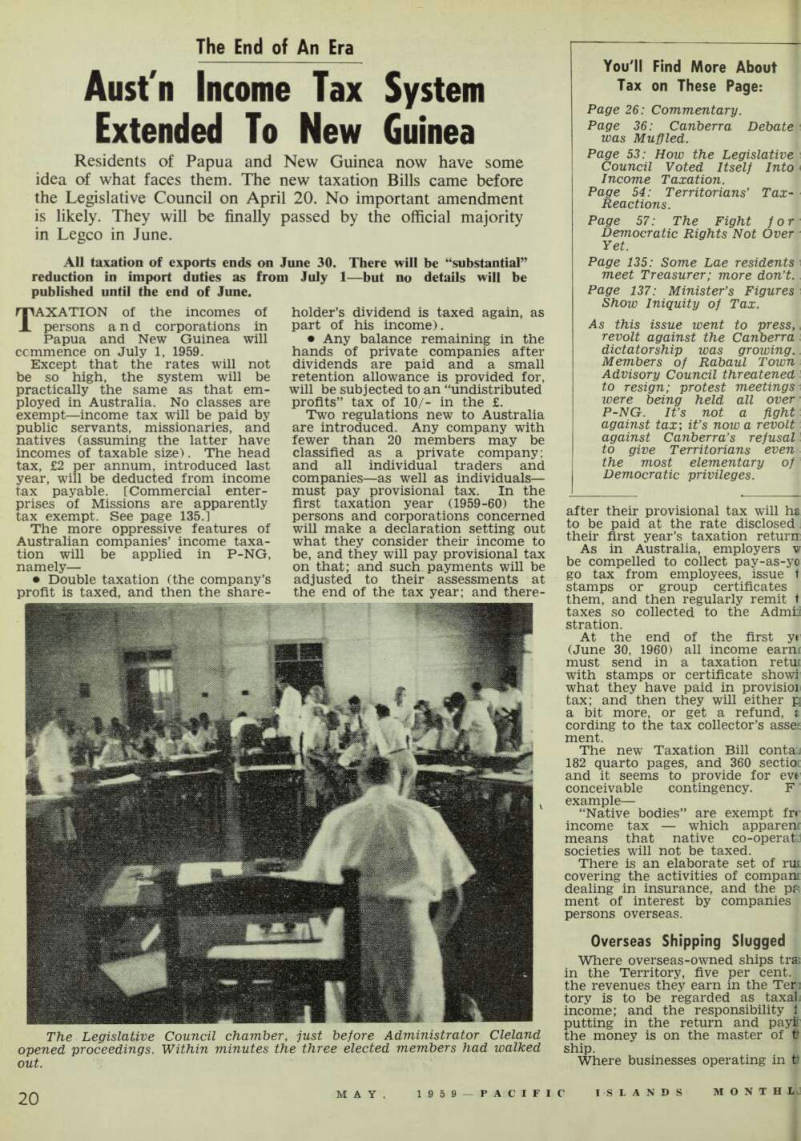
The Legislative Council chamber, just before Administrator Cleland opened proceedings. Within minutes the three elected members had walked out.
■itory are owned by persons seas, and in the opinion of the collector the business is not iucing a sufficient taxable in e, he can arbitrarily demand me tax on what he considers litable proportion of the total ipts. in Australia, no person after 1 will be allowed to leave Territory unless he or she has ncome tax “clearance”.
I persons carrying on business to keep sufficient records in the ish language to enable the Tax sctor to assess his income and ax.
I companies are to pay taxation Drofits at the rate of 4/- in lich is about two-thirds of Aus m rate. e rates of tax to be paid by iduals, compared with rates in ralia, can be shown by taking case of a taxpayer, with wife
factions allowed are: Personal, £286; £230; child, £130; student child, medical expenses, up to £150; in es, etc., up to £300; education ex up to £150; medical and hospital full.
Call for Tax Experts
npany tax is going to change of things in Papua and New ?a when it starts in July. Not east of them are the book ing habits of hundreds of small esses. h no income tax operating in
(Continued on page 146)
d After In In e deductions*
P-Ng
Australia £ £ £ 84 nil 184 2 284 4 484 14 80 684 26 884 43 1,084 63 1,284 85 1,484 110 330 1,884 167 i 2,284 234 2.484 271 695 4,484 721 1,627
the past, and thus no need to ke« complete sets of books, many sim businesses have been running om pay - the - rent - and - keep - the rest basis, without really knowiii where the money comes from whence it goes.
But now the income tax mi. will want to know. And he w want to know it all in English.
That is going to be a particuli shock to New Guinea’s Chin© traders, many of whom have new taken stock, and wouldn’t kno what their assets were, anyway.
Said a Rabaul businessman t) day the tax details were announce* “If you’ve got any friends Sou'i who have done even three wee of schooling or added up penn£ on a paper run, then tell ’em come up here. They’ll make for tunes as bookkeepers and clerh around this town”.
But, of course, there are plem of clerks and would-be accoujj tants in the Territory who hat already seen the writing on tl wall.
And there is more than a sprint) ing of qualified people who will s up shop as registered tax agenn after July 1. Many accountant
nesses in the Territory are ady making arrangements to die this extra work. doming Flood of Paper Work tie small people in the back ks, away from the towns, are g to be the worst hit. lese people run on a shoestring operate their businesses them es—using a minimum of book- They handle enough invoices et by with—and that’s all. le additional paper work that tax will enforce will eat into time they are already using to the more practical side of their ness. Many would be unable ay for clerks, even if they could them.
Highlands planter of long ex mce said, “What has been otten is that you can’t have lations demanding literacy in iliterate community, without a of people being disorganised.
Government demands the ir work but doesn’t say how it ) be done in a country where ve clerks are still a novelty”. g businesses won’t have the 3 problems. ley will be able to get the i people to handle the big ;ase in paper work because can afford to bring them from ralia. And these firms, of se, already operate adequate keeping systems. it the pay-as-you-go system as to them extra expenditure taff to do the job the Income Department itself should be g, but doesn’t—that is, the al collection of the taxes.