[?]y Know Where They're Going
pp. 19-20 · Read in the full issue
"Advice Only" From Europeans
[?]th Pacific Natives Think [?]y Know Where They're Going
From STUART INDER, in Rabaul.
What has been going on here at the Fourth South Pacific nference in the last week has proved, finally, that whatever >ht happen to the South Pacific Commission itself whether changes its name or changes its activities one day these stings of native peoples will have to continue.
ODY expected that this urth South Pacific Confer ee would fail, but I doubt if ly realised just how successful Id be. he man on the movies says, ing down the heroine’s neck, fight this, baby! This is than both of us!” first conference in 1950 I something of the promise as ahead, but the conference rrounded by politics, publicity fimmicks, and the native > for whom the show was were hardly aware of what all about. second conference, in 1953, i the indigenes to feel their rough some of the European ces that were directing them; 1956, with a new system of :tees operating, they were be ; to take over completely, and it out, correctly and without assment, that the Europeans erhaps attempting to influ lings more than they should, at they really ought to pull eads in, here in Rabaul at this Conference the Europeans ailed their heads in. And the int fact is that the indigenes Ives have largely been re le for seeing that they have
I Fellows Who Shove Off
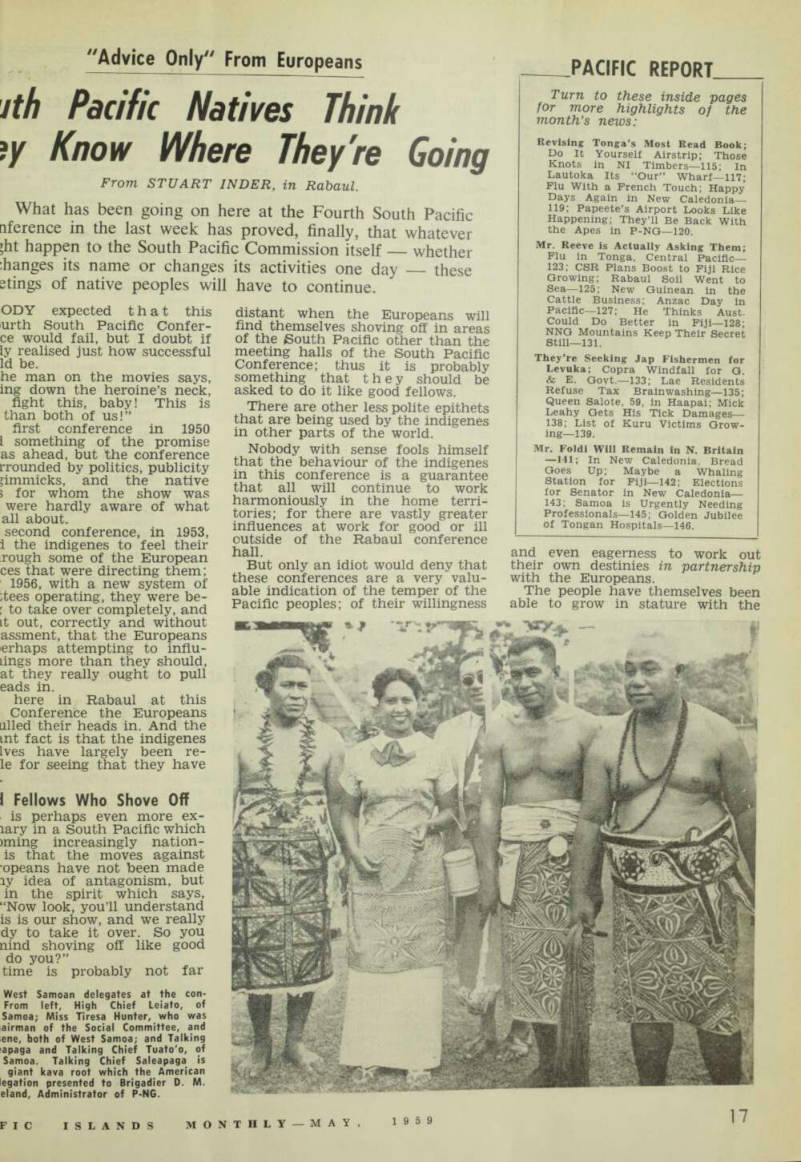
is perhaps even more ex lary in a South Pacific which >ming increasingly nation is that the moves against ■opeans have not been made ly idea of antagonism, but in the spirit which says, “Now look, you’ll understand is is our show, and we really dy to take it over. So you nind shoving off like good do you?” time is probably not far West Samoan delegates at the con- From left. High Chief Leiato, of Samoa; Miss Tiresa Hunter, who was airman of the Social Committee, and ene, both of West Samoa; and Talking apaga and Talking Chief Tuato'o, of Samoa. Talking Chief Saleapaga is giant kava root which the American egation presented to Brigadier D. M. eland. Administrator of P-NG.
distant when the Europeans will find themselves shoving off in areas of the South Pacific other than the meeting halls of the South Pacific Conference; thus it is probably something that they should be asked to do it like good fellows.
There are other less polite epithets that are being used by the indigenes in other parts of the world.
Nobody with sense fools himself that the behaviour of the indigenes in this conference is a guarantee that all will continue to work harmoniously in the home terri tories; for there are vastly greater influences at work for good or ill outside of the Rabaul conference hall.
But only an idiot would deny that these conferences are a very valu able indication of the temper of the Pacific peoples; of their willingness
and even eagerness to work out their own destinies in partnership with the Europeans.
The people have themselves been able to grow in stature with the
conferences, just as the stature of the conferences has grown; and any European who fails to take the hint deserves what is coming to him.
None of this is to decry the efforts of those Europeans who have helped to make this conference a success.
At the same time, it is most notice able that the most successful Euro peans have been those with the clos e s t connections with the indigenes.
One example is Mr. J. K.
McCarthy, adviser to the P-NG delegation, who has been so long in the Territory in connection with native affairs that, like Viri Voko tini (alias Scotsman Willie Watson, of the Cook Islands) he would probably win an election on the native vote, if he—or they—were ever given the chance.
The P-NG delegation has leaned heavily on McCarthy for support— but for support only of decisions they have themselves wanted to make. This is the kind of partner ship that is so vital to the future.
Criticism of Fiji Delegation
On the other hand, it would have been better if Mr. H. B. Gibson, leader of the three-man Fiji delega tion, had not come. This is not to decry the efforts of Mr. Gibson, whose period of time in Fiji is almost as long as that of Mr.
McCarthy in New Guinea.
But the Fijians and Indians are quite capable of presenting Fiji’s views at these conferences, which are not political, and if a European had to come then he could have come, like McCarthy, in the role of
adviser, and done his pushing from the rear.
Many conference delegates gained the impression that Fiji had picked its three delegates, a European, an Indian and a Fijian, all MLC’s, merely so they could watch each other—which is hardly in the spirit of the conference.
As it was, Dr. Sahu Khan and Semesa Siki You did a creditable job—the Fijian being elected Deputy Chairman of the Social Committee —but Mr. Gibson got himself in volved in something that turned out to be too big for him. And this was all because, being a European, he should not have made himself so prominent, but stayed in the background.
Mr. Gibson got himself elected as Chairman of the Economics Com mittee —despite some rather audible suggestions by the indigenes them selves, before the election, that an indigene would be the best man for the job.
There was also some confusion about who was who, and who was entitled to vote.
The result was that a full day of the conference’s time was wasted before the indigenes were able to muster their forces and work out a set of tactics that cleverly dis posed of Mr. Gibson.
But they did it, be it noted, with the kind of incomparable Polynesian charm and courtesy that saved everybody’s face, including that of their European protagonist.
Can anybody seriously doubt that the South Pacific peoples know where they are going, and that the South Pacific Conferences have pointed the way?
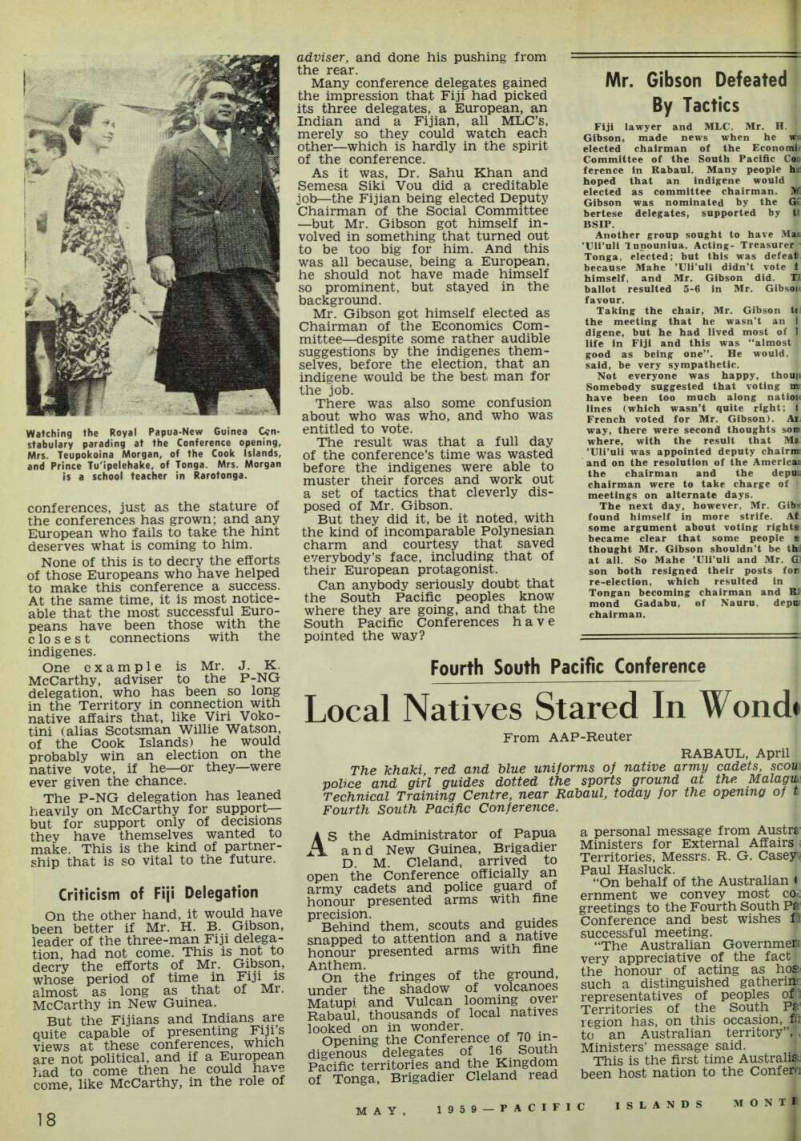
Watching the Royal Papua-New Guinea Con stabulary parading at the Conference opening, Mrs. Teupokoina Morgan, of the Cook Islands, and Prince Tu'ipelehake, of Tonga. Mrs. Morgan is a school teacher in Rarotonga.