Pacific Shipping And Cruising Yachts
pp. 103-115 · Read in the full issue
From the often tedious columns of the weekly Admiralty i>tices, a few recent random items in the dead-pan language the Lords Commissioners give little indication of the big )ries behind them.
! such notice; “Possible missile Dsecone sighted approx. 30 41 133 57 W . . . Object stainless iminium extended 3 to 4 ft and 10 ft below surface. Re vessels recover with caution, sighting to COMWESTSEA -gain; “Ocean Station ROMEO 172 W will be disestablished I Feb.” > was one of the weather re g and radar ships established g international oceanic air in post-war years. Again; iioactivity danger no longer ;s at the following atolls:
lap. . .Rongerik.. .Ailinginae.”
ill also be comforting for some )w that, thanks to the work h vessels as HMS Cook and IS Lachlan, a reef shown of Llhir Island off New Ire ;an be “expunged” from the as can some discoloured southeast of the Gleaner Reef iga waters. New charts of cer orts and anchorages in New i and the Solomons will also e on sale.
Dlomons And Hawaii
Her Broadcasts: To Our
i general summary of voice !r broadcasts of interest to s of small ships and yachts in Islands waters, last pub
lished in October, may be added two new items.
The Solomon Islands Broadcast ing Service is broadcasting an ocean forecast for that area at 0935 GMT (except Sunday) immediately fol lowing the BBC and local news. This station is now audible over a wide area of the Pacific with its increased power on 5960 kc-s. There is also a transmitter on 1030 kc/s in the broadcast band.
Of particular interest to yachts heading for Hawaii, the establish ment of a voice broadcast of navi gational warnings by the Coast guard station NMO, Honolulu, at 0600 and 1800 GMT on 2686 kc/s.
• Queen On The Coral: The
ESIP Government’s new 200-ton Coial Queen had her first bite at the coral at the height of the Royal Visit to the Solomons when she was acting as a vital unit of the official communications system.
Loaded with the official jeeps and with government officials, photo graphers, and a party of police, Coral Queen was approaching Auki, Malaita, early on March 20 when she grounded on a reef at 5.55 a.m., almost within cooee of the Royal Yacht.
The Symes vessel Ambon, the Cape Torrens, and smaller craft were soon on the scene, however,
and Cape Torrens took off the passengers. Britannia was advised ? lsha P and the Royal Yacht’s navigator, Commander P. e. C Burgess and another officer, soon a J£ ved m a launch to render ser vice‘ was decided that, if neces- S H the Roya l Yacht would be em ployed as a tug, but this was not necessary. With the aid of Ambon and own engines Coral Queen a £ 0 am * and arrived at Auki at 1.20 p.m., where the landed 1611 * aboard was immediately An examination of the hull by a diver and a shipwright from Britannia revealed no serious dam age, and Coral Queen returned to Honmra acconiing to plan at the end of the day’s celebrations.
• Danger Still Lurks'
Danger from unexploded mines and depth charges still exists in many Pacific coastal areas. Current Notices to Mariners list danger aieas near Port Moresby, Kavieng the north and south of Bougain ville, Shortland Island, south-east coast of Malaita, four points along the south-west coast of New Caledonia, including the approaches to Noumea, four points round Lspintu Santo, Undine Bay on Elate Island, six areas round Viti Levu and two points north and scuth of Vanua Levu, Funafuti, and the approaches to Nukualofa. There are unexplored depth charges in Milne Bay, Blanche Bay, and Gazelle Harbour in the New Guinea area.
• Change Of Hardware;
Though H-bombs are out of season in the Marshall Islands just now Washington announced on March 15 that a base for the testing of “antimissile missiles” will soon be built at Kwajalein. NIKE and
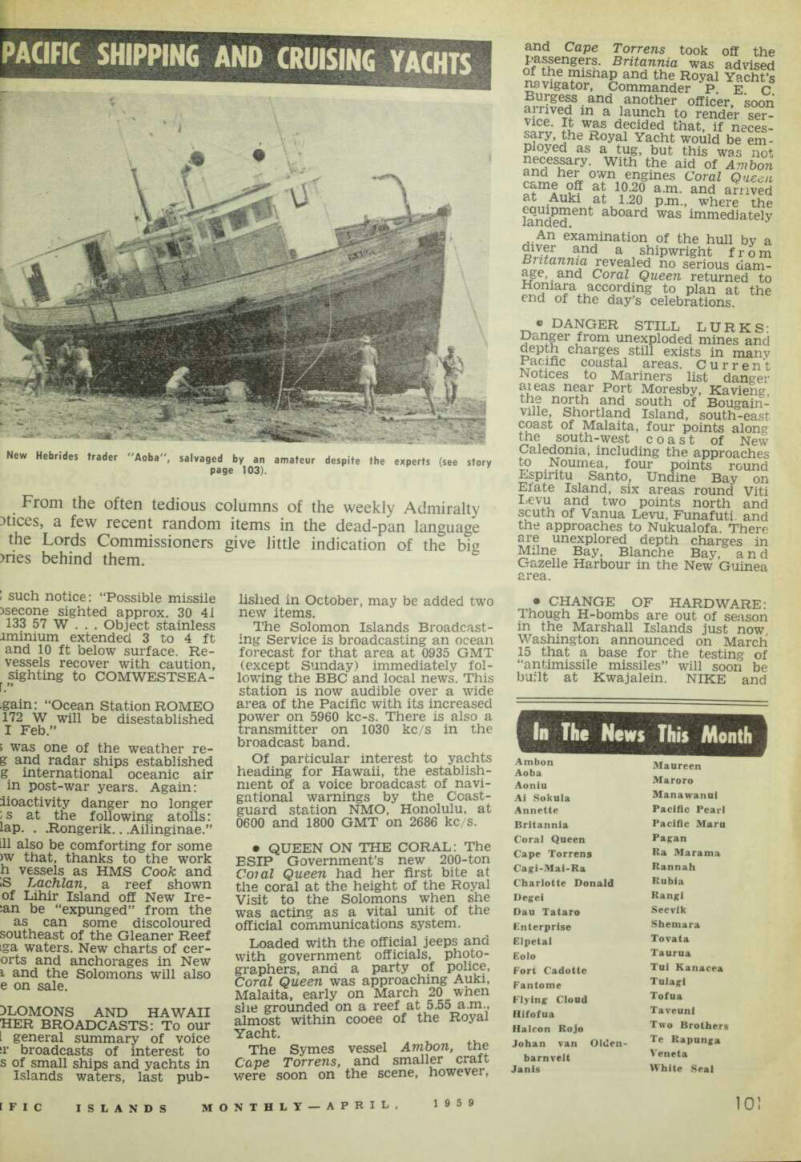
New Hebrides trader "Aoba", salvaged by an amateur despite the experts (see story page 103).
CUS missiles will be among those sted. The “fallout” from these, in b form of stray missiles, or portions same, will add to the interest of vigation in that general area jm time to time. • A BETTER ’OLE: American ;entists interested in the make-up the earth’s core and crust, are mning to drill a three-mile hole the sea-bottom somewhere near ji—presumably in very deep water, there would appear to be no vantage in performing the opera n at sea otherwise.
Dil wells drilled at sea in com ritively shallow water are no velty, but if this operation in- Ives a really deep ocean area it emises to be an event of more m usual interest. The problem of >oring the drilling vessel, or at ,st of keeping the drill in a rti c a 1 position whatever the ather ai the surface, seems for dable.
• Operation “Ferry”: The
it of the Duke of Edinburgh to ; Solomons in March was the asion of a major passenger trans rt operation by the local fleet of all ships. Large numbers of Dple were ferried to the ports call of the Royal Yacht Britannia >m outports. Special regulations /erning the movements of these >sels at ports during the stay of J Royal Yacht were posted, and were asked to be “dressed over ” for the occasion. A harbour lice patrol operated at Honiara ring the visit.
> He Showed Them How:
d faces, and perhaps even some om, accompanied a recent salvage jnt in the New Hebrides.
Some months ago Comptoirs mcais des Nouvelles Hebrides all wooden motor vessel Aoba nt ashore in the Banks Group, s surveyed there by the experts she lay on the reef, and classed a total loss, though some )ught otherwise. rhe owners or underwriters there on offered £5,000 for delivery of ; damaged vessel to Santo. “Fair ?ugh” thought Mr. Paul Coulon, Santo mechanic, who’d never dertaken a salvage job in his life, he headed for the Banks with ne labourers. The experts smiled, some little while later, Aoba was served to be entering port under : own power after a 200-mile <age from the place where she :l become a total loss. Next pro incement from the experts, after study of the hull, was that the it of recommissioning would )bably run to about £12,000. [Tiis is considered uneconomic 1 Aoba is now for sale. All the ;sent smiling is being done by chanic Coulon, who has his cheque £5,000 and can always be con ted for other similar jobs. Nice rk, when you can get it, he nks.
FRo Rmg
nrvt * 9P e . ratlon of the nf'Sv,™ f f IS the ? ource of plenty of sharp criticism at present.
One correspondent writes: “We have
rate hot Tis S
thfm nea “ y £2 P er ton higher ,7“ oeiore.
New Guinea planters were reccntly howling in PIM about freight rates on copra to England. Tell them to relax; we pay £l7 to Europe— and the opening of copra bags dur-
bulk loadin S is done in such a way and with such poor supervision of labour, that planters lose 40 per cent, of their bags ”
*B?' Sss
Guinea. Another caused a lot of legal work in Darwin. In January, we mentioned the New Zealand coaster Holmdale, which had be come Pacific Pearl and was seized in Japan at about the time of the Rose Pearl incidents in Darwin.
cific Pearl, sold by court order, Tie Pacific Maru. We now learn Pacific Maru is to be the base for marine salvage operations i carried out by a joint Aus ,n-Japanese company at Aitape, ak, and Kavieng. ading the Australian side of war-wreck salvage group is ain J. E, Johnstone, who ged the gold from Niagara, by German mines off New nd in World War 11, and other ic salvage operations. The New sa job may take four years to lete. The same group is saJvag sunken vessels from Darwin iur.
►Omething Old, Some-
G NEW: Ships were news in u February-March, with some ale, some sold, and some on or entering service. Most in ing item in the retiring group T ovata, ex Purple Sea, ex SC ,s famous in her way as Kon ind the other raft drifters. A 9f ocean current charts would little basis for a drift vovage a point 250 miles south of ulu to Fiji, such as that made maid Ernest Johnson in this laser in the last months of and early 1948, and told at length in the PIM at those and p, 107 this issue, t 1942, and much altered since rival in Fiji waters under tow British freighter Fort Cadotte had picked her up off the srn Lau, she has now been 5d unfit for further service by mens, Island Transport Ltd.— ildiary of W. R. Carpenter & d. She is to be stripped and ill offered for sale or scuttled, vessel, which set off from xlu with SC-671 in tow—an :al type of craft—is still in in French Polynesia as i. Fort Cadotte has either old and renamed, or broken she no longer sails the seas that name. sale at Suva is the 29-year -3-ton auxiliary cutter' Tui ea, which went ashore on Reef in February but got Suva. This vessel was origin lilt by Marlows in Suva but trgely rebuilt by Millers in and is owned by Morris om Ltd.
C. J. Anderson, of Victoria, to have got a bargain at 1 m the 20-year-old Fiji Gov it vessel Degei, 205 tons gross, le i 1 ? 8 . Purchased as a mother r fishing operations off Bris- Jovernment is being criticised y quarters in Fiji for having is vessel at this low price, reliable old “workhorse” for fD for many years was re id lay idle at Suva after the of the new Degei II from mg in November last year.
Degei was built at Suva in
1939 and launched in 1940. The steel was punched out in the United Kingdom and sent to Fiji.
All Fiji timbers were used in the
construction, including first-class
Kauri m her hull, which is still as good as when she was built r^'S ie i i )e i?So Und ! rwent an extensive refit m 1949 and was out of com ??« S nn 0 n n f fO K months She cost £lB,OOO to build in 1939.
She is powered by twin Gardner diesels of 75 hp each.
The new owner plans to sail the Degei to Brisbane from Suva as soon as the present spate of bad weather eases. Captain Hight will be m command. Mr. Anderson says that he has a good bargain and that no overhaul is necessary for the present. (Degei arrived in Syd ney early April).
Latest of the series of new Fiji government vessels acquired in re cent months —Ra Marama from Singapore, Degei II from Hongkong, Cagi-Mai-Ra from the local PWD Yard—comes Dau Tataro (Restrain), a new firefloat for use in Suva.
An outboard-powered craft of very shallow draft, 45 ft x 13 ft x 7 ft 9 in. moulded depth, she has been built by the same London yard as supplied the Tonga Government v/ith their landing craft Kao and towing launch Fonualei in 1957 — the Thames Launch Works of Twickenham. She has a fire and salvage pump with a capacity of 150 gallons per minute and four foam units capable of supplying a total of 1,800 gallons per minute from two 160-gallon foam tanks. The pro pelling outboard motor is a 35 hp Lister. A Leyland diesel drives the pumps. She is being shipped out to Suva as deck cargo.
Nf Battles Fought; One
°i the actions of World War n f^n Ch r * elped • P res er?e Lorn Japanese invasion was the 1942 bat £ le ° f , the Santa Cruz S!?nds. Aboard the American air mand Ca o r f 16 t r hi Enter ,V rise ’ in com mand of this action, was Vice admiral Osborne Bennett Hardison Last year Enterprise, which survived ai *». went to the shipbreaker«?
J?cn f rivate funds could not be found to preserve the carrier in a m^? eum - Last month Adkin?H d h.° n 7 as knocked down tnn d u by a truck m Washing ton, DC. He was aged 66. (Over)
Top is Commander S. B. Brown who has bought "Hifofua" (below) from the Tongan Govern ment for a reported £5OO and will use her for tourist cruises around the Fiji group. See page 111 for the details.
t NOT SO PACIFIC: There were re foul winds than fair in the ith Pacific during March. ureen, mentioned last month as ring been transferred from the IC Government fleet to the omons, reached Honiara March if ter a very tough passage with mg winds and big head seas all way. the had sailed from Tarawa on rch 3 and was forced to do a at deal of tacking to make any idway at all. Sea water pene ted into the fresh water tanks lay or so before the end of the 'age, and there was no drinking ber aboard for the last 24 hours, 'he same tropical depression— ich later did a lot of damage in north of New Zealand —delayed >s Tulagi in the New Hebrides on ■ Solomons run. l little later, as the storm moved ith, the Union Co.’s Tofua, bound ckland from Suva, met its full ce. A steward was injured and great deal of lounge furniture ashed up. The passengers were ; amused. Even Captain N. H. arson was prepared to concede it it was the worst storm he’d athered in 40 years at sea. ?his depression had moved very wly south until it reached a in t just north-west of New ledonia on March 13. At noon on it day it began to move very aidly in an ESE direction clpse it the Loyalty Islands, turning ith to touch the northern tip of and reach the central Tasman a westward curve by noon on irch 15, the pressure falling to as / as 965 millibars (28.5 ins.). t was one of the fastest moving d most intense depressions re dded in northern NZ.
> They’Ll Give Her The
CAT: Because of danger from fly ; debris to a nearby bakery, the nnah wreck, high on the reef on arua township. Rarotonga, is to demolished by fire rather than explosives (see March PIM ) if e’ll burn. rhe wooden hull will be well
used with (expensive) government
rosene in the hope that this will the trick and remove the un fitly and insanitary derelict, lose presence close to the harbour trance is also a potential source obstruction if moved by heavy rather.
• A Yacht And A Memory:
ie appearance of really big motor steam yachts in the South Pacific now a great rarity. Largest in st-war years was Norman B. oolworth’s Eljpetal. 1,079 tons oss, with a crew of 38, exclusive the owner and his eight guests, lich called at Papeete, Rarotonga, id Suva, in May, 1953, under the mmand of Captain Edward Fluhr. -mpared with that American yacht, r Bernard Docker’s 480-ton, twin rew motor yacht Shemara, which
. , in Februarycalled at Island ports m.
March, was smaU fry. S an d charter to a French film husband.
Shemara was built by Thorny crofts, of Southampton, Atlas Pcwered by a 3 Jescr?bed as diesels she is officially descnoeu a ketch, due only to the arrangement of her two ma f^ s 91 h f t overno sail. She measures 2!2 ft. over ah by 30 ft 3 m beam and has a normal draft 01 i<3
cruiser stern and a moderately n , ked and slightly curved bow-not the accentuated clipper bow usually associated with the older vessels of her breed. j d whitcombe> PlM ’s Business Representative in Auckland, dis cussing the big yachts of past ye a^s, recalled boarding one of them in 1923 -the late A E. Guiness’ 330-ton der Capta in H. Frogbrook RNR, crew of 30 an d 10 guests. She
as described as a barque in an d letter, though this may have jen a misnomer as it seems an un kely rig for a yacht, even of this ze.
Mr. Whitcombe, recalling the xurious appointments of this craft, id that it was aboard her that i saw his first radio receiver, over hich he heard a programme from Dme. But what amazed the mgans was a £7OO electric pianola, ley were familiar with pianos, but is instrument with its keys mov g of their own accord had the mgans petrified.
Whatever eventually became of at yacht, she was evidently too lall for Mr. Guiness, who pur ased the 1,261-ton Flying Cloud, four-masted schooner, from the ike of Westminster in 1930 and named her Fantome —and that cht, modernised, is now owned by e Greek-born fiag-of-convenience ipping magnate Aristotle Socrates lassis. The Fantome, of 1923, cost JO,OOO and an additional £75,000 s spent in stocking and provision- I the yacht for that world voyage all of which amounts to quite a ; of stout!
• In Ths Doldrums: With
s price of MOP shell below an momic figure for Australian erators, a number of Darwin arling luggers are for sale at pre it though not at give-away ices —and according to a recent Dort only four or five luggers i operating this season. There is big stock-pile of unsold shell in al warehouses.
► Those Tongan Funnels:
Tongans the answer may be iple enough, but for as long as )se two smart Dutch-built Tongan ps Aoniu and Hifofua sail the ls, outsiders seeing them are go f to keep on asking the signific ce of those funnel markings—an on the Copra Board’s Aoniu, d a “P” on the Prime Minister’s partment’s Hifofua. The answer M for mataka—meaning copra, d P for Puleanga—meaning Gov iment. It’s as simple as that. ► IN THE COOKS: The D. C. )wn ketch Taveuni, unable to find vacant Papeete marine slipway, urned to the Cooks recently with f intention of having another try )ut May, though she did manage engine overhaul while there.
Meanwhile, A. B. Donald & Co.’s arlotte Donald is undergoing an ensive refit at Papeete and when i>t finishes in May there is a •bability that the vessel will re in in the French Polynesia trade i that the schooner Tiare Maori I switch to the Cooks. For the ie being, Captain H. Williams’ bin is moving the Donald cargoes the latter area. dans for a shipping harbour at rotonga still seem to change with seasons. First plans were for
litt?e°drpripw ’ and ed ™ r?i r f dgmg was d J one there with simple equipment in 1956-58 Freshets in the Avarua stream quickly ruined that work, and a decision was made to transfer operations to Avatiu Harbour, a mile to the westward.
Tf . . . ...
It is now reported that after work is completed on improving the reefpassage at Mangaia Island with the new dragline machine, it will be brought back to again work on Avarua, this time forming a channel up to the bridge near the mouth of the stream. At that point, and not at the present wharf lighters will load fruit from the new cool store
for transport to ships at the anchor age off the island,
• Cruising, In Dutch; A
newcomer to the Pacific cruising ground in the Nederlands Line passenger liner Johan van Olden oarnevelt, 19,787 tons, which is to make a cruise this year from New Zealand to Suvl, Noumea and Syd ney, leaving Wellington on August 7. and arriving ba<~k in Auckland at tIK rnd of ihe circuit on August 24.
Th, c is a further demonstration of DuU h Interest in the Pacific pr senger trade. Fairly regular sail mp. across the Pacific to Panama and Europe are now scheduled by this and another Line. (Over)
Hifofua Now Maroro:
imander S. B. Brown, com iding officer of the Fiji Govern it’s new yacht, the controversial Marama, has finalised negotia s to buy the Tongan Govern it’s old Hifofua, which has been g at Suva. is believed that the purchase e was £FSOO.
Dmmander Brown has shown irprise as he intends to use the el for cruises round the Fiji up. He said at Suva that many ids in the Group were “just a ; too far away” for launches and hoped that the ship, now re
named the Maro. o, would serve the purpose.
The Maroro will also be available f Cr charter work anywhere in the Pacific Aft r sliDDinff an H extensive overb , 0 t s jJJva g the Maroro is exready “hef new with two-berth She is to be fitted with two oert accommodation for 16 It is believed that commanaer Brown bought the Maroro on behalf of a new company that has been formed. He will be m command of the ship. f , Commander Brown was formerly
in the Gilbert and Ellice Islands, where he was in command of the MV Tungaru, which is now up for sale.
« Brothers Afloat: The
coastal vessel Two Brothers, not Three, as one report had it, owned by Mr. Charles Blake, which sank in Rabaul harbour, New Britain, end of February, was raised again with little trouble during the fol lowing week.
The vessel sank at her moorings for no apparent reason. The native crew was alseep on board but swam or waded ashore.
• The Royal Visitor: Most
interesting vessel in Pacific waters this month is a yacht owned by the British Admiralty—the Royal Yacht Britannia, signal letters GQXC.
Built by John Brown & Co. on the Clyde, in 1944, Britannia measures 412.2 ft overall, 381 ft waterline, 55.1 fu in beam, and 32.5 depth of hull.
Gross tonnage is 5,769, nett tonnage 2 376, and Thames measurement tonnage 5,111. She is powered by four steam turbines geared in pairs to two shafts—an arrangement more usual in naval craft than in yachts.
• New Voice For Tuna
FLEET; The Japanese budget for 1959 makes provision of £30.000 Stg. for the building of a central fishery radio station on top of the Agri culture and Forestry Building in Tokyo. The station will maintain regular contact with the Fisheries Agency’s 40-odd patrol craft and with its inspectors aboard the pri vately-owned fishing fleet mother ships. It will also broadcast typhoon, radio-active fallout, and other navi-
you remember ? These are some Burns Philp Line [?]ers and others of World War I [?]ge. The photo [?]i is believed to been taken about —although how the [?]ers all got ashore [?]le spot, at the one is not stated. The [?]i was supplied to [?]y Captain J. Mac [?], now retired and [?] in Brisbane, who Sieved to be the survivor. The [?}s given are: Inset, [?]and right, Hillman [?] Maclnnes. Stand- Taffy Williams, [?]erall Smith (?), [?] Griffiths, Williams, [?]otherey. Seated: [?]Idson, Sam Morti- Green (Marine intendent) and W.
Perhaps some [?] can tell us more them, their cor initials and their
small Norwegian freighter "Slevik" operating under charter to Eria Estates, Ltd., of New [?]ea, which has appeared in Fiji and the Gilberts as well as in New Guinea waters, in recent months, and mentioned in recent issues of "PIM".
Photo: J. P. Shortall.
ional warnings to all Japanese ing vessels on the high seas.
Ai Sokula Back In Ser
3E: Following the announcement ; the Tovata had been withdrawn n service came the news that penters was bringing the “moth ed” Ai Sokula back into service, he Ai Sokula, which was retired August last year while under the Tis Hedstrom Ltd. flag, because ack of trade around the Group, since been anchored at the Bay [slands, near Suva, he ship was slipped, overhauled repainted and placed on the usavu, Buca Bay and Taveuni starting her first voyage from a on March 3. ne of the Colony’s old seafaring itities, Captain Mo Whippy, who been in command of the Ai ula when she was retired, is in her master. umours in Suva recently that ther Carpenter ship, the 90-ton orship Komahcai, which is still mothballs” at the Bay of Islands, coming back into service have been confirmed by the company.
fact that "Degei" (above) previously id by the Public Works Department of Fiji, recently sold to an Australian for a try £2,000" has created the usual spate riticism on the Suva waterfront. See story page 105.