The Month's New Reading
pp. 90-99 · Read in the full issue



With Judy Tudor
Henry Lawson is part of the Australian legend; part of the thing that Russel Ward in a book reviewed here a couple of months ago called mystique. How much of that essence is acknowledged by present generation Australian intellectuals who are bent on proving that the country is not all gum-trees and swagmen, is anyone’s guess.
LAWSON and the Sydney Bulletin were in their hey-day together, two or three generations back when our grandfathers made that Sydney weekly the Bible of the Bush.
The circulation of the present-day Bulletin is a fraction of what it was at the beginning of this century, and probably the number of people who read Lawson has shrunk in a very similar proportion.
In the post-war years, of course, there are hundreds of thousands of new settlers in Australia to whom gum trees and swagmen are not old stuff, best forgot; and these and others will be grateful for Colin Roderick’s selected Fifteen Stories by Lawson, published recently by A. & R., of Sydney.
Lawson Stories at
A Bob Each
Lawson was born in Grenfell, NSW, in June, 1867, and spent his early years in the country between there and Mudgee. His family was desperately poor and he had only four years formal schooling before he left it to help his father on their farm and later to work with him on the new railway line from Lithgow to Mudgee. When he was 18 his mother took her children to Sydney, where he was apprenticed to a coach-painter and also attended night school to learn English and History.
His first published work was characteristic of the man and his times. He was never far from the breadline in the early days, which produced the usual burning desire to reform society. His mind, says Roderick, simmered with plans for revolution. He gave expression to this in verse which J. F. Archibald published m the Bulletin in October, 1887, as “A Song of the Republic”.
Throughout his life, Lawson was what Australians still call a “battler”. Whether following his painting trade or, occasionally, be ing employed full-time as a journalist on one or other of the radical periodicals of the time, he was never more than one step ahead of acute poverty.
In the manner of the age, he moved about after periodical work,
following the outbreak of goldfields in Western Australia, and New Zea land; the shearing or the railways, and in this way absorbed the lore of the country, and its humour.
During one stage of the 1890’s de pression, Archibald gave him £5 and a railway ticket to Bourke and told him to stay there and write about the outback for the Bulletin. The three first stories in the Fifteen are from this period, and in a way con stitute Lawson at his best. In In a Dry Season he describes the journey to Bourke. . . “Draw a wire fence and a few rugged gums, and add some scattered sheep running away from the train. Then you’ll have the bush all along the New South Wales western line from Bathurst on.”
And in the Stragglers the slab, shearers’ hut comes vividly to life with its six “travellers” holed up, in the process of trying to live until next season. “In order to do this they must tramp for tucker, and trust to the regulation—and partly mythical—pint of flour, and a bit
of meat, or tea and sugar, and the goodness of cooks and ston keepers and boundary riders. Yi can only depend on getting tucl once at one place; then you mu tramp on to the next. If you cann get it once, you must go short; H there is a lot of energy in an emi stomach. . . To live you must wa To cease walking is to die.”
In such conditions as this was t Australian cult of mateship boc and Lawson was its prophet. In siu conditions was the very rigid soc boundary of “workers” and “boss« drawn and is still maintain!
“Government House,” as Laws calls the station homestead, mig have been only a bush hut, as t one described in Stragglers, but: represented authority and to it t “travellers” went with their tucl bags only when they knew the ms ager was likely to be away. The co there was a “good” cook —“too go to keep his place long.”
By 1896 his reputation as a wrii was growing and in that year married. He and his wife went Western Australia and the folic ing year to New Zealand, where was for a time a school-teacher a small settlement in the Kaikoun In 1900, David Scott Mitchi v/nose collection of books on At tralia was the foundation of t now famous Mitchell Library, loan Lawson the money for fares to Lo don. He had no trouble in havi his work accepted there but t climate suited neither Lawson r his family. They returned in 1! and in the 20 years until his des in Sydney in 1922 he eked out existence by writing. (Ot
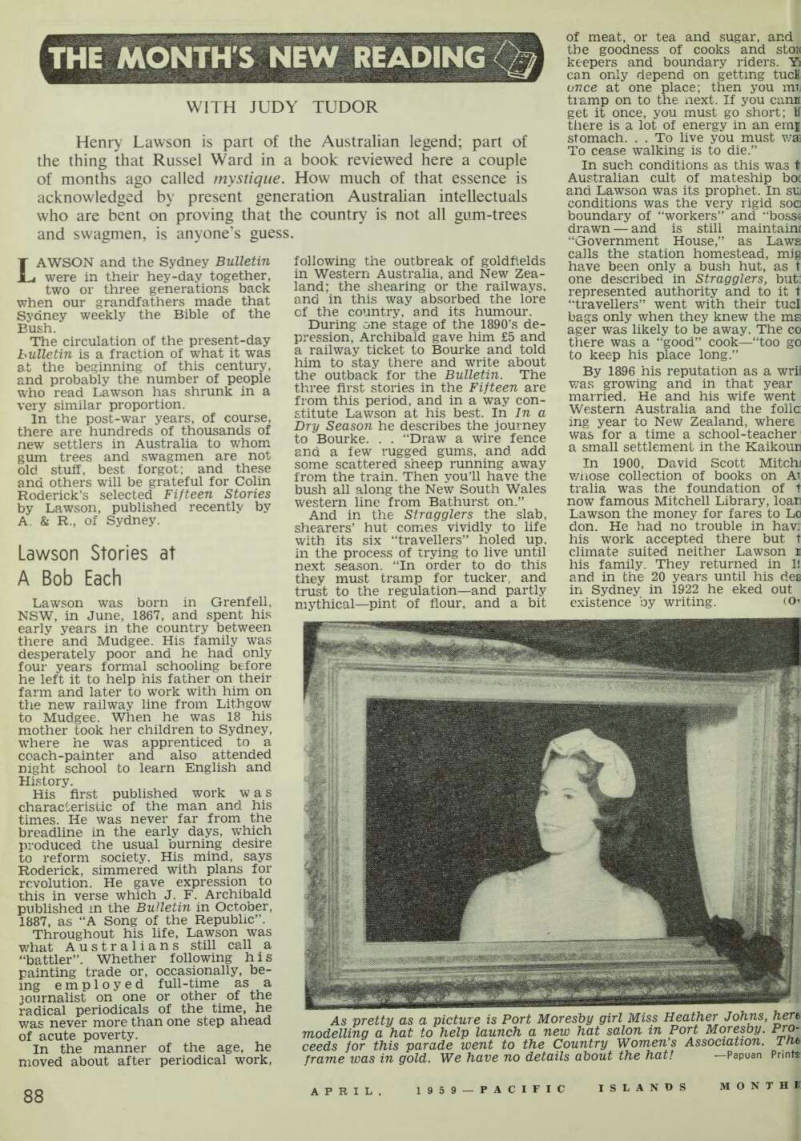
As pretty as a picture is Port Moresby girl Miss Heather Johns, her e modelling a hat to help launch a new hat salon in Port Moresby. Pro ceeds for this parade went to the Country Women’s Association. The frame was in gold. We have no details about the hat! —Papuan Prints
Ie wrote verse, stories, sketches: le serious, some humorous; and ; all writers he produced some ir quality material amongst his digious output.
Jut all the 15 stories in the pre t collection are excellent; in writ technique and style almost un ed.
FIFTEEN STORIES. Published by us and Robertson, Sydney. Australian >e, 15/-.)
's Mad About
arks—or Mad
rHAT is the fascination about sharks that has driven so many people in recent years to write ks about them? Hardly a popular ject one would suppose—and tarently be dead wrong, turing the month we received irks Are Caught At Night, by ncois Poli (translated from its ;inal French by Naomi Walford); [ almost at the same time PIM [ an enquiry for some South ific shark photos from a writer in United States who says he is ) writing a serious book on the ject. rancois’ book tells a great deal ut West Indian sharks and er monsters of the Caribbean, it is not so much “serious” as ertaining, even for those who .’t share his strange passion, a Europe he had a conversation h a friend who assured him that und Havana, sharks came in the ra Large, Economy, Family size; Dther words, as big as buses. He, refore, immediately set off on the st. a Havana he teamed up with a ntryman who was doing a series articles for a French newspaper I together they suffered the srmost discomfort in the most nitive conditions in order to 3h sharks. They would go out h a local fisherman, bait the ;e hooks with rotten flesh, toss m overboard attached to floats rked with a hurricane lantern — I waited. . . “We waited for two irs, and nothing happened. . . 3 boat switchbacked on the swell. nbert held his Rolliflex camera the ready and Romilio leaned r the water holding a very ripe >rdfish head at arm’s length. He »t tapping it with a club, to at ct the sharks by the resulting v of blood and rotting flesh. . .” md later; “. . . Romilio put the aying head back into a bucket.
Suizo uncorked the whisky. nbert swallowed another dram mine capsule. He went on fish »> ’he book is full of anecdotes »ut the local fishing types; the lesome details of the shark-meat de ;and herculean struggles with sinister creatures that appear to mt the West Indian seas. But no ere does the author explain why wants to catch sharks, anyway.
heh re o^ l it ab Aftpr d fl°n S It : ’i U ?, t >f for th u sillier than eninl S’a&o!V ™ ucb elephants’and’lions’ Afr '° a *° Sh ° ot idHAPVG adit PublShfd by Runert Hart nlvif IG T H J' Australian p?ice, R 2o/- * t ' Davls - Ltd - T -i lail-rieCG T c+~ 10 tie mI TV .
HE most extraordinary and probably the best of the quite unspectacular bunch of books this month, is James Jones’ The Pistol, which after all these years of silence might be regarded as a
tail-piece to that author’s first monumental and controversial novel, F,om Here To «»• Possibly Jones made sufficient out °- j l * s best-seller and the motion picture that came later, to be in no hurry to write a successor. In any event, he can’t be regarded as be ing a prolific writer, having, so it is said > taken eight years to produce Eternity, and something like the same period to produce his second major effort, Some Came Running, which will be published in its Eng hsh edition later this year, The Pistol takes up where the first novel left off—with the Japanese bombing Pearl Harbour on De
>er 7. 1941—and presents one ; in the things that come later, uld as easily have been included in the scope of From Here To lity, without much trouble, and the author should single it out pecial treatment now, and after ng, is anyone’s guess. wever, although Author Jones \ big breaths between his try exercises, his hand has not ,ts cunning and his writing has same economical vividness and ;y to create atmosphere as it half a dozen years ago. r has his opinion of the US or the men and officers who iose it, suffered any great ?e. One feels that ex-Corporal, jrgeant Jones still has a poor Dn of officers. les joined the army right after il —not unlike Private Richard in The Pistol. He was at field Barracks on that fateful nber 7 morning, and in the ring year attained the rank of ral. But not for long. Eighteen hs later he was again a private, hen, in 1944, he was made a ant, soon to be demoted once One way and another, he »to be natural material for not ? eye to eye with Army Brass, nost of his fictional (or not so tial) officers are a poor lot, or ;ligible quantity, ording to The Pistol, on the :he Jap bombs fall on Pearl mr, Private Mast was on guard which position entitled him to strapped round his middle, a ! pistol had to be signed in and mt in the confusion that fol the bombing, and the deploy f the army units around the es in preparation for an an ted Japanese landing, Mast re i the revolver. his eyes, it soon acquired con ,bly more significance than Df just a lethal piece of iron ery. It was a talisman; the possession of it proof against vn vulnerability. He saw it as neans of protecting his life the imaginery Japanese Major vould some day threaten it. m being Mast’s obsession, the er rapidly becomes the ;ion of his comrades in arms, idividually and in partnerships i relieve him of it, by bribery, vords, trickery and violence, nly thing they did not do was lm for it. pistol thus becomes a paradox rinbol of disunity, yet in the jefore the Army catches up t and it returns to its rightful -also one of unity, s doubtful if this book could itten about any other soldiery Americans, those hard-boiled, lental creatures whose attach to inanimate objects made iasy pickings for Digger manu ers of Samuari swords and ilcanal finger-rings made out aid toothbrush handle.
The “dedication” of this book is a typical James Jones touch “ This book is not dedicated to anything or anybody. I would dedicate it to my wife Gloria, who helped as a wife and as reader, were it not that I am tired of books dedicated to wives by men who are grateful to their wives for being wives. My wife agrees with me.” (THE PISTOL. Published by Wm.
Collins, Ltd. Australian price, 15/6.)
A Touch
Of Neurosis
WHEN the Times Literary Supple ment reviewer, a couple of years back, said of Elizabeth de Vegh’s collection of short stories (A Case of Eye Shadow ) that there was “a penetrating hint of neurosis behind each story”, he summed up the contemporary short-story per haps better than intended.
Most short stories that are in any way “contemporary” are, of course, no longer stories —in the sense that the O. Henry writings of a past generation were. They do not aim to entertain; but rather are used as a medium of self-expression. If they also can be described as a sort of elongated “shaggy dog”, that leave the reader, at the end, deep in the woods, that is just an unfortunate by-product of the modern art of writing.
Mrs. de Vegh now has written a full-length novel, A Knot of Roots, in which she expands her technique to suit, fortunately with better effect as far as the normal reader is concerned.
The theme is still slight to the extent of being non-existent and, of course, does not resemble an old fashioned plot at any point. It is a slice out of life as, with variations, it might be lived by thousands of people. Of Mary Simms, well off and lately widowed, her family grown, who buys a country property some way out of New York: and of Golder Harris, the coloured man who helps her look after it.
The characterisation is quite good; but it is distinctly a portrait painted in the monochromes of the modern. (A KNOT OF ROOTri. Published by Wm. Heinemann, Ltd. Australian price, 18/9.)
Just Like Papa
NOW doing a second-time-round are some of the early Daphne du Maurier novels — The Loving Spirit, her first novel, published in 1931; and her third, of 1933, The Progress of Julius, just received Neither bear much more than in cidental resemblance to the historical pieces she wrote later; or to the slicker, modern atmospheric novels of the Rebecca variety.
Julius, who makes the progress, is designed as something of a monster but either because we have become
litioned to monsters in the past ears, or because the bogey-men ne generation seldom scare the ers of the one following, he uently seems more tedious than :ed. le story of Julius begins in a 11 French village on the banks le Seine. The child’s upbringing gainst a background of squalor the days before the Franco isian war, and as the son of ivaricious French trollop and a h-abused, Jewish misfit who fies his soul by playing the flute, the end, Mama drives Papa to ler, with Julius an enthusiastic encouraging witness, and the survivors of this piece of family lay then flee to Algiers, which ds the right atmosphere for is’ flowering talents as a junior ster, om Algiers, the progress con -3S to England, where he goes the catering business. He ires a wife, a million, a knight , and a daughter with golden —all of which can be regarded i legacy from his French ler, Julius does not resemble ’apa at all—except in one thing, that comes at the end when he itles the woman he loves, this had been written today it d simply be regarded as a ing from life, not as an exercise >od and evil. It’s interesting to :t, therefore, that even so re y as 25 years ago, things such ins and virtues were so much clearly delineated in black and g e modern psychological treat : of Julius would have had him :gling manfully with his inner soul. The du Maurier of 25 > ago afforded Julius little soul no struggling whatever —which ibly proves nothing, anyhow, 3t that life has become so much e complicated in the last ber-century.
Ie Progress Of Julius. Pub
by Wm. Heinemann. Ltd. Australian 15/6.)
Murder, With
Nautical Effects
THE story goes that, years ago, New Zealander Ngaio Marsh, having read an Agatha Christie, said: “I bet I could do as well.” The result has been a long list of ex cellent thrillers: excellent not only in the technicalities of crime writ ing, but in style, characterisation and general entertainment.
Connoisseurs of crime fiction won’t be disappointed in the current story, either —Singing in the Shrouds —which was probably produced for the Christmas trade in the United Kingdom, and has only just arrived here.
Although by no means as prolific a writer as Christie, Ngaio Marsh’s stories have in recent years main tained a better average standard and in the opinion of many readers she now not only does as well as Christie, as promised, but usually a great deal better.
Like Christie, Ngaio Marsh is in terested in the theatre and a few years ago brought a NZ University repertory company to Australia for a season. But while Christie has had an overwhelming success with mystery plays in London’s West End, Marsh seems to have made no at tempt to follow her into this field.
The action in Singing in the Shrouds all takes place during a voyage to Cape Town. When the “Cape Farewell” pulled out of the Port of London on a February night, she left behind the body of a murdered girl on the wharf and carried with her amongst her nine passengers, a murderer.
Discovery of the corpse is too late
and the clues too inconclusive to hold the vessel up, but Superin tendent Roderick Alleyn joins her off Portsmouth and continues with her to Cape Town, by which time Ngaio has executed a lot of amus ing and entertaining writing, and Alleyn has snared the murderer.
(Singing In The Shrouds. Published
by Wm. Collins, Ltd. Australian price, 15/6.)
Corrigan Colours
The Orient
John Foster Dulles And
Mark Corrigan were running neck-and-neck in the number of countries they could visit in the shortest possible time, before the former was recently whisked into hospital. At the moment Corrigan has it all his own way.
In his last two major works he was pursuing sex and mystery in Chicago and Honolulu; in the current volume he has dashed off to Siam, Which fact you can find out, fortunately, without reading more than the title —Menace in Siam —and looking at the dust jacket showing a sinister type In Manchu moustachios, a purple coolie hat and jacket to match, pursuing with a knife a red-headed version of Sabrina, in a revealing red dress.
Mark goes to Thailand, at the express invitation of the US In telligence Department to investigate a family called Fang, which is en dangering US influence in the Philippines.
It all sounds terribly involved, so to help him in his labours, the US kindly sends along one of its most seductive hired-helps—she of the
-much-cleavage in the red dress ) is being pursued by the type the purple coolie-hat on the :et front. his winsome wench seems to be ally disturbing to Corrigan and his more constant girl-friend, ker McLean.
ENACE IN SIAM. Published by Angus Robertson, Ltd. Australian price, )
en the Birdies
ve the Nest
IRBARA GOOLDEN writes ex clusively—and prolifically for those whose interests are female, domestic. Presumably some js have read these turgid dramas he hearth and home, but they t be few, indeed. - Ships of Youth, the emotions in over-possessive mother are bare for 266 pages as she slowly ises that her three children, two , one daughter, plan lives of r own. le way author Goolden works it tut and wraps it up will “deeply ;fy her many readers.” says so on the jacket-flap.
IE SHIPS OF YOUTH. Published by Heinemann, Ltd. Australian price,