Nine Picks Up
pp. 86-87 · Read in the full issue
The Pieces
The rugged, hard-working people of Nii Island in March were beginning to clean up, a:i even build again, after the island’s worst hur cane had struck suddenly in late February.
The hurricane hit the 100-square-mile Nii population 4,700 with a wind force 100 mph, and lasted for an hour, with son gusts of 120. There followed another 12 hou of terrific winds with heavy rain, which maj the lot of the homeless even more miserab,'
A TOTAL of 320 houses were di stroyed and 160 damaged, du ing those frightful 13 hou:i leaving only 290 houses intact.
In one of the island’s 13 village Makefu, 23 out of the 31 housE were entirely blown away, and tl others severely damaged. At Hik'; tavake, 12 were reduced to rubt and the other nine made unii. habitable.
Ten of the 13 villages lost the water catchment areas, vital waterless Niue, which is a con outcrop, a New Zealand territon 1,400 miles north-east of New Zei; land. Its people are NZ citizens..
Churches Hit Badly
Among the large buildings, tl London Missionary Society’s churches were the worst hit. Onf two remained intact—three we:j blown away, and the others unroofc' or partly unroofed and otherwii seriously damaged.
The LMS loss was put at £BO,OK but a lot of irreplaceable histo:< went, too, such as that surroundin
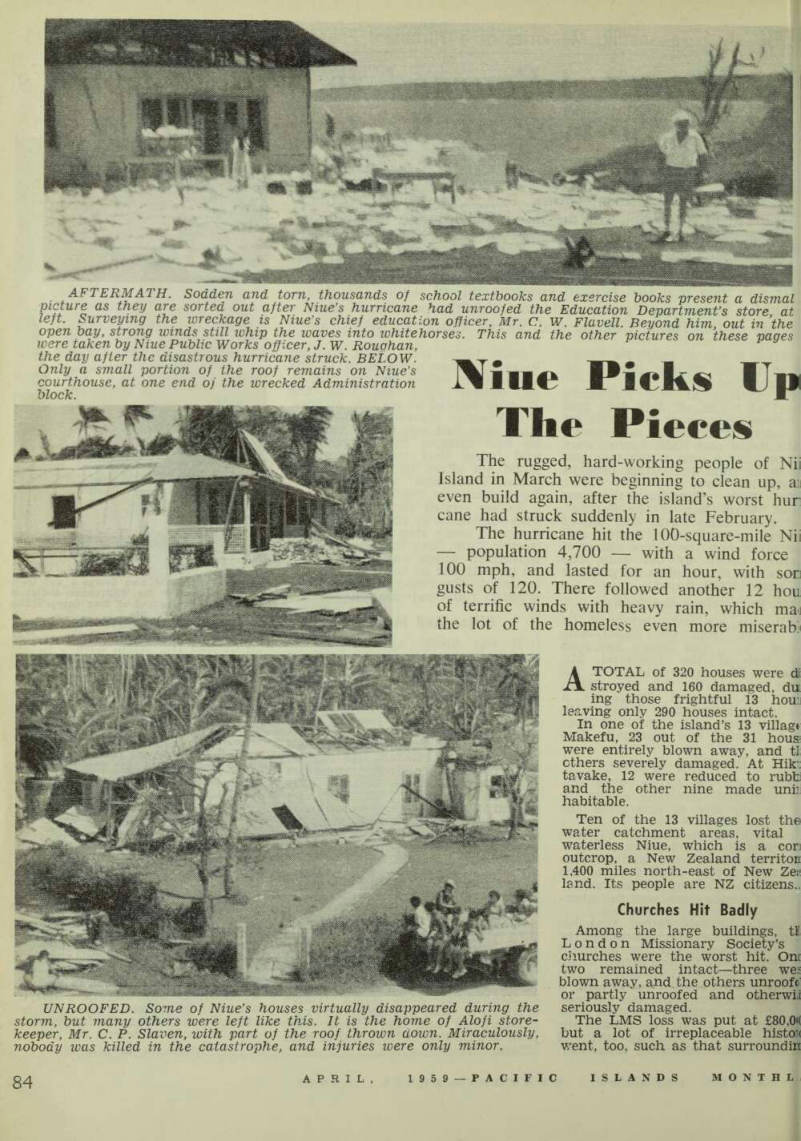
AFTERMATH. Soaden and torn, thousands of school textbooks and exercise books present a dismal Picture as they are sorted out after Niue’s hurricane had unroofed the Education Department’s store, at left. Surveying the wreckage is Niue’s chief education officer. Mr. C. w. Flavell. Beyond him out in the open bay, strong winds still whip the waves into whitehorses. This and the other pictures on these pages were taken by Niue Public Works officer, J. W. Roughan,
the day after the disastrous hurricane struck. BELOW.
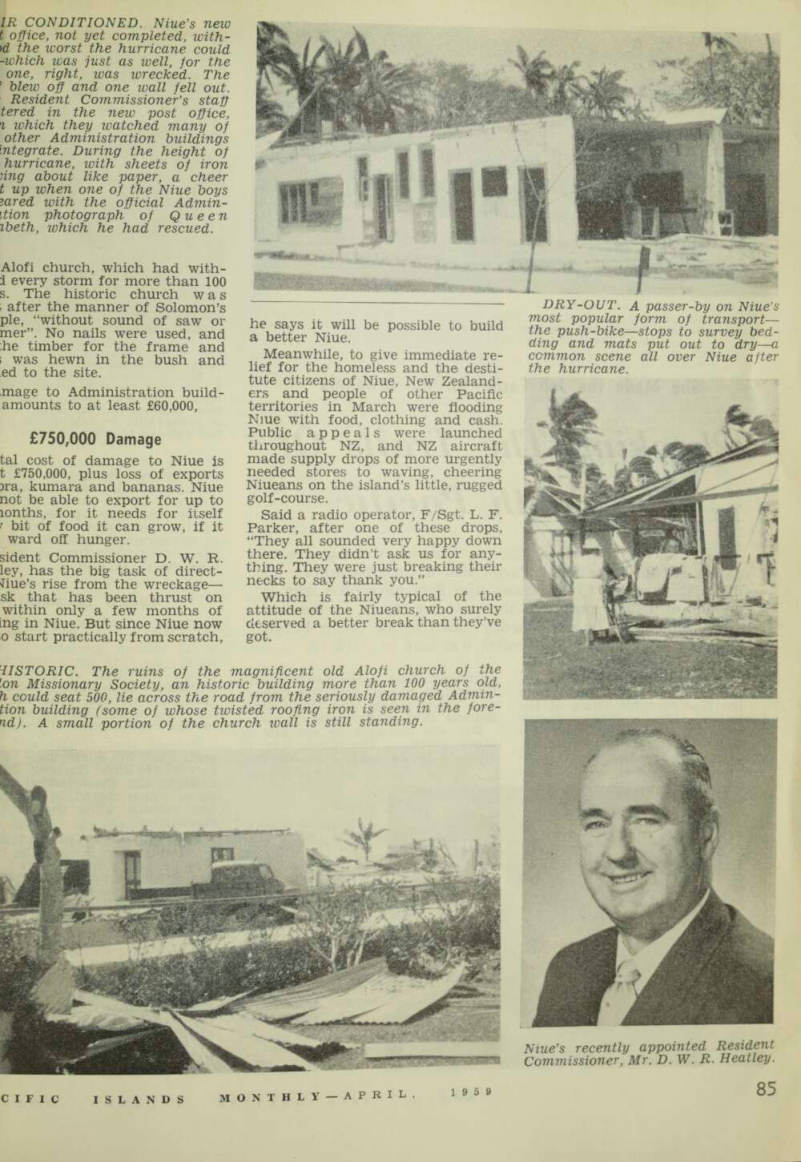
Only a small portion of the roof remains on Niue’s courthouse, at one end of the wrecked Administration block.
UNROOFED. Some of Niue’s houses virtually disappeared during the storm, hut many others were left like this. It is the home of Alofi store keeper, Mr. C. P. Slaven, with part of the roof thrown down. Miraculously, nobody was killed in the catastrophe, and injuries were only minor.
Alofi church, which had with i every storm for more than 100 s. The historic church was . after the manner of Solomon’s pie, “without sound of saw or mer”. No nails were used, and he timber for the frame and i was hewn in the bush and ed to the site. .mage to Administration build amounts to at least £60,000,
£750,000 Damage
tal cost of damage to Niue is t £750,000, plus loss of exports Dra, kumara and bananas. Niue not be able to export for up to lonths, for it needs for itself 7 bit of food it can grow, if it ward off hunger. sident Commissioner D. W. R. ley, has the big task of direct hue’s rise from the wreckage— sk that has been thrust on within only a few months of ing in Niue. But since Niue now o start practically from scratch,
he says it will be possible to build a better Niue.
Meanwhile, to give immediate re lief for the homeless and the desti tute citizens of Niue, New Zealand ers and people of other Pacific territories in March were flooding Niue with food, clothing and cash.
Public appeals were launched throughout NZ, and NZ aircraft made supply drops of more urgently needed stores to waving, cheering Niueans on the island’s little, rugged golf-course.
Said a radio operator, F/Sgt. L. F.
Parker, after one of these drops, “They all sounded very happy down there. They didn’t ask us for any thing. They were just breaking their necks to say thank you.”
Which is fairly typical of the attitude of the Niueans, who surely deserved a better break than they’ve got.
[?]IR CONDITIONED. Niue’s new [?}t office, not yet completed, with [?}d the worst the hurricane could -which was just as well, for the one, right, was wrecked. The [?] blew off and one wall fell out.
Resident Commissioner’s staff [?}tered in the new post office, [?] which they watched many of other Administration buildings [?]ntegrate. During the height of hurricane, with sheets of iron [?]ing about like paper, a cheer [?] up when one of the Niue boys [?]ared with the official Admin [?]tion photograph of Queen [?]beth, which he had rescued.
[?]ISTORIC. The ruins of the magnificent old Alofi church of the [?]lon Missionary Society, an historic building more than 100 years old, [?]h could seat 500, lie across the road from the seriously damaged Admin [?]tion building (some of whose twisted roofing iron is seen in the fore [?]ad). A small portion of the church wall is still standing.
DRY-OUT. A passer-by on Niue’s most popular form of transport— the push-bike—stops to survey bed ding and mats put out to dry—a common scene all over Niue after the hurricane.
Niue’s recently appointed Resident Commissioner, Mr. D. W. R. Heatley.