Developed
p. 77 · Read in the full issue
Shoddy Stuff Wanted the Basket Trade Needs To Be Developed
om J. P. Shortall, In Auckland Uthough there is said to be an it drive in progress for the im ment of the economy of New nd’s insolvent Island terri , there still appears to be / of scope for development of existing resources, some of i might look like small-time ?es as viewed from Australia or Zealand, but which could make il contribution in territories ; basic earnings are compar f very low.
AT of the basket trade, for jxample? Although the market s flooded these days with every of dinky plastic shopping t and bag, the women who do eavy family shopping mostly that there’s nothing like a capacious well-made cane affia type of Island shopping t for the job—yet these are ,lly unobtainable in New Zea mtion was drawn to this situa by a lady from Palmerston one of the country’s larger i cities, who said that a week 0 before Christmas —the time the retail market is at its best combed that city for such a t and finally found one store lad three —all smaller than the he sought. vever, she bought the largest >y no means large, and it cost 5/6. s was a basket of the Niue 1 type, and the price there or nga would be about 5/-. Apart the price factor, these three ts appeared to represent the i stock of the city at that time.
Over Christmas, inquiries were made about such baskets in a num ber of country towns, and later in Auckland and everywhere the situation was the same; the Islands’ basket seemed virtually unobtain able.
Yet shop attendants and women seemed unanimous that they were an ideal basket, that the price of 15/- might not be considered ex cessive, and that they would readily sell if made available.
Just the Thing
In the country towns, some re tailers vaguely remembered having seen these baskets, were emphatic that they were just what country women would buy, but had no idea how they could obtain supplies, or in fact, that these baskets came from the Islands.
The baskets which were on sale were from Blind Institutes or Dis abled Servicemen’s organisations.
They have a plywood bottom, and in the main are not as strong or as well made as a well made Islands’ basket, nor as attractive.
In Auckland the buyer, for one of the largest chain stores in New Zealand—a man who served for many years with a well known firm in the Islands said that they “usually” had some in stock —there was none in sight at two branches visited on that day.
He could not say what was wrong with the supply. They just weren’t coming forward. He could sell all he was offered—at the right price!
He could also sell thousands of dozens of the Islands’ type of spirally woven cane circular table mats, but just could not obtain sup plies. . , , Another importer painted a rather different picture. The chain store, he said, was the downfallof the Islands’ basket trade. The people had accepted excessively low prices for big orders, then, to balance their books, they had turned out an increasingly shoddy job. Handles were falling off and the good reputation of the Islands basket was demaged. Then, with the increasing world price of copra,
it was a better proposition to divert the labour to copra. That was why the baskets were scarce, he said.
There is nothing to suggest, however, that the reputation of the Islands’ basket has been seriously damaged, and there is everything to suggest that if the Islands’ co operatives and village groups had a lively marketing officer located in New Zealand to promote the sale of baskets and other produce, big new channels of business could be de veloped.
Plenty of Scope
Apart from the shopping type of basket, there would also seem to be great scope for the development of business in other basket-ware of modern design and usage—the neat table basket for serving bread rolls in restaurants and hotels, the very large type, with lid, as bedroom “hold alls” or for decorative pur poses in modern homes, containers for pot-plants, indoor decorative palms in hotel lobbies, etc.
Advice and instructions on de signs and shapes would be neces sary, and a proper inspection system of the produce—perhaps by women’s committees which already exist in the villages.
With a good reputation for wprk manship established and maintained there is every reason to suppose that the Islands basket trade could enter a new era of prosperity.
The present time for such a re vival seems particularly opportune for Niue.
Import restrictions in New Zea land which apply to Tonga do n<Dt affect Niue, a New Zealand tern- There is also the fact that with the copra trade dealt a heavy blow by the February hurricane (see elsewhere) Niueans will be looking for earnings from other sources.
The experience of NZ customers is equally true of those in Australia.
Buka basketware, from the Bum area of Bougainville, is probably the best in the Pacific— certainly the strongest—but little of it ever gets to Australia, and prices then are far too high.
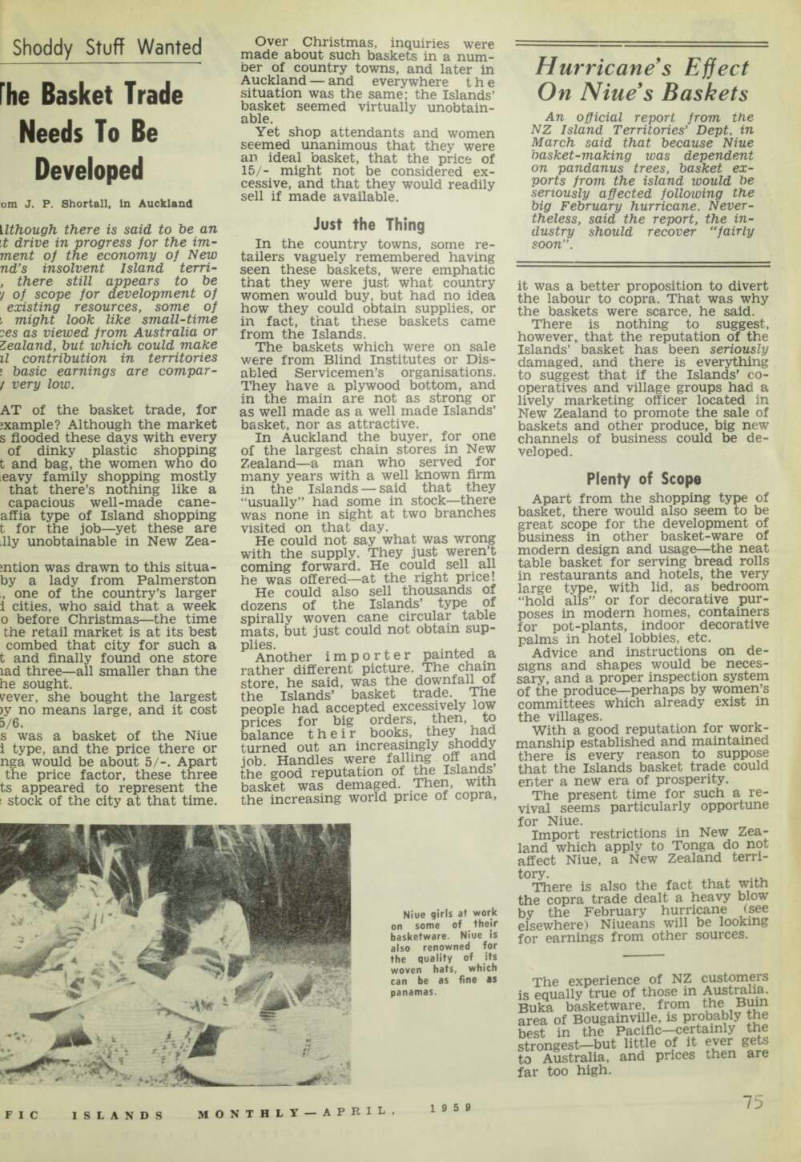
Niue girls at work on some of their basketware. Niue is also renowned for the quality of its woven hats, which can be as fine as panamas.