[?]ot A Colour
p. 71 · Read in the full issue
Problems Of The [?]ders In NZ [?]ot A Colour [?]ar, But A ustom' Bar
Prom a NZ Correspondent
he Auckland Star, in two
sr lengthy articles, recently
eyed the problems faced by—
caused by—the Pacific Is ers living in New Zealand
especially those living in
kland city.
E last census showed an islander population in New Zealand of about 6,900, nearly of whom were resident in land. By the 1961 census it is :ted that this figure will be led for the city and about [) in total. th recent proof of discrimina against New Zealand Maoris in in hotels, picture theatres, and r here, and the associated over publicity involved, there has some soul-searching in the try where it has always been cly held that no discrimina existed. th Islanders, as with New Zea- Maoris, the discrimination I only slightly be described as lour bar. In most cases—and cularly with Islanders —it is a om bar”. st of the opposition to Island >oils down to their custom of ’egating in large numbers in 5S or flats, and holding frequent es, not necessarily disorderly, )ften late, always noisy—or at well flavoured with music i not everyone in the neigh lood enjoys as a regular nightly re.
Barred from Houses e effect of this custom is to [slanders from houses or flats leasant suburban areas and them to find inferior accom ,tion in the older slummish of the city, where substantial ies are gradually forming, not ise they want to live in these , but because it is often im ble for them to find accommo n elsewhere. In some of these Europeans are actually mov- Decause Islanders have moved i either side.
'tain land agents are catering he housing needs of Islanders ffering them old city houses, r of them approaching the end leir days. e Star found that preference :iven to large families with high
earning power capable of meeting the large weekly instalments. On old wooden houses selling at about £3,000 the down-payments range from £2OO to £6OO.
No White Collar Jobs Some big old houses of this type have been purchased by Islanders for the express purpose of provid ing accommodation for other Islanders, and not unnaturally large numbers often live or congregate in such buildings under congested cir cumstances conducive to immorality,
and also to poor hygiene through lack of adequate bathing, washing, and toilet facilities.
In the matter of employment, while Islanders are welcomed, and in some cases actually favoured, in factory and labouring work, the Star found that, as with New Zea land Maoris, there is a definite bar to office and white-collar jobs, or even jobs as factory or labouring foremen—unless the entire gang or group concerned are Islanders—re gardless of the man’s qualifications.
Auckland social workers, closely connected with the welfare of Islanders, told the Star that they foresee a serious slum problem as soci a t e d with Islanders, unless action is taken to see that these people are able to obtain better housing in suburban areas, and un less there is closer supervision of derelict houses and housing in gen eral.
Almost all crime committed by Islanders in Auckland is associated with liquor, and, on a population basis, the incidence of this type of ciime is somewhat higher than with Europeans —Niue Islanders having somewhat the worst reputation in this respect. Niueans are very apt to become violent after consuming liquor. But the overall crime rate is not excessive.
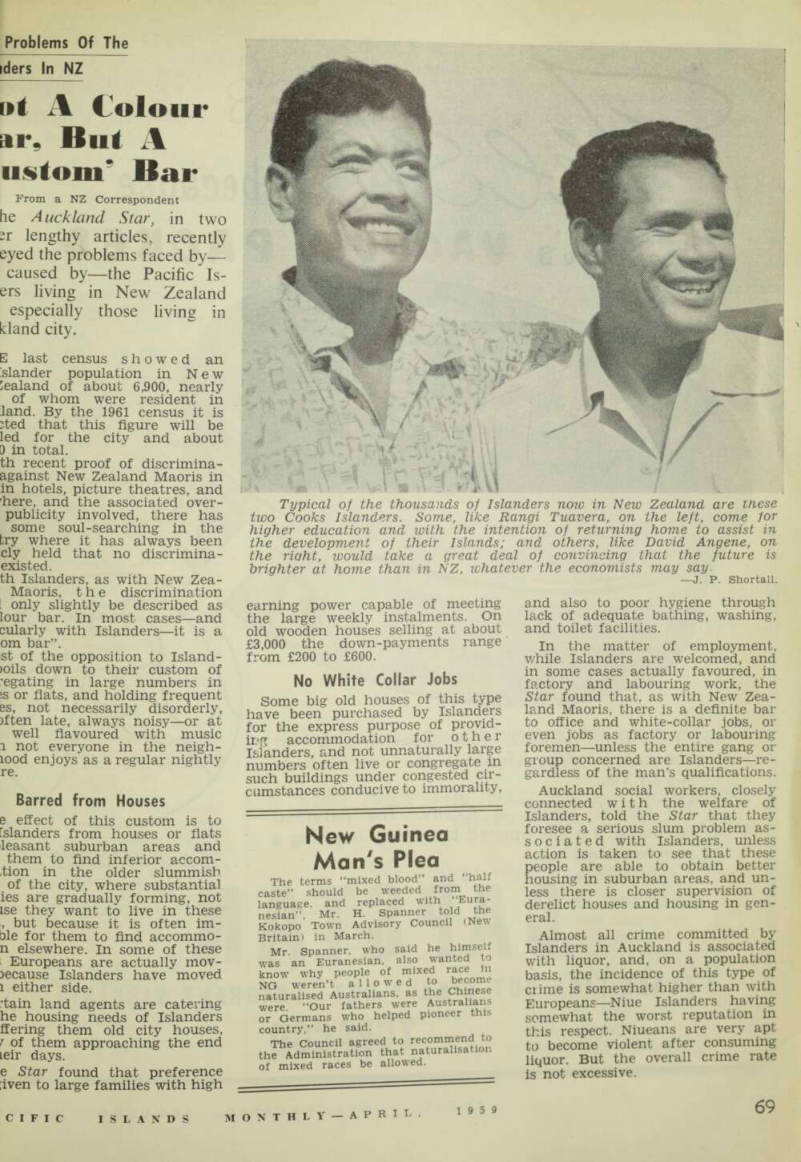
Typical of the thousands of Islanders now in New Zealand are these two Cooks Islanders. Some, like Rangi Tuavera, on the left, come for higher education and with the intention of returning home to assist in the development of their Islands ; and others, like David Angene, on the right, would take a great deal of convincing that the future is brighter at home than in NZ, whatever the economists may say. — J. P. Shortall.