Wu Guinea Goes
pp. 55-57 · Read in the full issue
loyal Show Success Is Worth Repeating Wu Guinea Goes To Town !
By a Staff Writer
When PIM visited the Papua-New Guinea exhibit at the dney Royal Show, Australia’s biggest annual camival-cum hibition, everyone was doing very nicely answering hun ?ds of questions, seeing thousands of interested visitors and ing away what amounted to over 100,000 pamphlets before ; Show ended after its traditional “10 days and eight nights”, t this was by way of being a rushed job; next year everyone pes to do even better.
)OUPLE of ways to do better ould be to get European lanters and, say, the P-NG ibers of Commerce, on the Then there might even be real piece of Australian timeiana the übiquitous pie Bag” of P-NG produce, as ground coffee and choco bars done up in appropriate ges; or roast peanuts and ated coconut. le merchants have already ;ively agreed to co-operate on chocolate bar and ground level but the time was too this time to do much about : plan for later.
P-NG exhibit at Sydney’s is “Royal” has been talked for years but nothing was about this one until January, g barely two months to make lans and get the props down Port Moresby, The whole ), which took up a handsome of space in the Arts and ; Pavillion (legacy of the h Exhibition of a couple of ago), was designed by Mr.
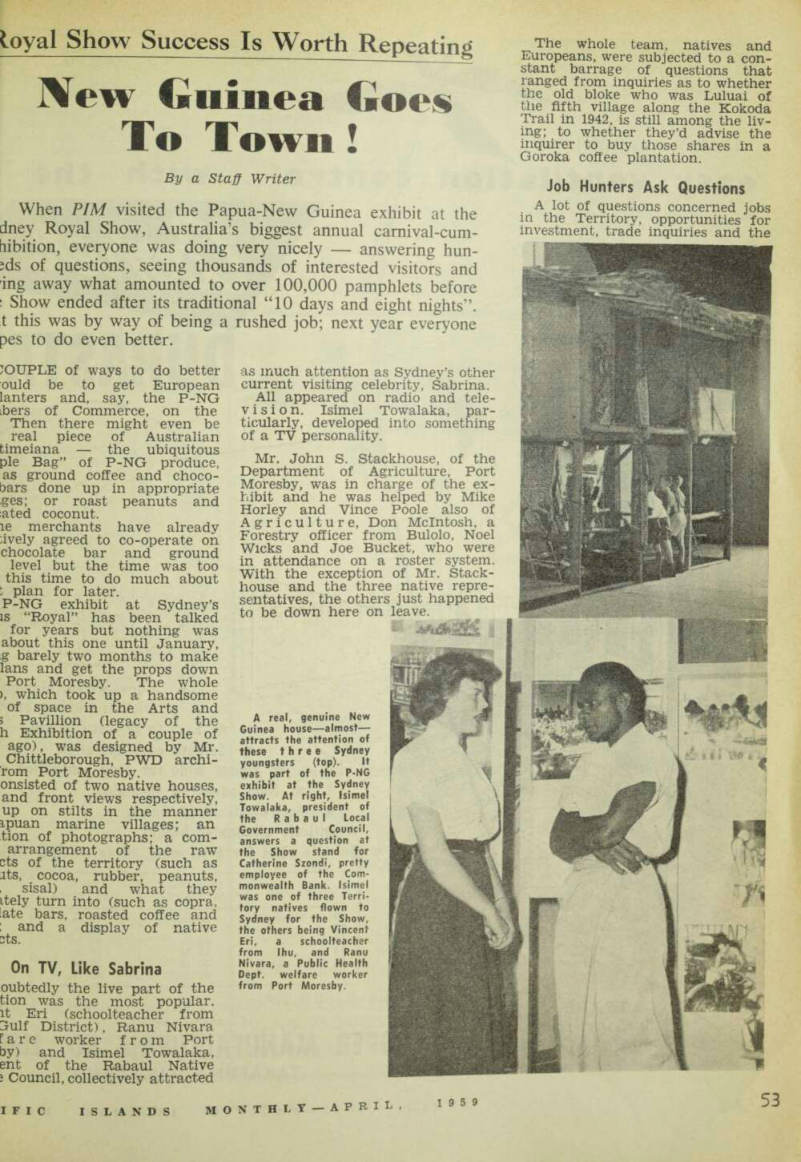
Chittleborough, PWD archi rom Port Moresby, onsisted of two native houses, and front views respectively, up on stilts in the manner ipuan marine villages; an tion of photographs; a corn arrangement of the raw cts of the territory (such as its, cocoa, rubber, peanuts, , sisal) and what they itely turn into (such as copra, iate bars, roasted coffee and and a display of native 3ts.
On TV, Like Sabrina
oubtedly the live part of the tion was the most popular, it Eri (schoolteacher from 3ulf District), Ranu Nivara fare worker from Port by) and Isimel Towalaka, ent of the Rabaul Native j Council, collectively attracted
as much attention as Sydney’s other current visiting celebrity, Sabrina.
All appeared on radio and tele vision. Isimel Towalaka, par ticularly, developed into something of a TV personality.
Mr. John S. Stackhouse, of the Department of Agriculture, Port Moresby, was in charge of the ex hibit and he was helped by Mike Horley and Vince Poole also of Agriculture, Don Mclntosh, a Forestry officer from Bulolo, Noel Wicks and Joe Bucket, who were in attendance on a roster system.
With the exception of Mr. Stack house and the three native repre sentatives, the others just happened to be down here on leave.
The whole team, natives and Europeans, were subjected to a con stant barrage of questions that ranged from inquiries as to whether the old bloke who was Luluai of the fifth village along the Kokoda Trail in 1942, is still among the liv ing; to whether they’d advise the inquirer to buy those shares in a Goroka coffee plantation.
Job Hunters Ask Questions A lot of questions concerned jobs in the Territory, opportunities for investment, trade inquiries and the
A real, genuine New Guinea house —almost — attracts the attention of these three Sydney youngsters (top). It was part of the P-NG exhibit at the Sydney Show. At right, Isimel Towalaka, president of the RabauI Local Government Council, answers a question at the Show stand for Catherine Szondi, pretty employee of the Com monwealth Bank. Isimel was one of three Terri tory natives flown to Sydney for the Show, the others being Vincent Eri, a schoolteacher from Ihu, and Ranu Nivara, a Public Health Dept. welfare worker from Port Moresby.
;rictly speaking, they are not stration business and that is epresentation from Chambers merce and planting interests ssed. The team did its best with each inquiry and has 3d the lot for distribution to ed parties when they return Territory. ?y interior decorators were [arly interested in the mat •owls and carving in the houses and other display .1, and indications are that r ould be a ready market for pe of thing in Australia, ung on the stands of the ex >uld have been sold 10 times ig the most interesting trade s was one from a Japanese who was interested in coffee, nd plywood. ; were hundreds of questions r ould-be tourists—a field of that the team can do very bout as Papua-New Guinea tually no organised tourist V p Window for Millions vhole of the exhibit was pre ;ed in the Territory, taken 3 Sydney by ship and plane hree weeks before the Show and re-erected by the Com ilth Works Department, the supervision of John lorough, who flew down for while; and of John Stack who when we saw him was ;ting out outsize photographs ;ing them into wall panels, itween this, he was answer telephone; explaining that “large yellow and orange really were cocoa-pods; and y restraining a pack of small im removing all the portable along with a pile of ets. (At one stage it seemed is “good Bangkok silk tie”
had gone with the rest of the samples, but it was found under the Klinkii pine reception desk).
Another Stackhouse chore, in cidental to exhibiting at the Royal Show, was to arrive there before everyone else at 8 o’clock and sweep the place out.
By the time the Show ended, just after Easter, something like a million Sydneysiders and their country cousins had learned just that little bit more about Papua- New Guinea, the mystery land of the north that they are helping to subsidise to the tune of about £12,000,000 per annum.
This time it has been little more than a peep into the shop-window; but with this start and the experi
ence gained, plus some co-operation from private interests in the Terri tory, there is no reason why, in future years, the shop window shouldn’t grow into a full scale de partmental store.