Territories Talk-Talk
pp. 39-44 · Read in the full issue


By Tolata
I notice that Port Moresby’s Jimmy James has had omething to say about the substitution of the word “native” 1- i - T(i . XT * v ,„ Dr the indigenes of both Territories. None of them took of mce, says he, until some outside influence worked them ud V a Ctatp nf affirm j a stare or action.
ID therein lies the crux of the whole position. What will the lame eventually be (in English) i the Federated States of New lea have moved into the box ? It will depend to a great ex upon the local prototype of imah or Banda, and whether bails from Rabaul, Manus or )ka. it surely the whole idea of the I “native” casting any oppro n on the indigenous people is rd and ridiculous and suggests ‘outside influences” doing every l possible to create a spirit of .tisfaction amongst an erst while )y people. the past there have been es applied to the native people ess-thoughtful Europeans, such coon”, “kanaka”, “boong” and ?er”, which obviously were not plimentary—though not neces y derogatory. So often in these inologies it is the inflection of voice which conveys the feeling le heart.
Ith so many long-haired experts bo-analysing the up and com jeneration of native people, and ng directives as to what should should not be done with these sient folk, there is a danger of Administration becoming too rous and pusillanimous in its ts to guide the primitive ue through the shoals approach civilisation. ne and common usage will ad many of these problems which l to be out of proportion today.
icise and
rwise
id speaking of the gentle art omenclature, let us not forget we generally base our judg : on the Anglicised version of es which, invariably, is entirely rent in the local language, lat of Cho-sen, which we call a? Taiwan, which we refer to ’ormosa? There is Nippon for n; Thailand for Siam; we jr over Iran, sometimes it is la, sometimes Iran. What of schland for Germany, Espana Spain, Suomi for Finland, ige for Sweden and so on? 3 don’t want to remain too in • where proper names are con ed.
To Betel or Not to Betel That is the question which has received some publicity since the appearance of an article in a tem perance magazine, written by Seven Day Pastor K. J. Gray, of the Eastern Highlands, in which he roundly denounces betel-nut chew ing as a “revolting, filthy” habit which “turns the teeth into the famed ‘black stumps’ and ... opens the road to decay.”
P-NG Health Director Dr. Scragg poises a lance opposing the Gray allegation; but admits it is not a habit to be encouraged on account of its “lift” propensities; while Dental Officer D. Barmes claims in vestigations show the habit has little effect upon the teeth.
Smoking, alcohol and betel-nut chewing are, as most people know, anathema to conscientious Seventh Day Adventists. And, naturally, they are entitled to their opinion. But they should not distort facts in an endevaour to eradicate an old-time
custom which is distasteful to them, yet so much a part of native etiquette and hospitality.
My experience of ordinary betel nut chewing (areca nut, pepper stick or leaf, with lime) is that it has a beneficial effect upon the teeth, nor does it follow that habitual chewing necesarily blackens the teeth.
I have known addicts with the whitest of teeth, and I firmly believe the civilised white requires far more dental attention than the primitive New Guinean; despite the charges laid by Pastor Gray.
Let us not forget that under the Trusteeship we are pledged to “re spect the cultures” of the native people. Is it wise to endeavour to abolish their old lores and customs at this particular stage of tran sition?
Providing such customs are not opposed to the laws and good order of the country the answer is obviously in the negative.
Native
Languages
Mr, Justice Mann’s remarks in conjunction with the Navunaram incident anent the advisability of Native Affairs Officers learning native languages, it followed to their logical conclusion, may ultimately be the saving of much trouble in the not-distant future.
Administrator Cleland didactically remarks that “it is no easy matter”.
And his statement, no doubt, is based on the fact that it has never been adequately examined and nobody wants to be bothered with learning a native dialect anyway— if they can get away with it.
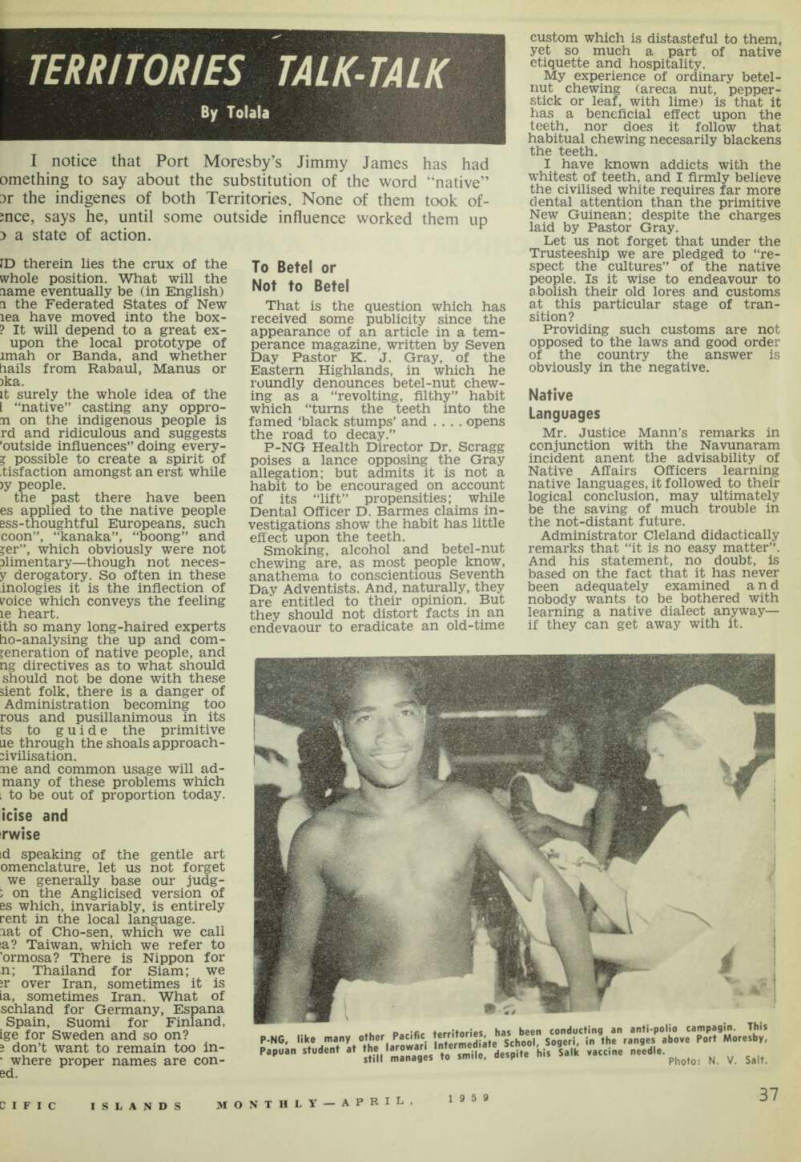
P-NG, like many other Pacific territories, has been conducting an anti-polio campagin, This Papuan student at the Iarowari Intermediate School, Sogeri, in the ranges above Port Moresby, Still manages to smile, despite his Salk vaccine needle.
Photo: N. V. Salt.
rith all due respect to the tall pies in the Administration, I nit that they cannot get away lout it. And that a knowledge i native dialect is of far greater le than much of the drill which jts must now absorb during r training. le of the biggest hurdles appears be the leave question, which 5 for frequent transfers of staff a district to district, and ough it might be unpopular with ly Public Servants, it might not inreasonable to review this leave jtion altogether. uite a few of the PS themselves ;end that leave after 21 months’ ice is too often and from a th point-of-view, with modern )hylatics and tropical hygiene, nnecessary and, insofar as the tomic aspect is concerned, Dst impossible. is really an old custom which e during those years when iria was rampant and amenities ; few. And it is not unrealistic assume that, with increased ical attention, refrigeration in home, modern transport and 0 communication, life is not 1 an ordeal in P-NG as it was >osed to have been in the dim, : ages before the War. ily too often the worry attached making ends meet during a 5 and the thought of the Un vn Home after the leave is hed, brings on a mental frustra far greater than any benefits /ed. ie cannot on principle, of course, ilise the PSA relinquishing one of its hard won amenities; if a vote were taken amongst its ibers (a secret ballot, mind you) ight indicate that the present ?m is not quite so popular as is rally thought. a scheme cannot be evolved that vs officers to return to the same ict, where they have obtained lowledge of the local language “there is something radically ig in the state of Denmark” we cannot be surprised if, in future, there are repetitions of maram, with perhaps more arrassing results, issionary workers seem to be to manage leave and a return leir districts—and I don’t mean RC workers who rarely leave Territory. t of the
nesians?
e Kokopo Town Advisory Coun as recommended to the Admin tion the naturalisation of Mixed JS. [See p. 69]. id if ever a recommendation rved approval it should be this -with the same provisions as down by the old German inistration regarding qualifica for European status: Where a -caste had adopted the Euro i way of living then he, or she, entitled to be accepted as a
European. The additional qualifica tion for a male aspirant was that he should serve the requisite term in the German Army or Navy.
The plea was made by Mr. H.
Spanner and, if he is anything like his father, he is probably prepared to fight to the last ditch. His dad, Harry Spanner, was a well-known identity in the post-War I days of Australia’s occupation of the Terri tory and later took up land on New Hanover, after having done a good job as a Road-Master for many years.
The argument, that if the Chinese are acceptable, then members of the Mixed Races are equally acceptable, should be difficult to reject.
I hope they have a win for many of them have done a very excellent job for the Territory, both during
War II and in development of the country.
The Worm
Turns
The shot-gun tactics adopted by Members of the NT Legco have cer tainly brought some promised changes in legislative procedure more in keeping with the people’s concept of democracy. But how and when the implementation of the promises takes place remains to be seen.
Meanwhile our own elected mem bers in the P-NG Legco have thrown down the gauntlet over the tax ation issue.
And more power to them.
But it does give one to wonder to what depths our Democratic Way
-.ife has sunk when such dire ics as threatened resignations of constitutionally-elected legis ts must be resorted to in order the voice of the people may leard and the despotic methods dictator overcome, seems that the more the people their representatives the less esentation do the people receive.
Much
)r y st how complex can we get over colour segregation ideas? uly tragic is the publicity given le Namatjira case; his convic the legal expenses he has in ed and the Ministerial inter ice as to venue of incarcera which was eventually changed wing threats to the famous iginal artist. ,n one not see the writing on P-NG wall in the event of ir permits being granted to ;enes? [other phase of segregation ilexities has been cited in re ; from Darwin stating that a e man “who prefers to live with igines has been warned he is e to arrest if he does so.” iften think that much of this .1 assimilation business would ; out better if allowed to adjust f without despotic regimenta from long-haired theorists. ie present overall picture of the s with plural populations does reflect a great deal of credit s, anyway.
ice Must Appear
te Done om time to time one reads in official P-NG Gazette of the intment of a So-and-So and t’s-His-Name to the position of ce of the Peace or Magistrate, riably these gentlemen are bers of the Native Affairs Dept, have, to a certain extent, won spurs to such a degree that may preside at Courts of ye Affairs and such like.
The question arises: Should em ployees of the Administration sit in judgment in cases in which their employers are of the plaintiff, en suring that justice will not only be done, but also appear to be done?
In some of the more primitive areas their powers of jurisdiction may be acceptable (which is open to doubt) but in the more civilised areas surely it behoves the Powers That Be to dissociate the judiciary from the ordinary run of Public Servant. Or is that too much to ex pect in this so-called Democratic Way of Life?
I cannot yet recall the time when an ordinary good and able citizen has been appointed a Justice of the Peace and has presided over his peers from the bench.
Steve Steps
Down And now another of the old-time T-NG officials, who was absorbed in the post-war amalgamation, pre pares to clean out the drawers of his office-table, and put away his last bluff folder in his Konedobu office.
After 36 years of top-level admin istrative duties, Steven Ainsworth Lonergan (popularly known through out both territories as “Steve”) re tires this month and, so the report has it, will reside in Australia.
It will be surprising if he is con tent to train roses round the door of his surburban home, or execute some of his worthy losing hazards off the red on the billiard table in his favourite club. His accumulated knowledge of territorial affairs is too great to be allowed to languish even in retirement.
Steve arrived in Rabaul back in 1923. He was posted to Central Administration when Vic West was Chief Clerk at the time and Harold Page had just taken over the job of Government Secretary. It was not long before Steve took over the duties of Chief Clerk and his knowledge of records, attained, after his evacuation from France, at HQ AIF depots in the UK at Tidworth in War I, stood him in good stead. An indefatigable worker, I have often seen him burning the midnight oil in CA in Rabaul. He was deserving of better recognition far earlier than when at last he was appointed Assistant Government Secretary in 1940. When War II developed he filled an im portant recruiting appointment in the Territory, and during the stoush rose to the rank of Lieut.
Colonel.
Steve will be missed hi the Territorv He never pandered to popularity, but when his advice was sought it was always dependable and sincere. o In Rabaul he was undoubtedly a Power Behind the Throne and he could with profit spend some of his retirement writing of T-NG in The
[?]ed at the Roman Catholic Church, Port [?]by, in March—Mr. J. Schellen and Miss [?]onk. Here they are photographed at their reception. —Papuan Prints.
Story Can Now Be Told” series, would be both interesting and li structive.
Happy retirement, Steve.
Unofficial
Ambassadors
In the broad sense, P-N publicity in the Australian Pre could not be said to have achieve a really high rating. Too oftc there is a stolid phrasing of ne T i which could only come from dt partmental hand-outs, and t'.i Aussie public is becoming a If fed-up with the bureaucratic, iu inspired blurbs, with their carefi timing and studied emphasis Administrative accomplishments.
But quite apart from the PF angle there is a section of P-NGitt who are really doing a wonderft job as unofficial ambassadors ai. boosters of the Territory, all their quiet, genuine way and as achieving better results than mo of the carefully studied offici: publicity.
They are the amateur phot! graphers on leave. Armed with j the modern gadgets connected wii making coloured pictures (movti and still), these camera fiends arrii on leave in Aussie and provii their friends and their friem. friends with some most excellea entertainment.
Many a home off the beaten trai has been enlivened with scenes Telefomin, Mount Hagen, Kavie* and Madang—all unofficial glimps of the life that is being lived a:j the way in which civilisation is fci ing pushed into the Back o’ Beyon And many a Rotary Club, Apex a;j Country Women’s meeting has beE the better for these demonstn tions, selling the Territory to tj Aussie taxpayers who have coc tributed to this advance.
In my own little neck of ti woods these ambassadors over t) past few years, have staged son most instructive screenings. T 3 latest to be viewed was a sen taken by Ken. Jarvis, a supervia of buildings with the Public Won branch. And who more qualified depict the progress of the constru tion of Administrative bridges as buildings than the same Ken?
He showed the various stages construction of these signs of pr gress in the Highlands centn Madang, Rabaul and elsewhei; natives making roads and n omitting native dangers.
Ken Jarvis is but one of mac such, and is deserving—with tt others—of an appreciable “tha* you” from the Dept, of Ten tories.
In fact, such gratitudes mig even be extended to removing iii port duties on such impedimenta . go to the making of these fill! that do so much in boosting P-K in an honorary way.